Building An IT Compliance Process That Holds Up Under Audit
Build an IT compliance process that holds up under audit: timestamped enforcement logs, rule change logs, and admin access controls for regulated stores.

The email from the carrier's compliance team lands on a Tuesday morning. It asks for documentation showing how vape products were kept from shipping to restricted ZIP codes between January and March. The store has a policy PDF and a settings screen full of rules. What it lacks, at least in a form an outsider can check, is proof that those rules actually fired on order #48213 and the 1,900 orders around it.
Most audits go sideways in that gap. Auditors give the most weight to records created automatically at the moment an order was checked. A restriction log that timestamps each blocked or allowed order is far stronger evidence than a spreadsheet pieced together after the request arrives, and that principle sits at the center of building an IT compliance process that holds up under audit.
Why the right rules can still fail the review
Regulated sellers in firearms accessories, alcohol, vape and supplements usually know their restrictions cold. Ignorance is rarely the problem. The compliance story lives in three places that don't talk to each other: a policy document, a platform configuration, and the memory of whoever set it all up.
Three common beliefs keep that split in place. Each sounds reasonable until an auditor starts asking for specific orders.
Automate Shipping Compliance
Block orders to restricted states automatically. 3-day free trial.
Start Free Trial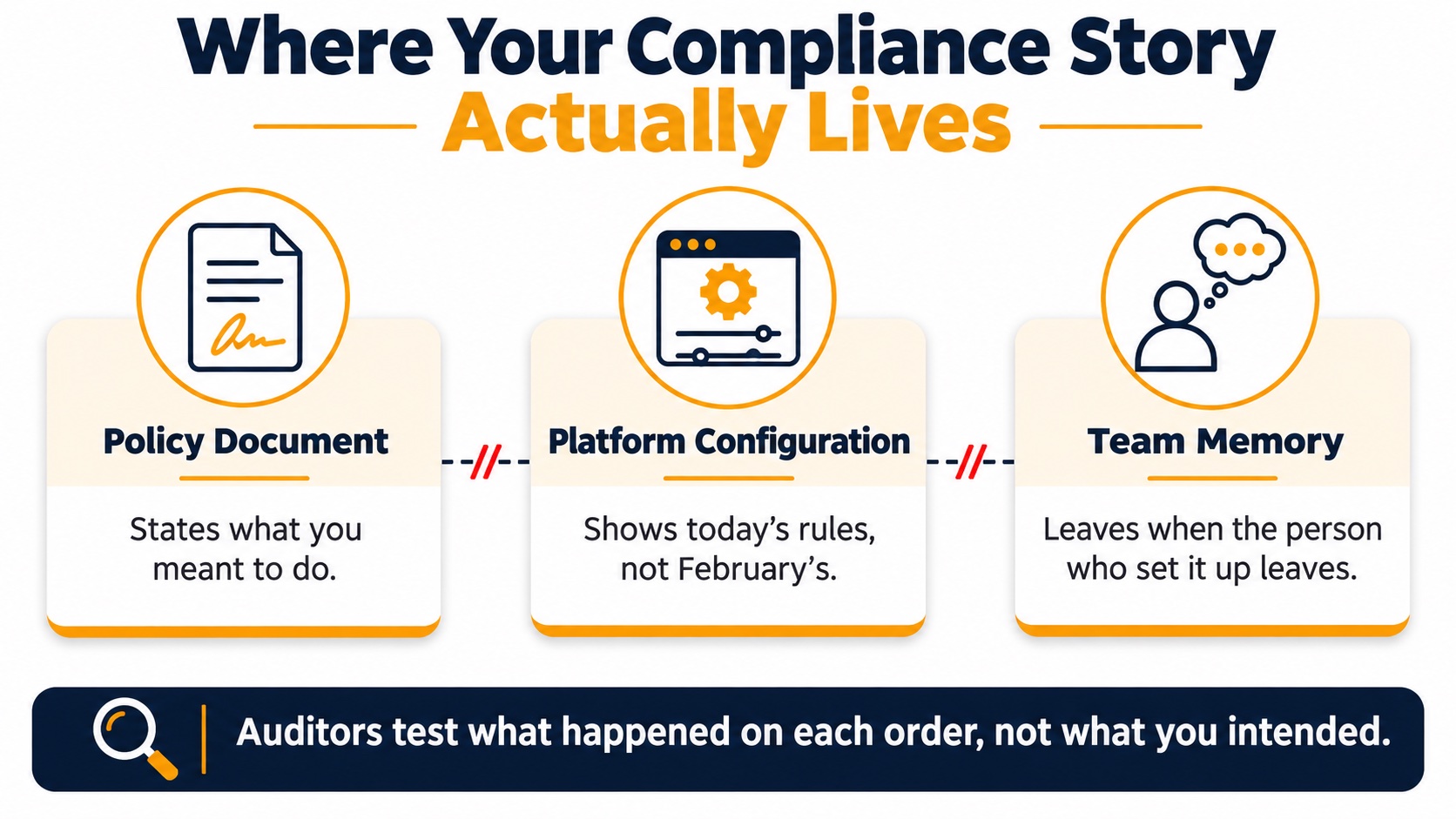
A written policy proves intent, not enforcement
The first myth is that a clear, signed restriction policy shows you're compliant. Policies are what lawyers draft and owners approve, so they feel official. An auditor reads one as a statement of what you meant to do.
What they test is whether you did it. Expect a sample request along these lines: pick 25 orders shipped to California, show the rule that evaluated each one, and explain why it passed. A screenshot of today's settings proves nothing about February.
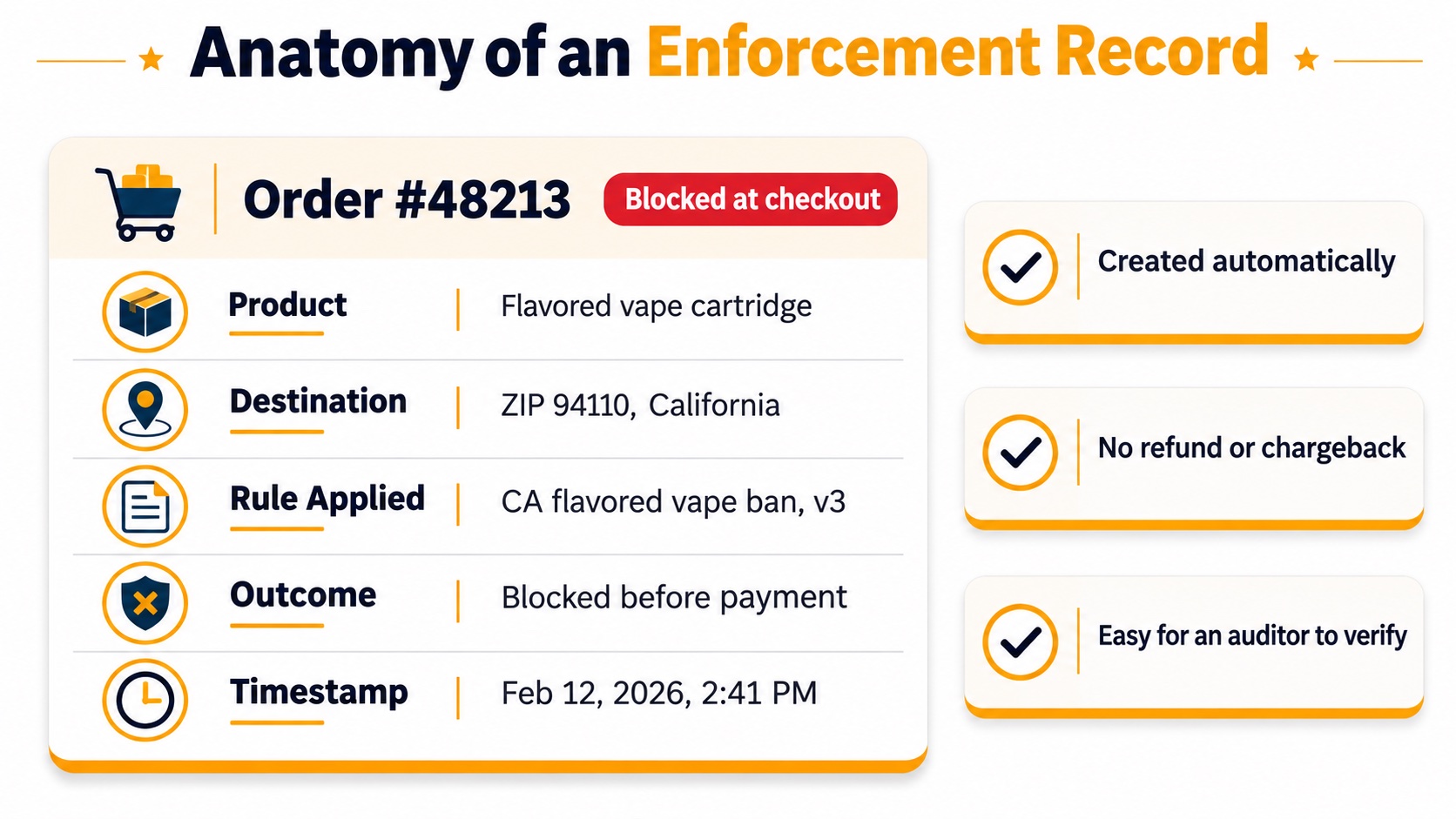
The fix is a habit of enforcement records. Every checkout decision should leave a trail: the product, the destination, the rule applied, the outcome and a timestamp. Blocking at checkout, before payment captures, keeps that record clean too, because no refund, cancellation or chargeback muddies what happened.
Setup day is where the record starts
The second myth says compliance is a project you finish. You research state rules, build the restrictions, test a handful of addresses and move on. It feels true because the initial build is the hard, visible part.
Rules don't sit still, though. A city adds a flavored-tobacco ban, a state rewrites its direct-to-consumer alcohol law, a carrier updates its prohibited list, and the restrictions you built in spring are wrong by fall. Carrier policy alone shifts often enough that a refresher on shipping restrictions federal shipping regulations belongs on the calendar instead of sitting in your bookmarks.
An auditor will ask when each rule was last reviewed and who changed it.
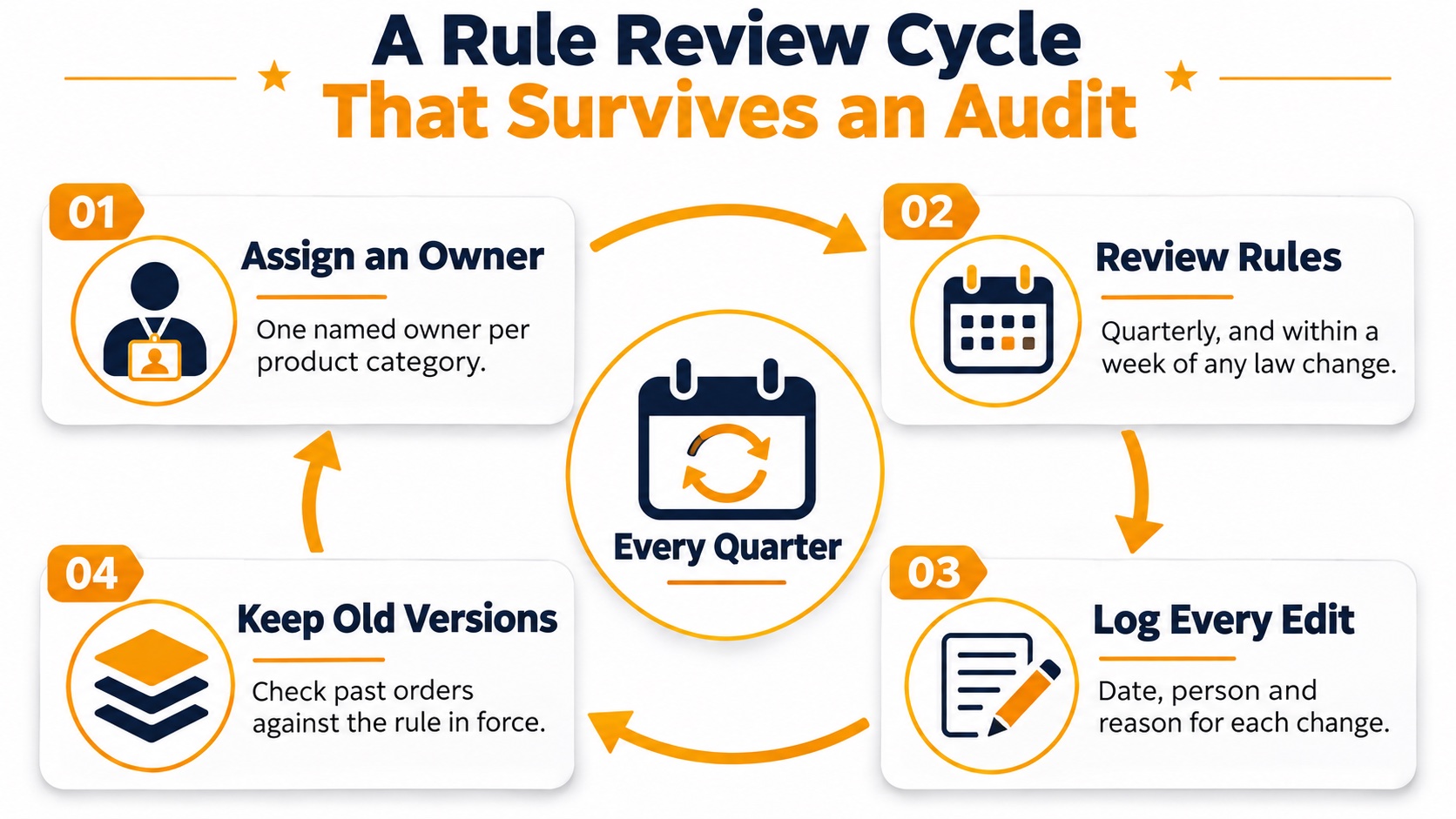
A change log answers that in seconds. A workable review cycle looks something like this:
- Assign one named owner to each product category's restrictions.
- Review state and city rules quarterly, and within a week of any announced law change.
- Record every rule edit with the date, the person who made it and the reason.
- Keep superseded rule versions instead of overwriting them, so past orders can be checked against the rule in force at the time.
Your shipping rules live inside an IT system
The third myth treats shipping compliance and IT security as separate jobs. Operations owns the restrictions; someone else worries about passwords and customer data. It looks tidy on an org chart.
Free Shipping Compliance Audit
We'll review your WooCommerce store's shipping compliance for free.
But every restriction runs on software. A former contractor who still has admin access to your store can delete a ZIP block in thirty seconds, and your enforcement log becomes evidence of a gap rather than proof of control. Auditors increasingly review both together, and the risk data shows why. According to Theiia, cybersecurity remains the dominant risk worldwide in its 2026/2027 global study, with 80% of internal audit respondents naming it among their five highest risks.
| Risk area | Share naming it a top-five risk | Change from prior survey |
|---|---|---|
| Cybersecurity | 80% | Remains the most-cited risk |
| Digital disruption, including AI | 58% | Up 10 percentage points, ranked second |
| Geopolitical and macroeconomic uncertainty | 48% | Up 10 percentage points |
| Survey base | 3,000+ responses | Six regional studies of internal audit leaders, audit committees and boards |
Digital disruption, which now covers the AI features creeping into storefront apps, jumped ten points in a single year. For a regulated store, any new app or integration that touches checkout is a possible route around your rules. Vet it as carefully as the rules themselves.
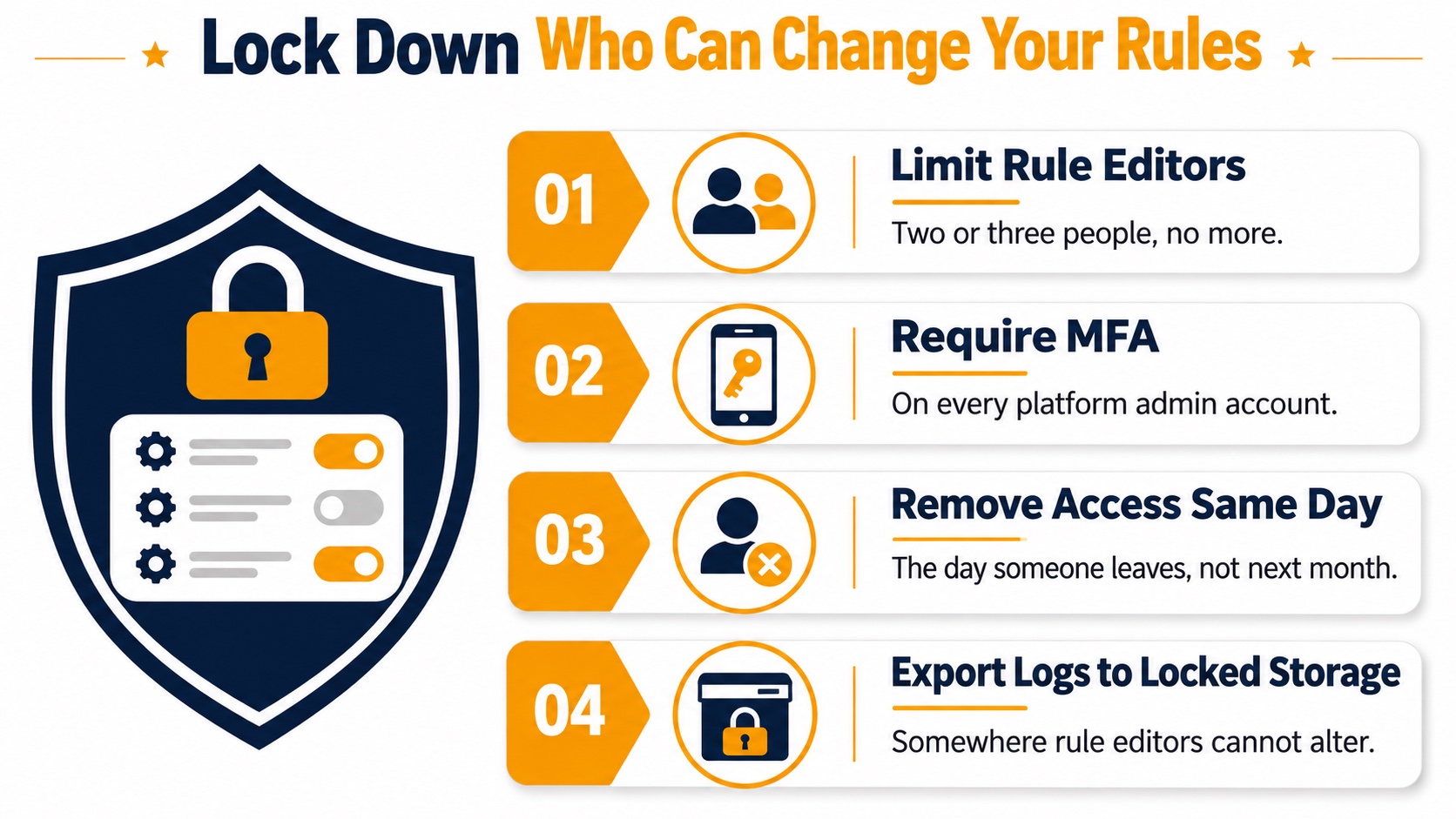
The controls are simple. Limit who can edit restriction rules to two or three people. Require multi-factor authentication on every platform admin account, remove access the day someone leaves, and export enforcement logs to storage that rule editors can't alter.
Run your own audit before someone else does
Pick a random week from last quarter. Pull ten orders that shipped to restricted states and ten checkout attempts that were blocked. For each one, try to show the rule that applied, the version of that rule in force on that day, and who last edited it. Give yourself one hour.
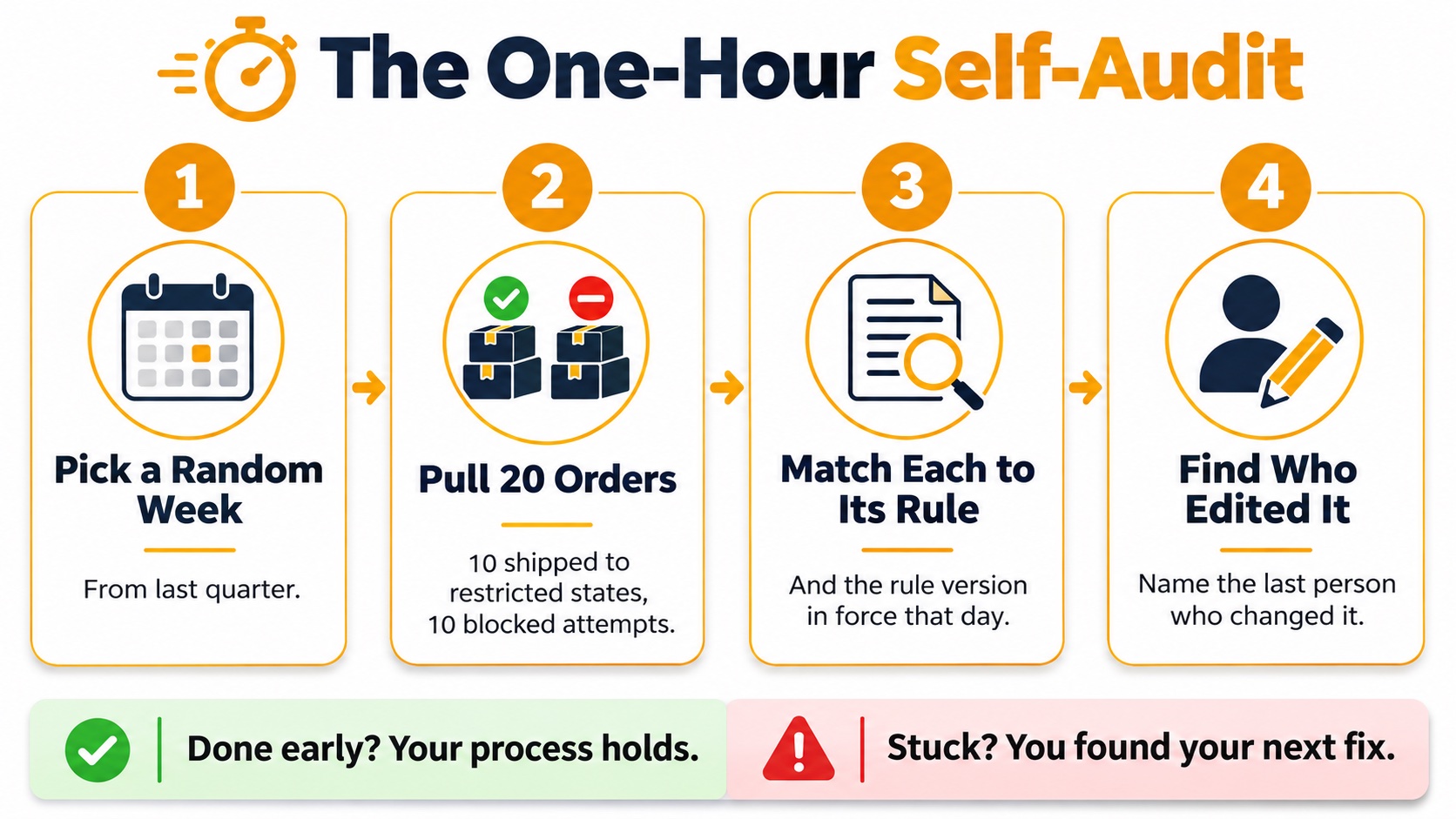
Finish with time to spare, and your process will probably hold. End up texting a former employee to ask why a ZIP rule vanished in March, and you've found your next fix, on your schedule instead of the auditor's.
Automate Shipping Compliance
Stop worrying about restricted states. Ship Restrict handles it automatically.

Cody Yurk
Founder and Lead Developer of ShipRestrict, helping e-commerce businesses navigate complex shipping regulations for regulated products. Ecommerce store owner turned developer.
Automate Shipping Compliance
- Block restricted states
- No more cancellations
- Set and forget
3-day free trial · Card required