Fireworks Shipping Restrictions by State: Your Quick Compliance Guide
Understand fireworks shipping restrictions by state and stay compliant. A concise guide covering laws, penalties, and practical ecommerce shipping tips.
Selling fireworks online means you're stepping into a complicated legal world. Federal law is one thing, but what really matters is the patchwork of individual state laws that say where consumer fireworks can actually be delivered. It creates a tricky situation where shipping from your state might be perfectly legal, but shipping to a customer's state is not. For any online seller, getting this right isn't just good practice—it's critical for staying in business.
Understanding the Legal Maze of Fireworks Shipping
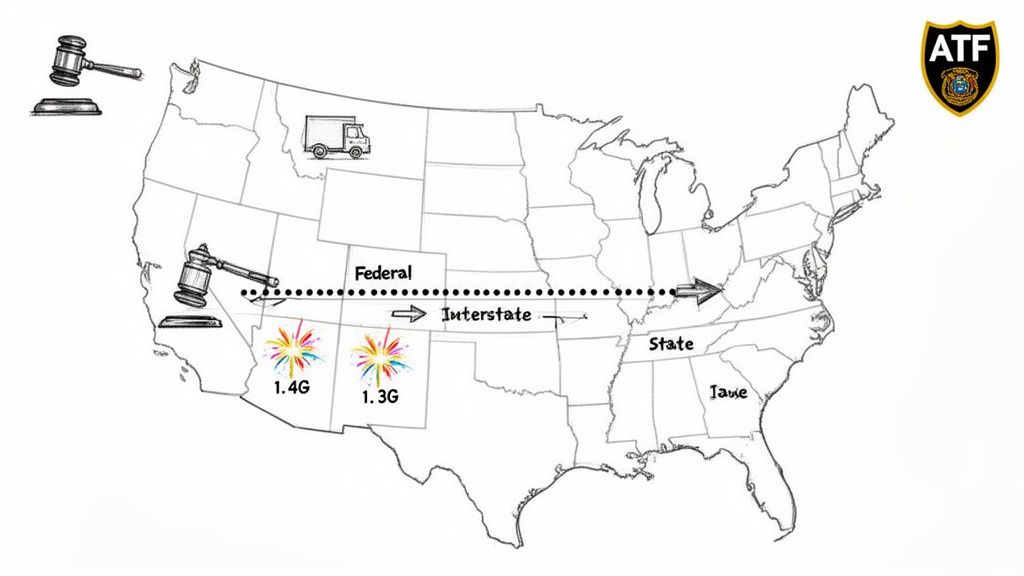
To sell fireworks online, you have to get familiar with a few layers of law. Up top, you've got federal agencies like the Bureau of Alcohol, Tobacco, Firearms and Explosives (ATF) and the Department of Transportation (DOT). They regulate how pyrotechnics are made, classified, and moved across state lines. But—and this is a big but—that federal oversight doesn't trump what states and local governments decide.
This is the most important distinction for any e-commerce fireworks business: federal law allows for interstate transport, but state law governs the final sale and delivery to the consumer.
Key Fireworks Classifications
The type of firework you're selling is what determines which rulebook you need to follow. For anyone selling directly to customers online, the main category you'll deal with is 1.4G Consumer Fireworks. This is the stuff people buy at retail stands—firecrackers, Roman candles, and small aerials.
Automate Shipping Compliance
Block orders to restricted states automatically. 3-day free trial.
Start Free TrialThe other major category is 1.3G Display Fireworks. These are the big, powerful pyrotechnics used in professional shows. They demand special licenses and handling, so they aren't part of the typical online B2C model. Your entire shipping strategy has to be built around the rules for 1.4G products, since that's what customers can legally order for personal use in states that allow it.
Federal Permission vs. State Prohibition
The real headache comes from the clash between federal allowance and state-level bans. Federal law says it's okay to make and ship consumer fireworks across state lines. But a state like Massachusetts, for example, completely bans the sale and use of all consumer fireworks.
This means you have a choice: either block all shipments to Massachusetts or risk having your products seized and facing legal action from state authorities. This legal mess turns your national shipping map into a puzzle of green, yellow, and red zones. A successful operation depends entirely on how accurately you can identify and enforce these boundaries at checkout.
To manage this complex web of rules, savvy online sellers build a compliant shipping framework from day one. You can't just rely on a checklist anymore. Configuring your e-commerce platform with a tool like Ship Restrict to automatically block or allow shipments based on state laws isn't a luxury—it's a necessity for protecting your business and avoiding massive fines.
Quick Reference Guide to State Shipping Rules
Trying to figure out where you can and can't ship fireworks feels like navigating a minefield. The laws are a complex patchwork that changes from one state border to the next. Before you get lost in the fine print of specific statutes, a high-level overview can save you a massive amount of time and help you dodge those initial compliance headaches.
Think of this section as your first line of defense. It’s built for quick decisions, letting you instantly sort a customer's address into a "go," "maybe," or "no-go" zone for shipping.
State Shipping Categories Explained
To bring some clarity to the nationwide legal mess, we’ve grouped states into three general categories based on how they treat consumer fireworks. Getting a handle on these categories is the first step to building a shipping strategy that won't get you into trouble.
-
Permissive States: These states are generally open for business and allow the sale and shipment of most 1.4G consumer fireworks. While some cities or counties might have their own rules, the statewide laws are favorable for online sellers.
-
Restrictive States: Shipping here is possible, but you’ll face major limitations. In most cases, you're limited to shipping specific items like novelties (think sparklers and snappers), while anything that goes airborne or makes a loud bang is strictly off-limits.
-
Prohibited States: It doesn't get any clearer than this. These states have a complete ban on shipping consumer fireworks directly to residents. Any attempt to send a package into these areas is a direct violation of state law.
Crucial Point: A state's overall "Permissive" status doesn't give you a free pass everywhere. A city or county within that state can—and often does—have its own total ban. You absolutely have to verify the rules at the local level before you ship anything.
The table below gives you an at-a-glance summary of where each state stands. Use it as your starting point to flag which states demand a much closer look at their specific regulations.
Free Shipping Compliance Audit
We'll review your WooCommerce store's shipping compliance for free.
State-by-State Fireworks Shipping Legality Overview
This table summarizes consumer fireworks shipping restrictions, categorizing each state based on its general legal framework. Refer to the detailed state breakdown section for specific rules.
| State | Shipping Status (Permissive, Restrictive, Prohibited) | Commonly Allowed Items for Shipment | Notes & Key Restrictions |
|---|---|---|---|
| Alabama | Permissive | All 1.4G Consumer Fireworks | Age 16+. Local permits may be required. |
| Alaska | Restrictive | Novelties & Sparklers | Most consumer fireworks are banned without a local permit. |
| Arizona | Restrictive | Ground-based items only | Aerials, firecrackers, and bottle rockets are prohibited. |
| Arkansas | Permissive | All 1.4G Consumer Fireworks | Age 12+. |
| California | Restrictive | "Safe and Sane" items only | Prohibits aerials, firecrackers. Many local bans exist. |
| Colorado | Restrictive | Ground-based items; no firecrackers | Aerial devices that fly over 150 feet are banned. |
| Connecticut | Restrictive | Sparklers & Fountains only | All other consumer fireworks are prohibited. |
| Delaware | Prohibited | None | Total ban on consumer fireworks sales and shipping. |
| Florida | Permissive | All 1.4G Consumer Fireworks | Buyer must sign a waiver for agricultural use. |
| Georgia | Permissive | All 1.4G Consumer Fireworks | Age 18+. |
| Hawaii | Prohibited | None | Total ban on consumer fireworks sales and shipping. |
| Idaho | Restrictive | "Safe and Sane" items only | Prohibits aerials, firecrackers, and reloadable mortars. |
| Illinois | Restrictive | Novelties & Sparklers only | Most consumer fireworks are banned. |
| Indiana | Permissive | All 1.4G Consumer Fireworks | Age 18+. |
| Iowa | Permissive | All 1.4G Consumer Fireworks | Age 18+. Subject to seasonal sales windows. |
| Kansas | Permissive | All 1.4G Consumer Fireworks | Local jurisdictions have significant control. |
| Kentucky | Permissive | All 1.4G Consumer Fireworks | Age 18+. |
| Louisiana | Permissive | All 1.4G Consumer Fireworks | Age 15+. |
| Maine | Permissive | All 1.4G Consumer Fireworks | Age 21+. |
| Maryland | Restrictive | Ground-based Sparklers & Novelties | All other consumer fireworks are prohibited. |
| Massachusetts | Prohibited | None | Total ban on consumer fireworks sales and shipping. |
| Michigan | Permissive | All 1.4G Consumer Fireworks | Age 18+. |
| Minnesota | Restrictive | Fountains & Ground Spinners | Prohibits aerials and explosive devices. |
| Mississippi | Permissive | All 1.4G Consumer Fireworks | Age 12+. |
| Missouri | Permissive | All 1.4G Consumer Fireworks | Age 14+. |
| Montana | Permissive | All 1.4G Consumer Fireworks | Local county-level restrictions are common. |
| Nebraska | Permissive | All 1.4G Consumer Fireworks | Age 12+. |
| Nevada | Restrictive | "Safe and Sane" in certain counties | Most of the state prohibits consumer fireworks. |
| New Hampshire | Permissive | All 1.4G Consumer Fireworks | Age 21+. |
| New Jersey | Restrictive | Sparklers, Fountains, Novelties | Prohibits all aerial and explosive fireworks. |
| New Mexico | Restrictive | Ground-based items only | Aerials are banned. Firecrackers limited to 50mg. |
| New York | Restrictive | Sparklers & ground-based fountains | Many counties have opted out and maintain full bans. |
| North Carolina | Restrictive | Novelties & Sparklers only | Anything that explodes or flies is prohibited. |
| North Dakota | Permissive | All 1.4G Consumer Fireworks | Age 12+. |
| Ohio | Restrictive | Novelties, Sparklers, Fountains | Aerials and firecrackers are prohibited for consumer use. |
| Oklahoma | Permissive | All 1.4G Consumer Fireworks | Age 12+. |
| Oregon | Restrictive | Ground-based items & some aerials | Prohibits anything that flies erratically (e.g., bottle rockets). |
| Pennsylvania | Permissive | All 1.4G Consumer Fireworks | Age 18+. |
| Rhode Island | Restrictive | Ground-based & hand-held items | Prohibits aerials and firecrackers. |
| South Carolina | Permissive | All 1.4G Consumer Fireworks | Age 16+. |
| South Dakota | Permissive | All 1.4G Consumer Fireworks | Age 18+. |
| Tennessee | Permissive | All 1.4G Consumer Fireworks | Age 16+. |
| Texas | Permissive | All 1.4G Consumer Fireworks | Age 16+. Many local restrictions apply. |
| Utah | Restrictive | Ground-based items & some aerials | Aerials cannot exceed 150 feet. Heavy local regulation. |
| Vermont | Prohibited | None | Total ban on consumer fireworks sales and shipping. |
| Virginia | Restrictive | "Safe and Sane" items only | Prohibits aerials, firecrackers, and rockets. |
| Washington | Permissive | All 1.4G Consumer Fireworks | Local and tribal restrictions are very common. |
| West Virginia | Permissive | All 1.4G Consumer Fireworks | Age 18+. |
| Wisconsin | Permissive | All 1.4G Consumer Fireworks | Requires a local permit for use. |
| Wyoming | Permissive | All 1.4G Consumer Fireworks | Age 16+. |
This table provides a solid foundation, but remember it's just the starting point. The real work begins when you drill down into the specific rules for each state, county, and city—something we cover in the next section.
Getting Granular: A Deep Dive Into State Shipping Prohibitions
The high-level overview is a good start, but a successful online fireworks business is built on knowing the details. State laws are notorious for their specific definitions, carve-outs, and exceptions that can make or break a shipment. Just knowing a state is "Restrictive" isn’t enough; you need to know exactly what's restricted and what's not.
This section breaks down the fireworks shipping restrictions by state, organized alphabetically so you can find what you need quickly. Each entry gives you a clear picture of what you can and can't ship directly to consumers, with links to the official state laws for verification. Think of this as your definitive guide to state-level compliance.
This infographic gives you a quick visual summary of the three main categories states fall into.
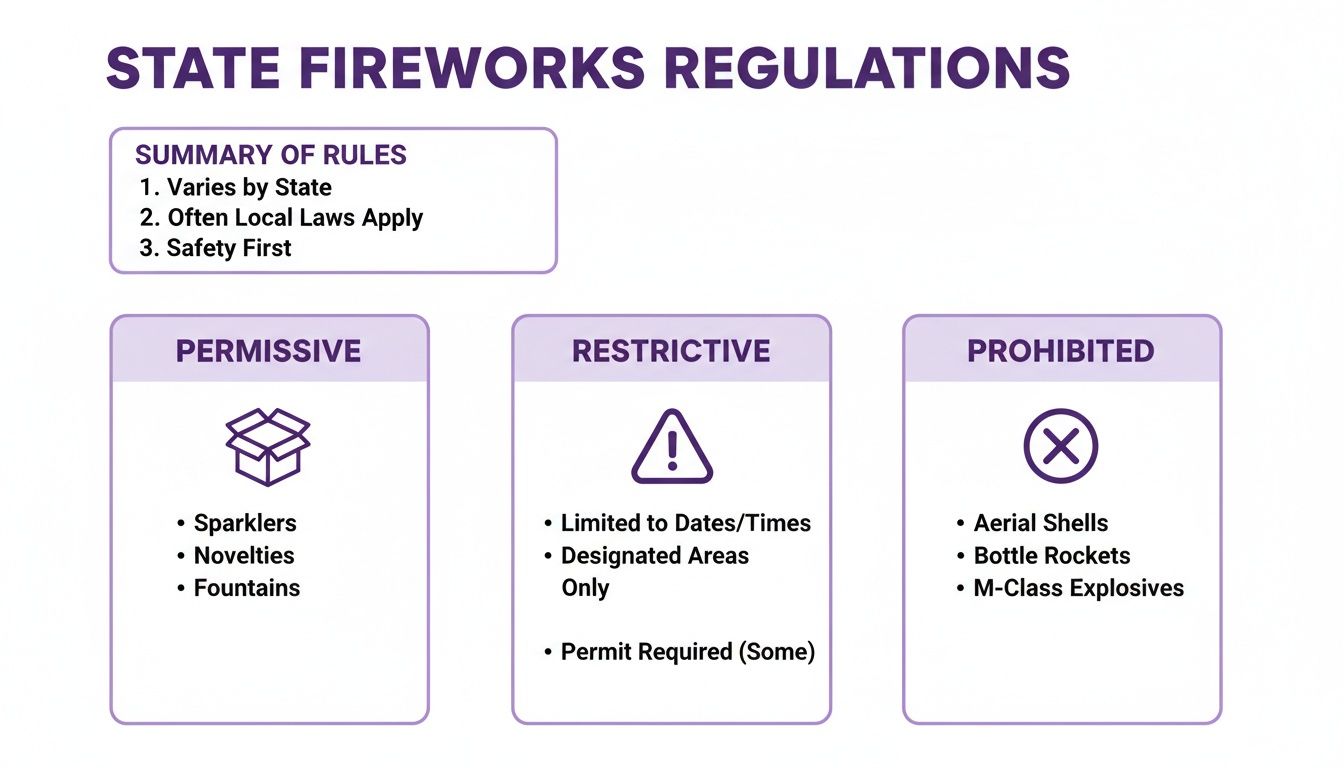
As you can see, a huge chunk of the country falls into that messy "Restrictive" category. This is exactly why e-commerce stores need precise, product-level shipping rules to stay compliant and profitable.
Prohibited States: The "No-Go" Zones
Some states have drawn a clear line in the sand with a complete ban on the sale, possession, and shipment of consumer fireworks. For online sellers, these are straightforward "no-go" zones. Any attempt to ship here is a direct violation of state law, period.
- Delaware: Maintains a full prohibition on all consumer fireworks. Not even sparklers can be legally shipped to a residential address.
- Hawaii: Given its unique geography and high fire risk, Hawaii enforces a strict, across-the-board ban. Shipping any consumer fireworks into the state is illegal.
- Massachusetts: Famously holds the distinction of being the only state to ban all forms of consumer fireworks, with no exceptions for sparklers or novelties.
- Vermont: Joins the list of states with a total ban. No consumer fireworks of any class can be shipped to Vermont residents.
Restrictive States: The "Safe and Sane" Divide
This is where things get complicated. This is the largest and most complex category of states, permitting some fireworks while heavily restricting others. Most follow a framework known as "Safe and Sane," which generally means ground-based items, fountains, and novelties get a pass, while aerials and loud explosive devices are banned.
California is the classic example of a "Safe and Sane" state. You can ship ground spinners, fountains, and sparklers, but items like Roman candles, firecrackers, and anything designed to leave the ground are strictly prohibited. Critically, many cities and counties in California have their own total bans, even on state-approved "Safe and Sane" products.
New York also operates on a restrictive model. While the state legalized sparklers and certain ground-based fountains, many of its largest counties opted out and still maintain a complete ban. This creates a messy patchwork of allowed and disallowed shipping zones within the same state.
Key Takeaway for Restrictive States: Your survival in these markets depends on your ability to configure shipping rules at the product category level. You have to be able to block "Aerials" while still allowing "Fountains" to ship to the same customer.
Here’s a look at how a few other key restrictive states break down:
| State | Permitted for Shipment | Banned for Shipment | Official Source |
|---|---|---|---|
| Arizona | Ground spinners, fountains, novelties | Aerial devices, firecrackers, bottle rockets | AZ Rev Stat § 36-1601 |
| Illinois | Novelties, sparklers, smoke devices | Firecrackers, torpedoes, skyrockets, Roman candles | Illinois Pyrotechnic Use Act |
| New Jersey | Hand-held sparklers, ground-based fountains, novelty items | Aerial fireworks, firecrackers, sky rockets | NJ Stat § 21:3-2 |
| Ohio | Sparklers, fountains, novelties | Firecrackers, bottle rockets, aerial shells | Ohio Rev Code § 3743.01 |
You can see the pattern here: ground-based, non-explosive items are usually okay, while anything that flies high or makes a loud bang is typically banned.
Permissive States: Open, But Not a Free-for-All
Permissive states generally allow the sale and shipment of all 1.4G consumer fireworks. These jurisdictions are your most straightforward shipping opportunities. However, "permissive" doesn't mean unregulated.
For instance, states like Indiana, Pennsylvania, and Michigan allow the full line of consumer fireworks to be shipped to residents aged 18 or older. These represent some of the largest and most accessible markets for e-commerce stores.
Even in these open markets, local rules can still trip you up. A customer in a permissive state like Texas might live in a county with a temporary burn ban or a city that prohibits fireworks entirely. While you can legally ship to their address, it’s a best practice to remind customers that it’s on them to comply with local ordinances.
Here are a few examples of permissive states with their own unique quirks:
- Florida: Allows shipment of all 1.4G fireworks, but state law requires the buyer to sign a waiver stating the fireworks will be used for agricultural purposes (like scaring birds from crops).
- Washington: The state is generally permissive, but local and tribal jurisdictions have significant authority to enact stricter controls. Smart sellers verify rules at the county level. The Washington State Patrol provides excellent guidance here.
- Wisconsin: Allows all consumer fireworks but puts the compliance burden on the customer, who must get a permit from their local government. You should make this requirement crystal clear during checkout.
The landscape of fireworks shipping restrictions by state is a mosaic of prohibitions, allowances, and weird local conditions. An effective compliance strategy means moving beyond broad categories and implementing detailed, verifiable rules for every single state you ship to. The legal sources linked here aren't just for reference; they are the foundation you must build your shipping logic on to protect your business from fines, seized shipments, and legal headaches. This level of detail is precisely what tools like Ship Restrict are designed to manage, turning this complex legal map into automated, enforceable rules at checkout.
How to Configure WooCommerce for Shipping Compliance

Knowing the complex fireworks shipping restrictions by state is one thing, but actually enforcing them on your WooCommerce store is a whole different ball game. Trying to manually check every order against a spreadsheet of state laws isn't just a massive time sink—it's a recipe for costly mistakes. This is exactly why a shipping restriction plugin isn't just a nice-to-have; it's an essential tool for your business.
Automating your compliance rules protects you from hefty fines and seized shipments. A good plugin acts as a hands-off, digital gatekeeper for your store, creating rules that stop customers in prohibited areas from ever completing a purchase. It effectively translates dense legal requirements into automated store logic.
Setting Up Basic State-Level Blocks
First things first: you need to block shipments to states where consumer fireworks are completely illegal. This is your foundational safety net. With a plugin, you can set up a simple but powerful rule that stops all orders heading to these "no-go" zones.
Example Rule: Block All Shipments to Prohibited States
- Rule Type: Restrict Shipping
- Condition: Shipping State/Province
- Value: is one of
Massachusetts,Delaware,Hawaii,Vermont - Action: Disable all shipping methods for the cart.
This single rule immediately prevents any order from being processed for delivery to these four states, wiping out your biggest compliance risk right from the start. We cover the specifics of this in our guide on how to block shipping to specific states with WooCommerce plugins.
Creating Product-Specific Rules for Restrictive States
The real headache comes from states with "Safe and Sane" laws, where some products are perfectly fine but others are strictly banned. To handle this, your rules need to be based on WooCommerce product categories. This is how you can allow the sale of "Novelties" while blocking "Aerials" or "Firecrackers" to a customer in the same state.
Below is an example of what this kind of product category rule setup looks like in practice.
This kind of interface gives you the granular control needed to define exactly which product categories are off-limits in which locations.
Example Rule: Enforce "Safe and Sane" Laws in California
- Create Categories: Before anything else, make sure your products are sorted into accurate categories like "Aerials," "Firecrackers," "Fountains," and "Novelties." Good data in, good results out.
- Build the Rule:
- Rule Type: Restrict Shipping
- Condition 1: Shipping State is
California - Condition 2: Cart contains products from categories
AerialsORFirecrackers - Action: Disable all shipping methods.
With this rule in place, a customer in California can buy all the sparklers and fountains they want. But the moment they add a rocket or a pack of M-80s to their cart, the checkout process will stop them cold.
This complex legal landscape is why vendors often have to refuse shipments to an estimated 10–15% of U.S. ZIP codes where state or local bans are in effect. Automating your store's rules ensures you aren't contributing to the recurring problem of confiscated shipments in these highly restrictive jurisdictions.
Managing Customer Expectations and Communication
How you talk to customers about fireworks shipping restrictions by state is just as important as how you enforce them. Getting this right is the difference between a frustrated customer who never comes back and one who understands you're a responsible, compliant business.
Think about it from their perspective. They spend time browsing your site, picking out the perfect assortment, only to get slammed with a cryptic "cannot ship" message at the very last step. It’s a jarring experience that leads to abandoned carts and angry emails. Proactive, clear messaging is your best tool to prevent that frustration and cut down on support tickets. When a customer knows why an item can't ship to them, they’re far less likely to get upset.
Crafting Clear and Professional Messages
The key is to be upfront. Inform customers early and often, using language that’s helpful, not accusatory. You want to make it clear that the restrictions are based on state laws, which are completely out of your hands. This positions you as a law-abiding seller, not an obstacle standing between them and their purchase.
Good customer communication is everything, especially when navigating these kinds of complex rules. For a deeper dive on general strategies, there are plenty of great resources online. The core idea is simple: be transparent and provide context.
Best Practice: Don't wait until the final checkout page to break the bad news. Display restriction notices directly on product pages and in the shopping cart. This sets expectations from the beginning and saves everyone a headache.
Here are a few templates you can adapt for your own WooCommerce store:
-
Product Page Disclaimer (for items like aerials or firecrackers):
- "Please Note: Due to state laws, this item cannot be shipped to addresses in CA, AZ, IL, NY, and several other states. Please check your local regulations before ordering."
-
Shopping Cart Notice (when a restricted item is added for a blocked state):
- "Shipping Alert: We're sorry, but [Product Name] cannot be shipped to [State Name] because of local fireworks laws. Please remove this item to proceed with your order."
-
Email Response to a Customer Inquiry:
- "Thanks for reaching out about our products! Unfortunately, we are unable to ship certain fireworks, like those in our [Product Category] collection, to [State Name] due to state-level legal restrictions. We can, however, ship anything from our 'Novelties' and 'Fountains' categories to your location. We apologize for any inconvenience."
Navigating Carrier Policies and Enforcement Risks
<iframe width="100%" style="aspect-ratio: 16 / 9;" src="https://www.youtube.com/embed/Wjn4tykwk2s" frameborder="0" allow="autoplay; encrypted-media" allowfullscreen></iframe>Trying to get around fireworks shipping restrictions by state isn't just a compliance headache; it's a gamble with some very real consequences. If you attempt to ship prohibited items, you're looking at immediate product seizures, big fines from state authorities, and potentially even legal trouble. Enforcement is no joke, and pleading ignorance won't get you off the hook.
This risk goes beyond just state regulators—it extends directly to your shipping carriers. The big names you use every day, like USPS, UPS, and standard FedEx services, have an outright ban on shipping consumer fireworks. They classify them as hazardous materials (hazmat), which require specialized handling that their standard parcel networks simply aren't built for.
Specialized Freight Is Non-Negotiable
Because of these policies, you can't just throw an order in a box and drop it off at the local shipping store. Doing so is a direct violation of carrier terms and federal regulations. The best-case scenario is getting your shipping accounts permanently shut down; the worst involves hefty financial penalties.
Every fireworks shipment must go through a licensed, hazmat-certified freight carrier. These are specialized services, often operating regionally, that are properly equipped to handle the unique safety, packaging, and documentation required for transporting explosive materials. Finding a few reliable partners is a critical first step. You can start by exploring different regional carrier options for regulated products to find services that meet these strict standards.
The bottom line is that the operational and financial risks of non-compliance are immense. From losing your entire shipment to facing thousands in fines, a single mistake can jeopardize your business.
The Critical Role of Labeling
Proper handling starts with clear identification. When it comes to regulated shipments, accurate and compliant labeling is everything. Sourcing quality wholesale shipping labels and tags is essential for meeting both carrier and Department of Transportation standards.
These labels aren't just stickers; they're a critical communication tool. They signal the hazardous nature of the contents to every person in the supply chain, ensuring the package is handled correctly and legally from the moment it leaves your warehouse to the time it reaches the customer's door.
Your Top Fireworks Shipping Questions Answered
When you're dealing with something as regulated as fireworks, a lot of questions pop up. Let's tackle the most common ones we hear from online sellers trying to get their shipping rules straight.
Do I Need a Special License to Ship Fireworks?
Yes and no. While your business will need the right federal and state licenses to sell fireworks, the license for shipping them belongs to the carrier.
You can't just drop a box of Roman candles at your local post office. Standard carriers like USPS and UPS won't touch them. You absolutely must use a specialized freight service that is certified to transport Class 1.4G hazardous materials. They're the ones who hold the necessary hazmat certifications to move your products legally and safely.
Can I Ship Fireworks to a P.O. Box?
That's a hard no. Fireworks are classified as hazardous materials, which means they require a physical street address for delivery and can't be sent to P.O. boxes under any circumstances.
On top of that, these shipments almost always require an adult signature upon delivery. Freight carriers simply don't deliver to post office boxes. You’ll need to set up a rule in your checkout process to block any orders heading to a P.O. box.
What Happens If I Accidentally Ship to a Restricted State?
The consequences are steep, and they happen fast. Best case scenario? The shipment gets confiscated by state authorities, and you're out the entire cost of the product and shipping.
But it can get much worse. You could be looking at thousands of dollars in fines from the state, penalties from your freight carrier for the violation, and even a review of your business licenses. A single mistake is incredibly expensive, which is why automating your shipping rules is so critical.
We've seen businesses hit with five-figure fines for a single non-compliant shipment. Automating your store's shipping logic isn't just a convenience—it's the single most effective way to prevent these costly errors before an order even gets placed.
How Should I Handle Local Laws Within a Permissive State?
This is a great question because it gets into the weeds of compliance. Even in a state where fireworks are broadly legal, you'll find plenty of individual cities or counties with their own outright bans.
Legally, the responsibility to know local ordinances usually falls on the customer. However, to protect your business and prevent headaches, it's a smart move to add a clear disclaimer during checkout. Something simple like, "Please verify your local laws before ordering, as we are not responsible for compliance with city or county ordinances," goes a long way in managing expectations and heading off potential disputes.
Stop losing sales to shipping errors and protect your business from fines. Ship Restrict automates your compliance by blocking illegal orders at checkout, ensuring every shipment follows state and local rules. Get Ship Restrict for WooCommerce today!
Automate Shipping Compliance
Stop worrying about restricted states. Ship Restrict handles it automatically.

Cody Yurk
Founder and Lead Developer of ShipRestrict, helping e-commerce businesses navigate complex shipping regulations for regulated products. Ecommerce store owner turned developer.
Automate Shipping Compliance
- Block restricted states
- No more cancellations
- Set and forget
3-day free trial · Card required