California Direct to Consumer Alcohol Shipping for WooCommerce Stores
A definitive guide to California direct to consumer alcohol shipping. Learn the laws, licenses, and logistics to legally ship alcohol with WooCommerce.
Navigating the world of California direct to consumer alcohol shipping can feel like hitting a moving target, but recent changes are blowing the doors wide open—especially for spirits producers. The state is on the brink of a major regulatory shift, and for any WooCommerce retailer, understanding the new rules of engagement is critical.
Understanding California's Evolving DtC Alcohol Shipping Rules
For years, California’s direct-to-consumer (DtC) market has been a tale of two industries. Wineries have long enjoyed pretty straightforward shipping privileges, allowing them to build thriving online sales channels. Meanwhile, the spirits world has been stuck behind a wall of restrictions, creating a massive bottleneck for craft distilleries dying to reach the huge California market.
Thankfully, that’s all about to change. This shift brings both massive opportunities and new compliance headaches you need to get ahead of.
The main driver behind this transformation is Assembly Bill 1246 (AB 1246), a piece of legislation set to completely reshape the DtC spirits game.
Automate Alcohol Shipping Compliance
Block orders to restricted states automatically. 3-day free trial.
Start Free TrialThe Impact of Assembly Bill 1246
This new law fundamentally changes the competitive landscape. With the passage of Assembly Bill 1246, set to take effect on January 1, 2026, California's DtC alcohol shipping rules are undergoing a seismic shift. This is a landmark moment: for the first time, out-of-state craft distilleries will be allowed to ship spirits directly to California residents.
The bill doesn’t just stop there. It also expands in-state distillers' shipping rights and doubles the daily volume limit from 2.25 liters to a much more practical 4.5 liters per person per day.
For more details, you can dig into the Sovos ShipCompliant breakdown of California DtC spirits shipping. This is a clear signal that California is modernizing its alcohol laws, finally catching up to consumer demand for greater access to craft products.
For WooCommerce merchants, this isn't just a legal memo; it's a strategic crossroads. Your potential customer base is about to explode, but so is the need for an absolutely airtight compliance process to handle the new rules and increased volume.
The table below breaks down the key changes you need to know.
Key Changes Under California Assembly Bill 1246
| Regulatory Area | Previous Rule | New Rule (Effective Jan 1, 2026) |
|---|---|---|
| Out-of-State DtC Shipping | Prohibited for spirits. | Permitted for licensed out-of-state craft distilleries. |
| In-State DtC Shipping | Allowed for licensed California craft distillers. | Rights extended and clarified. |
| Daily Volume Limit | 2.25 liters per person, per day. | Doubled to 4.5 liters per person, per day. |
| Market Access | Heavily favored in-state wineries and distilleries. | Opens the market to national competition, creating a more level playing field. |
| Compliance Burden | Focused on in-state producers and winery shipments. | Increases for all DtC shippers, requiring robust systems for volume tracking and tax reporting. |
These changes mean you can sell more to more people, but it also means the stakes for compliance are higher than ever.
What This Means for Your Business
The real-world implications here are huge. A bigger market means more potential revenue, but it also forces you to rethink your entire fulfillment and compliance strategy from the ground up.
Here’s what you should be thinking about right now:
- Bigger Carts, Bigger Revenue: The new 4.5-liter daily limit is a game-changer. That’s the equivalent of six standard 750ml bottles, which can seriously boost your average order value.
- A Whole New Audience: If you’re an out-of-state distillery, you can finally tap into millions of new customers who were previously off-limits.
- Compliance on Steroids: With more freedom comes more responsibility. You’ll need to meticulously track volume limits, nail down age verification, and manage more complex tax obligations.
Getting this right demands a solid ecommerce foundation. If you're building out your online store to capitalize on these new DtC opportunities, checking out a comprehensive guide to web ecommerce development can give you crucial insights.
Free Alcohol Compliance Audit
Selling alcohol online? We'll review your WooCommerce store's shipping compliance for free.
And don't forget the financial side—it's just as important. To get a handle on the money, you can learn more about how state excise taxes affect online alcohol sales and shipping in our detailed guide. This new era of California direct to consumer alcohol shipping will absolutely reward those who do their homework.
How to Get the Right Licenses for DtC Alcohol Shipping
Getting the right permits for California direct to consumer alcohol shipping is where the rubber really meets the road. It can feel like a mountain of paperwork and red tape, but this is the absolute, non-negotiable foundation of your entire DtC operation. Getting this wrong doesn't just mean delays—it can lead to serious fines and legal headaches you don't want.
The main agency you'll be working with is the California Department of Alcoholic Beverage Control (ABC). Think of the ABC as the gatekeeper. Every single bottle you ship has to be under the authority of one of their licenses. Skipping this step is like building a house without a foundation; it’s just not going to work.
Identifying the Correct ABC Permit Type
Before you even touch an application, you have to nail down the exact license that matches your products. California's licensing system is incredibly specific, and there's no such thing as a one-size-fits-all permit for alcohol. A classic mistake is thinking a general business license covers DtC shipping. It absolutely does not.
Here are the key permit types most WooCommerce DtC shippers will need:
- Type 02 Winegrower License: This is the go-to for California wineries shipping their own wine direct-to-consumer. It's the most common and established DtC permit in the state.
- Type 82 Out-of-State Winegrower's Shipper Permit: If your winery is located outside of California, this is your ticket in. It gives you the green light to ship wine to California residents.
- Type 94 Craft Distiller's Direct Shipper Permit: This is the game-changer for spirits. Both in-state and (soon) out-of-state craft distilleries need this specific permit to ship liquor directly to customers.
Don't guess which license you need. Applying for the wrong one is a surefire way to waste months of your time and hundreds of dollars in non-refundable application fees. If you're even slightly unsure, check with the ABC or a compliance consultant first.
Navigating the Application Process
Once you know your license type, the real work begins. The ABC application is thorough and demands meticulous attention to detail. You'll need to pull together a lot of documentation, so it’s smart to get organized well ahead of time.
Typically, the ABC will ask for a full packet that includes:
- Business Formation Documents: Your articles of incorporation or organization, partnership agreements, and other core business papers.
- Personal Affidavits: Detailed personal history for all owners and key players in the business.
- Financial Records: Proof that your business is financially stable and documents showing where your funding came from.
- Premises Diagrams: Detailed floor plans of your licensed location, whether it's a winery, distillery, or fulfillment center.
The whole landscape of DtC alcohol shipping in California is evolving. We're moving from old-school, post-Prohibition laws toward new opportunities. While wineries have had a smooth path for years, spirits are just now entering a new era. The big news is AB 1246, which is set to create a pilot program allowing out-of-state craft distillers to ship here. It's a fresh frontier for consumer access, and you can learn more about the impact of these DtC shipping laws to see the bigger picture.
Speaking of changes, the infographic below shows how the daily shipping limit recently doubled—a key shift that directly impacts how much you can sell.

This jump from 2.25L to 4.5L per day means customers can buy more in a single order, which can significantly boost your average order value.
Don't Overlook Local Requirements
A state-level ABC license is crucial, but it’s often not the final hurdle. Many cities and counties in California have their own business licensing and zoning requirements you also have to meet. Ignoring these local rules is a critical mistake.
For example, your warehouse or fulfillment center has to be in an area zoned for commercial or industrial activity that specifically allows alcohol storage and distribution. Operating out of a location that isn’t properly zoned can get your entire operation shut down by local officials, no matter what your state permit says.
Always, always check with the city and county planning departments where your business is physically located. Make sure you're fully compliant at every level of government before you ship your first box.
Packaging and Labeling Your Shipments for ABC Compliance
Once your licenses are in hand, your attention needs to shift to the physical package leaving your warehouse. Compliance for California direct to consumer alcohol shipping doesn't stop with paperwork; it rides along on every box you send out. Messing up the details here can lead to costly returned shipments, fines from your carrier, and a whole lot of unwanted attention from the ABC.
Your packaging really has two jobs: protect the product and prove you’re compliant. Breakage isn't just a loss of product and a refund—it's a ding to your brand's reputation. Nobody wants to open a box soaked in the craft gin they’ve been eagerly waiting for.
Mastering Mandatory Labeling Requirements
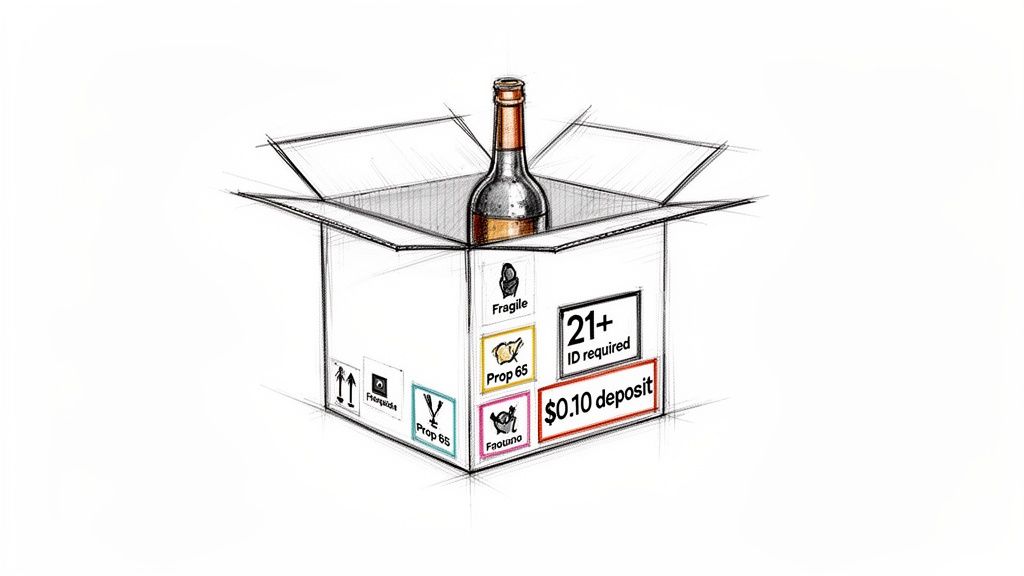
Every single package with alcohol heading to a California customer must have specific labels in plain sight. These aren't suggestions—they're legal requirements. Your shipping box is essentially a mobile compliance document that has to be perfectly clear to carriers and regulators.
The most important label, without a doubt, is the age verification warning. California law mandates that containers are conspicuously labeled with the words: “CONTAINS ALCOHOL: SIGNATURE OF PERSON AGE 21 YEARS OR OLDER REQUIRED FOR DELIVERY.” This has to be big and bold, telling the delivery driver they absolutely cannot leave the package without checking a valid ID and getting a signature.
But the state-mandated warning is just the start. You also have to navigate California’s own unique consumer protection laws.
Pro Tip: Don't even think about slapping these labels on the bottom of the box or using a tiny font. They need to be on the top or a main side panel, right near the shipping label. The goal is to make it impossible for the delivery person to miss them.
Proposition 65 and Bottle Deposit Rules
California’s Proposition 65 is a big one. It requires businesses to warn consumers about exposure to chemicals known to cause cancer or reproductive harm. Since alcoholic beverages are on that list, you'll need a Prop 65 warning on your shipments. This is a classic "gotcha" for out-of-state shippers and can lead to serious legal headaches if overlooked.
On top of that, there's the California Beverage Container Recycling Program (CRV). For certain containers, like glass bottles over 24oz, a $0.10 deposit gets added to the price. While you’ll handle this at checkout, your entire fulfillment and accounting process needs to track it properly. These "small" details add up fast and can become a huge compliance burden.
The sheer complexity of these rules—from Prop 65 stickers to bottle deposits and tax filings—shows why you need a solid system, especially if you’re running on WooCommerce. We see retailers in other tricky industries, like firearms, using tools like Ship Restrict to automate ZIP-code-level rules and stay compliant. That same model is a lifesaver for navigating the volatile world of spirits shipping. As you can see from recent industry reports, you need this kind of automation if you want to grow without tripping over regulations.
California DtC Alcohol Shipping Labeling Checklist
To keep things straight, a simple checklist is your best friend. Ticking these boxes before a package is sealed can save you from massive headaches down the road.
| Requirement | Placement | Notes |
|---|---|---|
| Age Verification Warning | Prominently on the outside box | Must state that alcohol is inside and an adult signature (21+) is required. |
| Proposition 65 Warning | On the product or outer packaging | Required for products containing chemicals on California's list. Don't skip this. |
| Recipient and Shipper Info | Main shipping label | Must clearly list your licensed business name and address, along with the customer's. |
| Carrier-Specific Labels | As required by FedEx or UPS | Both carriers have their own specific alcohol labels. You have to use them. |
| Internal Packing Slip | Inside the box | Include an itemized list of contents. This is a lifesaver for customer service issues or returns. |
Running through this checklist ensures every package that leaves your facility is buttoned up and ready for scrutiny.
Getting your packaging and labeling right is the last critical link in the compliance chain. It shows you’re serious about responsible shipping and protects your business from the painful consequences of what might seem like a simple mistake.
Choosing Your Carrier and Nailing Down the Logistics
Picking a shipping carrier for your California direct to consumer alcohol shipping isn't just an operational choice—it's a massive compliance hurdle. You can't just drop your packages off with any courier. In California, like the rest of the country, only a handful of carriers are legally set up to handle DtC alcohol, with FedEx and UPS being the big two.
This isn't an accident. These carriers have invested in specific, legally-vetted programs to manage the unique demands of alcohol delivery. The most important piece of that puzzle is the required adult signature verification at the door. Trying to sneak a shipment through a non-approved service like the USPS isn't just a bad idea; it's a federal offense that will put your business in hot water fast.
Getting an Alcohol Shipping Agreement in Place
Before a single bottle leaves your warehouse, you have to get a formal alcohol shipping agreement with your chosen carrier. This is much more than a standard business account. It's a specific contract where you prove you're a licensed alcohol seller and formally agree to play by all their rules, plus all the state and federal ones.
The process involves submitting copies of your ABC licenses and other business paperwork. The carrier’s legal team will go through your application to make sure you're a legitimate, licensed business. This can take weeks, so don't wait until the last minute. Kick this off long before you plan to start selling online. To get a feel for what's involved, check out our FedEx alcohol shipping account setup guide for a detailed walkthrough.
Think of this agreement as the foundation of your entire shipping operation. Without it, you can't legally generate a compliant shipping label. Trying to get around this by mislabeling your boxes is a direct violation of your contract and a surefire way to get your account shut down, on top of facing potential legal trouble.
Making Adult Signature Required the Default
A non-negotiable term of that carrier agreement is the mandatory use of an Adult Signature Required service for every single alcohol shipment. This service contractually binds the delivery driver to physically check a government-issued ID and verify the recipient is 21 or older. No exceptions.
This has to be baked into your WooCommerce store's checkout process. Your shipping settings must automatically apply this service to any cart containing alcohol. If you fail to do this, you're breaking your carrier contract and state law simultaneously.
Think through some real-world headaches this causes:
- Failed Deliveries: If no adult is home to sign, the driver can't leave the package. Carriers typically make up to three delivery attempts before sending the shipment back to you, and you'll probably have to eat the cost.
- Managing Returns: You need a solid policy for handling those returned shipments. Will you refund the customer minus the shipping fees? Charge a restocking fee? Be upfront about this on your website to manage expectations and avoid angry customers.
Sizing Up Carrier Performance in California
While FedEx and UPS both have solid alcohol shipping programs, their performance isn't identical. When you're picking a partner, you need to look past the sticker price on shipping rates.
How's their coverage in the more rural parts of California? What's their reputation for reliability and, just as important, for scan compliance? You need to know their drivers are actually following the signature protocol every time. The best way to find out is to talk to other local wineries, breweries, or distilleries. Ask them about their experience with filing claims for damaged goods and how responsive customer service is when things go wrong. A truly resilient fulfillment process depends on a carrier that acts like a real partner, not just a service provider.
Automating Shipping Rules with Ship Restrict
Let's be honest: manually checking every single order against California's maze of local shipping restrictions is a nightmare. It’s not just a time sink—it’s a surefire way to make costly mistakes that can land you in serious legal trouble. As your business grows, this manual approach simply breaks down.
This is the point where automation shifts from a "nice-to-have" to a must-have for anyone serious about California direct to consumer alcohol shipping.
<iframe width="100%" style="aspect-ratio: 16 / 9;" src="https://www.youtube.com/embed/BlCa_I_HQGQ" frameborder="0" allow="autoplay; encrypted-media" allowfullscreen></iframe>A powerful WooCommerce tool like Ship Restrict is built to solve this exact compliance headache. We're talking about California's sprawling network of "dry" or restricted ZIP codes where dropping off a bottle of wine is flat-out illegal. Instead of wrestling with a spreadsheet that's obsolete the moment you save it, you can build smart, automated shipping rules that stop non-compliant orders cold at checkout.
Blocking Orders from Restricted ZIP Codes
While California gives a green light to DtC shipping at the state level, that approval doesn't magically erase local laws. You'll find a surprising number of cities, counties, and even specific ZIP codes with their own ordinances that ban alcohol deliveries. And the real kicker? These can change without any warning, making manual tracking a fool's errand.
Think about it from the customer's perspective. Someone in a restricted area probably has no idea they can't get alcohol shipped to them. They place an order, you ship it out, and then the carrier either sends it back (on your dime) or, even worse, you get flagged for a violation.
Automation is your first and best line of defense here.
With Ship Restrict, you can set up a rule that specifically targets these "no-ship" zones. For example, you could build a rule in a few clicks that says:
- If a product in the "Alcohol" category is in the cart...
- And the shipping address is in ZIP codes 95451, 95934, or 92391...
- Then hide all shipping methods and show a custom message explaining the local restriction.
This check happens instantly while the customer is still on the checkout page, preventing an illegal sale before it ever hits your order queue. It's a double win: you stay compliant, and your customer gets a clear, immediate explanation, avoiding the frustration of a canceled order later on.
The screenshot below shows just how easy it is to plug multiple ZIP codes into a single rule, effectively building a powerful compliance block in minutes.
This visual editor lets you zero in on problem areas with precision, ensuring your compliance net is both wide and accurate.
Enforcing Volume Limits and Product Rules
Beyond just where you can ship, you also have to worry about how much. California's updated daily volume limit of 4.5 liters per person is a fantastic opportunity to boost average order values, but it introduces a new tracking headache. How do you stop a customer from placing a second order on the same day that puts them over the legal limit?
While a plugin can't track cumulative daily totals for a single customer without some custom work, it can enforce per-order limits based on weight or quantity. You can easily set up a rule that blocks the checkout process if the total weight of alcohol products in the cart exceeds the equivalent of 4.5 liters.
This acts as a critical backstop, catching obviously non-compliant orders before they ever get to your fulfillment team. You can also get more granular by creating rules for specific products. For example, if a high-value spirit can only be shipped via a particular carrier service, you can create a rule that only displays that single shipping option when that specific bottle is in the cart.
Automation isn’t about replacing your team; it’s about making them more effective. By letting the software handle thousands of routine checks, you free up your people to focus on complex cases, customer service, and actually growing the business. It’s the only way to scale DtC operations safely.
As you get ready to implement a tool like Ship Restrict, knowing the basics of installing a plugin in WordPress is a great first step. A proper installation ensures the tool works seamlessly with your WooCommerce store from day one. You can also dive deeper by checking out our guide on automated shipping compliance for WooCommerce stores to learn more advanced strategies.
By switching from manual checks to an automated, rules-based system, you turn compliance from a liability into a reliable, scalable asset. This approach will save you countless hours, prevent expensive shipping screw-ups, and give you the peace of mind you need to grow your DtC alcohol business in the massive California market.
Common Questions About California DtC Alcohol Shipping
Once you start shipping alcohol direct-to-consumer in California, you'll find that the big picture is one thing, but the day-to-day details are another. Even with a great plan, unique scenarios pop up that can leave you scratching your head. Here are some of the most common questions we hear from WooCommerce merchants, with straightforward answers to keep you compliant and your orders flowing.
Are the Shipping Rules the Same for Beer, Wine, and Spirits?
Not even close—and this is a critical distinction that trips up a lot of new sellers. It's a huge mistake to assume the regulations are interchangeable. California has a mature, well-established system for DtC wine shipping, which is why so many wineries have been shipping across the country for years with confidence.
Beer, on the other hand, operates under its own unique set of rules and licensing. And the most dynamic area right now is spirits, where Assembly Bill 1246 is just starting to open up what was previously a completely closed market.
Each category—wine, beer, and spirits—demands its own specific license from the ABC, comes with different volume limits, and has separate tax and reporting structures. You absolutely must get the right permit for each type of alcohol you want to ship. Trying to send spirits under a winegrower's license, for instance, is a serious violation that can put your entire business in jeopardy.
What if a Customer Misses the Delivery?
This is one of the most frequent logistical headaches you'll face. When an adult over 21 isn't home to sign, the carrier is legally forbidden from completing the delivery. They can't just leave it on the porch like a regular package.
Typically, FedEx or UPS will make up to three separate delivery attempts, usually on consecutive business days. If they strike out all three times, the package is sent to a local carrier depot. It's held there for a short period—often about five business days—giving your customer one last chance to go pick it up in person with a valid ID.
If the package goes unclaimed, it gets sent right back to you. This return trip can be surprisingly expensive, as you're often on the hook for the return shipping fees. At that point, you've got a customer service issue on your hands, which could mean a refund (minus shipping costs) or arranging for a reshipment. The key is to communicate this policy clearly on your product and checkout pages to manage expectations and head off disputes before they start.
Are There Any Cities or ZIP Codes in California Where I Cannot Ship?
Yes, absolutely. While California gives the green light to DtC alcohol shipping at the state level, that permission doesn't override local laws. The state is dotted with "dry" or restricted communities—cities, counties, and even specific ZIP codes—that prohibit the delivery of alcoholic beverages.
These local rules can change with little warning, and trying to track them with a manual spreadsheet is a recipe for disaster. One city might ban all alcohol deliveries, while another only restricts spirits.
This is precisely why relying on an automated tool is no longer a luxury—it's a necessity for staying compliant. Manually checking every single order against a constantly shifting list of local restrictions just isn't sustainable and exposes your business to serious risk. One bad shipment can lead to fines and penalties.
A solution like Ship Restrict lets you build rules that automatically block orders from these specific locations right at checkout. It's the only practical way to stay on the right side of every local law without sinking hours into manual verification.
How Do I Manage California Sales and Excise Taxes?
Tax compliance in California is a two-front battle. First, you have to collect the correct state and local sales tax based on the buyer's exact delivery address. Since these rates vary all over the state, you need a system that can calculate them on the fly.
Second, you're responsible for paying state excise taxes. These are calculated based on the volume and type of alcohol sold, not its price. This demands meticulous, transaction-level record-keeping.
You'll need to remit sales tax to the California Department of Tax and Fee Administration (CDTFA) and excise tax to the ABC, filing regular reports with both agencies. To avoid costly errors, nearly every successful DtC business uses specialized compliance software to automate these complex tax calculations and reporting requirements.
Ready to stop worrying about complex shipping rules and start growing your sales? Ship Restrict automates compliance for your WooCommerce store, blocking restricted orders by state, county, or ZIP code before they become a problem. Protect your business and save countless hours with powerful, easy-to-use shipping rules.
Automate Alcohol Shipping Compliance
Stop worrying about restricted states. Ship Restrict handles it automatically.

Cody Yurk
Founder and Lead Developer of ShipRestrict, helping e-commerce businesses navigate complex shipping regulations for regulated products. Ecommerce store owner turned developer.
Automate Alcohol Compliance
- Block restricted states
- No more cancellations
- Set and forget
3-day free trial · Card required