Up Selling and Cross Selling Difference: A WooCommerce Guide
Learn the up selling and cross selling difference and how to use them for regulated WooCommerce stores. Boost AOV on firearms while staying compliant.
You want higher AOV, but every automated offer in a firearms store carries a second question: does this create a restricted cart?
That's where most WooCommerce advice falls apart for FFLs. A generic ecommerce playbook will tell you to add “frequently bought together” widgets, push bundles, and test post-purchase offers. Fine for socks or supplements. Not fine when one added item can change shipping rules, destination restrictions, or the compliance review your staff has to do before fulfillment.
The up selling and cross selling difference matters more in a regulated catalog than it does in ordinary retail. In a firearms store, this isn't just about revenue technique. It's about deciding whether to offer a premium version of the same product, or a separate item that might trigger an entirely different legal check. If you treat both tactics like they carry the same risk, you'll either suppress revenue or create avoidable exposure.
Why Most FFLs Get Upselling and Cross-Selling Wrong
A customer adds a Glock to the cart. Revenue-wise, the obvious move is to offer a higher-trim version or a few add-ons. Operationally, that one decision can turn a clean order into a manual review if the offer includes a restricted magazine, ammunition, or a part your team cannot ship to that ZIP code.
Automate Shipping Compliance
Block orders to restricted states automatically. 3-day free trial.
Start Free TrialThat is the mistake many FFLs make. They treat upselling and cross-selling as the same merchandising tool, then apply one generic WooCommerce rule across the catalog.
The result is predictable. Safe offers never get shown, risky offers slip through, or the store shuts recommendation logic off entirely to avoid trouble.
Fear creates low-performing stores
I see this often in firearms ecommerce. Product pages are serviceable, traffic is decent, and conversion is acceptable, but the store leaves money on the table because every offer is judged by the highest-risk SKU in the catalog. So the owner removes related products, avoids upgrade paths, and skips accessory suggestions that could have raised AOV without changing the compliance profile of the order.
That approach reduces one kind of risk and creates another. Revenue stays flat, merchandising stays weak, and staff still deal with edge cases because the catalog itself has not been organized around shipping and legal rules.
The issue is not whether to make more offers. It is whether the offer logic reflects the restrictions attached to the item being promoted.
The operational mistake is usually classification
In a regulated store, a good upsell often stays close to the original buying intent and close to the original compliance path. A customer looking at a base pistol may move to the optics-ready SKU, factory night sights, or a package with better included features. Your team still reviews a firearm order, but the shipping method, transfer process, and FFL workflow usually remain familiar.
Cross-sells create more variables. Add a magazine, ammunition, or a regulated part, and the order may need different destination checks, different carrier handling, or a hard stop at checkout. If WooCommerce treats all add-ons as harmless basket builders, the store creates avoidable friction for the customer and avoidable cleanup for the staff.
That is why FFLs get this wrong. They copy mainstream ecommerce tactics built for low-risk catalogs, then wonder why AOV gains disappear into support tickets, blocked checkouts, and fulfillment exceptions.
Free Shipping Compliance Audit
We'll review your WooCommerce store's shipping compliance for free.
The stores that improve AOV do one thing differently
They separate revenue intent from compliance logic.
They still sell aggressively. They just do it with tighter rules. Upgrade offers stay close to the original SKU and purchase intent. Cross-sells are filtered by what can legally ship, what the customer can reasonably understand at checkout, and what the warehouse can fulfill without extra back-and-forth.
That is the practical standard for an FFL WooCommerce store. Raise order value where the legal and operational path stays clean. Restrict or suppress offers that change the order into something your team cannot process safely.
Upselling vs Cross-Selling A Clear Definition
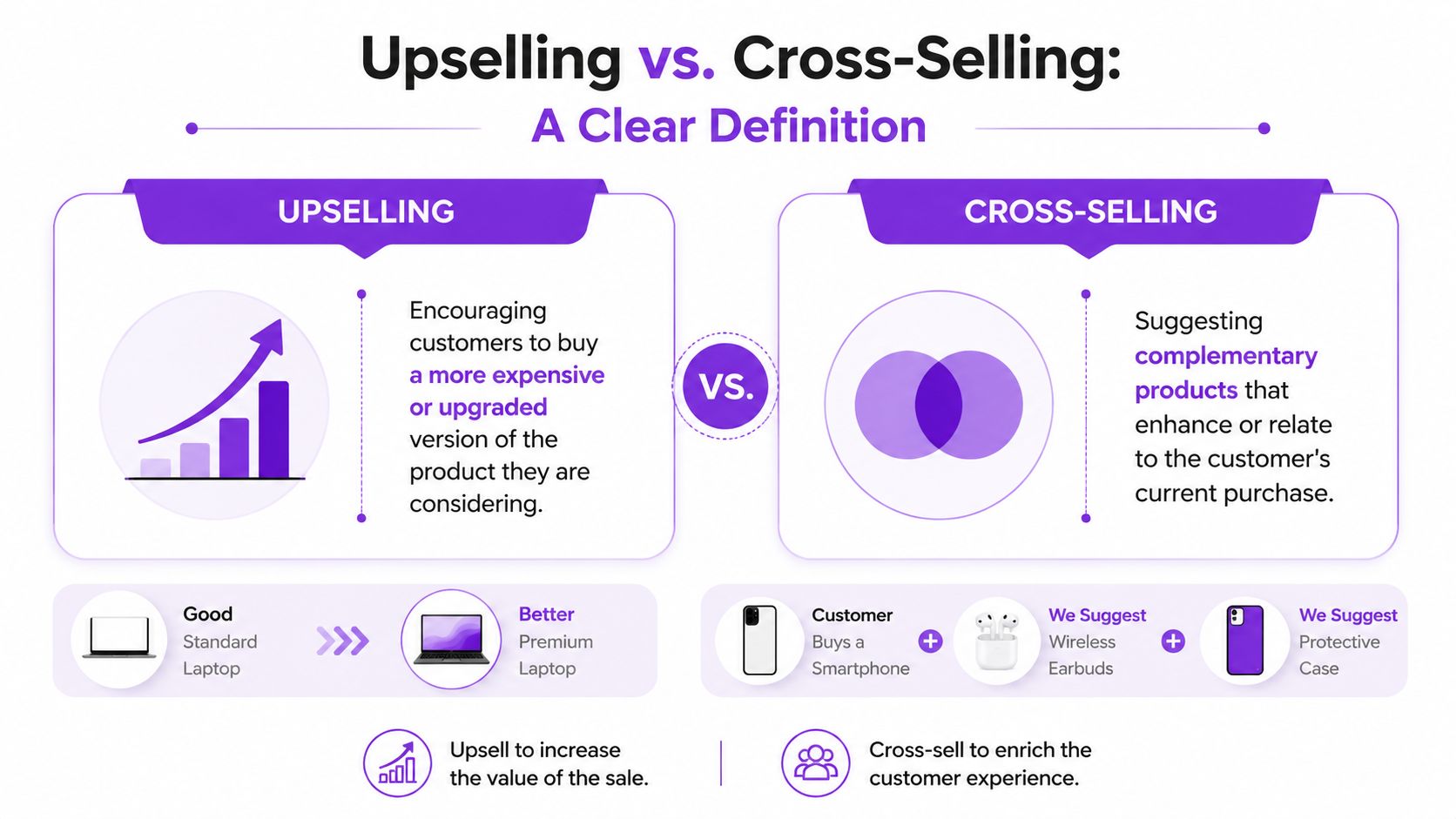
A shopper lands on a Glock product page, adds the base model to cart, and hesitates. If the store suggests the optics-ready version with factory night sights, that is an upsell. If the store suggests a holster, a cleaning kit, or a safe accessory, that is a cross-sell. The difference looks simple on the front end. In an FFL WooCommerce store, it affects checkout rules, fulfillment steps, and whether the order stays inside a clean compliance path.
| Criterion | Upselling | Cross-Selling |
|---|---|---|
| Core action | Replaces the original product with a better or pricier version | Adds another item alongside the original product |
| Customer decision | “Should I upgrade?” | “Should I add this too?” |
| Common firearms example | Swap a standard pistol SKU for the optics-ready or factory-night-sight version | Add a holster, cleaning kit, safe, or sling to the firearm order |
| Main business goal | Raise value on the primary item | Expand the basket with relevant items |
| Compliance profile | Often similar to the base item | Can change based on the added item's restrictions |
| Best use case | Buyer is already committed and comparing tiers | Buyer needs supporting gear or maintenance products |
What upselling actually means
Upselling means guiding the buyer to a higher-value version of the product they already intend to purchase. The item changes, but the buying intent stays the same.
In a firearms store, that usually looks like:
- A base rifle upgraded to a model with better furniture or sights
- A standard optic upgraded to a premium optic in the same product line
- A stripped upper upgraded to a complete upper with a stronger value case
The closeness of upsells to the original order logic is significant. The product may cost more, but the workflow often remains familiar for your staff. The same FFL transfer pattern usually applies, and the customer does not have to reconsider the whole purchase.
What cross-selling actually means
Cross-selling means adding a separate item that supports, complements, or completes the main purchase. It increases basket size instead of replacing the primary item.
For a firearms or accessory store, common cross-sells include:
- A holster with a carry pistol
- A cleaning kit with a shotgun
- A case or safe accessory with a rifle
- A sling with a hunting setup
Cross-sells can improve AOV fast. They can also create problems fast.
A holster is usually simple. A magazine, restricted part, or other state-sensitive product can change what you can ship, where you can ship it, and what checkout logic WooCommerce needs to apply. Stores that sell regulated products need staff-level clarity on those boundaries, especially if they handle multiple license types or mixed catalogs. A working grasp of FFL types, requirements, and ecommerce implications helps keep those offers aligned with the actual business model.
The practical difference for FFLs
Upsells are usually the safer revenue move because they keep the customer on the same buying track. The buyer is still choosing a handgun, rifle, optic, or upper. They are just choosing a better one.
Cross-sells require tighter controls. The offer may be relevant from a sales perspective and still be wrong for the destination, the carrier, or the checkout flow. That is the up selling and cross selling difference that matters in a regulated catalog. One tactic raises the value of the original decision. The other can expand the legal and operational scope of the order.
The best FFL stores define these terms this way inside their merchandising rules, not just in marketing copy. That is how you raise AOV without handing your team more exception handling than the extra revenue is worth.
Comparing Strategies for Regulated Product Sales
A shopper adds a pistol to the cart. An upsell to the optics-ready version usually keeps the order inside the same basic transfer process. A cross-sell for magazines, ammo, or a restricted part can change shipping rules, destination eligibility, and the checkout logic your WooCommerce store needs to apply.
That difference matters more than the label.
Revenue impact and compliance exposure are different decisions
In a typical store, upsells and cross-sells are merchandising tools. In an FFL store, they also shape operational risk.
Upselling replaces the original item with a higher-value option in the same buying path. Cross-selling adds another product to the order. Both can raise AOV, but they do it in different ways and with different consequences for review, fulfillment, and customer support.
I treat upsells as the cleaner option in regulated catalogs because they usually stay within one product family. If a buyer moves from a base rifle to a better-equipped version, the offer may increase margin without adding a second compliance problem to the cart.
Cross-sells need more scrutiny. The add-on may be commercially relevant and still create a shipping block, a state-law issue, or manual review work your team did not need.
Four ways to compare these tactics in firearms ecommerce
1. Revenue pattern
Upsells increase order value by shifting the customer to a better model, upgraded configuration, or higher-margin package. That works well when your margin is strongest on premium firearms, optics, safes, or factory-enhanced variants.
Cross-sells expand the basket. That can produce stronger AOV gains when your accessory attach rate is healthy, but only if the added products are shippable with the rest of the order.
2. Store setup and merchandising effort
Upsells are usually easier to configure in WooCommerce because the relationship is straightforward. Base model to premium model. Standard optic to upgraded optic. Smaller safe to larger safe.
Cross-sells depend on clean catalog data. Product categories, attributes, exclusion rules, and shipping classes all need to be accurate. If those inputs are sloppy, the recommendation engine will surface offers that create friction or force staff to clean up avoidable mistakes.
Bad cross-sells cost time twice. They convert poorly, and they create support tickets or order holds.
3. Customer experience at checkout
Upsells usually fit the buyer's mindset. The customer is still choosing between versions of the same item, so the offer feels relevant if the value is clear.
Cross-sells are less forgiving. They work when they complete the purchase. They fail when they distract from it.
A holster suggestion for a carry pistol makes sense. A pile of loosely related accessories before the firearm decision is final usually lowers trust and adds friction.
4. Compliance and fulfillment risk
Here, the gap gets large.
An upsell can still create problems if the upgraded product changes how the order must be transferred, shipped, or restricted by destination. But in most FFL catalogs, upsells are easier to review because they stay closer to the original compliance profile.
Cross-sells create more exceptions. Add a magazine with capacity limits, ammunition, or a regulated part, and the order may need different shipping methods, state filtering, or customer messaging. If your store handles mixed inventory and multiple fulfillment paths, your merchandising rules should match your licensing model and transfer process. A clear understanding of FFL types, requirements, and ecommerce implications helps prevent offers that look smart on the product page and fail at checkout.
What usually works better
When I audit a firearms WooCommerce store, I usually start with upsells. They are easier to explain, easier to configure, and less likely to create legal or shipping surprises.
Cross-sells work best when three conditions are true:
- The add-on is tightly related to the original purchase
- The item does not introduce a new fulfillment or destination problem
- The store can clearly explain any restriction or block at checkout
For regulated product sales, that is the practical up selling and cross selling difference. Upselling often improves AOV with less compliance overhead. Cross-selling can add meaningful revenue, but only if your catalog rules, shipping controls, and FFL workflows are already disciplined enough to support it.
Practical Use Cases for Firearms and Accessory Stores
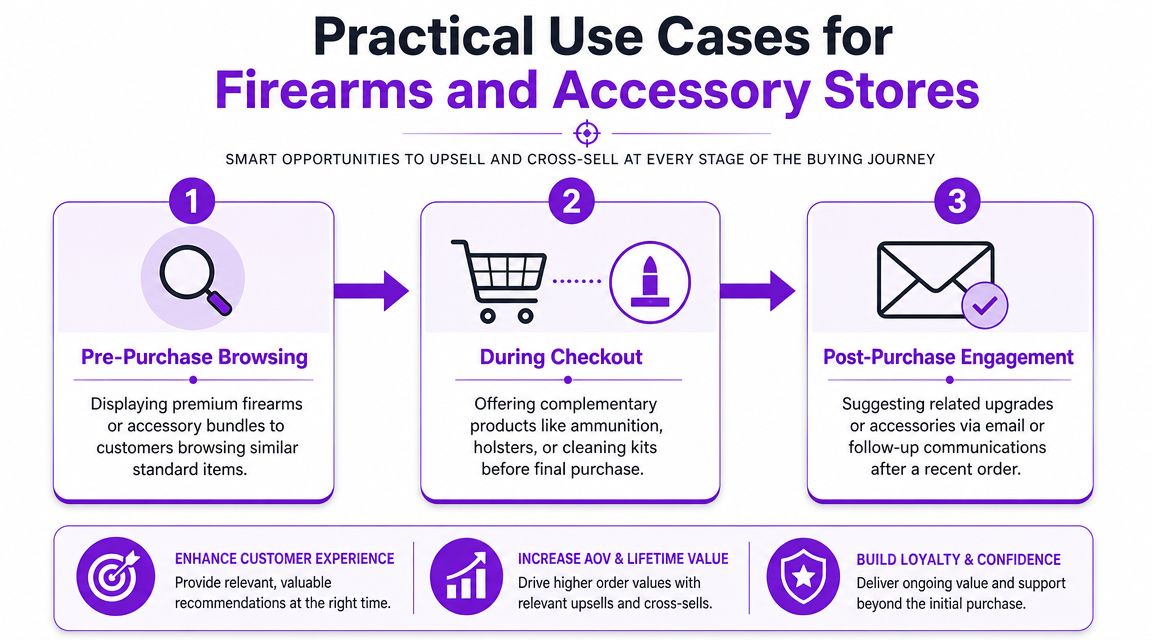
Theory doesn't help much when you're staring at a WooCommerce product editor and trying to decide what should appear on the page. The easiest way to build safe offers is to tie them to the buying stage.
Independent ecommerce research indicates that cross-selling can generate 10-30% of total ecommerce revenue, upselling can increase revenue by 10-30% on average, and effective strategies can raise average order value by 10-40%, according to OpenSend's ecommerce data on upsell and cross-sell performance. Those numbers matter, but in a firearms store the main issue is where the offer appears and what products you allow into that slot.
Product page offers
In this context, I like upsells most.
A shopper viewing a standard Glock 19 configuration can be shown a premium version with factory night sights or an optics-ready variant. The message is simple: spend more once, get a configuration that better fits the intended use. The buyer is still in comparison mode, so this feels helpful rather than disruptive.
Cross-sells on product pages should stay close to universal utility. Holsters, cleaning tools, storage options, and basic maintenance items usually make more sense here than anything that introduces location-specific complexity.
Compliance check: product-page add-ons should be filtered before display when possible. Don't show offers that the customer may be ineligible to receive based on destination or shipping constraints if your store can avoid it.
Cart stage offers
The cart is where cross-sells can either work beautifully or create chaos.
A customer adding a shotgun might respond well to a cleaning mat, case, or choke-related accessory. A rifle buyer may add a sling or maintenance gear. The key is that the original purchase is already decided. At this point, the cross-sell should feel like completion, not detour.
I'm more cautious with regulated accessories in the cart. If the add-on can create a blocked checkout or a separate shipping issue, the store needs crystal-clear messaging.
A useful reference for that broader fulfillment side is firearms and ammunition shipping compliance for WooCommerce stores, especially when you're deciding which accessories are safe to promote aggressively and which should be treated more carefully.
Customers tolerate a blocked add-on better than a blocked entire order. Keep the primary purchase moving whenever possible.
Post-purchase offers
Many stores often underuse follow-up revenue.
After an order is placed, you can suggest maintenance products, storage items, or future-use accessories tied to the original item. This is often a cleaner place for cross-sells because the first transaction is already secure. You're not risking the core sale just to squeeze one more item into the basket.
Examples that work well:
- After a pistol purchase, suggest a cleaning kit or range bag
- After a safe purchase, suggest dehumidifier accessories
- After an optic purchase, suggest lens care products
Compliance check: post-purchase offers still need the same rule discipline if they lead back to checkout. Don't assume a separate order removes the legal issue. It only changes when you have to solve it.
Bundle logic that usually fails
The most common mistake is forcing broad “frequently bought together” logic onto a regulated catalog. That may be fine for general retail. It's weak for FFL stores because customer intent is narrower and legal constraints are sharper.
Random accessory stacks don't build trust. Tight, use-case-based recommendations do.
How to Implement Upsells Compliantly in WooCommerce
WooCommerce already gives you the core structure you need. The challenge isn't finding a feature. It's deciding how to use native linked products without creating compliance messes.
Start with product hygiene
Before you assign a single linked product, clean up the catalog.
Use consistent product categories, tags, and attributes. If two pistol variants belong to the same upgrade path, their naming and structure should make that obvious. If an accessory is only suitable for a narrow group of products, don't place it in generic catch-all categories that encourage bad recommendation matches.
I usually separate implementation into two lanes:
- Upsell lane for premium variants, higher-spec models, and better packages of the same buying intent
- Cross-sell lane for accessories, maintenance items, storage gear, and low-friction complements
That separation helps staff think clearly. It also reduces the temptation to use cross-sells where an upsell would be cleaner.
Use WooCommerce linked products deliberately
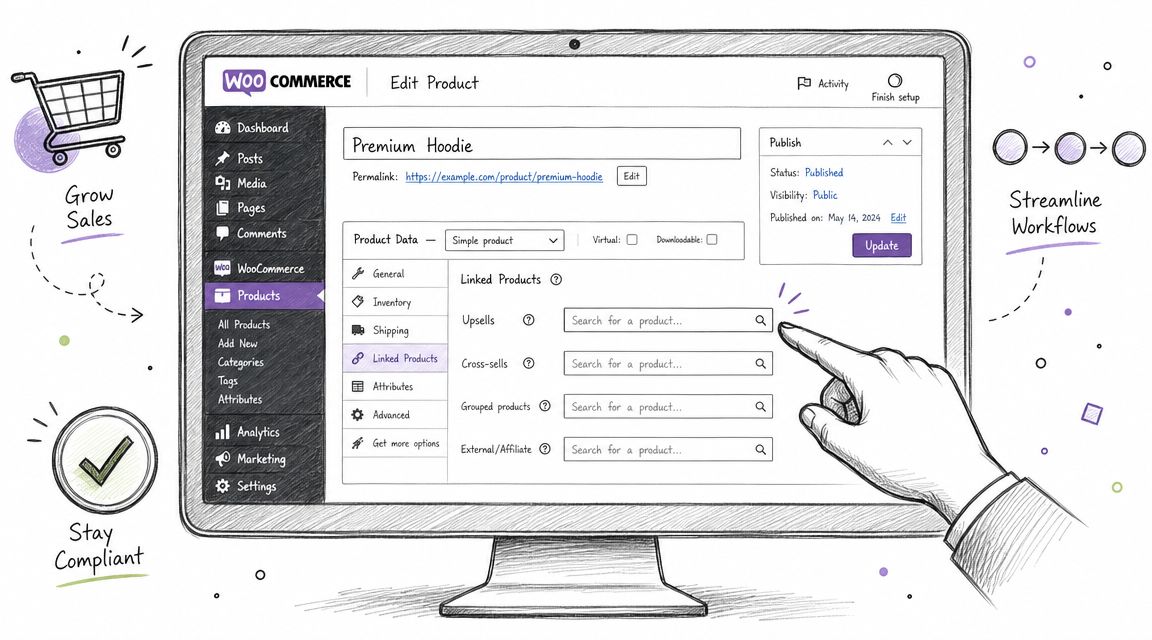
In the product editor, go to Linked Products and assign upsells and cross-sells with intent.
For upsells, keep the list short. Show the next logical product up, not every premium SKU in the category. A customer comparing a base AR-platform rifle doesn't need six alternatives. They need one or two better-fit choices.
For cross-sells, assign items that serve the original product directly:
- Holsters for a compatible carry pistol
- Cleaning tools for a shotgun or rifle
- Storage and transport gear for larger purchases
- Maintenance products that make sense after ownership begins
Don't use linked products as a dumping ground for overstock.
Build the rule layer behind the offer layer
A key distinction arises for regulated stores compared to ordinary WooCommerce setups. The merchandising layer can suggest products, but the restriction layer must decide whether the cart is allowed to proceed.
That means your team needs clear shipping and destination rules for the categories most likely to create trouble. If you're evaluating your stack, this overview of WooCommerce plugin options for regulated stores is a practical starting point because it frames plugins in terms of operational control, not just marketing features.
Operational advice: Treat merchandising and compliance as separate systems with separate jobs. One system should recommend. The other should enforce.
A short walkthrough helps if your staff is setting this up for the first time:
<iframe width="100%" style="aspect-ratio: 16 / 9;" src="https://www.youtube.com/embed/O7sU5KTnx98" frameborder="0" allow="autoplay; encrypted-media" allowfullscreen></iframe>What compliant implementation looks like in practice
A customer views a standard handgun. WooCommerce displays a premium variant as an upsell and a cleaning kit as a cross-sell. If the customer adds the premium variant, the order flow stays straightforward. If the customer adds the cleaning kit, that should remain low-friction.
But if you decide to recommend a more sensitive accessory category, the store needs enforcement rules that prevent the customer from completing an order that shouldn't ship. The offer itself isn't the problem. Unchecked cart composition is.
That's the pattern to follow. Build helpful offers first. Then make sure the store can block, remove, or explain restricted combinations before fulfillment becomes your staff's problem.
Key Metrics for Measuring Revenue Growth
A compliant offer can still be a bad offer.
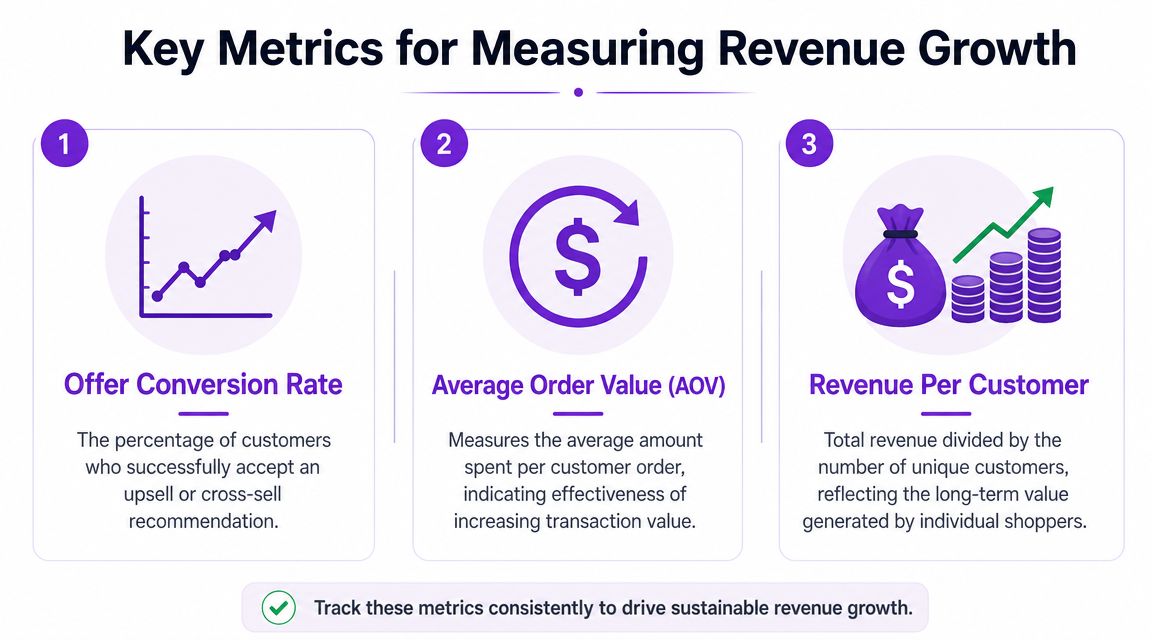
I watch four numbers before I call any upsell or cross-sell strategy successful: offer conversion rate, AOV, revenue per customer, and exception rate. In an FFL store, that last one matters because a revenue gain that creates more held orders, cart edits, or support tickets is not a real gain. It is extra labor dressed up as growth.
The KPIs that matter most
Offer conversion rate
Track acceptance rate by offer type, placement, and product class. A product-page firearm upgrade should not be judged against a cart-stage accessory add-on. Buyer intent is different, friction is different, and compliance exposure can be different too.
I separate these numbers in WooCommerce reports because blended conversion rates hide bad decisions. A cross-sell can look healthy on paper while creating a pile of blocked combinations your staff has to clean up later.
Average order value
AOV matters because it shows whether your merchandising is increasing order size. But AOV by itself is easy to misread. If a higher AOV comes from offers that trigger more manual review, address corrections, or post-purchase changes, margin usually shrinks even when top-line revenue goes up.
Measure AOV alongside fulfillment effort.
Revenue per customer
This metric shows whether the strategy improves customer value beyond a single checkout. That matters for accessory-heavy stores. A buyer may skip an add-on today, then come back for magazines, safes, cleaning supplies, or optics later if the first purchase was easy and handled correctly.
I would rather see slightly lower immediate attachment with cleaner repeat purchasing than force extra items into the first cart and create compliance friction.
Exception rate
This is the metric too many FFLs skip. Count how often an upsell or cross-sell leads to a blocked cart, manual order review, destination issue, customer service contact, or fulfillment hold. If exception rate rises with AOV, the offer needs work.
That trade-off is where regulated stores win or lose margin.
What to test in a firearms store
Use controlled tests with one variable changed at a time:
- Placement test. Show an upsell on the product page and move a similarly priced cross-sell to the cart or post-purchase flow.
- Intent framing test. Compare practical upgrade language against feature-driven language. For example, test “Upgrade to optics-ready” against “Choose the model better suited for carry.”
- Accessory relevance test. Compare a narrow accessory set tied to the firearm category against a broader recommendation block.
- Exception messaging test. If an add-on cannot ship with the order, test whether a specific explanation preserves the primary sale better than generic error copy.
For teams that want a broader framework for measuring ecommerce success, Million Dollar Sellers has a useful KPI overview that pairs well with offer-level reporting in WooCommerce.
How to read the results correctly
Do not judge the winner by line-item count or one strong week from a premium SKU. Read the full picture. Did the offer lift AOV? Did it preserve conversion on the base product? Did it increase holds, edits, or support load?
The best setup usually raises order value, fits buyer intent, and keeps compliance handling predictable. In a regulated catalog, revenue quality matters as much as revenue volume.
Answering Your Top Compliance and Sales Questions
What if a cross-sell item needs different shipping treatment?
Split the merchandising decision from the fulfillment decision. You can present the item if your store can clearly evaluate it at checkout, but don't let a sensitive add-on jeopardize the primary order. If needed, block the add-on and preserve the original purchase.
How should blocked offers be messaged?
Be specific and calm. Don't show a generic “unavailable” message if the issue is destination restrictions. Tell the customer the item can't ship to their location or can't be included with the current order. Clear explanations preserve trust better than vague errors.
Can I upsell a part that changes legal classification?
Treat that as a compliance-first product decision, not a merchandising experiment. If a part can alter how the item must be handled, shipped, or reviewed, it shouldn't be managed like a routine upsell.
Which is safer for most FFL stores?
Usually, upselling. It tends to stay closer to the buyer's original intent and often carries a simpler operational path. Cross-selling can still be valuable, but only when the added product has been mapped carefully against your shipping and destination rules.
If you run a WooCommerce firearms store and want higher AOV without relying on manual address checks, Ship Restrict helps enforce shipping restrictions before checkout so your upsells and cross-sells don't turn into compliance problems.
Automate Shipping Compliance
Stop worrying about restricted states. Ship Restrict handles it automatically.

Cody Yurk
Founder and Lead Developer of ShipRestrict, helping e-commerce businesses navigate complex shipping regulations for regulated products. Ecommerce store owner turned developer.
Automate Shipping Compliance
- Block restricted states
- No more cancellations
- Set and forget
3-day free trial · Card required