Mastering Shipping Dry Ice Fedex: 2026 Guide
Learn the essentials for shipping dry ice fedex in 2026. Our guide covers packaging, labeling, limits, & common mistakes to ensure safe delivery.
You've got a frozen order on the bench, dry ice on hand, a FedEx account, and a customer expecting the box to arrive solidly frozen. That sounds straightforward until you start reading FedEx guidance and realize the public instructions, dangerous goods rules, and store-level acceptance practices don't line up cleanly.
That mismatch is where small businesses get burned.
A shipment can be packed cold enough and still get rejected because the package can't vent. It can be labeled correctly and still get turned away because you brought it to the wrong FedEx location. For merchants shipping perishables, lab samples, or temperature-sensitive products, the expensive mistakes usually happen before the box ever moves.
The Challenge of Shipping Perishables
The first dry ice shipment usually starts with a simple assumption: put frozen product in a cooler, add dry ice, tape the box, and send it overnight. That's how a lot of merchants think about cold-chain shipping when they're new to it.
Automate Shipping Compliance
Block orders to restricted states automatically. 3-day free trial.
Start Free TrialThen the actual constraints show up.
Dry ice isn't just a refrigerant. It changes how the shipment must be packed, labeled, documented, and handed off. The product itself may be perfectly legal to ship, but the moment you add dry ice, you've stepped into dangerous goods handling. That creates a new set of operational checks that most general packing guides barely touch.
For a small business, this gets stressful fast. You're trying to protect margin, avoid spoilage, and keep the customer happy, while also navigating rules that are written for safety teams and trained shippers.
The shipment that hurts the most isn't always the one that thaws. It's the one that never gets accepted after you've already packed product, used dry ice, printed a label, and promised delivery.
That's why experienced shippers build process around edge cases, not just around ideal conditions. They ask practical questions first:
- What FedEx will accept: Not what a summary page implies, but what the staffed counter will physically take.
- What fails in the field: Venting mistakes, reused boxes, old labels, and handoff errors.
- What happens if the route slips: Whether the package design and transit choice still protect the contents.
If you ship live or temperature-sensitive products, it helps to study how specialized sellers communicate shipping risk to customers. A useful example is the Aquarium Supply Co. shipping policy, which shows how operational discipline and customer expectations need to work together when product condition matters on arrival.
Understanding FedEx Dry Ice Regulations
A common failure looks like this. A business owner reads FedEx's public guidance, sees a high allowable quantity for dry ice, packs to that number, then gets turned away at the counter because the service they booked or the location they chose applies tighter acceptance rules. The shipment is legal in one context and rejected in another.
Dry ice has to be treated as a dangerous goods workflow from the start. FedEx classifies it as UN 1845, Class 9 Miscellaneous Dangerous Goods. That classification is what triggers the marking and handling rules. FedEx's dry ice job aid requires the package to vent carbon dioxide and to display “Dry Ice” or “Carbon Dioxide Solid,” “1845,” and the net quantity in kilograms, with a maximum net quantity of 200 kilograms per package under the applicable dangerous goods conditions in that document (FedEx Dry Ice Job Aid).
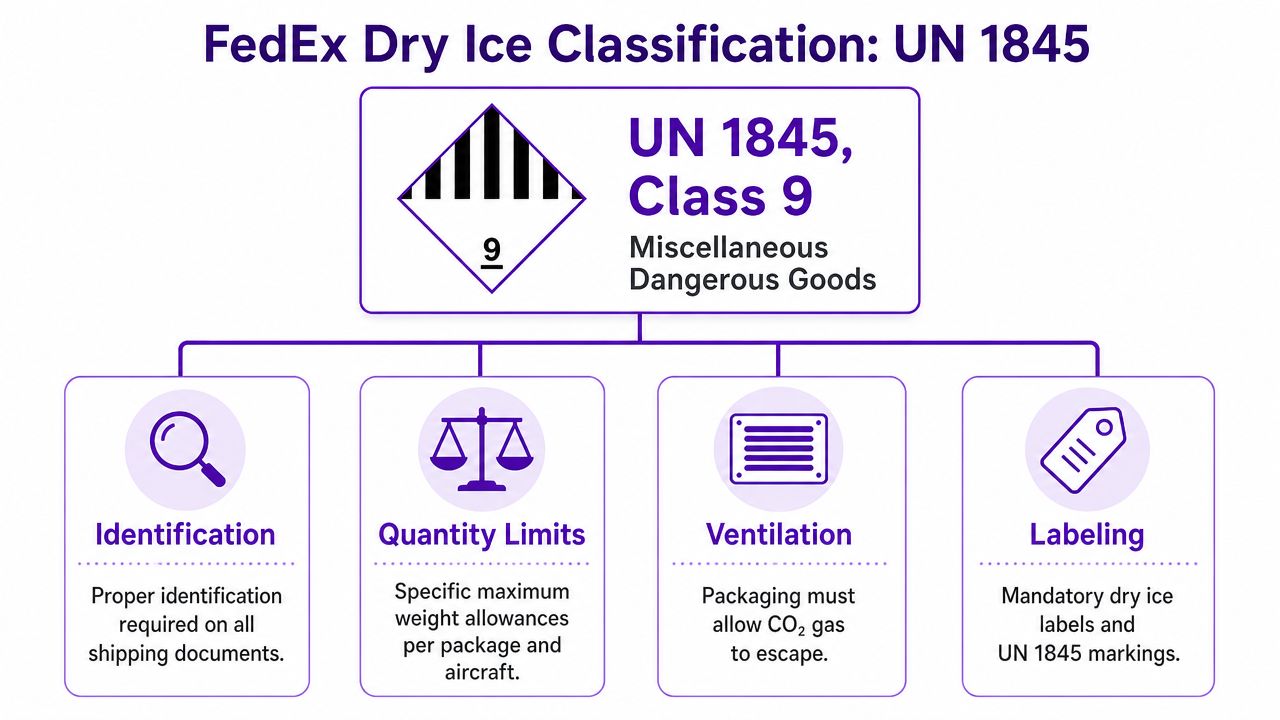
The rulebook number is not the same as the number your shipment can actually use
This is the part FedEx's public materials often leave muddy.
Free Shipping Compliance Audit
We'll review your WooCommerce store's shipping compliance for free.
The formal dangerous goods ceiling is not the same thing as day-to-day acceptance for a small-business parcel moving through a specific FedEx service lane. In practice, many routine FedEx air shipments operate under a much lower working limit than the regulatory maximum. The exact threshold depends on the service, the package setup, and whether the shipment is being handled under simplified dry ice acceptance rules or full dangerous goods procedures.
That distinction matters because counter staff do not approve shipments based on the broadest number you found online. They approve what their station is trained and authorized to accept.
| Issue | What it means in practice |
|---|---|
| Dangerous goods classification | Dry ice changes the shipment from ordinary parcel handling to regulated handling. |
| Regulatory maximum | The published ceiling applies only within the conditions of that dangerous goods framework. |
| Operational limit | Your booked service and acceptance point may allow less than the headline maximum. |
| Acceptance risk | A shipment can meet a broad rule and still be refused at handoff if station procedures are narrower. |
The same problem shows up in two places that confuse shippers all the time. One is the plastic bag contradiction. Sellers see references to bagged dry ice products, then assume any plastic containment is fine, even if it traps gas or sits inside a box that cannot vent. The other is the drop-off location paradox. FedEx may publish guidance that describes how dry ice can ship, but the staffed location in front of you may still refuse that package type because that site does not accept the service, quantity, or dangerous goods profile you prepared.
Those are not academic details. They are the reasons shipments get rebuilt, delayed, or discarded.
Why venting and markings get enforced so strictly
Dry ice turns into carbon dioxide gas. If the packaging traps that gas, pressure builds. FedEx's venting rule exists to prevent a safety failure during transport and handling.
The markings solve a different problem. They tell the accepting employee and downstream handlers exactly what refrigerant is inside, which dangerous goods identifier applies, and how much dry ice is present. Without that information, the shipment cannot be assessed correctly.
Shippers who already handle regulated materials usually adapt faster because they understand that compliance lives in the handoff details, not just in the product. Teams that also need to stay compliant with lab regulations tend to recognize this quickly.
If you need a broader frame for how carriers classify and control these packages, Ship Restrict's guide to dangerous goods shipments is a useful reference. A key operational win comes when you stop relying on staff memory, website summaries, and counter-by-counter judgment, and start converting those rules into checks your shipping process can enforce automatically.
Proper Packaging and Labeling for Dry Ice
The expensive mistake usually happens at the packing table.
A small business gets the product cold, closes the box tightly, prints a label, and assumes the hard part is done. Then FedEx rejects the shipment because the package cannot vent gas, the dry ice markings are missing from the outside, or the inner packaging setup does not match what the contents can do if they thaw or break.
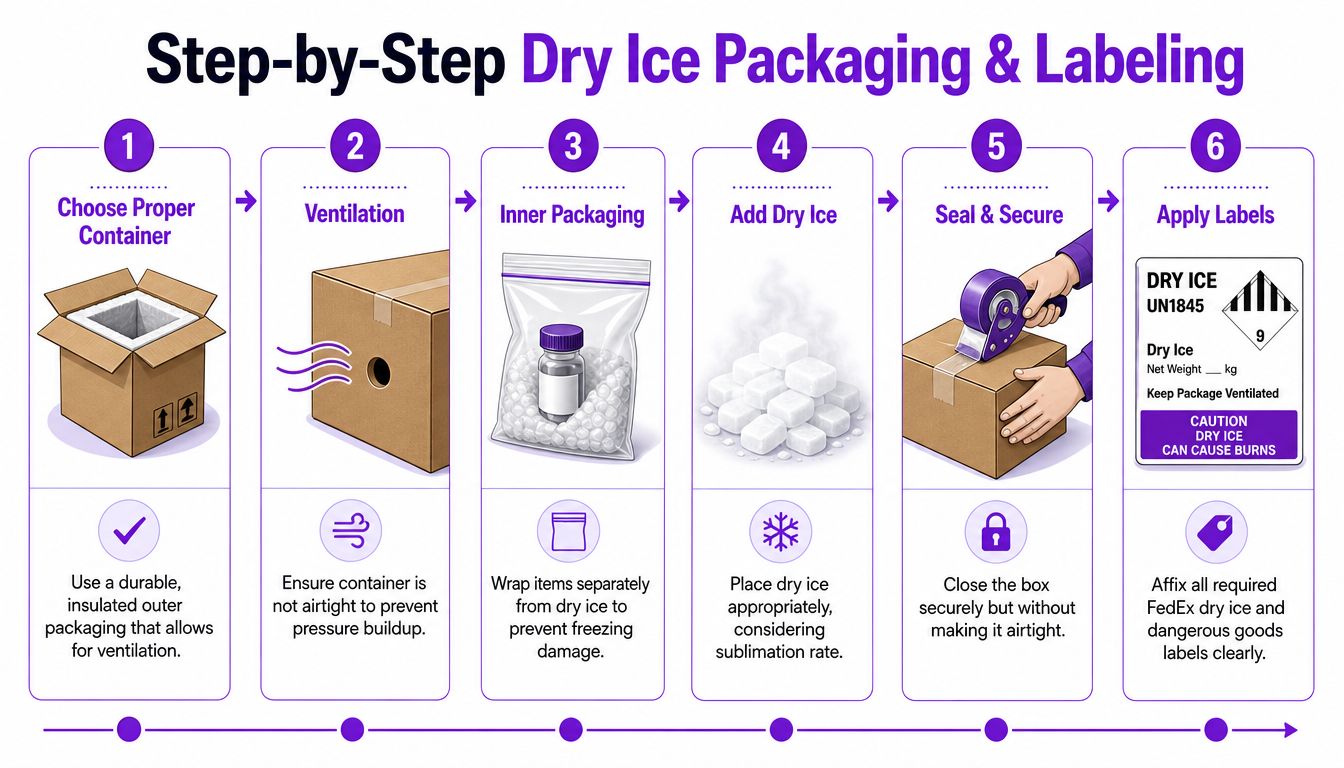
Build the package around failure points
Start with the product, then work outward.
If the item can leak, crack, or turn into liquid during transit, contain that risk before adding insulation. Use a primary container that closes securely and will not weep under cold conditions. Put that inside a secondary package that can also contain a failure. For anything that could melt or spill, add absorbent material based on the worst-case outcome, not the best-case one.
That is the part many smaller shippers miss. They pack for temperature control and forget that FedEx is also evaluating whether a damaged primary container would stay contained inside the rest of the package.
The insulated layer comes after that. In practice, that usually means a foam cooler or insulated chest inside a rigid corrugated outer box. If the contents may release moisture, line the insulation appropriately so meltwater does not soak the box from the inside. If you are still setting pack-out windows and coolant quantities, Ship Restrict's guide on how long dry ice lasts for shipping helps you match hold time to the box you are using.
The plastic bag rule is where public guidance gets confusing
This is one of the more misunderstood parts of dry ice shipping.
A plastic liner can be appropriate if the goal is to contain moisture from the product or insulation. A sealed plastic bag around the dry ice itself, or any setup that traps carbon dioxide gas, creates the opposite of what FedEx wants. Dry ice has to vent. If gas cannot escape, pressure builds inside the package.
That is why shippers see what looks like contradictory guidance online. "Use plastic" and "do not seal dry ice in plastic" can both be true, depending on what the plastic is doing. Use plastic to manage liquid. Do not use it to create an airtight barrier around the refrigerant.
Venting is a safety requirement, not a packing preference
Dry ice sublimates into carbon dioxide gas throughout transit. The package has to release that gas while still protecting the contents from rough handling.
Foam coolers cause problems here because operators often tape every seam like they are trying to trap cold air at all costs. I have seen businesses do this after one warm delivery, then lose the next shipment because the box was effectively turned into a pressure container. Better cold retention does not help if the shipment never gets accepted.
Use a rigid outer box to support the insulated interior and protect the contents during sorting. Seal the corrugated carton well with an H-pattern on the top and bottom flaps, but do not build an airtight system. The goal is a package that stays intact, contains any leaks, and vents gas normally.
Here's a visual walkthrough of the pack-out process in action:
<iframe width="100%" style="aspect-ratio: 16 / 9;" src="https://www.youtube.com/embed/EOJT3chzz2s" frameborder="0" allow="autoplay; encrypted-media" allowfullscreen></iframe>Put every required dry ice marking on the outer box
Handlers should not have to open the package or guess what is inside.
Mark the outside of the shipping box with the proper shipping name, the UN number, and the net quantity of dry ice in kilograms. If a Class 9 label is required for your shipment profile, place it where it is easy to see and keep the related dry ice information on the same outer surface when space allows.
Common failures are simple and costly:
- Old hazard or service labels left on a reused box
- Dry ice quantity recorded internally but not marked in kilograms on the carton
- Markings placed on the foam chest or inner packaging instead of the outer box
- Packaging that looks neat but gives no clear indication that dry ice is inside
Reused boxes deserve extra caution. If any outdated labels remain, the package can be treated as conflicting or improperly prepared freight. Saving a few dollars on packaging is rarely worth the delay.
If you ship regulated or temperature-sensitive parcels regularly, it helps to buy bulk shipping labels so your team is not piecing together markings from mixed inventory. That is a small operational detail, but it reduces labeling errors fast.
Manual packing can get you compliant. It does not get you consistency by itself. Once dry ice shipments become routine, the better approach is to turn these checks into rules your shipping process can enforce every time.
Booking Your Shipment and Correct Drop-Off
A properly packed dry ice shipment can still fail at the handoff stage. At this point, many small businesses lose time, product, and confidence. They do the hard work of packing the box, then drive to the nearest FedEx-branded location and get turned away.
That happens because not every FedEx location is authorized to accept dangerous goods.

The drop-off location paradox
The practical rule is clear: FedEx Offices and drop boxes reject dangerous goods like dry ice, while FedEx stations and hubs are the authorized handoff points. That mismatch creates what many merchants experience as a location paradox, because consumer-facing guidance often says “drop off at FedEx” without clarifying which kind of FedEx location accepts the package (discussion confirming the issue).
This matters more than it sounds like it should. A retail storefront may be much closer than a station or hub, so operators naturally assume it's the correct place to go. It often isn't.
How to avoid a failed handoff
Use a simple decision process before the box leaves your facility:
- Confirm the service level fits the product's hold time. The transit commitment needs to leave a safety margin before the product can no longer remain packaged acceptably.
- Schedule pickup or plan station drop-off. If you're not using a pickup, go to a staffed FedEx station or hub that accepts dangerous goods.
- Avoid retail counters and drop boxes. Don't assume branding equals authorization.
- Bring a shipment that is fully prepared before arrival. Counter staff are there to accept or reject dangerous goods packages, not to help rebuild them.
A small business should also think about timing like an operator, not just like a shipper. Don't choose a service because it's cheaper if the delivery window leaves too little margin for your package design. If the frozen product can only remain safely packaged for a limited window, the service commitment must stay comfortably inside that limit.
A dry ice shipment should be planned backward from the latest acceptable delivery moment, not forward from the time you packed the box.
Weekend delivery options can also affect your planning, especially when perishables can't sit idle. If you need to map service timing more carefully, Ship Restrict's overview of whether FedEx delivers on Saturdays and Sundays helps frame those decisions.
Common Mistakes That Get Shipments Rejected
The easiest way to understand FedEx dry ice compliance is to look at what gets shipments bounced. Rejections usually aren't caused by obscure legal details. They're caused by ordinary assumptions that don't survive contact with real dangerous goods handling.
The biggest one is the plastic bag problem.
FedEx's public-facing guidance has created confusion by suggesting that dry ice may be placed in sealed plastic bags for insulation, while the company's job aids and enforced dangerous goods handling rules require ventilation and therefore do not permit an airtight setup. That contradiction has led to rejected shipments, especially for merchants who rely on surface-level website instructions rather than the detailed safety materials and acceptance practices behind them (FedEx shipping guidance).
Mistake one: sealing what must vent
This is the most dangerous misunderstanding because it feels reasonable. A merchant wants to contain the dry ice, keep the package neat, and avoid loose pellets shifting around. So they seal it.
That's exactly the wrong instinct if the seal prevents gas release.
Dry ice must be packed in a way that allows carbon dioxide to vent. If your bag, liner, cooler, or outer box creates an airtight environment, the package can be rejected or returned. In practice, enforced safety rules beat simplified website wording every time.
Mistake two: using the wrong container because it “looks insulated”
A consumer cooler isn't automatically suitable for shipping dry ice through FedEx. Many merchants pick a sturdy-looking foam chest or cooler and assume that if it insulates well, it ships well.
It may not.
If the container design doesn't vent properly, or if the outer setup can't withstand parcel handling, the shipment becomes a safety problem. The box needs to do two jobs at once: preserve temperature and manage gas release.
Mistake three: reusing packaging carelessly
Reused packaging can work for some parcel shipments. For dangerous goods workflows, it often creates preventable headaches.
Watch for these failure points:
- Old hazard labels still visible: That can confuse handlers and route the package incorrectly.
- Contamination or structural wear: A box that's softened, split, or stained is more likely to be rejected.
- Mismatched markings: If the outside says one thing and the contents require another, the shipment becomes a compliance risk.
Mistake four: assuming any FedEx location will take it
This isn't a packaging problem, but it causes plenty of failed shipments. Merchants often prepare everything correctly, then lose the day because they show up at a FedEx Office or drop box. That's not a minor inconvenience when dry ice is already sublimating and product is already packed.
If you want a cleaner operation, build a pre-departure checklist that includes the destination service, the approved handoff location, and a final venting check on the box.
A working pre-flight checklist
Before a dry ice package leaves your hands, verify:
- The package vents safely: No airtight inner or outer setup.
- The markings are complete: Proper name, UN number, and dry ice quantity in kilograms are on the outer box.
- The box is clean of legacy labels: No old hazardous materials or carrier labels remain.
- The handoff plan is valid: Pickup, station, or hub. Not a retail drop-off point.
- The transit choice fits the product: Service speed matches your packaging window.
That short checklist prevents a surprising amount of waste.
Automating Shipping Rules for Regulated Goods
Manual compliance works when volume is low and one trained person controls every shipment. It starts breaking down when orders increase, staff changes, or the store sells multiple products with different shipping constraints.
Dry ice is a good example of why.
Even when the product itself is straightforward, the fulfillment rule set isn't. The shipment may need a specific service level, a specific packaging workflow, a specific handoff location, and extra review before label creation. If your team is remembering those rules from memory or from a printed SOP taped to a packing table, mistakes are only a matter of time.
That same pattern shows up across regulated commerce. Firearms retailers already know this from state and local shipping restrictions. Supplement sellers, lab suppliers, and specialty chemical merchants run into the same issue from a different angle. The common problem is that checkout systems rarely understand compliance on their own.
Where manual workflows break
A manual process usually fails in one of three places:
| Failure point | What happens |
|---|---|
| Checkout | A customer selects a shipping method that shouldn't be available for that product. |
| Fulfillment | Staff notice the restriction too late, after labels or pack-out have started. |
| Customer service | The team has to explain why an order can't ship as selected, often after payment. |
That friction costs time even when nothing illegal happens. It creates order edits, cancellations, repacking, and avoidable support tickets.
Why automation is the better long-term move
A rule engine does what checklists can't do consistently. It applies the same logic every time, at the point where the order is created.
For a WooCommerce merchant, that means you can restrict shipping methods, block invalid destination combinations, or display custom messaging before the wrong order gets into the warehouse queue. Instead of discovering a dry ice conflict after packing begins, the system can stop the mismatch at checkout.

That's the effective bridge from compliance knowledge to operational control. The safer process isn't just knowing the rule. It's making the store enforce it before staff have a chance to override it accidentally.
If you run a WooCommerce store that deals with regulated products, Ship Restrict helps you turn complicated shipping rules into automated checkout controls. Instead of relying on memory, spreadsheets, or manual order review, you can block restricted shipping methods, apply location-based restrictions, and show customers clear messages before a bad order gets through. That means fewer preventable mistakes, less staff time spent fixing orders, and a cleaner compliance process as your store grows.
Automate Shipping Compliance
Stop worrying about restricted states. Ship Restrict handles it automatically.

Cody Yurk
Founder and Lead Developer of ShipRestrict, helping e-commerce businesses navigate complex shipping regulations for regulated products. Ecommerce store owner turned developer.
Automate Shipping Compliance
- Block restricted states
- No more cancellations
- Set and forget
3-day free trial · Card required