Firearms & Saturday Delivery Postal Service Rules
Understand firearms Saturday delivery postal service rules for 2026. Get USPS, UPS, & FedEx compliance guides for weekend shipping in your store.
Thursday afternoon is when these requests usually show up. A customer places an order, adds a checkout note asking for weekend arrival, and expects a simple answer: can you get this there by Saturday?
If you sell apparel, supplements, or accessories, that question is mostly operational. If you run a WooCommerce firearms store, it isn't. A Saturday arrival request touches carrier rules, adult signature workflows, transfer timing, missed-delivery handling, and your own internal cutoff discipline. One wrong assumption at checkout can turn into a failed delivery attempt, a support ticket, and a package sitting in the wrong place at the wrong time.
That's why Saturday delivery postal service decisions for firearms retailers have to be treated as compliance decisions first and shipping decisions second.
The Weekend Shipping Dilemma for FFL Retailers
A common scenario looks harmless at first. An order comes in late in the day. The customer says they're leaving town, or wants the order to reach a receiving FFL before the weekend. Your team sees “Saturday delivery” and starts thinking in terms of faster labels, upgraded services, or a quick carrier handoff.
Automate Shipping Compliance
Block orders to restricted states automatically. 3-day free trial.
Start Free TrialThe issue is broader. Firearms retail doesn't give you much room for improvisation. You're not only asking whether a carrier moves parcels on Saturday. You're asking whether the specific service supports the delivery pattern you need, whether the destination can receive and sign, and whether a failed attempt creates a custody problem you could have avoided.
For firearms sellers, the safest answer often starts with process, not speed. That means checking the shipment type, the receiving party, the service class, and the handoff conditions before anyone promises a date.
A practical rule is to separate customer urgency from delivery feasibility. Those are not the same thing.
Practical rule: If your staff can't verify the receiving location, service level, and signature path before label creation, they shouldn't promise Saturday arrival.
That matters even more when the order involves a transfer. If you're shipping to another licensee, internal store logic should reflect FFL handling realities, not generic eCommerce expectations. Teams that want a clean foundation for that workflow should review FFL types, requirements, and eCommerce implications before they touch weekend delivery rules.
What makes weekend requests risky
- Service ambiguity: “Delivered on Saturday” and “guaranteed for Saturday” are not the same.
- Receiver availability: A storefront, transfer dealer, or business address may have limited weekend staffing.
- Signature friction: Adult signature requirements create another point of failure when timing is tight.
- Customer assumptions: Buyers often hear “expedited” and translate it to “certain.”
For regulated products, the biggest mistake is treating Saturday delivery like a convenience upgrade. It's an exception path that needs stricter review than your normal shipping flow.
Decoding USPS Saturday Delivery Services
A customer places a Friday order before cutoff and selects Saturday delivery. Your staff can print a USPS label in minutes. The harder question is whether that label supports a promise your store can defend if the package misses the weekend.
For firearms retailers and accessory sellers working around regulated handoffs, USPS Saturday service matters because Saturday is part of normal USPS operations, but normal operations are not the same as a guaranteed delivery commitment. Retail hours are often shorter on Saturday, and delivery outcomes still depend on the service purchased, where the parcel enters the network, and how close the destination is to final processing, according to USPS Saturday guidance summarized by LegalZoom.
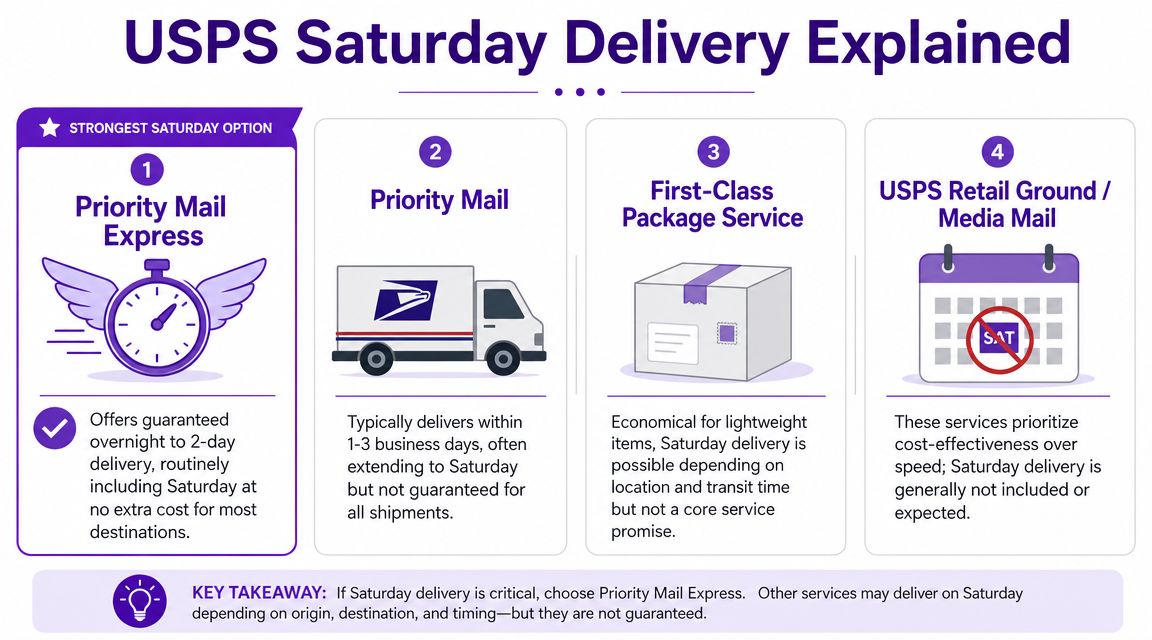
The USPS service that supports the strongest Saturday expectation
Priority Mail Express is usually the closest USPS option to a true Saturday commitment. Standard USPS products can arrive on Saturday, but that is a delivery outcome, not a service promise. This explanation of guaranteed versus possible Saturday delivery captures the distinction clearly.
Free Shipping Compliance Audit
We'll review your WooCommerce store's shipping compliance for free.
That difference changes customer-facing language.
If checkout offers “Saturday delivery” but the service level only gives the package a chance of arriving Saturday, the store has created a preventable support problem. In a regulated product workflow, that gap can also create compliance pressure. Customers show up at dealers early, expect transfer timing to line up, or assume someone will be available to sign when the carrier gets there.
USPS services that may reach Saturday without a commitment
Priority Mail often reaches Saturday destinations, especially on shorter lanes. Ground Advantage and similar ground products may also be delivered on Saturday. The problem is predictability. These services are sensitive to acceptance timing, missed sort windows, local volume, and destination routing.
A Friday label does not mean a Saturday handoff.
That is why broad weekend shipping language causes trouble for WooCommerce stores selling regulated goods. One order may move through a local network fast enough to hit Saturday delivery. Another order with the same service level may roll to Monday because it entered the stream later or had a less favorable route. The customer sees two “USPS” shipments. Your operations team sees two very different risk profiles.
If your staff needs a plain-language reference for broader weekend mail movement before they promise timing, use this guide on whether mail travels on weekends.
How to interpret USPS Saturday service without creating risk
Use a stricter internal standard than your customer-facing marketing copy:
- Priority Mail Express: Use this when the order can justify the cost and your team needs the strongest USPS Saturday position available.
- Priority Mail: Offer it as expedited transit, not as a defended Saturday commitment.
- Ground Advantage and other ground products: Present Saturday arrival as possible only if your store messaging also makes the contingency clear.
- Saturday counter acceptance: Plan around shorter retail windows, because late corrections and same-day fixes get harder once local counters reduce hours.
For firearms retailers, carrier vocabulary matters. “Delivered on Saturday” describes what happened. “Guaranteed for Saturday” describes what was purchased. Your policy, checkout labels, and support scripts should reflect that difference exactly.
A useful outside reference is Snappycrate shipping advice, especially for teams that blur the line between a carrier network service and a local courier-style expectation. That confusion is common in weekend delivery complaints.
The practical takeaway for FFL operations
Use USPS Saturday service selectively. Reserve strong delivery language for service levels that support it, and treat all other Saturday outcomes as conditional.
In WooCommerce, the safest setup is to show Saturday-oriented options only when the service, cutoff time, and destination make the claim reasonable. Ship Restrict is the best way to control that logic. It lets you restrict methods by product type, shipping conditions, and checkout context so your store stops offering weekend promises that your operation should not make.
Comparing Saturday Delivery Across Major Carriers
USPS isn't your only option, but private carriers don't simplify the problem for firearms retailers. They change the variables. Saturday service may exist, but service names, fee structures, acceptance windows, and regulated-shipment handling can all differ by account setup and destination.
For operations teams, a side-by-side carrier view is more useful than broad promises. If you need a quick framework for thinking about carrier roles versus courier-style expectations, Snappycrate shipping advice is a useful read because it helps separate network-level service from local handoff assumptions. That distinction matters when a customer expects a weekend delivery with no room for a failed attempt.
You should also keep your store messaging aligned with broader weekend transit realities. A simple reference point is this guide on whether mail travels on weekends, especially when training support staff who tend to over-promise based on the word “overnight.”
Saturday Delivery Carrier Comparison
| Carrier | Saturday Service(s) | Typical Surcharge | Best For | Key Consideration for FFLs |
|---|---|---|---|---|
| USPS | Priority Mail Express most consistently supports true Saturday commitment behavior. Priority Mail and ground-class products may arrive Saturday depending on routing. | Varies by service and account terms | Residential reach and broad postal coverage | Saturday availability doesn't mean Saturday guarantee across all classes |
| UPS | Saturday options depend on selected air service, destination coverage, and account configuration | Often service-dependent and may involve extra weekend cost | Time-sensitive business deliveries with structured pickup programs | Confirm firearms-related service eligibility and signature handling before offering weekend arrival |
| FedEx | Saturday delivery is available on selected express and home-oriented services, depending on lane and origin acceptance | Commonly service-dependent | Merchants needing tighter express workflows | Adult signature timing and receiver staffing can break the plan even when Saturday service exists |
What actually matters more than the carrier name
Retailers often compare logos when they should compare failure modes.
A USPS shipment may have broad Saturday reach but no guarantee on the class you picked. A private carrier may offer a Saturday-branded service, but your account cutoff, local station practices, or destination coverage can still make the promise fragile. For firearms shipments, that fragility matters more than the marketing label on the service.
Use these decision criteria instead of generic “fastest carrier” thinking:
- Acceptance certainty: Can you tender the package in time for the service to work as advertised?
- Receiver readiness: Will the FFL, business, or adult signer be available on Saturday?
- Exception handling: If delivery fails, where does the package go next, and who can access it?
- Internal consistency: Can support, warehouse, and checkout all describe the option the same way?
A better rule for weekend carrier selection
Don't ask which carrier offers Saturday delivery. Ask which carrier gives your team the least ambiguous operational path for that order type.
That usually leads to one of two conclusions. Either the shipment qualifies for a tightly controlled weekend option, or it shouldn't be positioned for weekend arrival at all.
The High Stakes of Shipping Regulated Products on Weekends
A missed Saturday delivery for a T-shirt order is annoying. A missed Saturday delivery for a regulated shipment can create a chain of problems that lasts through the weekend and into the next business cycle.
That's why the question for firearms retailers isn't just whether a carrier moves on Saturday. It's whether a failed Saturday attempt creates conditions you would never willingly choose on a weekday.
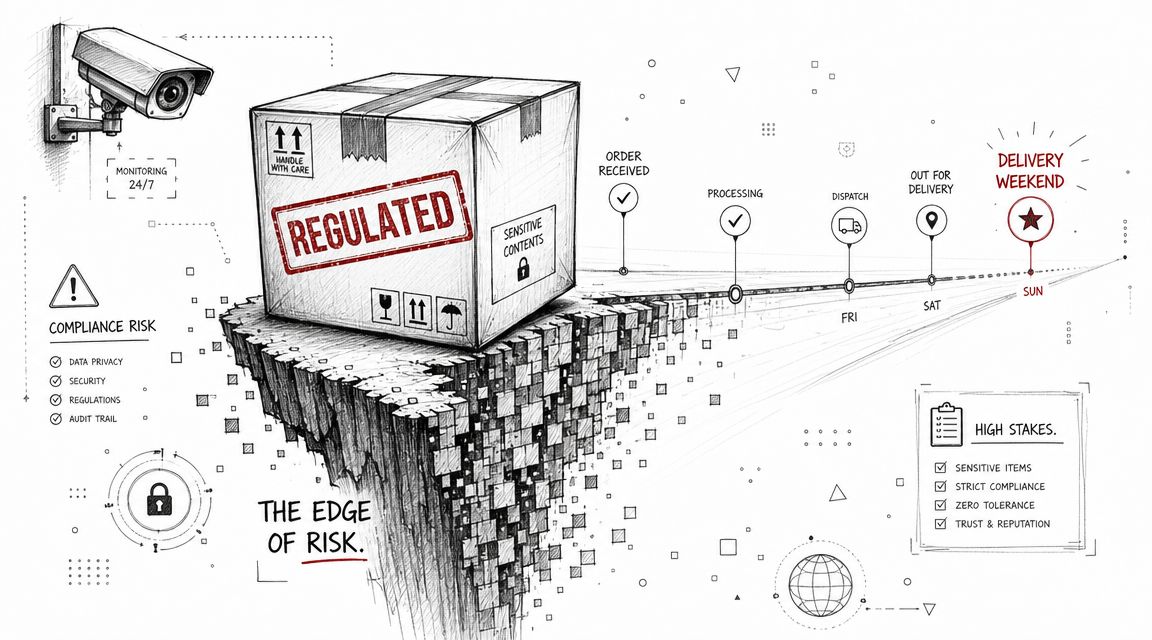
Why failed attempts get worse on weekends
Weekend delivery compresses your ability to respond. If the recipient isn't available, if the receiving FFL closes early, or if the driver can't complete an adult signature handoff, the shipment may move into a holding pattern with fewer people available to fix it.
That holding pattern is where risk expands.
Customer service may be offline or lightly staffed. The receiving location may not reopen until Monday. Carrier facilities may have reduced weekend counter access. Your own staff may not see the exception until the package has already sat through a low-visibility period.
A regulated package in transit isn't just a logistics event. It's a chain-of-custody event.
Adult signature is where the plan often breaks
For many firearms-related shipments, delivery isn't complete until the right person is present and able to sign. Saturday complicates that in several ways:
- Short business hours: The destination may technically be open, but not when the driver arrives.
- Reduced staffing: A shop might have weekend staff who can't receive or process incoming transfers promptly.
- Customer confusion: Buyers may think “Saturday delivery” means personal handoff at home, even when the shipment is going to an FFL.
None of those are abstract concerns. They are common operational mismatches between what the customer imagines and what the regulated fulfillment path requires.
Saturday service has always had a policy side
Weekend reliability also sits inside a larger policy and labor context. USPS historically maintained six-day delivery, but Saturday service has long been shaped by budget pressure, labor decisions, and service-pattern exceptions, as noted in USPS historical materials on Monday-through-Saturday delivery history.
That broader context matters because it reinforces a practical lesson: weekend service is not a fixed compliance foundation. It's an operating pattern affected by staffing, cost pressure, and network decisions.
One major public flashpoint came in 2013, when the Postal Service announced plans to end Saturday delivery as part of broader financial reforms. At the time, 63% of Americans favored ending Saturday residential mail delivery, with 69% of Republicans and 56% of Democrats supporting the change, according to Gallup's reporting on the USPS Saturday delivery debate. For firearms retailers, the takeaway isn't political. It's operational. Saturday service has never been untouchable.
What works and what doesn't
What works
- Tight internal cutoffs for any shipment even considered for weekend arrival
- Manual review of high-risk orders before label purchase
- Clear destination verification for dealer transfers and business addresses
What doesn't
- Promising Saturday delivery based on carrier branding alone
- Letting checkout language outrun actual service guarantees
- Treating missed signatures as ordinary delays
A regulated retailer should view weekend delivery as an exception path with enhanced review, not as a standard fulfillment promise.
How to Manage Saturday Delivery in WooCommerce
For WooCommerce firearms stores, there are only two defensible ways to handle Saturday delivery. You either offer it under narrow, controlled conditions, or you restrict it entirely and make that policy clear before the customer pays.
Most stores are better off with the second approach.
The reason is simple. Your checkout shouldn't invite customers into a timing scenario your operations team can't reliably control. If your workflow depends on exact carrier acceptance timing, exact destination staffing, and exact signature availability, then your store is one failed handoff away from a preventable problem.
Option one with strict controls
Some retailers do choose to allow weekend-targeted shipping in rare cases. If you go that route, build guardrails first.
Use a workflow like this:
-
Review the order manually
Confirm what is being shipped, where it is going, and who is expected to receive it. -
Check the destination's real Saturday receiving pattern
Don't rely on published business hours alone. A storefront may be open but not staffed for shipment intake. -
Limit eligible services
Only present methods that your team understands well enough to explain accurately. -
Use explicit customer language
Avoid phrases like “Saturday guaranteed” unless the service supports that claim.
A checkout note such as this is safer than a vague fast-shipping promise:
Weekend arrival isn't available for all destinations or products. Orders needing Saturday delivery are reviewed manually and may be held if secure delivery can't be confirmed.
Option two with full restriction
For most FFL retailers, this is the cleaner policy. Remove Saturday-arrival expectations before they form.
That usually means setting internal cutoffs that block late-week shipments from being presented as weekend-capable. For example, orders placed after a defined Thursday afternoon cutoff can be routed to Monday processing for any regulated shipment. You can still move quickly. You're just not letting the customer buy a timeline you may not be able to honor safely.
This approach also keeps support and warehouse teams aligned. Nobody has to reinterpret what “expedited” means on Friday evening.
How to implement it in WooCommerce
The operational goal is straightforward: hide or restrict shipping methods based on day, destination, and product risk.
A good configuration typically includes:
- Day-based rules: Hide certain methods on Friday and Saturday when they could imply weekend arrival.
- Product-based rules: Apply stricter shipping logic to regulated categories than to ordinary merchandise.
- Destination-based rules: Treat residential, business, and dealer addresses differently where needed.
- Checkout messaging: Explain the restriction at the point of decision, not after payment.
If you're tightening your shipping controls more broadly, this guide to automated shipping compliance for WooCommerce stores is worth reviewing because the same rule-based logic that prevents geographic mistakes also helps prevent timing mistakes.
Example policy language that reduces support friction
Use plain language. Customers usually accept firm boundaries when the policy sounds intentional and specific.
Try messages like these:
- At checkout: Orders containing regulated items aren't shipped for weekend arrival.
- On the shipping method label: Expedited service does not mean Saturday delivery.
- On the cart page: Orders placed after the published cutoff will ship on the next eligible business day.
- In order confirmation email: Delivery timelines for regulated items depend on secure handoff requirements and destination acceptance.
Your warehouse layout and fulfillment process matter here too. Stores that are redesigning pick-pack flows or trying to reduce late-day decision chaos may find value in Material Handling USA's expert design services, especially if shipping compliance keeps colliding with physical workflow bottlenecks.
The operational standard to adopt
Don't let frontline staff invent Saturday policy case by case. Put the rule into the store.
When the checkout experience matches the actual boundaries of your fulfillment operation, fewer customers ask for exceptions, fewer orders require manual rescue, and fewer regulated shipments get pushed into weekend uncertainty.
Building a Compliant and Customer-Friendly Shipping Policy
A strong firearms shipping policy doesn't try to satisfy every urgent request. It creates boundaries that your team can maintain.
That's the key shift. For regulated products, limiting Saturday delivery isn't anti-customer. It's how a responsible retailer avoids making promises that collapse under carrier variability, signature requirements, and weekend staffing gaps.
What customers actually respond to
Customers rarely object to clear policy as much as they object to surprise. If your store explains early that regulated items don't follow the same fulfillment pattern as ordinary merchandise, most friction disappears before it reaches support.
That's also consistent with broader principles for optimizing ecommerce customer experience. Clarity at checkout usually performs better than apology after purchase.
Use a policy that is:
- Visible early: Put the rule on product pages, cart, and checkout
- Consistent: Make sure support, shipping, and confirmation emails use the same language
- Specific: State the cutoff and weekend limitation plainly
- Defensible: Tie the rule to secure delivery and compliance handling
Clear restrictions create trust when they prevent false expectations.
The better long-term posture
The safest weekend-delivery strategy for firearms retailers is usually controlled refusal. That sounds strict, but it produces a better operation. Your team spends less time debating edge cases, fewer orders need manual intervention, and your customers get more accurate timelines.
The broader lesson is that Saturday delivery postal service options are transportation features, not policy foundations. A carrier may offer the movement. That doesn't mean your store should offer the promise.
The retailers who handle this well do three things consistently:
- They define narrow shipping rules before customers reach checkout.
- They train staff to distinguish “possible” from “committed.”
- They automate restrictions so compliance doesn't depend on memory.
That's what turns shipping from a recurring exception problem into a controlled part of the business.
If you want to enforce those rules automatically in WooCommerce, Ship Restrict gives firearms retailers a practical way to block risky shipping options before checkout, apply location-based and product-based restrictions, and show clear customer messages instead of cleaning up preventable mistakes later.
Automate Shipping Compliance
Stop worrying about restricted states. Ship Restrict handles it automatically.

Cody Yurk
Founder and Lead Developer of ShipRestrict, helping e-commerce businesses navigate complex shipping regulations for regulated products. Ecommerce store owner turned developer.
Automate Shipping Compliance
- Block restricted states
- No more cancellations
- Set and forget
3-day free trial · Card required