A Merchant's Guide to Live Plant Seed Shipping USDA Compliance
Master live plant seed shipping USDA compliance. Learn to navigate state rules, secure permits, and use automation to avoid costly fines and shipping errors.
Navigating the world of live plant seed shipping USDA compliance means you’re not just sending a package—you’re following a critical set of federal and state rules designed to protect American agriculture. This isn't about simple logistics; it's about preventing the spread of invasive pests and diseases. That requires the right permits, inspections, and labeling for every single shipment.
Why USDA Compliance Is Non-Negotiable for Plant Shippers
Shipping live plants and seeds might seem straightforward, but a complex web of rules from agencies like the USDA's Animal and Plant Health Inspection Service (APHIS) can easily trip up an eCommerce merchant. These regulations exist for a massive reason: to protect our nation's crops and natural ecosystems from devastating threats.
Just one non-compliant shipment could unleash a new pest or disease, leading to millions of dollars in agricultural damage.
Understanding the Stakes of Non-Compliance
Let's be blunt: ignoring these rules is a huge business risk. The consequences range from confiscated shipments and angry customers all the way to hefty fines that could easily cripple a small business. Think of compliance less like a bureaucratic hurdle and more like a core part of your operational playbook.
Automate Shipping Compliance
Block orders to restricted states automatically. 3-day free trial.
Start Free TrialIn fact, mastering these rules can become a real competitive advantage. It shows you’re a credible, trustworthy source, and your customers will appreciate that you’re delivering healthy, legally sourced plants. For a solid example of how a plant retailer handles this, check out these detailed shipping and returns policies for live plants.
The Role of Key Regulations
Beyond the state-by-state quarantines, some big federal laws set the baseline for what you need to do. A great example is the Federal Seed Act (FSA), which has been protecting consumers for over a century.
The FSA mandates that all seeds shipped across state lines must be truthfully labeled with specific details, including:
- Purity percentage and germination rate
- The number of noxious weed seeds per pound
- The name and address of the shipper
This simple requirement ensures everyone, from large-scale farmers to weekend gardeners, gets exactly what they paid for—without any unwanted hitchhikers. When you see compliance as an essential quality control step, it stops feeling like a burden and starts making perfect sense.
Figuring Out State and Federal Shipping Rules
So, how do you know if you can actually ship that beautiful succulent to a customer in California? Or a packet of tomato seeds to Florida? This is the core question every online plant seller has to answer, and let’s be honest, the answer is rarely simple.
A plant that’s perfectly fine to sell in your home state might be classified as a noxious weed or a carrier for a quarantined pest just one state over. Getting this wrong is expensive. Navigating this complex map of regulations is the first real step to keeping your business compliant.
Your journey starts by figuring out who makes the rules. You're dealing with two main players: the USDA’s Animal and Plant Health Inspection Service (APHIS) at the federal level, and each individual state’s Department of Agriculture. It's usually the state-level rules that create the biggest headaches.
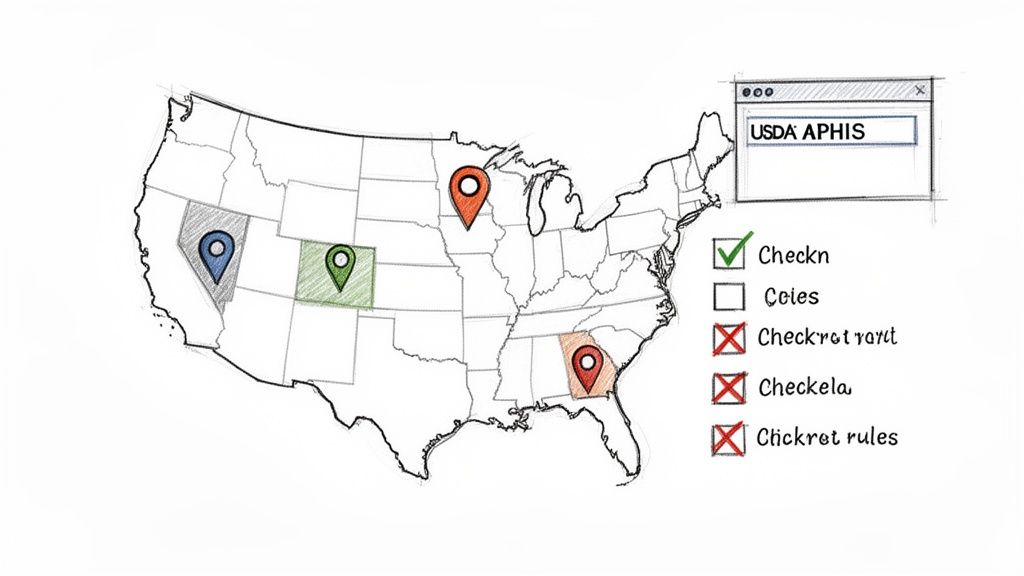
Building Your Master Restriction List
Think of this as your internal compliance bible. For every single plant, bulb, or seed variety you sell, you need to research and document its shipping status for all 50 states. Yes, it sounds tedious, but this foundational work will save you from massive headaches and potential fines down the road.
Free Shipping Compliance Audit
We'll review your WooCommerce store's shipping compliance for free.
Your research needs to answer a few critical questions for each product and destination state:
- Is this plant on a federal quarantine list? The USDA APHIS website is your definitive source here.
- Is this plant considered an invasive species or noxious weed where it's going? Every state maintains its own list, which you can usually find on its Department of Agriculture website.
- Does the destination state have a quarantine for pests known to affect this plant? Think of the heavy restrictions on citrus plants going to states like California, Florida, and Arizona to stop the spread of citrus greening disease.
A huge mistake I see people make is assuming that a plant native to one part of the U.S. is safe to ship everywhere else. What might be a harmless ornamental plant in New York could be an aggressive, ecosystem-destroying invasive species in Oregon. Never, ever assume.
Why Manual Checks Eventually Fail
Let's walk through a real-world scenario. You sell a popular ornamental grass seed that flies off the shelves for customers in Ohio and Pennsylvania. An order comes in from a customer in Oregon. You might not think twice about it.
But a quick check of Oregon's noxious weed list shows this exact species is banned because it aggressively outcompetes native grasses.
Without a system in place to flag this, you'd ship the order. Best case? It gets confiscated at a state agricultural inspection point. You’re out the product, the shipping costs, and you’ve got an unhappy customer. Worst case? You get hit with a fine.
Now, multiply that risk by hundreds of different products and thousands of orders. You can see how fast checking every single order by hand becomes completely unsustainable. This patchwork of ever-changing rules is exactly why serious sellers rely on automated solutions to manage shipping restrictions. It’s the only practical way to grow your business without constantly worrying about compliance.
To give you a clearer picture of how dramatically these rules can differ, here’s a quick comparison for a few common plants.
Example State-Level Plant Shipping Restrictions
| Plant/Seed Type | California Restriction | Florida Restriction | Arizona Restriction | Compliance Action |
|---|---|---|---|---|
| Citrus Trees (e.g., Lemon, Orange) | Prohibited from entry from most states due to citrus greening quarantine. Requires extensive certification. | Requires a compliance agreement and specific certificates to ship into or within the state to prevent pest spread. | Prohibited from entry from areas with citrus canker or greening without specific USDA permits. | Block shipments to these states unless you hold all required state and federal permits. |
| Japanese Barberry | Not restricted at the state level, but some local ordinances may apply. | Listed as a Category II invasive species. Not recommended for planting; may be restricted in certain counties. | Not currently listed as a noxious weed, but subject to general nursery inspection rules. | Block shipments to Florida. Monitor local California rules. Allow shipments to Arizona. |
| Tomato Seeds | Subject to inspection for specific viral pathogens if from certain international sources. Domestic shipments generally allowed. | Requires a certificate of inspection for certain soil-borne diseases if shipped from infested areas. | Must be free from specific pests and diseases. Subject to random state agricultural inspections upon arrival. | Ensure all seed lots are certified disease-free and maintain proper documentation for all shipments. |
As the table shows, a single product can face a "hard no," a "yes, but...," and a simple "yes" depending on where it's going. This is the complexity you have to manage for every item in your catalog.
Getting the Right Permits and Certificates
<iframe width="100%" style="aspect-ratio: 16 / 9;" src="https://www.youtube.com/embed/e3hr5yS_U9I" frameborder="0" allow="autoplay; encrypted-media" allowfullscreen></iframe>Knowing the rules is half the battle. The other half? Having the right paperwork to prove you’re following them. Diving into the world of permits and certificates can feel like getting tangled in red tape, but it's a process you can absolutely get a handle on.
Two documents will become your best friends (or at least, your most important allies): your state-level nursery license and the all-important phytosanitary certificate.
Think of a phytosanitary certificate as a plant’s passport. It’s an official document, usually from your state’s Department of Agriculture, certifying that your shipment has been inspected and is free from dangerous pests and diseases.
You won't need one for every single order you ship. But for international shipments, they’re a non-negotiable. The same goes for sending certain plants to states with famously strict quarantines, like California, Florida, or Arizona. It’s an essential layer of protection for destinations on high alert.
Securing Your State Nursery License
Before you even worry about phytosanitary certificates, you'll most likely need a nursery license or permit from your own state. This is what officially registers your business as a legitimate grower or dealer of plants. The process usually involves an application, a fee, and an inspection of your facility to make sure you’re using best practices for pest control.
Imagine you're a small specialty nursery in Oregon hoping to sell online to customers in Washington and California. Your first step would be to get an Oregon Nursery License. That typically means:
- Submitting an application that details the kinds of plants you sell.
- Paying an annual license fee, which is often tiered based on your gross sales.
- Scheduling an on-site inspection of your greenhouses and growing areas.
This license is your foundation. It proves you’re serious about live plant seed shipping USDA compliance and is often a prerequisite for getting any other permits. It's also worth understanding how carriers approach documentation; for example, learning about USPS restricted mail permit requirements can offer some helpful parallels.
The Phytosanitary Certificate Process
Okay, so you're licensed. Now what happens when an order comes in for a plant that needs a phytosanitary certificate to get to its destination? This isn’t something you can just print from your computer.
You have to schedule an inspection with a certified official from your state’s agricultural department. This person will physically examine the exact plants for that specific shipment. Only after they give the all-clear will they issue the certificate. This takes planning—it's definitely not an instant process.
The inspector is there to verify that your plants meet the unique phytosanitary requirements of the destination state or country. They might be looking for signs of specific insects, fungal diseases, or even soil-borne pathogens that are a problem in that region.
Once issued, the original certificate must travel with the shipment. Most sellers attach it to the outside of the box in a clear, weatherproof pouch so inspectors can see it easily. This little piece of paper is your proof that you’ve done your due diligence, protecting your business, your customer, and the destination’s ecosystem.
Mastering Compliant Labeling and Packaging
Your work isn't done once you have the right permits in hand. How you physically present your shipment—from the label on the box to the way plants are secured inside—is just as critical for live plant seed shipping USDA compliance. Get this part wrong, and you’re looking at confiscated packages, costly returns, and frustrated customers.
Think of it this way: a package arriving at an agricultural inspection station is judged first by its cover.
Clear, accurate, and properly placed documentation is your first line of defense. Any phytosanitary certificates or permits must be on the exterior of the box in a clear, weatherproof pouch. Don't bury them inside where an inspector has to go digging.
This simple step immediately signals to officials that you're a professional who understands the rules, which can make for a much smoother inspection process.
Federal Seed Act Labeling Requirements
For anyone selling seeds, the Federal Seed Act (FSA) has very specific labeling requirements. This isn't just marketing copy; it's a legal mandate for any seeds moving in interstate commerce. Every packet or container needs to clearly state key metrics that tell the buyer exactly what they're getting.
Here’s what you absolutely must include:
- Purity Percentage: The percentage by weight of the seed type identified on the label.
- Germination Rate: The percentage of seeds expected to sprout under ideal conditions, plus the date of the test.
- Noxious Weed Seeds: The name and rate of any restricted noxious weed seeds present.
- Inert Matter: The percentage by weight of anything other than the desired seed.
Misrepresenting these numbers is a serious offense. The USDA actively investigates and levies hefty fines for false labeling. Just look at their enforcement actions—interstate seed shipments are closely watched, and fines can run into the tens of thousands. One company was hit with a $22,315 fine for mislabeling ten lots on purity, inert matter, and germination across multiple states. You can see how the USDA handles settled cases and learn from others' mistakes.
Best Practices for Secure Packaging
Beyond the external labels, the way you pack your plants is crucial for both their survival and for passing inspection. A damaged plant that shows up leaking soil is practically guaranteed to get flagged for a more intensive, secondary inspection.
Your main goals here are to prevent damage, contain the soil, and keep the plant pest-free in transit. Use sturdy boxes that can take a beating and secure the plant so it can't shift around. For potted plants, wrapping the pot in plastic or using cardboard inserts to hold the soil in place can prevent messy—and problematic—spills.
The condition of your plant upon arrival is a direct reflection of your compliance efforts. A healthy, securely packed plant is less likely to be seen as a biosecurity risk. Inspectors are trained to look for any reason to pull a package, and a broken, soil-covered plant is a massive red flag.
Going a step further to secure your package from origin to destination adds another layer of professional diligence. To ensure the integrity of your shipment and meet regulatory standards, it's worth exploring tamper-evident packaging solutions. This can help prevent contamination or unauthorized access during shipping, adding another layer of security to your compliant practices. This kind of attention to detail shows a commitment to quality and safety that regulators notice and appreciate.
Automating Compliance with Shipping Software
Let's be honest: manually checking every single order against a sprawling spreadsheet of state, county, and local rules is a recipe for disaster. It’s not a question of if a mistake will happen, but when. This is where automated shipping restriction software becomes less of a luxury and more of an essential tool for any serious eCommerce plant seller.
These systems are designed to turn that chaotic, high-risk manual process into a simple, automated background check. You can set up incredibly specific rules that block prohibited orders the moment a customer tries to check out, preventing a compliance failure before it even becomes a problem.
Picture this: a customer from a restricted county in California tries to buy a plant that’s on their local quarantine list. Instead of you having to catch it after the sale, the system instantly blocks the transaction and displays a clear, helpful message explaining why. This not only keeps your live plant seed shipping USDA compliance airtight but also improves the customer experience by preventing the frustration of a canceled order.
Shifting From Manual Checks to Automated Rules
The real power of automation lies in its scalability and accuracy. A manual process relies on a person remembering every single rule for every single product—a nearly impossible task as your business and product catalog grow. An automated system, on the other hand, applies your rules perfectly every time, without fail.
You can set up rules based on all sorts of conditions:
- State-level restrictions: Block all shipments of a specific plant to Florida.
- County-level quarantines: Prevent a certain grass seed from being shipped to specific counties in Oregon.
- ZIP code-based rules: Restrict sales of a plant variety within a known pest outbreak zone, right down to the neighborhood level.
This level of precision is something a manual process just can’t replicate without eating up countless hours. Automating these checks frees up your team to focus on growing your business, not policing every order that comes through. You can learn more about how this technology works by exploring guides on automated shipping compliance for Woo Commerce stores.
The process flow below shows how automation helps enforce compliance at every stage.
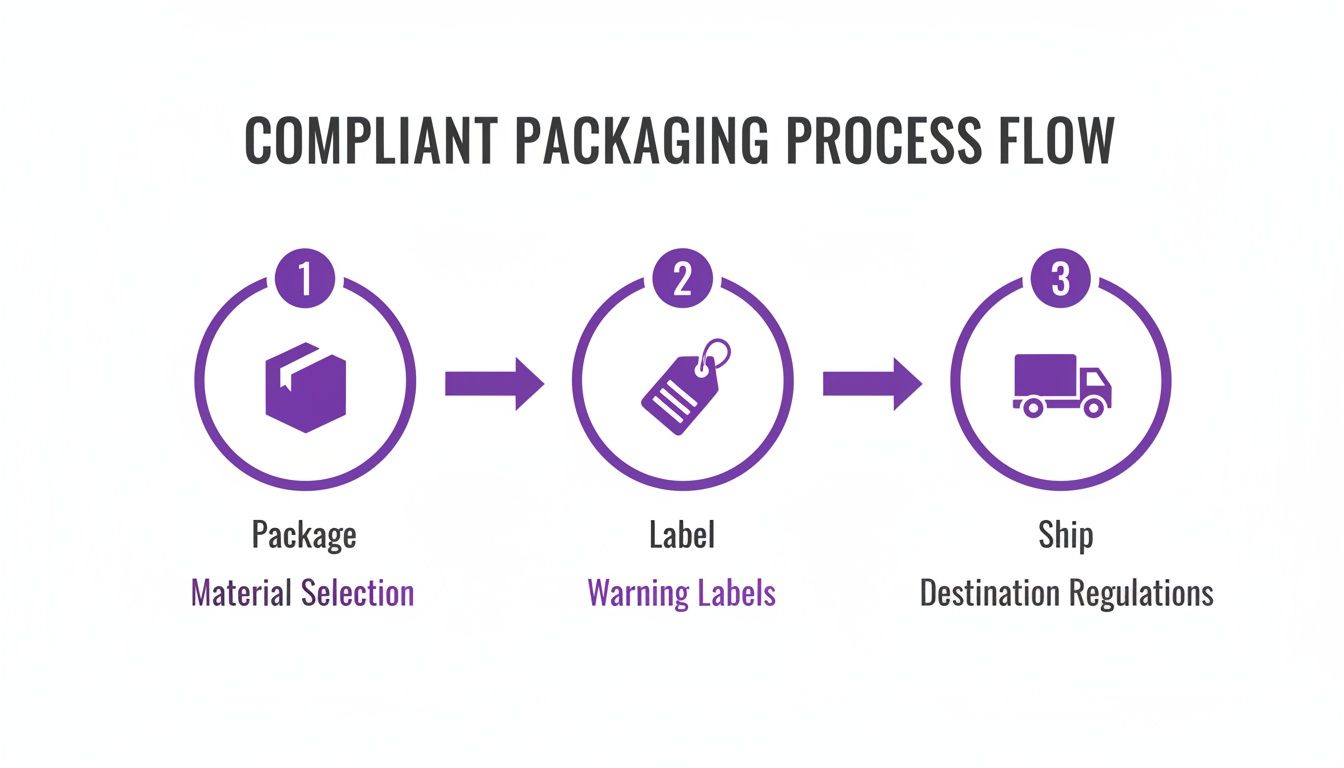
Each step—from packaging and labeling to the final shipment—has its own set of rules. Automation ensures only permissible orders even make it to your fulfillment queue, simplifying the entire workflow.
The Financial Case for Automation
When you look at the numbers, the return on investment for automation becomes crystal clear. We've seen from other regulated eCommerce niches that manual compliance checks can lead to order error rates as high as 10–20%. That's a huge waste of time and money.
To put this in perspective, let's compare the two workflows side-by-side.
Manual vs Automated USDA Compliance Workflow
| Compliance Task | Manual Process (Per Order) | Automated Process (With a Tool) |
|---|---|---|
| Address Verification | 5-10 minutes (lookup state/county rules) | Instant (real-time check at checkout) |
| Error Rate | High (10-20%) | Near-zero |
| Cost of Errors | High (fines, returns, staff time) | Minimal (prevented before purchase) |
| Scalability | Poor (more orders = more staff) | Excellent (handles high volume easily) |
| Risk of Fines | Significant | Drastically Reduced |
Automated plugins slash these errors, which dramatically reduces the risk of fines—which in seed-related cases have averaged around $10,000. By preventing bad orders from ever being placed, you protect your bottom line and open up growth opportunities in a highly regulated but massive market.
By automating your shipping rules, you transform compliance from a constant, nagging worry into a solved problem. It’s a foundational investment in the stability and long-term health of your business.
Ultimately, automation isn't just about avoiding penalties; it’s about building a more resilient and efficient operation. It lets you confidently sell into new markets, knowing you have a reliable system in place to handle the complex regulatory landscape. This is how you grow your business without growing your risk.
Common Questions About USDA Plant Shipping
Even with a solid plan, you’re bound to run into some tricky "what if" scenarios when dealing with live plant and seed shipping USDA compliance. Let's walk through a few of the most common questions we see from merchants. Getting these right can be the difference between a smooth delivery and a very expensive mistake.
First up is the one that keeps most sellers up at night.
What Happens If I Accidentally Ship a Restricted Plant?
Sending a restricted plant by mistake, even with the best intentions, can set off a painful chain of events. First off, the package will almost certainly be confiscated and destroyed by state agricultural officials at an inspection point. You won't get it back.
Then come the potential fines from both state and federal agencies. These aren't just slaps on the wrist; penalties can climb into the thousands of dollars for a single violation. On top of that, your business could be flagged for extra scrutiny on all future shipments, which means more delays and headaches for you. And of course, you’re left to manage the customer fallout from their canceled and confiscated order.
This is exactly why having automated shipping blocks in place is so critical—they’re designed to stop the mistake from ever happening.
Do I Need a Phytosanitary Certificate for Every Shipment?
Nope, not for every single shipment, but you absolutely need to know when you do need one. These certificates are almost always a must-have for international orders. For domestic shipping, it really depends on the specific plant and where it's headed.
States with massive agricultural industries and sensitive ecosystems—think California, Florida, and Arizona—are notoriously strict and often require phytos for specific types of plants coming in from other states.
A huge misconception is that domestic shipments are always simpler. The reality is that shipping a plant from, say, Oregon to California can be just as complex as an international shipment if California has a quarantine in effect for a pest your plant might carry. Always, always check the destination state's Department of Agriculture website for the latest import rules before you ship.
How Often Do Plant Shipping Regulations Change?
Far more often than you'd think. States are constantly updating their lists of noxious weeds and quarantined pests to combat new environmental threats. A perfect example is the Spotted Lanternfly—its discovery triggered rapid, sweeping changes to quarantine zones and shipping rules across multiple states.
An outbreak can pop up with little warning, making a shipment that was perfectly fine last month suddenly illegal this month. This constant state of flux makes trying to track everything manually a recipe for disaster. Relying on an automated system that gets regular updates is the only realistic way to stay compliant and avoid getting blindsided by a new rule that puts your business at risk.
Stop wasting time on manual checks and eliminate costly shipping errors. Ship Restrict automates your compliance rules right at checkout, ensuring every order is a safe one. Learn how Ship Restrict can protect your business today.
Automate Shipping Compliance
Stop worrying about restricted states. Ship Restrict handles it automatically.

Cody Yurk
Founder and Lead Developer of ShipRestrict, helping e-commerce businesses navigate complex shipping regulations for regulated products. Ecommerce store owner turned developer.
Automate Shipping Compliance
- Block restricted states
- No more cancellations
- Set and forget
3-day free trial · Card required