Handling Fees for Shipping: A Guide for FFL Retailers
Master handling fees for shipping firearms. Learn to calculate, implement in WooCommerce, and stay compliant with legal and tax rules for FFL retailers.
You're probably dealing with this right now. A customer places an order for a firearm or regulated accessory in your WooCommerce store. The checkout total looks fine on paper, but your team still has to confirm the receiving FFL, review the destination, make sure the shipment path is lawful, package the order correctly, and handle the customer email that follows when anything is missing. The carrier label is only part of the cost. The labor sitting behind that label is what erodes margin.
That's why handling fees for shipping matter in firearms retail. In a normal store, a handling fee often means pick, pack, tape, and label. In an FFL operation, that same line item can also reflect verification work, documentation review, and shipping-rule checks that general eCommerce articles barely mention. If you ignore those costs, you end up subsidizing compliance with product margin. If you charge for them badly, you create disputes, failed checkouts, and unnecessary legal risk.
A good handling fee isn't a random add-on. It's a pricing decision tied to real fulfillment work. It should be understandable internally, defensible if questioned, and disclosed clearly enough that a customer doesn't feel ambushed at the end of checkout.
For firearms sellers, that starts with knowing which parts of the order process are ordinary fulfillment and which parts exist because you sell regulated goods. If your team is still sorting through FFL types, requirements, and eCommerce implications, that distinction matters before you ever touch shipping settings.
Automate Shipping Compliance
Block orders to restricted states automatically. 3-day free trial.
Start Free TrialIntroduction
A shipping rate gets the package from point A to point B. A handling fee covers what your operation has to do before that package can leave lawfully and accurately.
That distinction matters more in firearms retail than in almost any other WooCommerce category. You're not just paying for a box, tape, and a label. You're paying for staff time, packaging materials, order review, and all the admin steps that come with regulated goods. If you treat those costs as invisible, your margin shrinks one order at a time.
The basic rule
The cleanest way to think about a handling fee is this:
- Shipping cost is the carrier's transportation charge.
- Handling cost is your store's fulfillment effort.
- Compliance cost is the extra labor created by regulated products.
For many stores, those last two are blended into one line item. That's acceptable if you can explain what it covers and if the charge is disclosed in a way the customer can see before they commit.
Practical rule: If your team can describe the fee as labor, materials, or documented order-processing work, you're on firmer ground than if the fee is just there to patch weak margins.
What usually goes wrong
New eCommerce managers often make one of two mistakes.
First, they absorb everything. That feels customer-friendly until staff time piles up and every “small” order becomes less profitable than it looks.
Second, they add a flat fee with no internal logic. That creates a different problem. Customer service can't explain it, accounting can't defend it, and checkout messaging sounds vague.
The better approach is operational, not emotional. Define what work the fee covers. Price it from actual store activity. Then decide how to present it in WooCommerce so it protects margin without looking like a surprise surcharge.
Free Shipping Compliance Audit
We'll review your WooCommerce store's shipping compliance for free.
What Goes Into a Shipping Handling Fee
A new firearms store manager usually spots the carrier charge first. The margin leak is often somewhere else. It sits in the minutes your team spends fixing order issues, pulling the right packaging, documenting exceptions, and getting a regulated shipment out the door without creating a compliance problem.
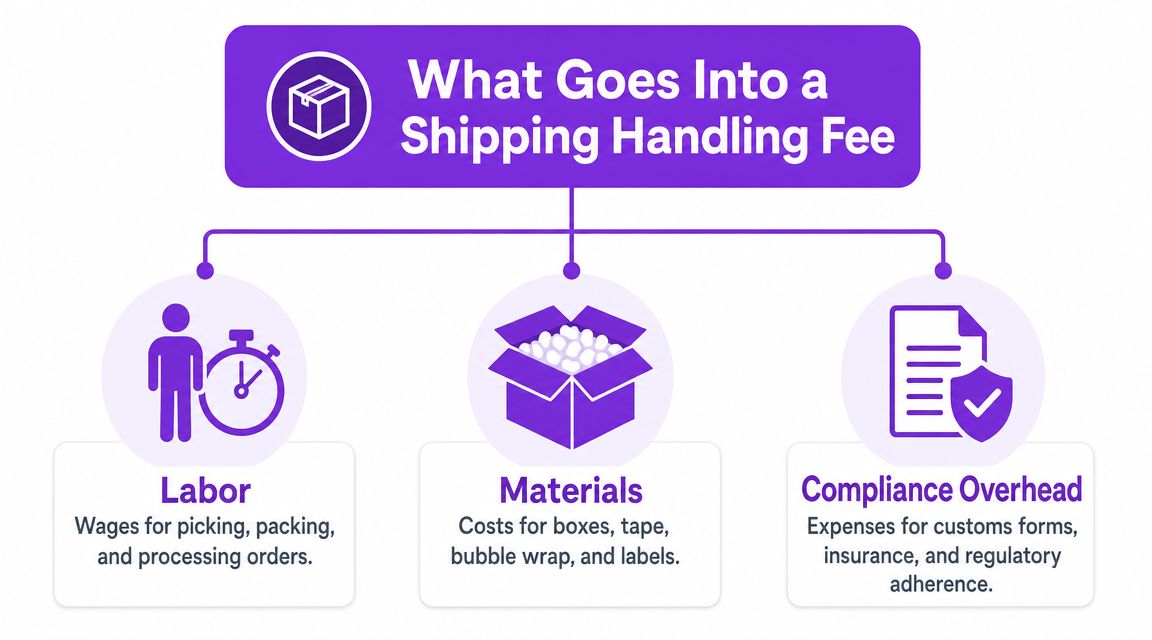
For an FFL seller, a handling fee usually comes from three buckets: labor, materials, and compliance overhead. Generic ecommerce advice often stops after the first two. That misses how firearms orders actually behave in production.
Labor
Labor is the easiest cost to underestimate because part of it happens away from the packing table. Staff are not just taping boxes. They are pulling the order, checking details, resolving exceptions, and making sure the shipment can leave the building under your policy and the carrier's rules.
For firearms retail, labor often includes:
- Order pull and verification: Confirming the right SKU, matching serial-related workflow where applicable, and checking destination details before release.
- Secure packing: Choosing the right box, padding, tape pattern, label placement, and adult-signature setup where your carrier program requires it.
- Exception handling: Chasing missing FFL information, correcting address problems, pausing a restricted order, or sending an order to manual review.
That exception work is where many stores subtly lose money.
A flat handling fee can still make sense, but only if it reflects the actual labor pattern in your operation. If half your orders clear cleanly and the other half need back-and-forth emails, document review, or manager approval, one generic fee may underrecover costs on the orders that create the most work.
Materials
Materials are more than the box on the shelf. They include tape, labels, padding, printer supplies, inner packaging, replacement cartons for repacks, and the waste that comes from trial-and-error packing standards.
ShipBob notes that many merchants estimate handling cost by grouping warehouse labor, packing supplies, and related operating expense, then allocating that total across order volume in ShipBob's guide to shipping and handling. That approach is useful if your store is growing and you need a defensible baseline before you build a tighter cost model.
The trade-off is accuracy. A simple monthly allocation is easy to maintain, but it can hide the difference between a low-touch accessory order and a firearm order that needs stronger packaging controls or more repacking. Review it often.
Bad inventory discipline also distorts handling fees. If packaging consumption, storage friction, and rework are not tracked well, your fee ends up based on guesswork. The article on CFO advice for ecommerce inventory management is useful for that reason. It connects fulfillment cost control to inventory accuracy, which matters when you are trying to defend your pricing and protect margin at the same time.
Compliance overhead
This is the cost category that generic handling-fee guides usually miss.
In firearms retail, some orders trigger work that has nothing to do with tape or void fill. Staff may need to intake FFL information, review destination restrictions, verify order details against store policy, document an exception, or hold the order until questions are resolved. None of that is optional busywork. It is part of shipping regulated goods correctly.
Charging for that work is legitimate if the fee reflects real, repeatable processing activity and the customer sees the charge before completing the order. The mistake is treating compliance labor like invisible overhead while pretending the carrier charge is the whole shipping cost.
A practical internal test is simple. If your staff can point to the tasks the fee covers, operations can defend it, accounting can track it, and customer service can explain it without improvising. That is a much stronger position than posting a vague surcharge and hoping nobody asks.
How to Calculate Your Handling Fee
A new eCommerce manager usually hits the same problem fast. Carrier rates go up, a few orders need extra review, and the store starts absorbing labor that never appears on the checkout page. If you set a handling fee by feel, you either erode margin or create a charge your team cannot justify.

Start with a method your warehouse lead, customer service rep, and bookkeeper would all describe the same way. For most WooCommerce firearms stores, that means choosing one of three structures: flat per order, per item, or percentage-based. The right choice depends less on what sounds simple and more on what matches the work your team performs.
Flat per order
This is the cleanest option to launch with. Every qualifying order gets the same handling fee, which keeps checkout logic simple and makes disputes easier to answer.
It fits stores with a narrow product mix and fairly consistent fulfillment effort. If a typical order follows the same path from pick to pack to label, a flat fee usually recovers cost without creating much friction.
Pros
- Easy to explain: Customers see a single rule.
- Easy to configure: WooCommerce can apply it without much custom setup.
- Stable margin recovery: Useful when order processing time stays within a tight range.
Cons
- Weak fit for mixed carts: A magazine-only order and a serialized firearm order can carry very different labor.
- Can miss exception costs: Orders that require manual review or extra coordination can cost more than the fee collects.
Per item
A per-item model works better when each additional line item adds real work. That could mean more packing time, more materials, or more staff review.
This structure can make sense for stores that sell a mix of firearms, accessories, and products with different packaging demands. It gets risky if the fee stacks up faster than the customer expects. A cart with several small accessories can look overcharged unless the rule is disclosed clearly before checkout.
Use it when item count reliably increases labor or packaging cost.
Percentage of order total
This model looks convenient because it scales on its own. The problem is that order value is a weak proxy for fulfillment effort.
A premium optic may raise cart value sharply without adding much packing time. A lower-priced firearm transfer order may create more staff work even though the order total is smaller. In firearms retail, that mismatch matters because a percentage-based handling fee can look like a margin play instead of cost recovery.
Build the fee from labor first
The safest starting point is still simple. Estimate the average minutes required to process a normal order, convert that time into hourly labor cost, then add the repeatable non-labor expenses tied to handling. If your team spends about seven minutes processing a standard order at a $16 hourly wage, the labor portion alone is just under two dollars.
That gives you a baseline, not a final answer.
From there, use a practical workflow:
- Time ordinary orders for a short sample period. Do not use your worst problem orders as the baseline.
- Separate routine fulfillment from exception work. If some orders need extra compliance review, isolate that labor so your base fee stays defensible.
- Add recurring materials and operational overhead. Include packaging supplies and other repeatable handling costs that show up consistently.
- Test the result against real orders. If the fee over-recovers on simple accessory carts or under-recovers on firearm orders, adjust the structure, not just the number.
- Review it whenever carriers or workflows change. If UPS, FedEx, or your FFL intake process changes, your handling fee should change with it.
One rule keeps stores out of trouble. Charge for work you can name, track, and explain.
For WooCommerce firearms sellers, that often means using a modest default fee for routine orders and reserving more complex logic for orders requiring additional labor. That approach is easier to defend internally, easier to maintain when carrier costs shift, and less likely to look like a hidden markup at checkout.
Compliance Rules for Firearms Handling Fees
The most important question isn't “Can I add a fee?” It's “Can I defend this fee if a customer, payment processor, marketplace, or regulator asks what it covers?”
For firearms retail, that question gets sharper because part of the work behind fulfillment isn't ordinary warehouse labor. You may be reviewing FFL information, validating destination restrictions, screening shipping paths, or managing exceptions that don't exist in most consumer categories.
Legitimate fulfillment charge or disguised price increase
Easyship identifies a key problem that most handling-fee content ignores: whether a handling fee is a real fulfillment charge or just a hidden price increase. It also notes that for regulated products, fulfillment complexity can include identity checks, document review, restricted-route screening, and exception handling, and that most guides don't address the auditability or legal risk around charging for those administrative costs in its discussion of what to charge for shipping.
That's the right frame for firearms sellers.
If your fee covers labor your team performs in order to process and ship a regulated order, it can be justified more easily than a generic “service fee.” The weak point is usually not the existence of the fee. It's poor disclosure and poor documentation.
What usually works better
Here's how the common structures compare in a firearms context:
| Fee structure | Margin protection | Customer clarity | Compliance defensibility |
|---|---|---|---|
| Separate handling line item | Strong if clearly defined | High when disclosed early | Strong if tied to documented fulfillment work |
| Rolled into product price | Moderate | High at checkout | Harder to isolate internally |
| Folded into shipping charge | Moderate | Medium | Can confuse carrier cost vs store cost |
A separate line item often gives you the cleanest internal record. It lets customer service explain what the charge covers, and it gives accounting a clearer basis for review. The downside is obvious. Customers notice it.
Rolling it into product price reduces checkout friction, but you lose visibility. That can be fine for simple catalogs. It's less useful when some orders create much more compliance work than others.
What firearms merchants should document
Good policy is boring, and that's a compliment. Document the fee so it survives turnover and disputes.
Use an internal checklist like this:
- Define covered tasks: Include packaging labor, materials, and any order-processing steps unique to regulated goods.
- Write a customer-facing explanation: Keep it plain. Avoid legal jargon and vague labels.
- Create exception rules: Decide when extra review is absorbed, when it triggers manual contact, and when the order should stop.
- Retain an audit trail: Your team should be able to show what checks were performed and why the fee exists.
For broader legal context, this overview of understanding regulatory compliance is a useful reminder that compliance isn't just following rules in theory. It's building procedures people can repeat and verify.
If your WooCommerce store sells firearms or ammunition, the shipping side of that policy also needs to line up with your restriction logic. This guide on firearms and ammunition shipping compliance for WooCommerce stores is a good operational reference because fee policy and restriction policy should never be designed separately.
A fee is easier to defend when it mirrors a written process. If the process is vague, the fee looks arbitrary.
Tax and platform considerations
Tax treatment of handling fees can vary by jurisdiction, and platform or processor rules may care less about your internal logic than about how clearly the fee is disclosed. That means two practical rules apply.
First, get tax treatment reviewed for the jurisdictions where you operate. Second, make sure your checkout language and store policy describe the fee before the customer is surprised by it. In regulated retail, trust drops fast when a fee appears late and no one can explain it cleanly.
Fee Structures and Their Impact on Sales
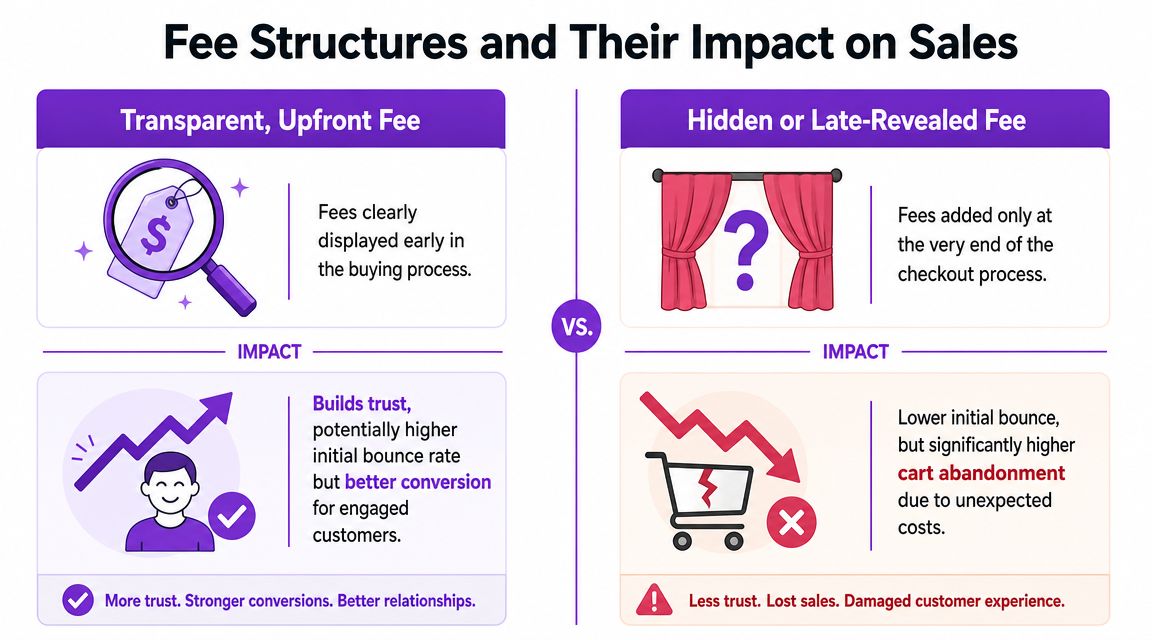
A handling fee can protect margin and still hurt conversion if you present it badly. In WooCommerce, the structure matters. So does the timing.
Some stores bury cost recovery inside product price. Others combine it with shipping. Others show it as a separate line item. None of those approaches is always right. The better choice depends on how varied your order profiles are and how much operational complexity sits behind each order.
Three ways to present the fee
Embedded in product price
This is the least visible option. Customers like clean checkout totals, and support conversations about fees tend to drop. But you lose precision. If one order requires routine processing and another requires extra review, both are subsidized by the same pricing model.
Bundled into shipping
This works when you want fewer line items but still need cost recovery. The problem is that customers often assume “shipping” means carrier transportation only. That creates confusion when they compare your rate against a seller who is pricing the same cost elsewhere.
Separate handling line item
This gives the strongest transparency. It also produces the most immediate customer scrutiny. If you use this approach, reveal it early and label it clearly. Don't wait until the final checkout step to introduce a fee the buyer hasn't seen before.
Static fees versus dynamic fees
A flat handling fee is easy to administer. It's also the easiest way to drift out of alignment with reality.
ICC Logistics notes that carrier fee schedules can change mid-contract, with accessorial surcharges changing frequently, and frames the practical issue well: merchants need a way to keep handling fees current without overcharging customers or losing margin. It also points to more dynamic, data-driven methods rather than relying only on a static flat fee in its guide to hidden shipping fees and surcharge recovery.
That matters in firearms retail because packaging profile, destination profile, and exception workload aren't stable forever. A fee that made sense months ago can gradually become wrong.
A workable WooCommerce decision model
Use this rule set:
- Choose embedded pricing if your catalog is simple and you want the smoothest checkout.
- Choose bundled shipping if you need some flexibility but don't want another line item.
- Choose a separate fee if your team needs operational clarity and your orders vary in compliance workload.
- Choose dynamic review if carrier behavior or order mix changes often enough to make a static fee unreliable.
Here's where stores get stuck. They think “dynamic” means complicated automation on day one. It doesn't have to. It can mean reviewing invoices, classifying common order types, and adjusting fee logic based on actual order-processing patterns rather than assumptions.
If checkout abandonment becomes a problem, your answer usually isn't “remove the fee immediately.” The better first move is to improve explanation and timing. For conversion-focused checkout messaging, Netco Design's latest guide is worth reading because many fee objections are really trust objections.
Copy you can use
Try language like this near shipping methods or under your fee label:
Orders containing regulated items may include a handling charge to cover fulfillment processing, packaging materials, and compliance-related order review.
Or, if you embed cost elsewhere:
Product and shipping prices may reflect the added processing required for regulated-item fulfillment.
Both are better than “fee may apply” with no context.
Implementing Handling Fees in WooCommerce
Getting the policy right is only half the job. The other half is configuring WooCommerce so the fee appears consistently and makes sense to the buyer.
For a simple setup, start with native shipping tools.
Native WooCommerce setup
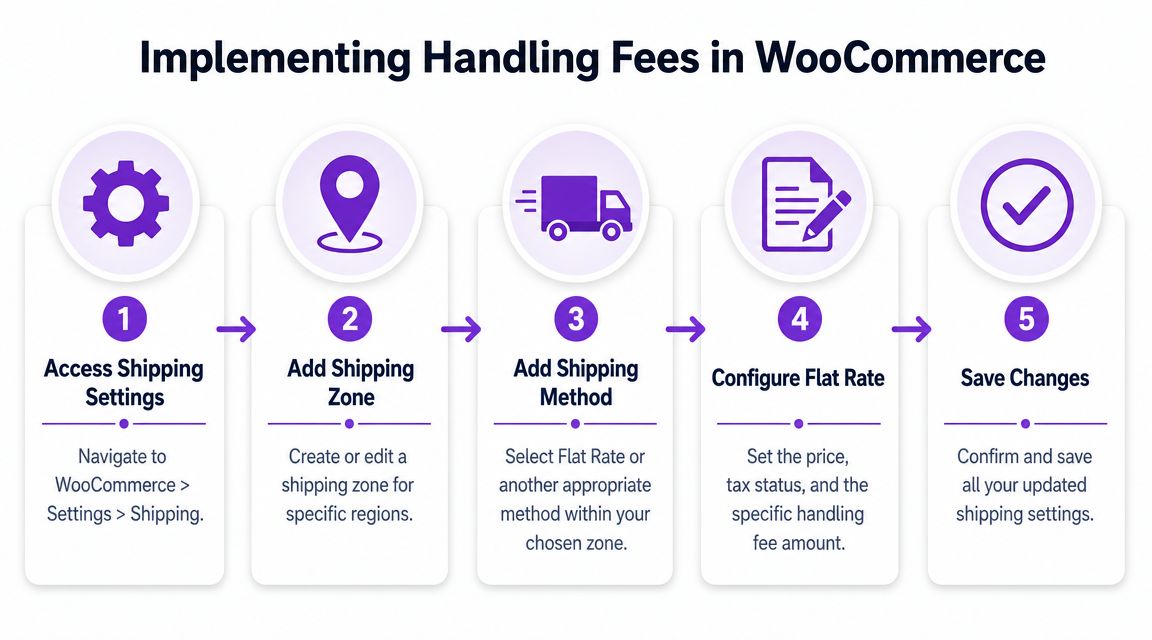
A basic approach usually follows this path:
- Open shipping settings in WooCommerce.
- Create or edit a shipping zone for the states or regions you serve.
- Add a shipping method, often Flat Rate for simple logic.
- Configure the amount so the shipping method includes your chosen handling charge logic.
- Test checkout messaging before pushing it live.
This works well when your fee is stable and doesn't depend on product type, order composition, or destination-specific compliance logic.
Where native tools start to break
Native settings become limiting when you need rules like:
- Different handling fees by product class
- Different fees for firearms versus ordinary accessories
- Conditional fees by destination
- Logic tied to shipping classes, restricted items, or mixed carts
If your catalog includes products with very different fulfillment burdens, shipping classes become important. This walkthrough on shipping classes in WooCommerce is useful because class-based logic often becomes the bridge between a blunt flat fee and a more accurate fee model.
A short visual walkthrough can help if you're setting this up for the first time:
<iframe width="100%" style="aspect-ratio: 16 / 9;" src="https://www.youtube.com/embed/nye0EG9xfLk" frameborder="0" allow="autoplay; encrypted-media" allowfullscreen></iframe>Messaging that reduces disputes
The configuration is only part of implementation. The language around the fee does a lot of the work.
Use short explanations in cart and checkout:
- For a separate line item: “Handling covers order processing, packaging materials, and regulated-item compliance review.”
- For a bundled shipping method: “Shipping price includes carrier charges plus order handling and processing.”
- For manual-review orders: “Some regulated-item orders require additional verification before shipment. If anything is needed, our team will contact you before processing.”
Final checks before launch
Before you turn the fee on, verify these points:
- Tax behavior: Make sure your tax setup treats the fee the way your jurisdiction requires.
- Mixed-cart testing: Test ordinary items, regulated items, and combinations.
- Store policy alignment: Your FAQ, shipping policy, and checkout wording should match.
- Support readiness: Customer service should know how to explain the fee in one sentence.
If support can't explain it clearly, the fee isn't ready.
Common Questions About Handling Fees
Can I charge a handling fee and still offer free shipping
Yes. “Free shipping” usually means the customer isn't paying a separate carrier transportation charge. You can still recover fulfillment cost elsewhere, but the presentation has to stay clear. If you advertise free shipping and then surprise the customer with an unexplained fee late in checkout, expect complaints.
Should handling fees be the same for every order
Not always. A flat fee is fine when your orders are operationally similar. It becomes weaker when some orders need extra review, restricted-destination checks, or more manual intervention. In firearms retail, fee logic should follow operational reality.
My handling fee seems to be hurting checkout completion. What should I do
Start with disclosure, not panic. Move the fee explanation earlier. Rewrite the label so it describes actual processing work. Test whether bundling the fee into shipping or product price produces fewer objections without hurting your margin discipline.
Can I charge for compliance-related work
You can make a stronger case for it when the charge reflects real order-processing labor and is disclosed transparently. The more clearly your team can document the workflow behind the fee, the more defensible it is.
If you run a WooCommerce store selling firearms, ammunition, or other restricted products, Ship Restrict helps prevent restricted orders before checkout by automating shipping compliance rules at the state, county, city, and ZIP level. That reduces manual review, lowers the chance of costly shipping mistakes, and gives your team a cleaner operational base for pricing handling fees accurately.
Automate Shipping Compliance
Stop worrying about restricted states. Ship Restrict handles it automatically.

Cody Yurk
Founder and Lead Developer of ShipRestrict, helping e-commerce businesses navigate complex shipping regulations for regulated products. Ecommerce store owner turned developer.
Automate Shipping Compliance
- Block restricted states
- No more cancellations
- Set and forget
3-day free trial · Card required