First Overnight vs Priority Overnight: The FFL Guide 2026
First Overnight vs Priority Overnight: Which is right for your firearms store? This guide compares cost, delivery times, and compliance rules for FFLs.
A transfer customer is waiting. Another FFL expects the package tomorrow. Your staff is at the shipping screen, and the choice looks simple: FedEx First Overnight or FedEx Priority Overnight.
For a firearms dealer, that choice isn't just about speed. It affects margin, customer communication, handoff timing, claim handling, and how much room you leave for error when a regulated item has to move cleanly from one licensee to another. If you pick a service that's faster than the situation requires, you burn profit. If you pick a service that's too relaxed for the transfer window, you create unnecessary risk.
That's why the question in first overnight vs priority overnight isn't “Which is better?” It's “Which one fits this shipment's compliance and operational reality?”
FFLs also have one extra complication that general eCommerce stores don't. Checkout promises can create downstream obligations. If your WooCommerce store presents overnight options loosely, your staff ends up cleaning up exceptions manually, calling receiving dealers, and fixing customer expectations after the sale. Strong shipping decisions start with carrier knowledge, but they also depend on good process design and clear customer contact workflows. Teams that handle urgent transfers well usually pair carrier selection with better status updates, exception handling, and advanced logistics communication solutions so the customer, the shipping clerk, and the receiving FFL stay aligned.
Automate Shipping Compliance
Block orders to restricted states automatically. 3-day free trial.
Start Free TrialIntroduction Choosing Your Next-Day Shipping Strategy
The practical way to look at overnight shipping is this: you're buying a delivery window, not just a label.
That matters more in firearms commerce than in ordinary retail. A regulated shipment often has a scheduled receiving workflow on the other end. The receiving FFL may have intake hours, transfer appointments, or limited staff for package acceptance. A package that arrives “tomorrow” can still be operationally late if it lands after the receiving dealer planned its day around it.
Here's the mistake I see most often. Dealers treat all next-day air services as interchangeable until a problem forces them to care about the clock. By then, the package is already in transit, the customer is already expecting a transfer call, and the receiving dealer is already annoyed.
Practical rule: If the shipment's timing affects compliance handling, scheduled intake, or a customer appointment, choose the service based on the receiving dealer's workflow first and the label price second.
The right strategy is usually straightforward:
- Use the earliest service when the morning itself matters.
- Use the mid-tier service when next-business-day delivery is enough.
- Avoid making checkout promises your team can't enforce consistently.
An FFL that ships regularly shouldn't decide this order by order from scratch. You want a default rule, a short list of exceptions, and a checkout setup that doesn't let customers steer a regulated shipment into the wrong service level.
First and Priority Overnight Core Service Differences
An FFL choosing between these two services is deciding how much the first part of the business day is worth on a regulated shipment.
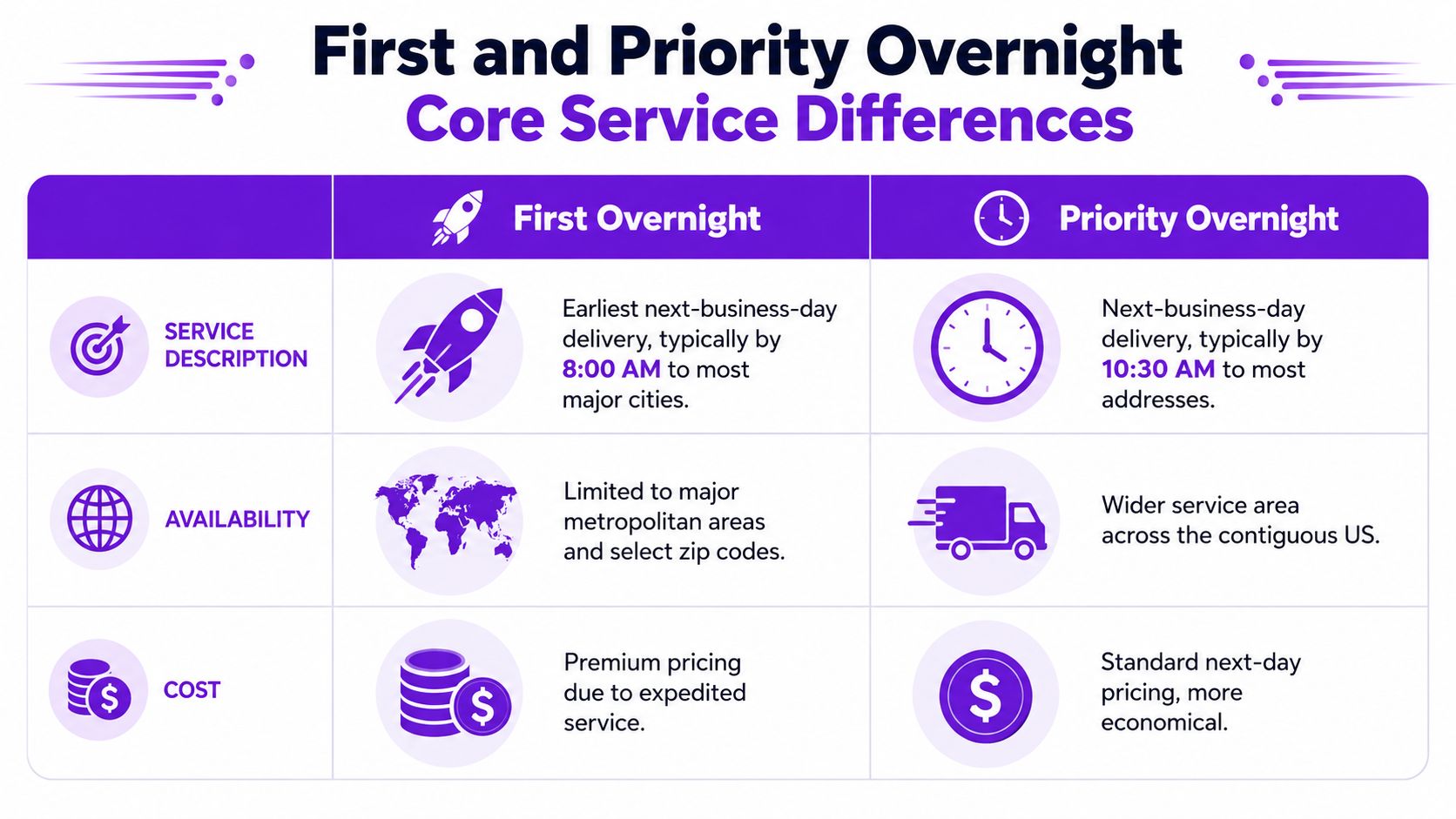
FedEx separates First Overnight and Priority Overnight by committed delivery window. First Overnight is the earliest next-business-day option. Priority Overnight is still a morning service, but it gives the carrier a later delivery window. For an FFL, that difference affects more than customer perception. It affects whether the receiving dealer can accept, log, and route the firearm into the day's transfer or inventory process without disruption.
| Feature | First Overnight | Priority Overnight |
|---|---|---|
| Core promise | Earliest next-business-day delivery | Next-business-day morning delivery |
| Typical business delivery window | Earliest morning window in eligible areas | Later morning window in eligible areas |
| Typical residential delivery window | Earlier next-day option where offered | By late morning or midday in many areas |
| Operational role for FFLs | Use when staff availability or intake timing is tight | Use when next-day morning delivery is sufficient |
| Cost posture | Highest overnight premium | Lower premium than the earliest service |
What the timing difference changes for an FFL
A one- or two-hour gap can be operationally minor for ordinary eCommerce. It is often meaningful for firearms shipments. Many receiving dealers batch inbound packages early, before counter traffic picks up, before NICS-related customer activity starts, and before the person who handles acquisition entries gets pulled into other work.
Free Shipping Compliance Audit
We'll review your WooCommerce store's shipping compliance for free.
If the package lands inside that early window, the firearm is more likely to get checked in the same way every time. If it lands later, the receiving FFL may still accept it, but the handoff into their compliance workflow can slow down. That creates unnecessary follow-up calls, delayed customer notifications, and avoidable friction between dealers.
The service choice also affects exception handling. If you already know the destination FFL keeps narrow receiving hours, First Overnight can reduce risk. If the destination has normal commercial receiving capacity, Priority Overnight usually covers the need without paying extra for time your process does not use.
Why the distinction matters more with regulated shipments
Firearms do not move through your business like generic merchandise. The shipment has to arrive when someone can accept it, secure it, and process it correctly. That is why carrier selection and service selection should be treated together. If your store also ships other regulated products, your team should already be comparing which carriers allow ammunition shipping and under what restrictions, because the same operational discipline applies here.
Priority Overnight is often the better default for routine FFL-to-FFL orders. First Overnight earns its keep when early morning receipt has clear business value, such as same-day intake goals, limited back-office staffing, or a destination dealer that only processes inbound firearms at opening.
A fast label is not the same as a well-timed label.
For first overnight vs priority overnight, the cleanest takeaway is simple. First Overnight buys an earlier recovery window if something in the receiving workflow goes wrong. Priority Overnight buys next-day speed at a lower premium for shipments that do not need the first available hour.
Detailed Comparison Cost Availability and Guarantees
A dealer can burn through a week's shipping margin with a simple habit. Staff sees a handgun order, clicks the fastest overnight option, and moves on. The label gets the package there, but the extra spend often bought delivery time the receiving FFL never needed.
Cost still matters, especially for serialized inventory, replacement shipments, and orders where freight is already high relative to margin. Published examples show First Overnight pricing materially above Priority Overnight in common scenarios. EasyPost's comparison lists FedEx First Overnight at $79.59 versus FedEx Priority Overnight at $48.59 for one five-pound example, and $157.07 versus $118.78 in another example for Tuesday delivery, according to EasyPost's overnight rate comparison.
That spread changes the decision.
If your WooCommerce store ships routine FFL-to-FFL transfers, Priority Overnight usually protects service levels without turning premium freight into a default tax on every urgent order. First Overnight should earn its way onto the label.
First Overnight vs Priority Overnight Feature Breakdown
| Feature | First Overnight | Priority Overnight |
|---|---|---|
| Delivery posture | Earliest next-day option | Morning next-day option |
| Cost examples | Higher published example rates | Lower published example rates |
| Best fit | Time-sensitive intake or limited receiving windows | Standard urgent dealer shipments |
| Margin impact | Higher cost per label | Better control of freight spend |
| Use discipline | Approval-based exception | Strong default overnight rule |
Cost, availability, and guarantees need to be reviewed together
A cheaper label is only better if the service fits the destination and the receiving workflow. FFL holders should check three things before setting a storewide rule.
- Cost control: First Overnight can be justified for a specific shipment. It gets expensive fast if counter staff or warehouse staff treat it as the safe default.
- Availability by destination: Early-morning commitments are not available in every ZIP, and commercial availability can differ from residential or limited-access locations. Promising the wrong service at checkout creates avoidable service failures.
- Guarantee value: A service guarantee has limited practical value if a late package causes a missed transfer appointment, a delayed intake, or extra customer support work your team cannot bill back.
For dealers shipping more than firearms, the carrier decision gets harder at checkout. Ammunition, firearms, and accessories do not always fit the same carrier policy or service rule. A good reference on which carriers allow ammunition shipping and under what restrictions helps show why regulated-product carts need tighter shipping logic than ordinary ecommerce orders.
What holds up in practice
Priority Overnight is usually the right premium default for an FFL operation that needs next-day delivery without paying for the first delivery window available.
First Overnight works best under a short approval rule. Use it when the receiving dealer has limited intake hours, the shipment is operationally urgent, or a delay would create a real business problem, not just anxiety on the shipping side.
I've seen this policy save dealers real money without hurting service. Require a stated reason for First Overnight. Let Priority Overnight flow as the standard overnight choice. That keeps urgency tied to an actual receiving or compliance need instead of a staff member's guess under pressure.
Firearms Shipping Compliance Rules
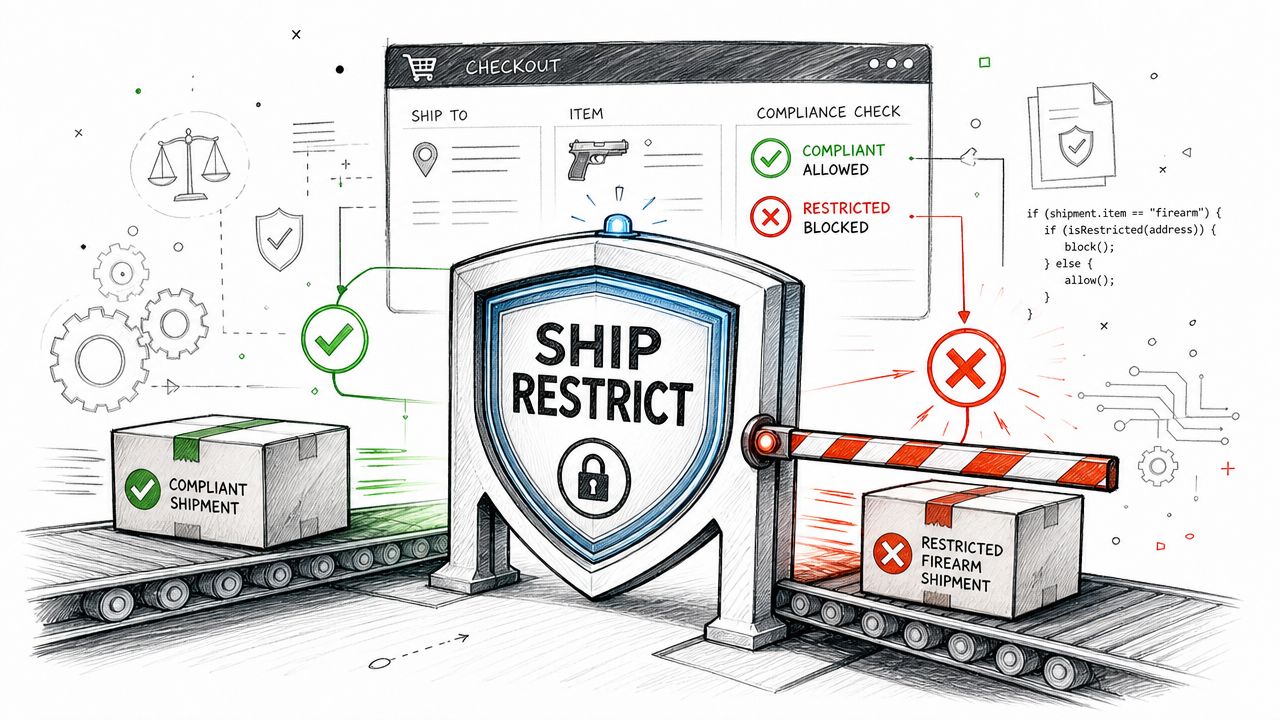
When firearms are involved, shipping choices sit inside a layered compliance framework. Carrier speed selection doesn't override that framework. It has to fit inside it.
The order of authority matters. Federal law comes first. Then state restrictions. Then carrier policy. Then any local rule or receiving-dealer practice that affects whether the shipment can move and be accepted cleanly.
The real hierarchy FFLs have to follow
A lot of shipping errors happen because dealers focus on the label and forget the chain of restrictions behind it.
-
Federal requirements
The shipment has to be lawful at the federal level. That includes who can ship, who can receive, and whether the transfer path is valid for the product and destination. -
State-level restrictions
Some states impose additional rules on what can be transferred, to whom, or under what conditions. If your store ships nationwide, these differences can't be left to memory. -
Carrier policy
Carriers can impose rules that are stricter than the bare legal minimum. Those rules matter because violating them can expose your account to suspension or create claim problems after a loss or service dispute. -
Local and operational acceptance realities
A shipment can be lawful and still create trouble if it arrives when the receiving location can't accept, log, or secure it the way it normally does.
Where overnight service selection fits
For an FFL, overnight service isn't just a convenience tier. It can be part of how you stay aligned with carrier handling requirements for certain regulated shipments, especially when you're trying to minimize dwell time and reduce unnecessary handling.
That's also why “cheapest compliant-looking method” is a dangerous mindset. Staff members may see a lower-cost label and assume the problem is solved. It isn't. A regulated shipment needs the right receiving party, the right service category, the right packaging workflow, and the right handoff controls.
Use a written internal checklist before the label is created:
- Verify the receiving licensee: Confirm you're shipping to the correct FFL and that your order record matches the intended destination.
- Match the service to the shipment type: If your business policy requires a next-day air service for a category, don't let staff substitute a slower option to save money.
- Apply signature controls: Adult signature and documented delivery handling should be part of the standard workflow for regulated shipments where your carrier and account settings support it.
- Review restricted destinations: State, county, city, and ZIP-level restrictions should be screened before payment, not discovered after the order is packed.
WooCommerce stores often struggle. The platform can sell products cleanly, but it doesn't natively understand regulated shipping logic well enough to enforce all of that without customization. For dealers building those controls, this FFL dealer shipping restrictions WooCommerce setup guide is a practical reference because it connects storefront configuration to real shipping restrictions.
Compliance failures rarely come from one dramatic mistake. They usually come from small unchecked assumptions stacked together.
The safest operators reduce those assumptions. They don't rely on memory, they don't let customers select methods freely for restricted items, and they don't assume every overnight option is interchangeable.
When to Choose First Overnight vs Priority Overnight
This decision gets easier when you tie it to actual shipping scenarios instead of abstract service descriptions.
Choose First Overnight when the morning itself is the asset
A few examples justify the premium.
A receiving FFL may have a narrow intake window before its retail floor gets busy. A high-value transfer may need to be checked in early so the customer can complete paperwork on a planned schedule. A shipment tied to a show, event, or hard business opening can also justify the earliest available delivery slot.
In those cases, you're not buying speed for its own sake. You're buying time to recover if something at the receiving end takes longer than expected. Early delivery gives the dealer more of the business day to solve intake issues, contact the customer, or reschedule internal handling.
Choose Priority Overnight when urgency is real but not extreme
For many FFL-to-FFL shipments, Priority Overnight is the operational sweet spot.
It gets the package there the next business day on a morning schedule that works for ordinary receiving routines. That's usually enough for stock transfers, routine customer orders, and dealer shipments where same-day intake matters but first-hour delivery doesn't.
A good mental model is this:
- First Overnight is for shipments with a narrow tolerance for delay inside the day.
- Priority Overnight is for shipments with a normal morning tolerance.
- Neither service should be selected just because a customer clicked “fastest.”
The best default for most dealers is the option that arrives on time for the receiving workflow, not the one that sounds most urgent at checkout.
A simple decision filter for staff
Ask three questions before buying the label.
-
Does the receiving dealer need the package very early, or just tomorrow morning?
If “very early” is a real operational need, First Overnight may be justified. -
Will a later morning arrival disrupt intake, scheduling, or customer handoff?
If the answer is no, Priority Overnight is usually the better business decision. -
Is this shipment exceptional enough to warrant premium handling?
Exceptional means there's a concrete reason tied to timing, not just a general preference for speed.
What doesn't work is making every regulated shipment feel exceptional. That approach drives up cost and trains your team to skip judgment. Good shipping discipline means reserving First Overnight for shipments that benefit from it and using Priority Overnight as the stronger default where practical.
Automating Shipping Rules in WooCommerce
Most WooCommerce stores can display shipping methods. That's the easy part. The hard part is making sure the right method appears for the right regulated order every time.
A basic setup usually starts with zones, carrier integrations, and service mappings. You connect your rates, decide which methods to show, and let customers select from the available options. For ordinary retail, that may be enough. For firearms and other restricted products, it usually isn't.
Where the default WooCommerce setup breaks down
Native WooCommerce shipping logic doesn't understand the legal and operational nuance behind a regulated order.
It won't know that one product category should never be offered a certain service to a certain destination. It won't know that a county-level restriction should block checkout. It also won't know that your internal policy requires a different service level when a cart contains a specific firearm type or when the receiving address falls into a restricted area.
That leaves dealers with a bad fallback. Manual review.
Manual review creates several problems at once:
- It slows fulfillment: Staff has to inspect orders after checkout instead of letting clean orders flow through.
- It creates inconsistency: Two employees may interpret the same shipment differently.
- It shifts errors downstream: The customer sees an option at checkout that the business later has to revoke.
- It raises labor cost: Your shipping team ends up spending time on preventable exception handling.
What a better workflow looks like
A stronger WooCommerce process makes shipping decisions earlier. The checkout should already reflect your business rules before the customer pays.
That means building logic around product type, destination, carrier limitations, and service eligibility. If a regulated item can only move under certain conditions, those conditions should drive which methods are visible. If a destination is blocked, the store should stop the order before payment.
For stores dealing with this problem now, this guide to automated shipping compliance for WooCommerce stores is a useful reference because it addresses the gap between normal WooCommerce shipping tools and the rule-heavy reality of regulated commerce.
Operational rules worth automating
The most valuable rules are usually the least glamorous.
- Hide ineligible methods: Don't display shipping options that your team would later reject.
- Restrict by geography: Apply state, county, city, or ZIP-based logic where your product catalog requires it.
- Map service levels to product categories: Different regulated items often need different handling rules.
- Display clear messages: If checkout blocks an order, tell the customer why in plain language.
When those rules are automated, your team stops debating individual orders and starts working from a repeatable system. That's how you protect compliance and control cost at the same time.
How Ship Restrict Prevents Costly Shipping Mistakes
The missing piece for many firearms dealers is enforcement at checkout. Not review after the order. Not a spreadsheet in the shipping office. Actual enforcement before the customer can place a non-compliant order.
Ship Restrict does that by letting WooCommerce merchants apply granular shipping restrictions to regulated products based on destination and business rules. For an FFL, that means you can stop invalid shipping choices before they become label problems, customer service problems, or compliance problems.
A practical example is where this becomes valuable. If a cart contains a handgun-category product, you can prevent ineligible shipping methods from appearing. If an address falls within a restricted state, county, city, or ZIP, you can block fulfillment logic at checkout instead of catching it after payment. That removes a lot of risky manual judgment from the daily workflow.
The operational benefit is just as important as the compliance benefit. Your staff doesn't need to re-evaluate the same rules on every order. Customers don't get shown options that will later be denied. And your shipping process becomes more consistent across employees, shifts, and stores.
If your WooCommerce store sells firearms or other regulated products, Ship Restrict gives you a practical way to enforce shipping rules before bad orders get through. It helps FFLs block restricted destinations, hide ineligible shipping methods, and reduce manual review so the checkout process matches the realities of firearms compliance.
Automate Shipping Compliance
Stop worrying about restricted states. Ship Restrict handles it automatically.

Cody Yurk
Founder and Lead Developer of ShipRestrict, helping e-commerce businesses navigate complex shipping regulations for regulated products. Ecommerce store owner turned developer.
Automate Shipping Compliance
- Block restricted states
- No more cancellations
- Set and forget
3-day free trial · Card required