Cross Country Shippers: Compliance Guide for Firearms
Cross country shippers face a maze of state laws. Learn how firearms retailers stay compliant, avoid fines, and automate checkout restrictions.
You're probably staring at a cart right now that looks routine on paper, but you know better. One bad ZIP, one county rule nobody caught, one carrier exception buried in a policy page, and a clean sale turns into a refund, a return, or a compliance problem you'll be explaining to your FFL network for weeks.
That's the job of cross country shippers in firearms eCommerce. It isn't moving a box from point A to point B. It's preventing a restricted order from ever becoming a shipped order, then making sure the order that does ship matches the law, the carrier, and the customer's delivery window. On North American lanes alone, the scale is huge, with $1.6 trillion in transborder freight in 2025 and trucking moving $1.0 trillion of that total, plus 55.7% of U.S.-Canada trade and 73.6% of U.S.-Mexico trade moving by truck, according to the Bureau of Transportation Statistics transborder freight report. That volume is exactly why sloppy fulfillment gets expensive fast.
The Order That Almost Cost Everything
A mid-size firearms retailer gets a straightforward order late on Friday. The billing address checks out, the shipping ZIP looks familiar, and the SKU is something they've sold hundreds of times. The warehouse prints the label, but a manager catches the order before pickup and realizes the destination sits inside a local restriction the team never mapped into the checkout flow.
That's the kind of mistake that hurts twice. First, you eat the operational waste, repacking, relabeling, refunding, and answering angry messages. Then you absorb the reputational damage when the buyer learns the problem wasn't the law itself, it was your store's failure to enforce the rule before the order existed.
Automate Shipping Compliance
Block orders to restricted states automatically. 3-day free trial.
Start Free TrialWhy firearms shipping is different
Most eCommerce mistakes are annoying. Firearms mistakes can become regulated, serialized, and traceable. A missed rule on a magazine, a receiver, or an accessory isn't just a customer service issue, it can turn into a transfer problem, a return problem, or a documented compliance failure.
The hard truth is that cross country shippers in this category don't get to improvise. They need every order to pass three gates in the right sequence, jurisdictional knowledge, carrier acceptance, and operational enforcement. If any one of those fails, the shipment shouldn't move.
Practical rule: If your team is still “reviewing later” and shipping first, your process is already broken.
That's why firearms shipping has to be managed as a live operating system, not a one-time legal memo. The store that wins is the one that blocks bad orders early, explains the block clearly, and keeps fulfillment moving for the orders that are allowed.
The Layered Compliance Framework for Firearms Shippers
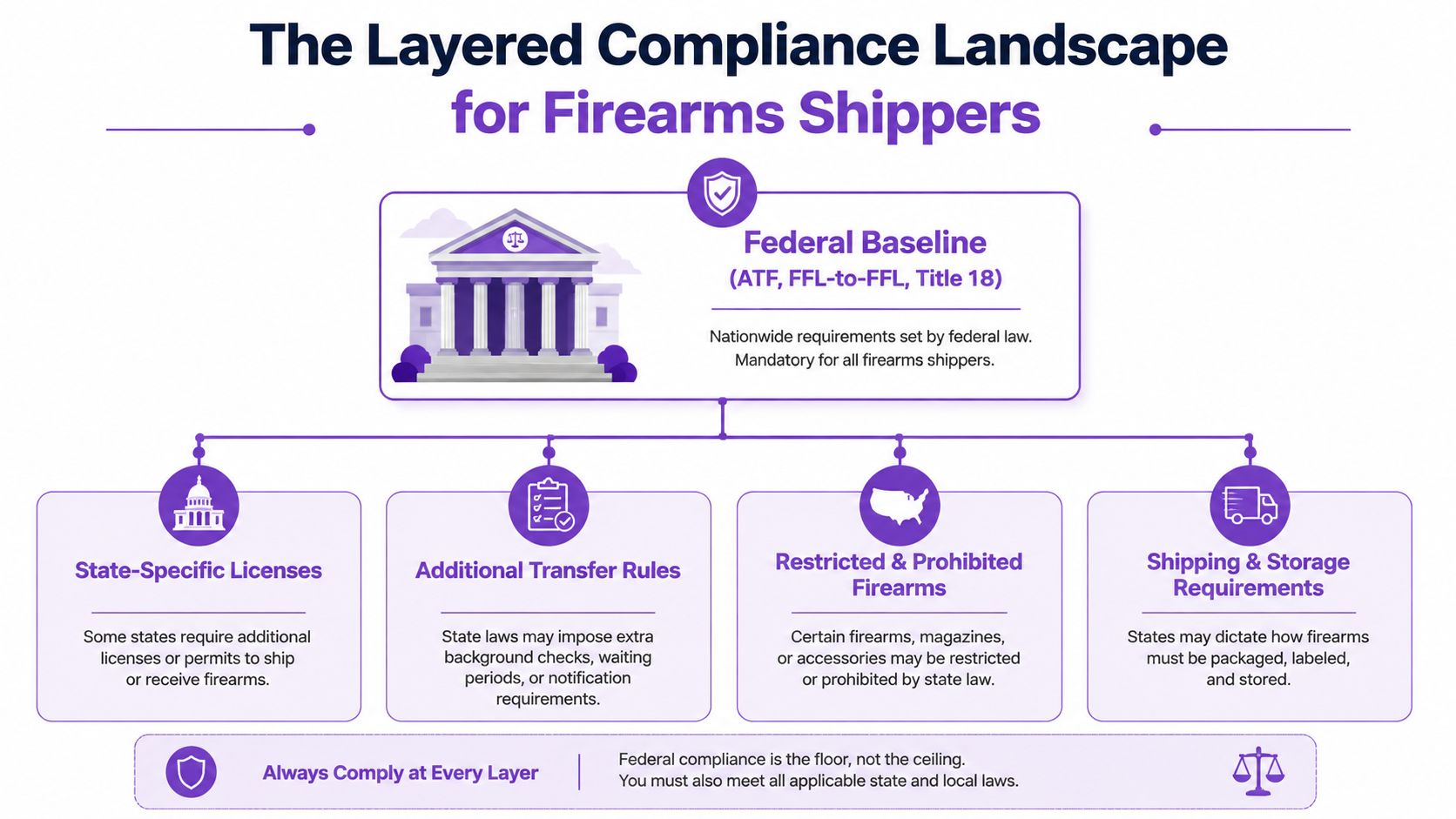
A restricted shipment does not usually fail because one rule was missed. It fails because the team checked the wrong layer and treated that as enough. Federal rules, state restrictions, and local overlays all have to line up before an order can move, and your checkout has to enforce that logic before a buyer can complete the purchase.
Federal baseline first
Start with the federal rules. ATF rules, FFL-to-FFL transfers, and Title 18 obligations determine whether the item can move at all and who can receive it. A state permit does not override a federal prohibition, and a carrier policy does not excuse a federal violation.
For a plain-language overview of how state rules sit on top of that baseline, the internal state firearm laws resource gives your compliance team a starting point. Use it as a map, not as a substitute for the product-by-product review each destination still needs.
State, county, and city rules stack on top
State rules are where a lot of stores get burned. A state may treat handguns and long guns differently, limit magazine capacity, restrict certain platforms, or narrow which transfers are allowed. County or municipal rules can then make a destination legal at the state level but blocked at the city level.
A flat shipping zone cannot handle that. A state line is not a compliance boundary by itself, and a ZIP code is often too blunt to make a lawful decision. If you sell regulated firearms products, your rule logic has to evaluate the destination with enough precision to catch the restriction before checkout closes.
Free Shipping Compliance Audit
We'll review your WooCommerce store's shipping compliance for free.
For adjacent logistics roles, it helps to look at how other regulated shipping categories handle carrier requirements and insurance. Duncan & Associates' FMCSA guide is a solid reminder that regulated freight lives or dies on matching the shipment to the right operational and coverage rules, not on optimism.
Key Takeaway
Compliance is layered. If your checkout only knows state names, it is blind to the parts that usually hurt you.
That is why cross country shippers in firearms need policy logic, not guesswork. The store has to check federal eligibility, state legality, and local restrictions before a label is ever printed. If those layers stay manual, the failure rate climbs as soon as the catalog grows, the geography expands, or the team changes.
Carrier Policies and What They Will Actually Accept
Carriers don't care that your item is lawful in the destination. They care whether their policy allows the package, whether the shipper is authorized to tender it, and whether the paperwork matches the product category. That's where a lot of otherwise good orders die.
Compare the big options before you ship
UPS, FedEx, and USPS all have different acceptance rules, different service constraints, and different signatures or documentation expectations. Specialized firearms couriers can fill gaps, but they're not a universal answer. Use them when the lane or product demands it, not as a default crutch.
| Carrier Comparison for Firearms Shipping | Handguns | Long Guns | Ammunition | FFL Required | Signature Required |
|---|---|---|---|---|---|
| UPS | Policy-specific handling, verify current terms before tender | Policy-specific handling, verify current terms before tender | Policy-specific handling, verify current terms before tender | Often required by product and route | Often required |
| FedEx | Policy-specific handling, verify current terms before tender | Policy-specific handling, verify current terms before tender | Policy-specific handling, verify current terms before tender | Often required by product and route | Often required |
| USPS | Policy-specific handling, verify current terms before tender | Policy-specific handling, verify current terms before tender | Policy-specific handling, verify current terms before tender | Depends on item and mailing category | Often required |
| Specialized firearms couriers | Built for restricted freight lanes | Built for restricted freight lanes | May vary by service | Commonly used | Commonly used |
Use the UPS vs FedEx vs USPS ammunition shipping guide when you need a carrier-level reminder, but don't outsource judgment to a blog post. Your shipping desk still needs to verify the exact service and item combination before it books anything.
Don't ignore the hidden gotchas
Optics with batteries can create packaging and handling questions. Propellants and other hazmat-adjacent items bring a different rule set. Long-gun boxes can trigger dimensional pricing headaches that make a “cheap” carrier choice look expensive after the invoice arrives.
The cleanest operating rule is simple. Match the product to the carrier that explicitly accepts it, then confirm signature, transfer, and documentation requirements before dispatch. If the lane is unusual, choose the courier that is built for unusual freight, because the cheapest option isn't cheap once it bounces back.
Decision rule: Handguns, long guns, ammunition, and accessories should each have a default ship path. If your team has to debate the route every time, you don't have a shipping policy, you have a habit.
Packaging, Documentation, and Fulfillment Best Practices
A compliant shipment can still fail at the warehouse bench. Bad packing, weak paperwork, or sloppy recipient verification can create returns, chargebacks, and audit headaches even when the law and carrier choice were correct.
Build the box like someone will inspect it
Use inner protection that prevents movement, then use an outer box that doesn't scream what's inside. The goal is simple, protect the item, protect the chain of custody, and avoid drawing unnecessary attention. For serialized items and regulated transfers, treat the packing list like a compliance artifact, not a throwaway slip.
If the order requires FFL documentation, include it in the exact format your process expects. If the order needs adult signature, make that requirement visible in the fulfillment workflow, not just in someone's memory. If batteries or accessories are involved, handle them with the same care you'd use for any shipment that could be delayed by a carrier inspection.
Use a checklist that survives staff turnover
- Verify the recipient class: Confirm the buyer, recipient, or receiving dealer is eligible before the box leaves the dock.
- Match the product to the documents: If it's a receiver or another serialized item, make sure the transfer paperwork is complete and attached where your SOP requires.
- Print the right service level: Signature, restricted delivery, or other service flags should be built into label creation, not added after the fact.
- Check box fit before tape: Oversized packaging creates avoidable cost and can trigger a carrier review you don't need.
- Retain a shipment record: Keep enough detail to answer a carrier question or an ATF trace without rebuilding the order from scratch.
That last point matters more than people admit. A warehouse that can't reconstruct what was shipped, to whom, and under which authorization is running on luck.
Why Restricted Orders Slip Through Manual Workflows
Manual review sounds safe until volume rises. Then the process starts leaking at the edges, and the leaks are predictable.
The weak points are structural
ZIP-to-county mapping errors happen because ZIP codes are built for mail delivery, not compliance zoning. A new law passes, the spreadsheet doesn't update, and the shipping team keeps trusting stale data. A customer edits the address after checkout, and now the original approval is meaningless.
Drop-ship partners make it worse. They may follow different restrictions, different cutoffs, or different documentation rules, which means your internal policy and your fulfillment partner's policy aren't always the same thing. That gap is where orders slip through and where blame gets passed around after the fact.
Tribal knowledge breaks first
A lot of firearms stores run on the knowledge of one or two experienced employees. That works until someone is out sick, a rush hits, or a new marketplace expands your order volume into a state the old guard hasn't memorized. At that point, the operation stops being a process and becomes memory.
The problem isn't the people. The problem is that manual enforcement can't scale with a changing rule set and a growing SKU catalog. If your store relies on a shared spreadsheet and a quick eyeball check, you're one missed update away from a bad shipment.
Operational reality: The more states, counties, and product classes you serve, the less manual review protects you. It becomes a bottleneck, then a liability.
That's why cross country shippers in regulated categories need an enforcement layer upstream of fulfillment. The point isn't to work harder at the warehouse. The point is to stop bad orders before the box exists.
Automating Restrictions at Checkout Before Orders Are Placed
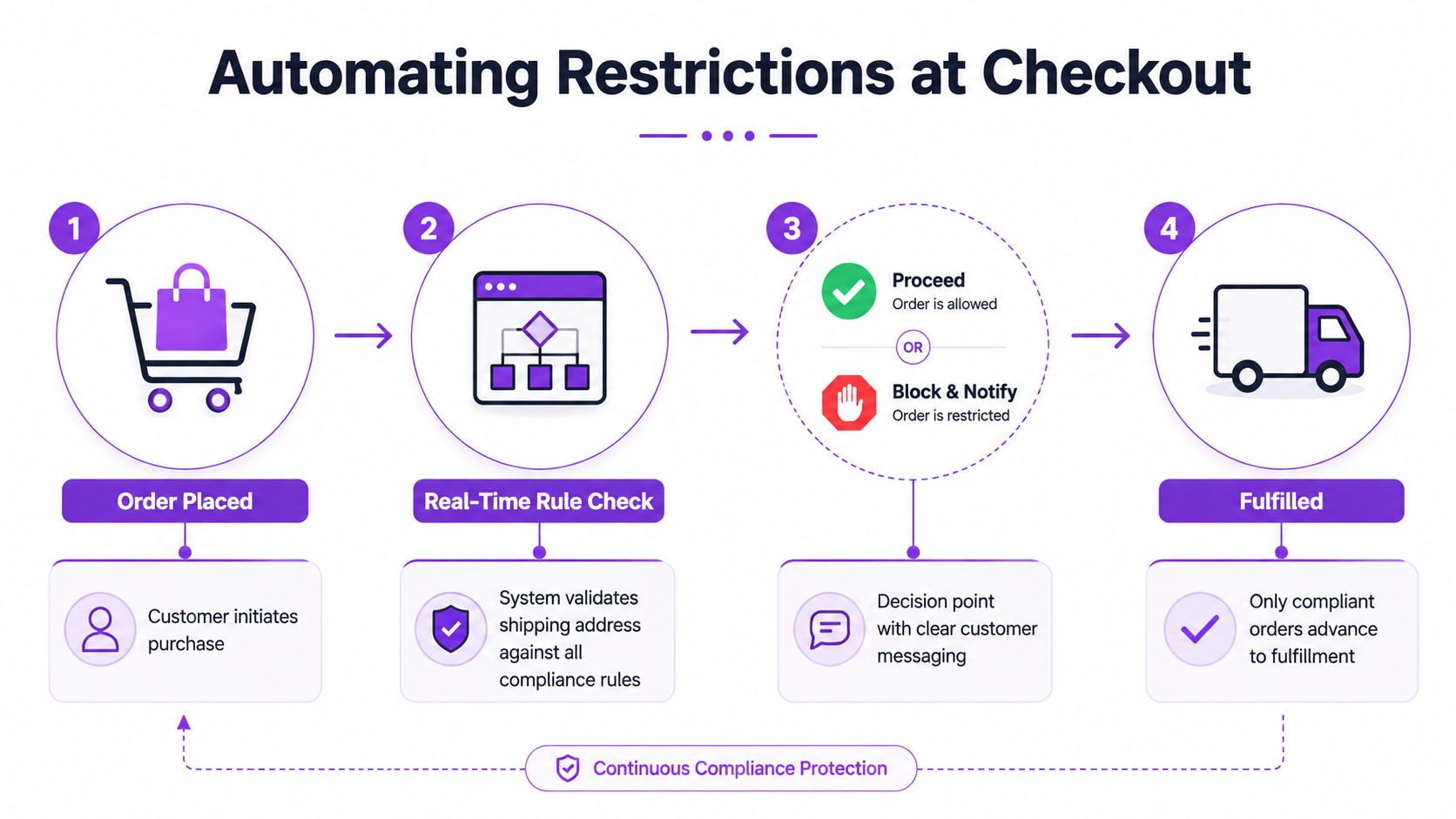
Checkout is where compliance should happen. If the cart is blocked correctly, the customer gets an immediate answer, the payment never settles on a bad order, and your team doesn't waste time cleaning up a preventable mess.
Real-time logic beats post-sale cleanup
The best workflow checks the destination against state, county, city, and ZIP-level rules as the order is being placed. If the order fails, the customer gets a clear explanation, not a vague rejection that reads like a software error. If the order passes, it moves forward without human intervention.
That change matters because the cheapest exception is the one you never accept. Once the order is charged, every mistake becomes a refund, a support ticket, a packing correction, or a chargeback risk. Catching the issue at checkout protects cash flow and keeps the customer experience clean.
Schedule the rules before they go live
Automated enforcement should also support future-dated rule changes. If a restriction is scheduled to start on a specific date, you want the system ready before the law or policy takes effect, not after the first bad order lands. That gives you a buffer for updates, staff training, and customer messaging.
Cross-border commerce is already massive, with McKinsey estimating cross-border goods eCommerce at about $300 billion and projecting it could reach $1 trillion by 2030, while also reporting 9.3 billion cross-border orders in 2020 and 60% of them intercontinental. Pitney Bowes also reported more than 131 billion parcels across 13 major markets in 2020, or more than 4,000 parcels every second, which is exactly why automated restriction logic matters when order volume scales.
<iframe width="100%" style="aspect-ratio: 16 / 9;" src="https://www.youtube.com/embed/wujEIvy0Z64" frameborder="0" allow="autoplay; encrypted-media" allowfullscreen></iframe>Wiring Ship Restrict Into a WooCommerce Store
WooCommerce stores don't need another spreadsheet. They need checkout logic that blocks restricted orders, explains the block, and keeps compliant orders moving without staff intervention.
Map the rules to the store, not the other way around
Start by building restrictions at the level your business uses, state, county, city, and ZIP. Bulk rule creation matters because a firearms catalog can't rely on one-off exceptions. A good setup lets you load restrictions in batches, then apply them consistently across product categories.
The cleanest implementation ties the rule to the checkout event. If the destination violates the policy, the order stops there. If it passes, the order moves on with no manual review and no uncertainty.
Make the message do work
Customers don't need a policy lecture. They need a direct explanation of why the order can't proceed and what part of the destination triggers the restriction. That transparency cuts down on support friction and prevents the “I already paid, why was I blocked?” argument from turning into a long email thread.
Here is the rewritten paragraph:
Scheduled start and expiry dates help here. A temporary restriction can be preloaded before it takes effect, then removed when it's no longer relevant. That keeps the store aligned with changing rules without forcing the team to babysit the checkout every day.
For a technical overview of the platform side, see the WooCommerce integration page. It's the practical reference for merchants who want to picture how checkout enforcement works inside an active store instead of in theory.
Keep the rollout realistic
- Solo stores: Start with the most common restricted destinations and product categories.
- Multi-store operators: Standardize the rule library so every storefront uses the same logic.
- Agency builds: Document the restriction hierarchy before launch so the client isn't guessing after go-live.
The value here is operational, not cosmetic. You're replacing panic and manual review with deterministic checkout enforcement, which is what regulated commerce needs.
A Monday Morning Action Plan for Safer Cross Country Shipping
Monday morning is the right time to get honest about the gap between policy and execution. If your store can't say exactly which rules are enforced at checkout, which carriers accept which products, and who updates the restriction list when the law changes, you've got work to do.
Start with the rules you already know
Audit your current destination list first. Separate what is legal from what is merely “usually fine,” then match each product category to the correct carrier and transfer path. If you sell firearms, ammo, or accessories, don't let one product class inherit another class's shipping logic.
Then inspect the manual steps. If someone is still checking destinations in spreadsheets or browser tabs, that's your first automation target. If the approval happens after payment, that's the second problem to kill.
Treat compliance like a growth system
A cleaner shipping operation reduces cancellations, shortens support cycles, and makes expansion into new markets less painful. That's not theory, it's what happens when your team stops rescuing bad orders and starts processing only valid ones. If you need help designing the broader workflow, logistics software planning is worth reviewing as a way to think about rules, exceptions, and operational structure before code goes live.
The stores that scale are the ones that make compliance boring. The store that still depends on tribal knowledge eventually pays for it in returns, delays, and customer trust.
Lock in a review cadence
Do a quarterly rule review at minimum. Update destination logic, carrier constraints, and any product-specific handling changes before the next spike in orders. That cadence keeps you ahead of drift instead of reacting to it.
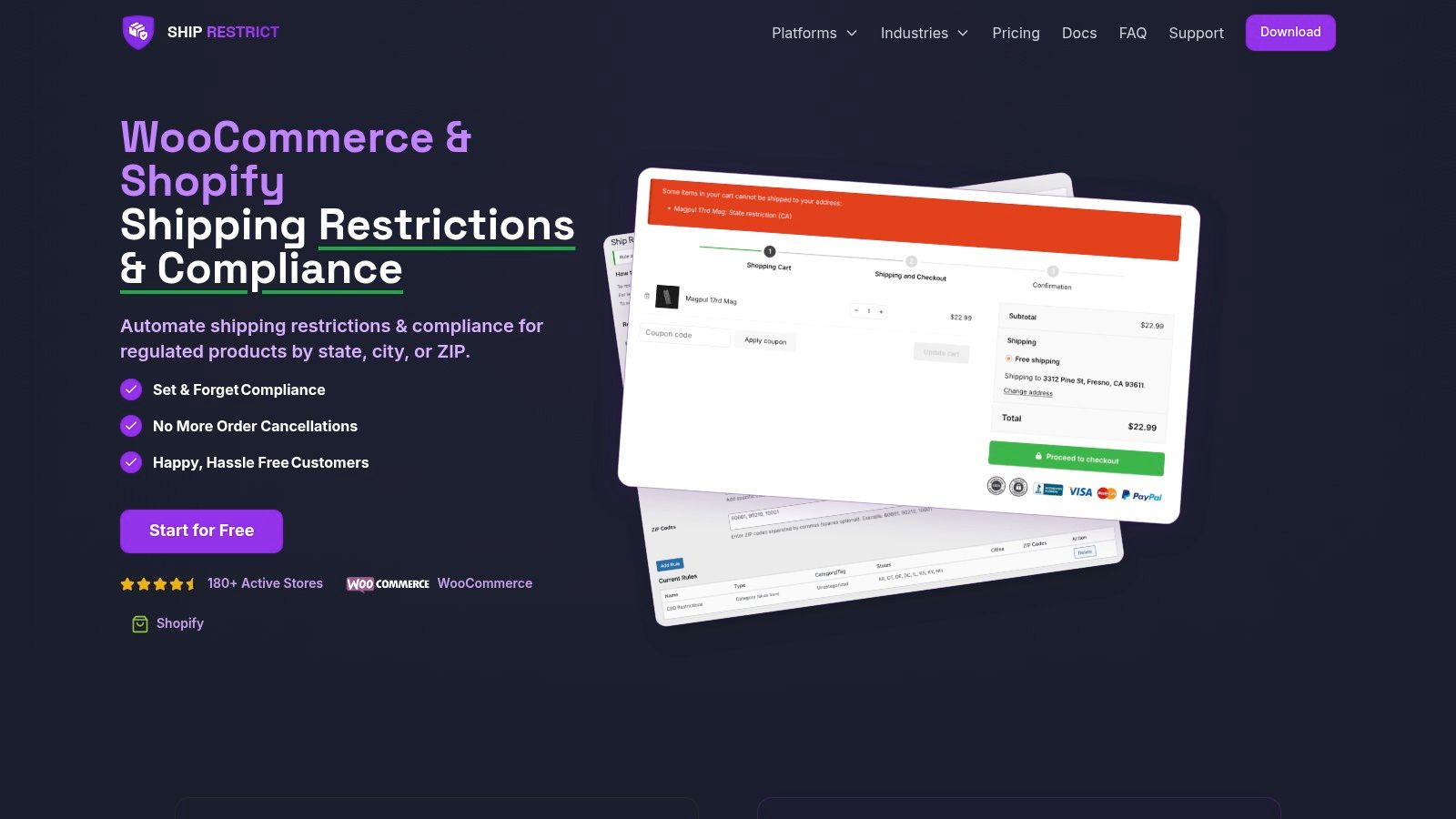
If you want your firearms eCommerce operation to stop leaking restricted orders at checkout, Ship Restrict is built for that exact job. Visit Ship Restrict and put automated restriction enforcement between the customer and the bad order before the next mistake costs you time, money, and credibility.
Automate Shipping Compliance
Stop worrying about restricted states. Ship Restrict handles it automatically.

Cody Yurk
Founder and Lead Developer of ShipRestrict, helping e-commerce businesses navigate complex shipping regulations for regulated products. Ecommerce store owner turned developer.
Automate Shipping Compliance
- Block restricted states
- No more cancellations
- Set and forget
3-day free trial · Card required