Optimize Firearms Compliance Risk Management 2026
Safeguard your firearms eCommerce store. Master compliance risk management in 2026 with key frameworks, KPIs, and automated shipping to avoid fines.
If you sell firearms or related regulated products online, you probably know the routine. An order comes in from a customer with a perfectly normal cart, then someone on your team stops everything to check the shipping address against a spreadsheet, a saved browser folder, maybe a county list, maybe a local ordinance note somebody added six months ago. You approve the order only after that uneasy pause where you're hoping nothing changed since the last time you checked.
That isn't a workflow. It's a gamble.
For firearms eCommerce, compliance risk management isn't a boardroom phrase. It's the day-to-day discipline of stopping bad shipments, documenting decisions, and keeping your store from turning one overlooked address into a regulatory problem. Generic compliance advice rarely gets into the hardest part of this business: granular geographic restrictions and stopping non-compliant transactions before checkout. Recent industry commentary also points to the growing need for centralized inventories and trusted alerts to keep up with changing requirements, which is why this has become a live operational control problem, not just a policy issue (Scrut best practices for compliance risk management).
That same problem shows up in other regulated shipping contexts too. If your operation also deals with cross-border logistics, this guide to understanding HS codes and customs is a useful reminder that classification errors and shipping restrictions often start upstream, long before a package leaves the dock.
Automate Shipping Compliance
Block orders to restricted states automatically. 3-day free trial.
Start Free TrialThe Daily Gamble of Shipping Regulated Products
A firearms order rarely fails because the customer typed in the wrong street number. It fails because the business relied on memory, scattered notes, or a manual check that didn't happen at the right moment.
What the manual process looks like
For a lot of stores, the pattern is familiar:
- Order comes in: Staff sees a shipping address in a state that might allow the product, but only under certain conditions.
- Someone pauses fulfillment: They check product type, magazine capacity, destination state, maybe county, maybe city.
- A judgment call gets made: If the rules are unclear, the team either holds the order or ships with crossed fingers.
- Nobody wants to own the mistake: Because if the shipment is wrong, the consequences don't stay inside the shipping department.
The issue isn't that your team doesn't care. It's that manual review breaks down once order volume rises, staff changes, or the rule set gets more granular.
Practical rule: If compliance depends on one employee knowing where to look, you don't have a control. You have a key-person risk.
Why firearms sellers feel this more than most
Most online stores don't have to decide whether a specific product can ship to one ZIP code but not another. Firearms businesses do. That's why broad compliance advice often misses the mark for this industry.
A firearms retailer isn't just managing one law. You're dealing with federal requirements, state restrictions, local variations, product-specific rules, carrier realities, and the business cost of canceling orders after the fact. That's why the financial fallout from violations doesn't stop at fines. It can include returns, support tickets, chargebacks, staff time, and a long audit trail you never wanted to create in the first place. If you want a concrete look at how those costs pile up, this breakdown of the true cost of shipping compliance violations is worth reading.
The practical answer is to treat compliance like an operational system. That means identifying where violations can happen, deciding which ones matter most, and putting controls in place before an order becomes a shipment.
What Is Compliance Risk Management Really
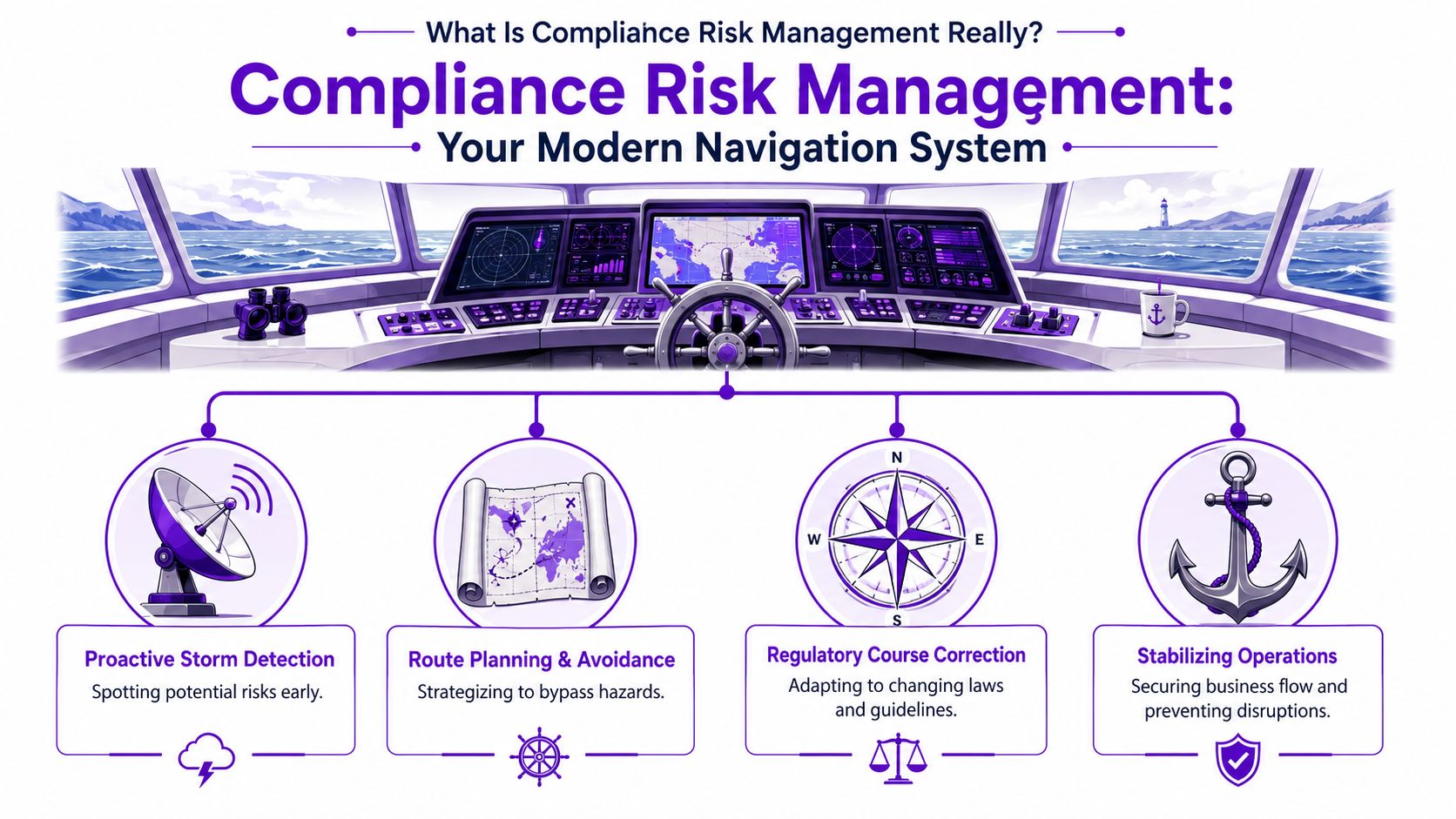
Think of compliance risk management like a ship's navigation system. A captain doesn't wait until the vessel hits shallow water to start caring about the chart. The whole point is to spot hazards early, choose a safer route, correct course when conditions change, and keep the operation stable.
For a firearms eCommerce business, that same logic applies. You don't want compliance to start after an order is packed. You want it built into the route the order takes from cart to checkout to fulfillment.
Free Shipping Compliance Audit
We'll review your WooCommerce store's shipping compliance for free.
The four parts that matter in practice
A lot of explanations make compliance risk management sound abstract. In a firearms business, it comes down to four working parts.
-
Identify risks
Start with your operation's failure points. Wrong product to wrong jurisdiction. Outdated restriction list. Manual override without review. Customer confusion at checkout. Vendor or workflow gaps that let non-compliant orders move downstream. -
Assess and prioritize
Not every issue deserves the same attention. A typo in an internal note isn't in the same class as shipping a restricted item into a prohibited location. The point is to rank risks so your team spends time where a mistake would hurt most. -
Control and mitigate
In this stage, process becomes useful. You add approval steps, address validation, product restrictions, training, escalation rules, and checkout blocks. Good controls don't just detect problems. They stop them. -
Monitor and report
You need proof that the system still works. That means reviewing exceptions, failed checkouts, policy changes, unresolved findings, and places where staff still rely on manual judgment.
What small and mid-sized stores usually get wrong
Smaller teams often assume compliance risk management means more paperwork. It doesn't. It means fewer preventable errors.
What doesn't work:
- Policy-only compliance: A written policy that nobody sees during checkout won't stop a bad order.
- Annual review mindset: In regulated eCommerce, waiting too long to review rules creates drift between your store logic and the practical rule set.
- Treating all products the same: Different SKUs create different exposure.
What works is a tighter operating model. Keep a current rule inventory. Assign ownership. Review exceptions on a schedule. Build controls where decisions happen.
If you want a broader non-firearms perspective on how organizations structure the full process, this end-to-end compliance risk guide gives a useful outside view.
For regulated WooCommerce stores, a practical place to begin is a recurring review cycle. This quarterly compliance review guide for regulated eCommerce is a solid template for turning compliance from a scramble into a routine.
The High Stakes of Firearms eCommerce Compliance
Firearms eCommerce has a patchwork problem. Federal rules are only part of the picture. State restrictions can differ from one border to the next, and local limits can be even more specific. A process that feels manageable at low volume starts to fail once your catalog expands, your shipment count grows, or your team assumes last month's rule is still good.
That matters because the cost of being wrong is rarely contained to one incident.
The business case is already there
A widely cited 2024 benchmark found the average annual cost of non-compliance was $14.82 million, while the cost of maintaining compliance was about $5.47 million. In other words, non-compliance cost about 2.7 times more on average. The same benchmark reported that regular compliance audits saved $2.86 million on average, and a formal incident response process saved $1.89 million on average (Hyperproof compliance statistics).
Those aren't firearms-only figures, but the lesson applies directly to firearms retailers. Compliance isn't just a defensive function. It's a cost-control function.
Where firearms sellers take the hit
The obvious risk is regulatory action. The less obvious risk is operational damage that spreads fast.
- Orders stall: Staff has to investigate addresses manually.
- Customers get mixed messages: One employee approves an order another later cancels.
- Fulfillment gets clogged: Warehoused orders sit while someone figures out whether they can move.
- Management loses visibility: You don't know whether errors are rare exceptions or signs of a broken process.
A practical compliance setup for a firearms store has to address all of that at once. That's why checkout logic matters so much. If the store can identify restricted combinations before payment or fulfillment, you cut out a large share of downstream risk and friction.
For store owners working on WooCommerce, this guide to firearms and ammunition shipping compliance for WooCommerce stores gets closer to the actual operational issues than generic policy articles do.
This video gives more context on how shipping-related compliance issues can affect regulated sellers:
<iframe width="100%" style="aspect-ratio: 16 / 9;" src="https://www.youtube.com/embed/O4aX5LdNAvE" frameborder="0" allow="autoplay; encrypted-media" allowfullscreen></iframe>The real threat isn't one dramatic mistake. It's a repeatable process that allows small mistakes to keep getting through.
Building Your Compliance Risk Assessment Framework
Most businesses make risk assessment harder than it needs to be. You don't need a giant spreadsheet with every possible nightmare scenario on day one. You need a workable way to sort risks by urgency so the serious ones get controls first.
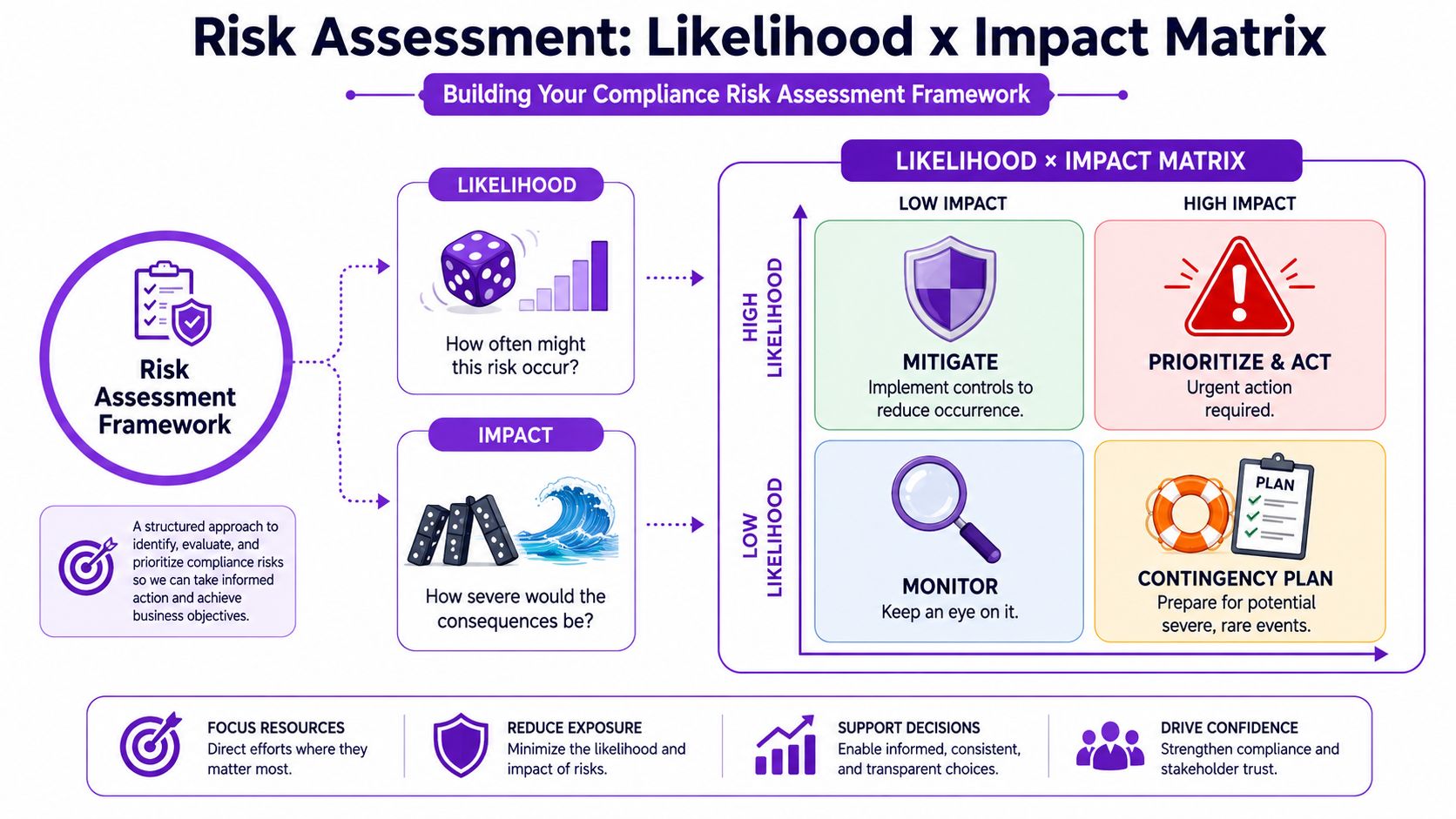
The simplest model is still the most useful: likelihood × impact.
How to score risks without overthinking it
Likelihood asks one question: how likely is this to happen in your current workflow?
Impact asks another: if it happens, how bad is it?
Used together, the matrix helps you decide where to invest attention, process, and automation. Guidance on compliance assessments describes this model as a core way to prioritize control investments, assign responsibilities, document mitigation, and track residual risk. The same source also notes that automated questionnaires and compliance mapping can reduce assessment cycles from days to hours in some examples (DataGuard compliance risk assessment matrix).
A firearms-focused example matrix
Here's a practical way to think about common issues:
| Risk scenario | Likelihood | Impact | Priority |
|---|---|---|---|
| Restricted product ordered to a blocked jurisdiction | High | High | Immediate control |
| Staff uses outdated local restriction notes | High | High | Immediate control |
| Customer enters an address needing manual legal review | Medium | High | Escalation workflow |
| Product page lacks clear restriction notice | Medium | Medium | Content fix |
| Internal tag or memo typo | Medium | Low | Monitor |
That table isn't legal advice. It's an operations tool. It helps you decide what gets blocked automatically, what gets reviewed manually, and what can wait for a scheduled fix.
What to document in the first pass
Don't try to map everything at once. Build a first-pass register around the points that cause real shipping exposure.
- Product rule conflicts: Which SKUs create destination-specific restrictions?
- Address complexity: Which states, counties, cities, or ZIP codes require tighter checks?
- Workflow gaps: Where can an order move forward without a verified compliance decision?
- Ownership: Who updates rules, who reviews exceptions, who signs off on edge cases?
If your team struggles with researching underlying legal questions, especially when local rules are layered on top of state-level restrictions, a resource on mastering legal research with TheLawGPT can help tighten the research side before you build store logic around it.
The value of the matrix is focus. It stops you from treating every issue like a fire and forces you to reserve your strongest controls for the risks that can actually damage the business.
Implementing Controls and Measuring What Matters
A risk assessment is only useful if it changes what happens in the store. That's where controls come in. For firearms eCommerce, the most important distinction is between preventative controls and detective controls.
Preventative controls stop the bad order before it becomes your problem. Detective controls tell you after the fact that something went wrong. Both matter, but they don't carry the same weight.
Prevent first, review second
A manual audit of yesterday's orders is better than nothing. But if the order already processed, the control is late.
Preventative controls in this business usually include:
- Checkout restrictions: Block orders that match prohibited destination and product combinations.
- Product-level rule logic: Apply different rules to firearms, magazines, ammunition, or accessories based on destination.
- Clear customer messaging: Tell the buyer why checkout is blocked or limited before support gets dragged in.
- Escalation paths: Route edge cases to a designated reviewer instead of leaving them to whoever happens to see the order.
Detective controls still matter. You should review exceptions, canceled restricted orders, and manual overrides. But the more your program relies on post-order cleanup, the more exposure you carry.
Operational advice: If you're measuring compliance only by counting violations, you're learning too late.
KPIs and KRIs are not the same thing
Many stores remain immature. They track whether work got done, but not whether risk is rising.
Guidance on compliance metrics makes the distinction clearly. KPIs show whether controls are operating as intended. KRIs act as predictive triggers that warn when risk is approaching or exceeding tolerance. Practical examples include policy exceptions, overdue control tests, vendor questionnaire completion rates, and unresolved high-severity findings (MetricStream on reporting compliance metrics).
For a firearms WooCommerce store, that translates well into everyday metrics.
Useful KPIs
- Blocked order review completion: Did the team review restricted-order exceptions on schedule?
- Rule update completion: Were known rule changes entered into the system promptly?
- Customer notice accuracy: Are checkout messages aligned with the current restriction logic?
Useful KRIs
- Manual review percentage: If too many orders need human interpretation, your automated rules are probably incomplete.
- Override frequency: A rising number of staff overrides usually means the control design needs work.
- Unresolved rule questions: If product or jurisdiction questions sit unanswered, risk is building.
A healthy program uses both. KPIs tell you whether the engine is running. KRIs tell you whether you're drifting toward trouble. That's how compliance risk management moves from a checklist into an early warning system.
Automating Shipping Controls with Ship Restrict
Most compliance programs fail at the same place. They identify risk correctly, then leave the control manual. That creates a gap between policy and execution.
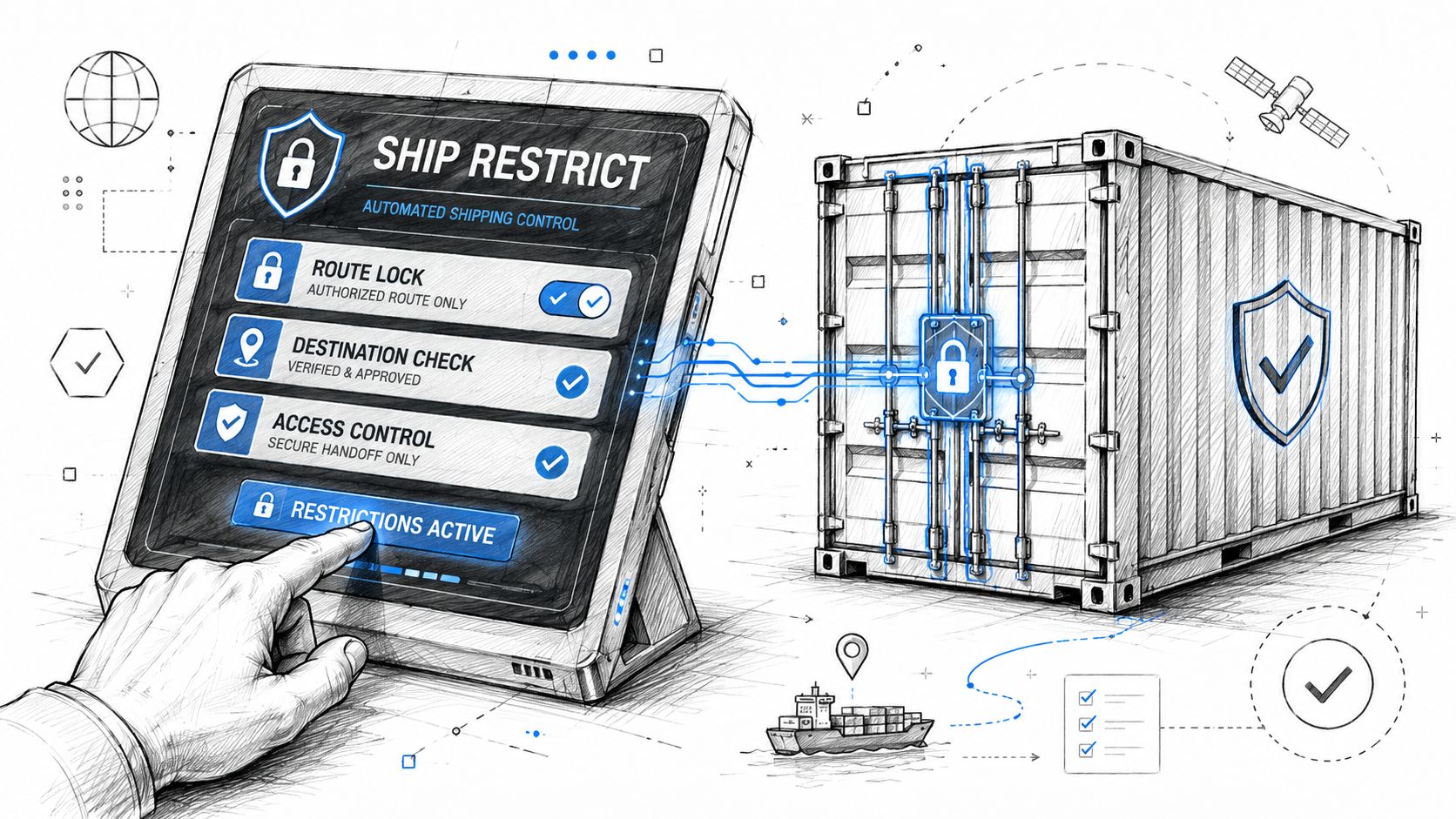
For regulated eCommerce, especially firearms, the strongest control is the one that applies the rule automatically at the moment the customer enters a restricted address or tries to buy a restricted item. Recent guidance has pushed harder on this exact point: organizations need to test and validate controls, not just document them. That same guidance highlights a deeper question, which is how to prove a compliance program works. Automated enforcement answers that by design because compliance is actively enforced on each transaction, not merely reviewed afterward (Secureframe on compliance risk).
What automation should do in a firearms store
At minimum, an automated shipping control should handle four jobs well:
- Apply location rules with granularity: State-only restrictions aren't enough when county, city, or ZIP differences matter.
- Match rule logic to products: A store needs different outcomes for different regulated items.
- Stop bad orders before payment or fulfillment: Blocking late still creates support and warehouse friction.
- Show the reason clearly: Customers need a usable message, not a generic checkout error.
A WooCommerce tool like Ship Restrict addresses compliance risk management. It lets merchants create granular restriction rules by state, county, city, or ZIP code, which means the most error-prone part of firearms shipping can move out of staff memory and into enforceable checkout logic. In practical terms, that reduces dependence on manual address checks and makes the restriction itself part of store operations.
What good implementation looks like
Automation only helps if the rule design is disciplined. Start narrow. Build rules for the highest-risk product and destination combinations first. Test them with sample orders. Review blocked-order logs. Tighten customer-facing messages so support doesn't have to decode the system after the fact.
A sound rollout usually includes:
- Mapping restricted products to the destinations that require blocking or review.
- Creating rule groups that reflect how your team thinks about restrictions.
- Testing edge cases before relying on the control in production.
- Reviewing exceptions regularly so the system stays current when requirements change.
Bulk rule creation, scheduled updates, and customizable messages aren't convenience features in this context. They're part of maintaining a control that stays usable over time. A rule that exists but is painful to update is the kind of control staff works around. A rule that updates cleanly has a better chance of surviving real-world store operations.
From Reactive Anxiety to Proactive Confidence
The difference between a weak compliance process and a strong one usually isn't intent. It's timing. Weak programs react after the order appears. Strong programs apply the rule before the order can turn into a shipment problem.
For firearms sellers, that's the shift that matters most. Manual spreadsheets, saved bookmarks, and tribal knowledge create anxiety because they force your team to make compliance decisions under pressure. A better compliance risk management approach moves those decisions into defined rules, assigns ownership, tracks exceptions, and measures whether the controls still work.
That changes more than risk posture. It changes how the business runs.
You get fewer fulfillment pauses. Fewer internal debates over edge cases. Better customer communication at checkout. More confidence when your catalog or shipping footprint expands. Most important, you stop treating compliance like a recurring fire drill and start treating it like infrastructure.
The businesses that handle regulated eCommerce well don't eliminate complexity. They operationalize it. They build guardrails where mistakes happen, then they maintain those guardrails as part of normal store operations. That's what lets them grow without adding the same amount of risk, friction, and manual effort.
If you're tired of checking addresses by hand and hoping your restriction list is current, Ship Restrict gives WooCommerce firearms sellers a way to enforce shipping rules at checkout using granular location-based restrictions. It helps turn compliance from a manual review habit into an active store control, so your team can spend less time second-guessing orders and more time running the business.
Automate Shipping Compliance
Stop worrying about restricted states. Ship Restrict handles it automatically.

Cody Yurk
Founder and Lead Developer of ShipRestrict, helping e-commerce businesses navigate complex shipping regulations for regulated products. Ecommerce store owner turned developer.
Automate Shipping Compliance
- Block restricted states
- No more cancellations
- Set and forget
3-day free trial · Card required