CBD/Hemp/THCA Shipping Laws New Jersey: Complete Guide
Learn everything about CBD/Hemp/THCA Shipping Laws New Jersey. Stay compliant and navigate shipping regulations with our expert guide.
New Jersey is drawing a hard line in the sand: federally compliant CBD and hemp products are still legal to ship, but intoxicating cannabinoids like Delta-8 and THCA are now strictly prohibited. This is a major shift that carves out clear legal boundaries for e-commerce businesses shipping to the Garden State.
Navigating New Jersey's Hemp Shipping Regulations
The rules for shipping CBD, hemp, and THCA into New Jersey have been completely overhauled. What was once a bit of a gray market, operating under the wide umbrella of the 2018 Farm Bill, is now a much tighter, more restrictive environment. For online retailers, getting this right isn't just good practice—it's a matter of survival.
Think of the state’s new regulations as a freshly paved highway with two very different lanes. One lane is wide open for compliant, non-intoxicating hemp products. This includes things like CBD oils, topicals, and edibles containing less than 0.3% Delta-9 THC on a dry weight basis. This lane has clear guardrails, like mandatory third-party lab testing and proper labeling.
The Legislative Shift Behind the Ban
Meanwhile, the other lane—the one for intoxicating cannabinoids—has been shut down for good. This was a direct response to the flood of psychoactive products that popped up, all technically derived from legal hemp. New Jersey originally aligned its laws with federal guidelines via the New Jersey Hemp Farming Act of 2019, but the game changed dramatically when Senate Bills S3235 and S4509 were passed.
Automate CBD / THCA Shipping Compliance
Block orders to restricted states automatically. 3-day free trial.
Start Free TrialThese new laws took direct aim at the intoxicating hemp-derived cannabinoids that became common in smoke shops and online stores. As of 2025, New Jersey has banned the manufacture, sale, and distribution of these products, including:
- Delta-8 THC
- Delta-10 THC
- HHC (Hexahydrocannabinol)
- THCP
- THCA (in any form meant for consumption that can become psychoactive)
This move effectively slammed the door on the loopholes that let these substances be sold outside the state's official, regulated cannabis market. You can dive deeper into the specifics by reading more about New Jersey's new intoxicating hemp law.
The infographic below breaks down the key checkpoints for shipping hemp products under New Jersey's updated rules.
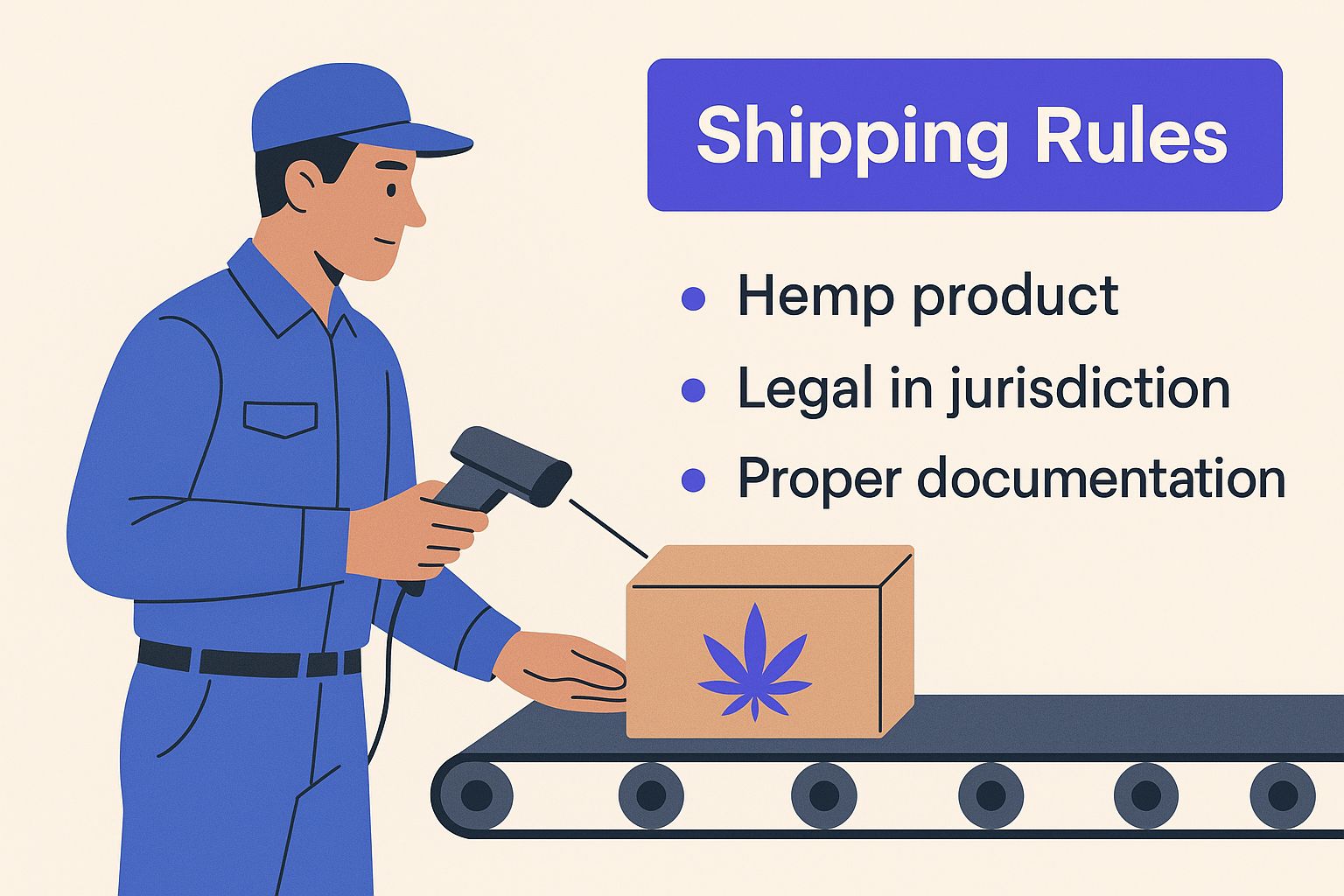
As you can see, the process now demands strict proof of THC limits and verifiable lab results before a package can even be considered for shipment.
Why This Matters for Your Business
This clear-cut division means your business has to be more careful than ever. Shipping a banned item like a THCA vape cartridge to a customer in New Jersey isn't a gray area anymore—it's a direct violation that comes with serious consequences.
The bottom line is simple: New Jersey now treats intoxicating hemp products the same way it treats state-regulated marijuana, leaving zero room for interpretation. If a product is designed to get someone "high," you can't legally ship it into the state under hemp rules.
To give you a quick reference, here’s a breakdown of the current situation.
NJ Hemp Shipping Compliance at a Glance
This table offers a snapshot of what’s allowed and what’s not when shipping cannabinoid products to New Jersey addresses.
| Product Type | Current NJ Shipping Status | Primary Compliance Factor |
|---|---|---|
| CBD Products | Allowed | Must contain < 0.3% Delta-9 THC and be non-intoxicating. |
| Hemp Flower | Allowed | Must contain < 0.3% Delta-9 THC; THCA content now a major risk. |
| Delta-8 THC Products | Prohibited | Explicitly banned as an intoxicating cannabinoid. |
| THCA Products | Prohibited | Banned if intended for consumption that results in intoxication. |
This proactive stance from New Jersey is designed to protect consumers and hold retailers accountable. It also makes automated compliance tools an essential part of navigating these state-by-state complexities.
Free CBD / THCA Compliance Audit
Selling CBD or THCA products? We'll review your WooCommerce store's shipping compliance for free.
Why CBD, Hemp, and THCA Are Treated Differently
To get a handle on New Jersey’s shipping laws, you first have to understand that the state doesn’t see all hemp-derived products as the same. The entire regulatory framework pivots on a single, straightforward question: can it get you high? This simple distinction is what creates separate legal paths for CBD, traditional hemp, and compounds like THCA.
Think of it like the difference between an inactive and an active ingredient in medicine. In a psychoactive sense, non-intoxicating CBD and hemp are seen as "inactive." They don’t produce a high and are popular for other properties, so they’re legal to ship and sell as long as they follow strict testing and labeling rules.
The THCA Transformation Problem
THCA, on the other hand, is a whole different ballgame. New Jersey treats it as a potentially "active" ingredient. While it’s non-intoxicating in its raw form, THCA (tetrahydrocannabinolic acid) is the direct precursor to Delta-9 THC. When you apply heat—think smoking, vaping, or cooking—a process called decarboxylation chemically converts THCA into the very same intoxicating THC that federal and state laws strictly regulate.
This potential to transform is the exact reason New Jersey banned it. Regulators don't see high-THCA flower as harmless hemp; they see it as a loophole to sell what is essentially marijuana in waiting. The state’s big concern is that these products create a legal gray area that undermines its licensed cannabis market and public safety goals.
The scientific reality that THCA becomes psychoactive THC upon heating is the bedrock of New Jersey’s ban. The state isn't just regulating the compound as it sits on the shelf; it's regulating its potential end-use.
Clarifying Legal Definitions
With its CBD/Hemp/THCA shipping laws New Jersey has drawn a clear line in the sand. If a product is non-intoxicating and contains less than 0.3% Delta-9 THC, it's legal to ship and sell. But any intoxicating hemp products—and that explicitly includes those with high levels of THCA—are now banned from being made, distributed, or sold in the state.
This approach separates hemp intended for wellness or industrial use from products designed for intoxication. For an e-commerce business, getting this fundamental difference is the first step toward staying compliant. You can learn more by exploring the critical shipping law differences between hemp and marijuana products.
The key takeaway is simple: in New Jersey, a product's chemical potential matters just as much as its current chemical state, and that fact changes everything for online sellers.
Your Essential Compliance Checklist for NJ Shipments
 Getting a handle on New Jersey's updated CBD, hemp, and THCA shipping laws isn't just about knowing what's banned. It requires a proactive, almost obsessive attention to detail for every single package you send out. Just one slip-up can mean seized shipments, unhappy customers, and some pretty hefty fines.
Think of this checklist as your pre-flight inspection before a package heads to the Garden State. Each step is designed to build a solid wall of compliance, protecting your business and your customers.
The absolute cornerstone of all this is the Certificate of Analysis (COA). This isn't just another piece of paper; it's your definitive proof that a product is legal. Every product you ship must have a current, batch-specific COA from a licensed, third-party lab. This document is what verifies the Delta-9 THC concentration is below the 0.3% federal limit and confirms you're not shipping harmful contaminants.
Labeling and Packaging Requirements
Once your COA is in order, the next critical checkpoint is how your product is presented. New Jersey's rules are all about transparency and safety, so your labels and packaging have to be on point.
Your packaging should include:
- Clear Cannabinoid Content: List the total CBD, THC, and other major cannabinoids present in the product. No guesswork.
- Batch or Lot Number: This number must link directly back to the COA, creating an unbroken chain of traceability.
- QR Code: A scannable QR code that takes customers directly to the product’s COA is a must.
- Child-Resistant Features: Any consumable products absolutely must be in child-resistant packaging to prevent accidents.
A compliant label does more than just tick a legal box—it builds trust. When a customer can scan a QR code and instantly see lab results, it validates your brand's commitment to quality and safety.
Carrier and Documentation Protocols
Finally, your internal processes have to be just as tight as your external packaging. Not all shipping carriers are comfortable handling hemp products, even when they're 100% legal. It's on you to vet your shipping partners and confirm they have policies that explicitly permit transporting hemp-derived goods.
You also need to maintain a full set of compliance documents for every single shipment. This "compliance packet" should include the COA, a notice to law enforcement explaining the package contains legal hemp, and a copy of your business's hemp license. This simple prep work can be the difference between a routine inspection and a costly seizure.
As you build out your checklist, it's also a great time to think about how you can integrate sustainable shipping practices.
The Real Costs of Non-Compliance in New Jersey
Ignoring New Jersey's updated hemp regulations is like driving the wrong way down a one-way street—it’s not a matter of if you’ll get caught, but when. The state isn't just suggesting compliance; it's actively enforcing it with a penalty structure designed to make you think twice.
For any e-commerce business in this space, understanding these risks isn't just good practice, it's essential for survival. The consequences aren't a simple slap on the wrist. They're built to escalate quickly, turning a minor oversight into a major financial headache. Shipping a banned THCA product or a mislabeled CBD oil isn't just a mistake in the eyes of state regulators; it’s a direct violation.
Escalating Fines and Penalties
New Jersey's enforcement model is designed to make repeat offenses incredibly costly. The state’s Cannabis Regulatory Commission (CRC) has the power to issue civil penalties that grow with each violation.
Think of it this way: the first mistake might sting a little, but the next one is meant to hurt. Fines start at $100 for a first offense, jump to at least $1,000 for a second offense, and climb to a minimum of $10,000 for each subsequent violation. This tiered system makes it painfully clear that ignoring the rules is far more expensive than following them.
The financial penalties are just the beginning. Enforcement agencies can also seize and destroy non-compliant products, meaning you lose the inventory and the revenue from those sales.
Beyond the Financial Impact
While the fines are big enough to get your attention, the damage from non-compliance goes much deeper. The CRC and other state agencies can take actions that threaten the very existence of your business. These measures include:
- Product Seizures: Any shipment found to contain banned substances like THCA or improperly labeled CBD can be confiscated on the spot.
- License Revocation: If you operate within New Jersey, repeated violations can lead to the suspension or even total revocation of your license to operate.
- Reputational Damage: News of enforcement actions spreads fast. Once customer trust is broken, it's incredibly difficult to rebuild in such a competitive market.
These consequences highlight why a proactive compliance strategy isn't just a good idea—it's a core business necessity. The risks are simply too high to leave to chance. To get a broader look at the dangers, check out our guide on the true cost of shipping compliance violations. The stakes in New Jersey are clear: comply or face the severe costs.
How New Jersey Fits into the National Hemp Crackdown
New Jersey’s move against intoxicating hemp products isn’t happening in a vacuum. It's actually a key piece of a much larger puzzle unfolding across the country, as states scramble to close the loopholes blown open by the 2018 Farm Bill.
That bill accidentally created a "gray market" for psychoactive products like Delta-8 and THCA. What followed was a Wild West scenario, and now regulators are finally trying to get things under control.
This regulatory wave marks a major turning point for the hemp industry. The initial gold rush is over, and we're seeing a shift toward a more stable, safety-focused market. States like New Jersey are at the forefront, making it crystal clear that consumer protection and regulated sales are the future. This crackdown is forcing businesses to pivot away from intoxicating hemp and double down on compliant, non-psychoactive CBD and industrial hemp.
The Economic Ripple Effect
This shift is having a huge economic impact, pushing the industry toward legitimacy whether it's ready or not. While businesses that thrived in the gray market are facing a tough road ahead, the compliant CBD market is still showing strong signs of growth.
Nationally, the CBD market is on track to blow past $20 billion by 2030. But as more states follow New Jersey's lead with strict bans, the slice of the pie for intoxicating hemp products is going to shrink. It’s a double-edged sword: some praise the move for making products safer for consumers, while others argue it's killing innovation. You can get more insights on the future of the CBD market at ZebraCBD.com.
By watching what's happening on a national scale, e-commerce businesses can get a pretty good idea of what's coming next. New Jersey’s playbook is likely to be copied elsewhere, making proactive compliance the only real strategy for long-term survival.
For online sellers, this means the days of skating by on legal technicalities are officially over. The game has changed. Success now depends on building a sustainable business around products that are verifiably compliant. Adapting to these stricter CBD/Hemp/THCA shipping laws in New Jersey and other states isn’t just about dodging fines anymore—it’s about securing your brand’s place in a more predictable and stable future.
Using Automation to Simplify Shipping Compliance
Trying to manually track the tangled web of CBD, Hemp, and THCA shipping laws in New Jersey—let alone the other 49 states—is a recipe for disaster. For any growing e-commerce business, it’s not just inefficient; it's practically impossible. One wrong shipment can lead to seized products, furious customers, and the kind of legal penalties we've already covered.
This is where automated compliance software becomes an indispensable tool. Think of it as a digital bouncer for your online store. Instead of relying on a human to remember that THCA is a no-go in New Jersey but fine elsewhere, the software handles it instantly at checkout. It acts as an always-on, expert legal assistant that simply doesn't make mistakes.
This screenshot shows how an app like Ship-Restrict can display clear, customized messages to customers when an item is restricted in their location.

This automated process stops illegal sales before they ever happen, protecting your business while keeping the customer experience transparent and professional.
How Automation Prevents Costly Errors
Picture this: a customer in Newark adds two items to their cart. One is a compliant CBD tincture, and the other is a THCA vape cartridge, which is now illegal to ship to New Jersey. Without automation, that sale might slip through unnoticed, putting your entire business at risk.
With an automated system in place, the checkout process would look completely different:
- The compliant CBD tincture is approved for purchase without a hitch.
- The illegal THCA vape cartridge is automatically blocked.
- A clear, helpful message pops up, letting the customer know exactly why that specific item can't be shipped to their address.
This selective restriction shields your business from legal trouble, saves countless hours of administrative headaches, and completely eliminates the risk of human error. For businesses on popular platforms, getting familiar with automated shipping compliance for WooCommerce stores can be a fantastic first step.
By automating these rules, you transform your compliance strategy from a reactive, manual chore into a proactive, foolproof system. It ensures every single order adheres to state-specific regulations without you ever lifting a finger.
To take it a step further, many companies are looking into how Robotic Process Automation for Compliance Regulatory Reporting can streamline adherence to complex legal frameworks and slash manual effort. This approach fundamentally changes how businesses manage the weight of intricate legal requirements.
Common Questions About Shipping Hemp to New Jersey
Trying to wrap your head around the new CBD, hemp, and THCA shipping laws in New Jersey? It can feel like a moving target, but don't worry. Most of the confusion boils down to a handful of key questions. Let's cut through the noise with some straight answers.
The bottom line in New Jersey is the difference between intoxicating and non-intoxicating products. That single distinction is what dictates whether a product can legally land on a doorstep in the Garden State.
Can I Still Get CBD Oil Mailed to My New Jersey Address?
Yes, absolutely. Shipping CBD oil and other non-intoxicating hemp products to a New Jersey address is perfectly legal.
The crucial detail is that the product must contain less than 0.3% Delta-9 THC by dry weight and meet all the state's testing and labeling requirements. The new laws were laser-focused on intoxicating cannabinoids, leaving the market for compliant CBD oils, creams, and edibles untouched. If it's a legitimate, non-intoxicating CBD product, you're in the clear.
Is Shipping THCA Flower to New Jersey Now Illegal?
That's a hard yes. It is now illegal to ship THCA flower and similar intoxicating hemp products into New Jersey. The state slammed the door on cannabinoids like THCA because they convert into psychoactive Delta-9 THC when you heat them up.
Any online store sending these products to a New Jersey customer is breaking the law, period. Those shipments can be seized, and both the seller and the buyer could face legal trouble. New Jersey officials saw high-THCA products as a backdoor around their regulated cannabis market and have shut it down completely.
It's not about what the product is on the shelf; it's about what it becomes. New Jersey's rules are based on the product's potential to be intoxicating, not just its raw chemical state.
What Should I Look for When Buying CBD Online for NJ Shipment?
Your top priority, without question, should be the Certificate of Analysis (COA). Think of this as the product's report card—it's non-negotiable if you want to ensure what you're buying is legal and safe.
Before you click "buy," find the third-party COA for the exact batch you're purchasing. This lab report tells you two critical things:
- It confirms the cannabinoid profile and proves the Delta-9 THC content is safely below the 0.3% legal threshold.
- It shows the product has been screened for nasty stuff like pesticides, heavy metals, and mold.
Trustworthy brands make this easy. They'll have clear labels, QR codes linking directly to the COA, and full ingredient lists. That kind of transparency isn't just good business; it's the sign of a company that respects the law and its customers.
Stop guessing and start complying. Ship Restrict automates complex shipping rules, blocking illegal orders at checkout and protecting your business from costly fines and penalties. Learn how Ship Restrict can secure your e-commerce store today!
Automate CBD / THCA Shipping Compliance
Stop worrying about restricted states. Ship Restrict handles it automatically.

Cody Yurk
Founder and Lead Developer of ShipRestrict, helping e-commerce businesses navigate complex shipping regulations for regulated products. Ecommerce store owner turned developer.
Automate CBD / THCA Compliance
- Block restricted states
- No more cancellations
- Set and forget
3-day free trial · Card required