Catalytic Converter CARB Parts Shipping A Guide to Compliance
Master catalytic converter CARB parts shipping. Our guide helps you stay compliant, avoid fines, and automate complex shipping rules on your eCommerce store.
Shipping CARB-compliant catalytic converters isn't really a logistics problem—it's a legal one. Think of it like trying to ship alcohol or firearms; geography dictates what's legal. One wrong shipment to a restricted state can land you with thousands in fines, making compliance an absolute must-have for staying in business.
The High Stakes of Catalytic Converter Shipping

Selling auto parts online seems simple enough until you run headfirst into the patchwork of state emissions laws. The California Air Resources Board (CARB) set some of the toughest standards on the planet, and that decision has created a ripple effect across the country.
And no, this isn't just a California problem anymore. States like New York and Colorado have jumped on board, adopting similar rules and creating a tricky map for e-commerce sellers to navigate. Shipping a standard "49-state legal" part into one of these zones isn't just a mistake; it's illegal and puts your business at serious risk.
Why Manual Checks Are a Recipe for Disaster
A lot of shops try to get by with manually checking the shipping address for every single order. That approach isn't just slow and tedious—it's dangerously prone to human error. All it takes is one simple oversight to trigger a costly violation.
Automate Shipping Compliance
Block orders to restricted states automatically. 3-day free trial.
Start Free TrialAnd the consequences for getting it wrong are no joke:
- Hefty Fines: We're talking penalties that can climb into the thousands of dollars per violation.
- Returned Shipments: Incorrectly shipped orders become logistical nightmares and create seriously unhappy customers.
- Business Sanctions: Keep making the same mistake, and you could lose your ability to sell in certain states altogether.
The sheer size of the market makes this an even bigger gamble. The global car catalytic converter market is on track to hit $146.31 billion in 2025, a number fueled by ever-stricter rules just like CARB's. With that much on the line, automating your compliance isn't a luxury—it's a fundamental part of running a safe, scalable business.
At the end of the day, you have to know the rules inside and out. This means understanding not just emissions laws but also the broader context of handling regulated items, like learning how to safely ship hazmat products. Automating your shipping rules is the only reliable way to turn this massive headache into a competitive advantage and protect your business from expensive mistakes.
Why CARB Rules Are a National Problem for Sellers
It’s one of the most common—and most expensive—mistakes an online auto parts seller can make: assuming CARB compliance is just a California problem. The reality is far more complicated. It doesn't matter where your business is located; what matters is your customer’s shipping address. Your warehouse could be in Florida, but if you ship a non-compliant part to a customer in a CARB-regulated state, you're the one breaking the law.
California's aggressive emissions standards have kicked off a domino effect across the country. More and more states are adopting similar, if not identical, rules under Section 177 of the Clean Air Act. This provision gives them the green light to enforce California's stricter vehicle emissions standards instead of the more lenient federal EPA ones.
The Expanding Map of CARB States
This has created a messy and confusing regulatory map for anyone shipping catalytic converters. What used to be a niche "California issue" has exploded into a national compliance nightmare. Shipping a standard 49-state legal part to any of the locations below is illegal and can land you in serious hot water.
States that have adopted all or part of California's vehicle standards include:
- New York
- Colorado
- Maine
- Maryland
- Massachusetts
- New Jersey
- Oregon
- Pennsylvania
- Vermont
- Washington
- Connecticut
And this list isn't set in stone. More states are looking to adopt these rules to hit their own air quality targets. For e-commerce stores, this means the map of "no-ship" zones is always changing.
The Real-World Consequences of Non-Compliance
Trying to ignore these state-by-state rules is a high-stakes gamble. Regulators in states like New York and Colorado are actively hunting down out-of-state sellers who ship illegal parts to their residents. The penalties are steep enough to cripple a business that doesn't keep up.
Free Shipping Compliance Audit
We'll review your WooCommerce store's shipping compliance for free.
Fines are often slapped on a per-violation basis. That means a single botched shipment can trigger penalties reaching thousands of dollars. Repeat offenders face even harsher sanctions, potentially getting banned from a state's market altogether.
These tough regulations have completely reshaped the auto parts industry. For instance, CARB's LEV III standards, which require drastic emissions cuts by 2025, are influencing how parts are made all over the world. The U.S. autocatalyst market alone hit $3.39 billion in 2024, with much of that demand coming from states that have adopted CARB's tech standards. You can discover more about these automotive market trends and their impact.
At the end of the day, claiming you didn't know the law won't save you. The responsibility falls squarely on your shoulders to confirm the legality of every single order before it leaves your warehouse. This is exactly why a robust, automated system is no longer a nice-to-have for any automotive parts business selling online. Manual checks are just too risky when the financial and legal stakes are this high.
Your Compliance Checklist as an Online Retailer
Alright, let's move from theory to action. Getting a handle on catalytic converter CARB parts shipping isn't about memorizing regulations; it's about having a clear, repeatable system. One slip-up can lead to massive fines, so building a proactive compliance strategy is one of the smartest things you can do for your business. This checklist breaks down the concrete steps every online auto parts retailer needs to take.
Think of your product page as your first line of defense. It's where you educate your customers and prove your compliance from the very first click. Your descriptions have to be dead simple and leave zero room for misinterpretation by a buyer or, worse, a regulator.
Clearly Labeling Your Products
First things first: you have to visually and textually separate your inventory. Not all catalytic converters are created equal, and your website needs to make that obvious at a glance.
- CARB-Compliant Parts: These need to be clearly marked. Use phrases like "CARB Compliant," "50-State Legal," or "Approved for Sale in California & New York." This is the green light for buyers in restricted states, telling them they’ve found the right part.
- 49-State Legal Parts: These absolutely must carry an explicit warning. Don't be subtle. Use unambiguous language like, "Not for sale or use in California, Colorado, or New York." This disclaimer needs to be front and center, not buried in the fine print.
The single most critical piece of information for any CARB-compliant part is its Executive Order (EO) number. This number, issued directly by CARB, is your verifiable proof of compliance. Displaying the EO number on the product page isn't optional—it’s like a badge of authenticity that both regulators and savvy customers will be looking for.
Perfecting Your Product Descriptions and Documentation
Good labels are just the start. Your product descriptions are your legal safeguard. They need to be detailed and direct, explicitly stating where a part can and cannot be shipped legally. For a 49-state converter, for example, the description should repeat that it absolutely cannot be shipped to any CARB-adopting state.
Finally, meticulous record-keeping is your safety net. You must hang on to detailed documentation for every single sale. This includes the specific part sold, its compliance status (and the EO number if it has one), and the final shipping destination. If you ever face an audit, these records are your proof that you have a solid system in place to prevent illegal shipments. Proper documentation protects your business and shows you’re serious about operating lawfully.
Automating Shipping Rules in WooCommerce
Let's be real: manually checking every single order for compliance is a recipe for disaster. As your business grows, the sheer volume of orders makes it a matter of when, not if, a mistake will happen. A single slip-up in catalytic converter CARB parts shipping can cost you thousands in fines. This is the point where automation stops being a "nice-to-have" and becomes an absolute necessity for survival.
Putting automated shipping rules in place turns a stressful, manual chore into a reliable, hands-off system. If you're running a WooCommerce store, a tool like Ship Restrict can enforce these complicated regulations for you, making sure no non-compliant part ever gets shipped to a restricted state. This does more than just keep you out of legal hot water—it frees up your time to actually grow your business.
Setting Up Your First Restriction Rule
Creating your first rule is a lot easier than you might think. The goal is to set up a digital gatekeeper that instantly checks a customer’s location and the specific products in their cart against your list of restrictions. You can build rules based on states, counties, cities, or even drill down to specific ZIP codes for total control.
Here’s a classic scenario: you need to block a "49-State Legal" converter from being shipped to California, Colorado, and New York.
- Identify the Restricted Product: First, you’ll select the specific non-compliant catalytic converter (or an entire category of them) that needs to be restricted.
- Define the Restricted Locations: Next, you tell the system where this product can't go. In this case, you’d select California, Colorado, and New York.
- Set the Rule Action: Finally, you decide what happens when there's a match. The obvious choice is to block the shipping method and stop the checkout cold.
This decision tree gives you a clear picture of the compliance checkpoints that automation handles for you.
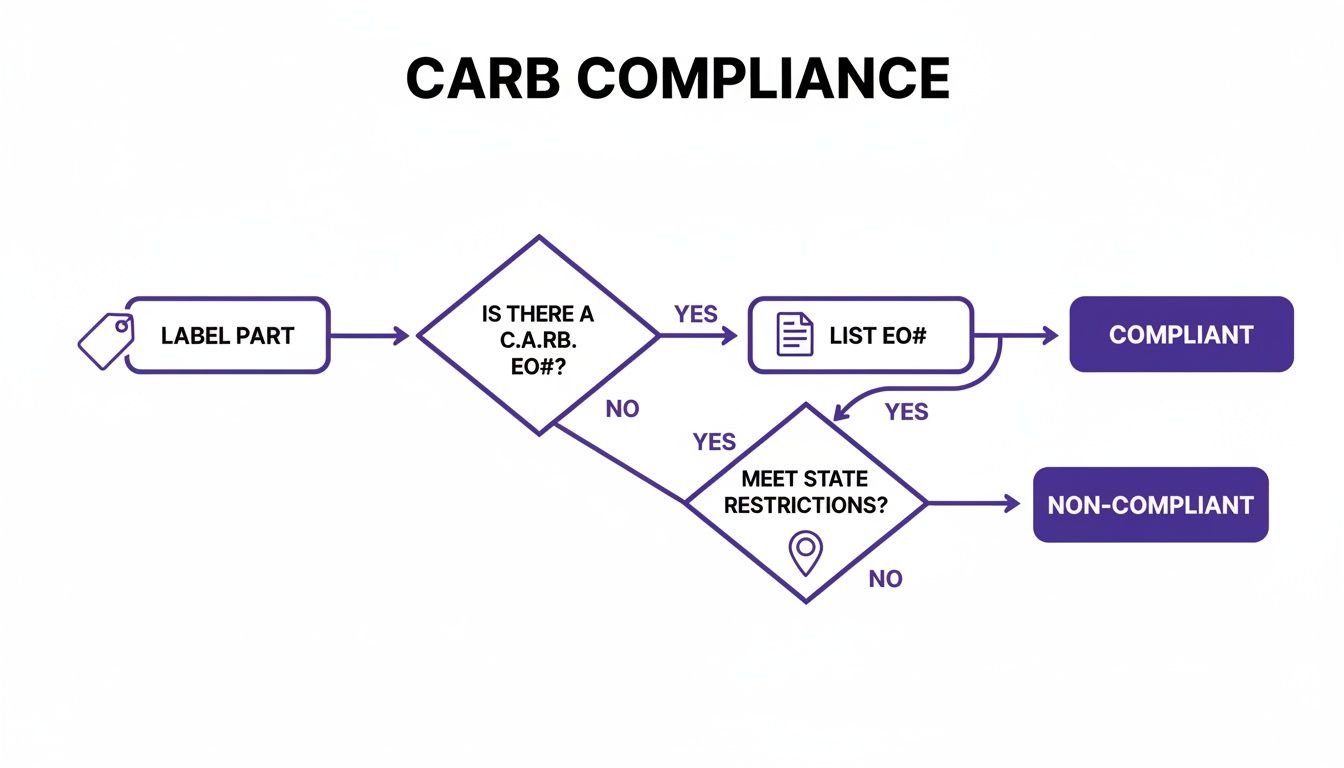
This process shows just how important it is to have your parts labeled correctly with their official Executive Order (EO) numbers. Automation pulls it all together by verifying those details against state-level restrictions before a shipping label can even be created.
Creating Product-Specific and Granular Rules
The real magic of automation is its flexibility. Not all your products are created equal, and neither are their restrictions. You might sell a CARB-compliant converter that’s good to go anywhere alongside its 49-state cousin that’s heavily restricted. Automation lets you create rules for each specific product, so you don't have to think twice about it.
- Rule for CARB Part: Let it ship to all 50 states. No restrictions necessary.
- Rule for 49-State Part: Block it from shipping to California, New York, Colorado, and any other Section 177 states.
With a dedicated tool, you can create a new rule set in just a few clicks. This is where you’d give your rule a name—something like "Block Non-CARB Converters"—and start adding the products and locations needed to enforce the shipping block.
By automating these checks, you build a system that’s not only more accurate but also works 24/7. It stops illegal sales before they happen, giving you a powerful layer of legal protection that a manual process just can’t offer.
If you’re ready to get into the nitty-gritty of setting this up, check out guides on automated shipping compliance for Woo Commerce stores for more detailed walkthroughs. Trust me, switching to an automated system is the single best way to handle the headaches of emissions regulations and make sure your business stays on the right side of the law.
How to Communicate Restrictions to Your Customers
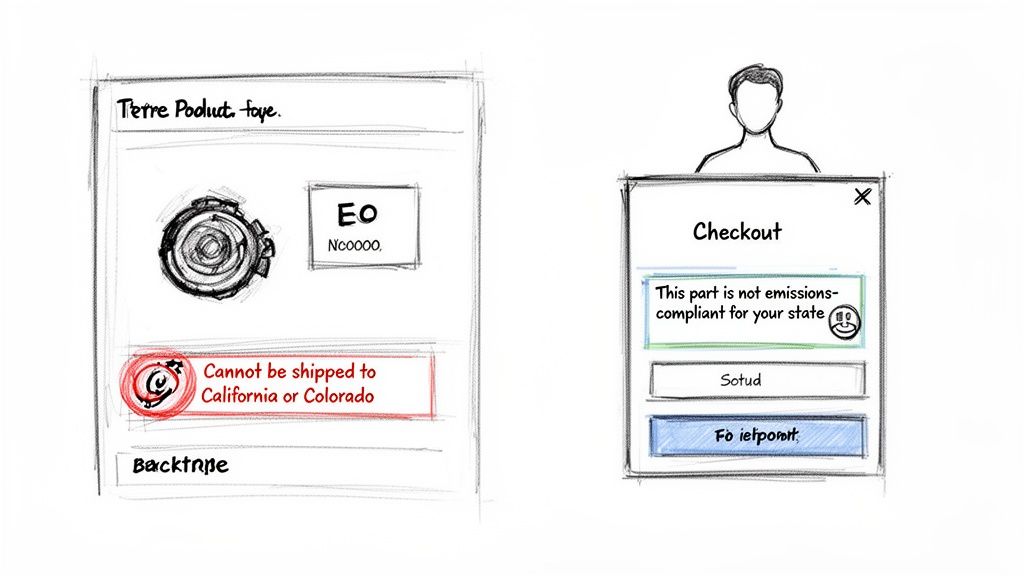
Blocking a sale feels wrong. It goes against every instinct you have as a store owner. But when you’re dealing with catalytic converter CARB parts shipping, it’s a non-negotiable part of doing business right. The trick is to turn a potential point of friction into an opportunity to build trust.
Clear, proactive communication is your best friend here. It helps you sidestep customer frustration and slash the odds of them abandoning their cart. This all starts right on the product page. Don't bury your restrictions in the fine print—make them impossible to miss. A bold, upfront notice on every non-compliant part is your first line of defense, saving your customers from a nasty surprise at checkout.
Crafting Clear and Helpful Messaging
Let's be honest, a generic error message is a dead end. Vague alerts like "Cannot ship to your location" just breed confusion and clog up your support inbox. Your real goal is to explain why the order is blocked and, if possible, point the customer toward a part that will work for them.
Here are a couple of templates you can adapt for your own store:
-
Product Page Notice (for 49-State Parts): "IMPORTANT: Due to state emissions regulations, this part cannot be shipped to addresses in California, New York, or Colorado. Please ensure your shipping destination is not in a restricted state before ordering."
-
Dynamic Checkout Error: "Heads up! This part isn't emissions-compliant for your state. To continue, please remove it from your cart and choose a CARB-compliant model. We're happy to help you find the right one!"
Beyond just the on-screen messages, remember the physical package. Using appropriate caution and warning labels helps shippers and customers handle these parts correctly, preventing costly damage.
This level of transparency does more than just inform; it positions your store as a knowledgeable and trustworthy expert. You’re not just blocking a sale—you’re helping the customer stay on the right side of the law.
For WooCommerce sellers in regulated industries, this whole process should feel familiar. It's the same principle as managing compliance for any other restricted product. Businesses that use plugins for ZIP-code-level blocking are already slashing their manual review time and boosting efficiency.
In a market expected to see $154.74 billion in growth by 2032, automating compliance isn't a luxury—it's essential for keeping up. You have to be able to scale without drowning in spreadsheets.
Protecting Your Business in a Regulated Market
<iframe width="100%" style="aspect-ratio: 16 / 9;" src="https://www.youtube.com/embed/kOj4q6-Gi_E" frameborder="0" allow="autoplay; encrypted-media" allowfullscreen></iframe>Trying to ship CARB-compliant catalytic converter parts can feel like you're navigating a legal minefield blindfolded. The core of the problem is a messy patchwork of state laws, with CARB leading the charge, creating serious risks for online sellers. A single mistaken shipment can trigger steep penalties, turning a profitable sale into a costly legal headache.
Relying on your team to manually check every order is a recipe for disaster. It's slow, mistakes are inevitable, and it's impossible to keep up as your business grows. The chance of a non-compliant part slipping through is just too high, putting your profits, reputation, and legal standing on the line. This is where you have to get proactive and let technology do the heavy lifting.
The Shift to Automated Compliance
The only way to truly solve this problem is with an automated system that enforces your shipping restrictions for you. By setting up rules that automatically block illegal sales based on a customer’s address and the specific parts in their cart, you take all the guesswork—and risk—out of the equation. Compliance stops being a constant source of anxiety and becomes a seamless, invisible process that works for you 24/7.
Proactive compliance isn't just about avoiding fines; it’s about building a trustworthy, scalable, and sustainable eCommerce business. Automation ensures every shipment is legal, protecting your bottom line and freeing you to focus on growth with complete confidence.
Stop gambling with manual checks and hoping for the best. By putting a solid, automated system in place, you can secure your operations against expensive mistakes. For a deeper look at this, check out these essential legal protection strategies for non-compliant orders. Switching to automation is the single most effective move you can make to protect your business in this tightly controlled market.
Common Questions About Shipping CARB-Regulated Parts
It’s easy to get tangled up in the red tape of catalytic converter regulations, especially when different states play by different rules. Let's clear up some of the most common questions we see from sellers trying to do the right thing.
Can I Ship a 49-State Converter to California if it's for "Off-Road Use"?
This is a common and costly myth. The short answer is no.
California law is crystal clear: it's illegal to sell, offer for sale, or ship any aftermarket catalytic converter into the state unless it has a valid CARB Executive Order (EO) number. There are no loopholes for "off-road" or "racing" applications. The rule is enforced at the point of sale, putting all the responsibility squarely on your shoulders as the retailer. Shipping a non-CARB part to California for any reason is a fast track to hefty fines.
What Is a CARB Executive Order Number and How Do I Find It?
Think of a CARB Executive Order (EO) number as a certificate of authenticity issued directly by the California Air Resources Board. It’s the official stamp of approval confirming that a part has survived a gauntlet of rigorous tests and meets the state's tough emissions standards.
For a catalytic converter, this number is non-negotiable proof of legality. It tells regulators that the part will function correctly with a vehicle's OBD-II system and control emissions just as the manufacturer intended.
You'll find the EO number physically stamped onto the body of the converter. As a seller, it's your job to get this number from your supplier and display it prominently on your product pages. This isn't just good practice—it's how you prove a part is legal for sale in California and other states that have adopted its standards.
My Business Isn't in California. Do I Really Need to Worry About CARB Rules?
Yes, absolutely. Where your warehouse is located doesn't matter one bit—what matters is the shipping destination.
If you're based in Florida and you ship a non-compliant converter to a customer in New York, Colorado, or Maine (all of which enforce CARB standards), you're breaking their state laws. Regulators in these states are known for actively pursuing out-of-state sellers, and pleading ignorance won’t get you out of trouble. This is exactly why an automated system that blocks sales based on the customer’s address is so essential. It’s the only reliable way to shield your business from cross-state legal battles and fines that could put you out of business.
Stop gambling with manual checks and protect your business from costly fines. Ship Restrict automates your shipping compliance, blocking restricted orders before they can become a problem. Get Ship Restrict for WooCommerce today and focus on growing your business with confidence.
Automate Shipping Compliance
Stop worrying about restricted states. Ship Restrict handles it automatically.

Cody Yurk
Founder and Lead Developer of ShipRestrict, helping e-commerce businesses navigate complex shipping regulations for regulated products. Ecommerce store owner turned developer.
Automate Shipping Compliance
- Block restricted states
- No more cancellations
- Set and forget
3-day free trial · Card required