Your Guide to Body Armor Shipping Laws by State
Navigate the complex body armor shipping laws by state. Our definitive guide covers restrictions, compliance, and eCommerce fulfillment for online retailers.
Here’s the simple truth: for any law-abiding adult, buying body armor is perfectly legal in 48 out of 50 states. But for eCommerce merchants, the devil is in the details. The regulatory landscape is complicated by two major exceptions—Connecticut and New York—which throw up serious roadblocks for online sales and delivery.
Understanding Body Armor Shipping Regulations
Successfully navigating the rules for selling and shipping body armor means getting a handle on regulations at both the federal and state levels. For online retailers, this isn't just about knowing where you can ship; it's about building a solid compliance framework that shields your business from legal heat.
At its core, the legal landscape is built on two layers of control. First, a federal statute bars anyone with a violent felony conviction from purchasing or possessing body armor. This is the baseline rule that applies nationwide, no matter where your customer lives.
Second, and more importantly for online stores, individual states have their own laws that can add restrictions or ban certain sales entirely. These body armor shipping laws by state are the most critical piece of the puzzle for any eCommerce business to manage.
Automate Shipping Compliance
Block orders to restricted states automatically. 3-day free trial.
Start Free TrialKey State-Level Restrictions
For online merchants, the biggest headaches come from Connecticut and New York. These states have passed laws that effectively kill direct-to-consumer online sales for most civilians.
- Connecticut: This state has a strict mandate that all body armor sales must be conducted face-to-face. This rule makes it illegal to ship an order from an out-of-state warehouse to a residential address in Connecticut. Simple as that.
- New York: After some recent legislative changes, New York now limits the sale of body armor to people in specific "eligible professions," like police officers or licensed security guards. Online stores cannot legally ship to unauthorized civilians there.
Because of these two states, almost every online body armor retailer treats them as "no-ship" zones. Trying to fulfill orders to customers in these locations can lead to steep penalties, including hefty fines and even potential criminal charges. A proactive compliance strategy, using tools to automatically block sales to restricted areas, is essential to operate legally and keep your fulfillment process smooth.
Quick Reference Guide to State Shipping Laws
For any eCommerce manager in the body armor space, having a quick way to vet orders is essential. This guide is your first line of defense, breaking down the complex web of body armor shipping laws by state into simple categories. Think of it as a cheat sheet to quickly flag potentially non-compliant orders before they become a problem.
The good news is that the vast majority of states keep things simple. These "Permissive" states follow federal law, which allows you to ship body armor to any law-abiding adult citizen. As long as your customer isn't a convicted felon, you're generally in the clear.
Things get a bit more complicated in a handful of "Restricted" states. While they don't ban online sales outright, they often have specific rules about who can possess armor or where it can be worn. For instance, some local laws might forbid wearing body armor at a protest or on school property.
Key Shipping Status Categories
Here’s a quick breakdown of how we classify each state:
- Permissive States: Most states fall here. Shipping to civilians is allowed, provided they have no felony convictions.
- Restricted States: Shipping is generally allowed, but you’ll need to pay close attention to local or situational laws that might apply.
- Prohibited States: Online shipments to most civilians are flat-out banned.
The "Prohibited" category is the one you absolutely cannot ignore. Right now, Connecticut and New York have laws that effectively stop online body armor sales to the general public. Connecticut demands a face-to-face transaction, making eCommerce sales impossible. New York only permits sales to a specific list of professions, which also requires in-person verification.
Make no mistake: these classifications are not suggestions. Trying to ship an order to a customer in Connecticut isn't just a fulfillment headache—it's a serious legal liability that could land your business in hot water with fines or even criminal charges.
Below is a quick-lookup table summarizing where each state stands. While this gives you a high-level overview, you should always cross-reference it with the more detailed breakdowns that follow in this guide.
Free Shipping Compliance Audit
We'll review your WooCommerce store's shipping compliance for free.
State-by-State Body Armor Shipping Regulation Summary
This table offers a snapshot of body armor shipping laws for civilians across the United States. Use it for a rapid initial assessment, then consult the detailed state sections for specific nuances.
| State | Shipping Status | Key Restriction Summary |
|---|---|---|
| Alabama | Permissive | No additional state restrictions beyond federal law. |
| Alaska | Permissive | No additional state restrictions beyond federal law. |
| Arizona | Permissive | No additional state restrictions beyond federal law. |
| Arkansas | Permissive | No additional state restrictions beyond federal law. |
| California | Permissive | No state-level shipping ban, but local ordinances may exist. |
| Colorado | Permissive | No additional state restrictions beyond federal law. |
| Connecticut | Prohibited | Bans all online sales; face-to-face transactions required. |
| Delaware | Permissive | No additional state restrictions beyond federal law. |
| Florida | Permissive | No additional state restrictions beyond federal law. |
| Georgia | Permissive | No additional state restrictions beyond federal law. |
| Hawaii | Permissive | No additional state restrictions beyond federal law. |
| Idaho | Permissive | No additional state restrictions beyond federal law. |
| Illinois | Restricted | Shipping allowed, but possession is restricted in certain situations. |
| Indiana | Permissive | No additional state restrictions beyond federal law. |
| Iowa | Permissive | No additional state restrictions beyond federal law. |
| Kansas | Permissive | No additional state restrictions beyond federal law. |
| Kentucky | Permissive | No additional state restrictions beyond federal law. |
| Louisiana | Permissive | No additional state restrictions beyond federal law. |
| Maine | Permissive | No additional state restrictions beyond federal law. |
| Maryland | Permissive | No additional state restrictions beyond federal law. |
| Massachusetts | Permissive | No additional state restrictions beyond federal law. |
| Michigan | Permissive | No additional state restrictions beyond federal law. |
| Minnesota | Permissive | No additional state restrictions beyond federal law. |
| Mississippi | Permissive | No additional state restrictions beyond federal law. |
| Missouri | Permissive | No additional state restrictions beyond federal law. |
| Montana | Permissive | No additional state restrictions beyond federal law. |
| Nebraska | Permissive | No additional state restrictions beyond federal law. |
| Nevada | Permissive | No additional state restrictions beyond federal law. |
| New Hampshire | Permissive | No additional state restrictions beyond federal law. |
| New Jersey | Permissive | No additional state restrictions beyond federal law. |
| New Mexico | Permissive | No additional state restrictions beyond federal law. |
| New York | Prohibited | Bans online sales to civilians; only eligible professions can buy. |
| North Carolina | Permissive | No additional state restrictions beyond federal law. |
| North Dakota | Permissive | No additional state restrictions beyond federal law. |
| Ohio | Permissive | No additional state restrictions beyond federal law. |
| Oklahoma | Permissive | No additional state restrictions beyond federal law. |
| Oregon | Permissive | No additional state restrictions beyond federal law. |
| Pennsylvania | Permissive | No additional state restrictions beyond federal law. |
| Rhode Island | Permissive | No additional state restrictions beyond federal law. |
| South Carolina | Permissive | No additional state restrictions beyond federal law. |
| South Dakota | Permissive | No additional state restrictions beyond federal law. |
| Tennessee | Permissive | No additional state restrictions beyond federal law. |
| Texas | Permissive | No additional state restrictions beyond federal law. |
| Utah | Permissive | No additional state restrictions beyond federal law. |
| Vermont | Permissive | No additional state restrictions beyond federal law. |
| Virginia | Permissive | No additional state restrictions beyond federal law. |
| Washington | Permissive | No additional state restrictions beyond federal law. |
| West Virginia | Permissive | No additional state restrictions beyond federal law. |
| Wisconsin | Permissive | No additional state restrictions beyond federal law. |
| Wyoming | Permissive | No additional state restrictions beyond federal law. |
This table is a starting point. For a complete compliance strategy, it's crucial to understand the "why" behind each state's status. To see how similar rules apply to other products, check out our guide on pepper spray and self defense product shipping restrictions by state.
When it comes to shipping body armor, most states keep things simple for online sellers and law-abiding customers. But a handful of jurisdictions create major roadblocks, effectively turning them into no-go zones for eCommerce merchants. These aren't just tricky guidelines; they're hard legal lines that can expose your business to serious penalties.
For anyone selling body armor online, two states in particular—Connecticut and New York—have passed laws that make direct-to-consumer shipments a direct violation. You have to get this right.
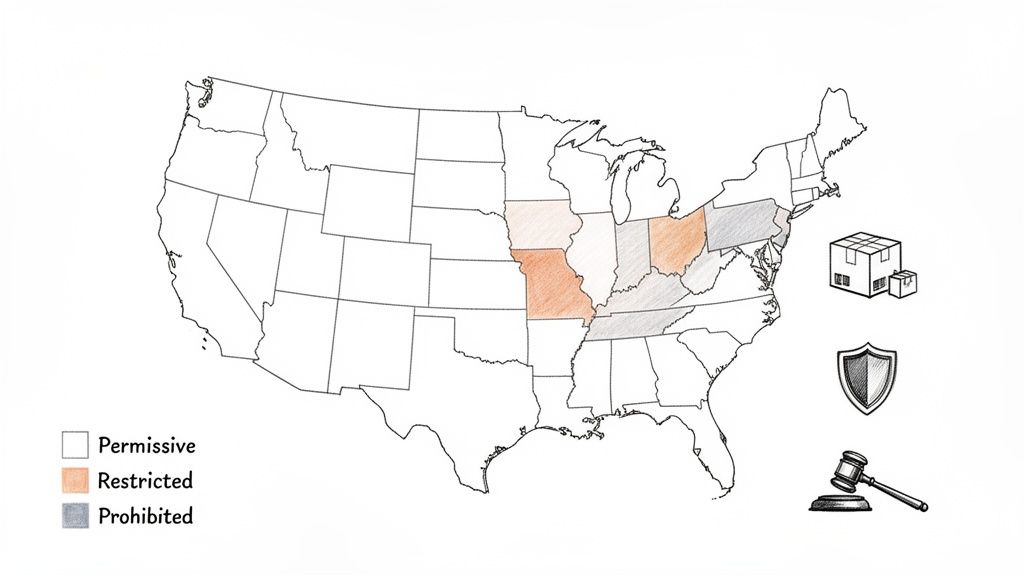
This chart gives you a quick visual breakdown of the legal landscape. As you can see, a small number of prohibited states require a disproportionate amount of attention.

While the map shows most of the country is open for business, those few red states are where compliance automation becomes an absolute necessity.
Connecticut: The Face-to-Face Mandate
Connecticut law is crystal clear: the sale or delivery of body armor is illegal unless the transaction happens in person. This one rule single-handedly slams the door on eCommerce shipments to any residential address in the state.
An online store, by its very nature, can't meet this face-to-face requirement. Shipping a plate carrier to a customer in Connecticut via UPS, FedEx, or USPS isn't just a bad idea—it's against the law.
Key Takeaway: The state of Connecticut classifies the illegal sale or delivery of body armor as a Class B misdemeanor. That comes with penalties of up to six months in prison and a fine of up to $1,000.
This is not a gray area. For any online retailer, Connecticut has to be a hard "no." The legal and financial risks are just too high, making automated shipping blocks for the entire state a must-have.
New York: The Eligible Professions Hurdle
New York takes a different path but arrives at the same destination for most online sellers. Thanks to recent legislation, the purchase and possession of "body vests" are now limited to people in specific "eligible professions." This list is pretty narrow, covering active law enforcement, military personnel, and certain licensed security professionals.
The real kicker is that the law puts the burden of proof squarely on the seller to verify a buyer's professional eligibility at the time of sale. For a standard online checkout process, reliably and securely verifying this kind of documentation is next to impossible.
This is why most online merchants simply treat New York as a prohibited state for any non-governmental sales.
- Verification Burden: You, the seller, are responsible for confirming the buyer's professional credentials. Standard eCommerce platforms aren't built for that kind of secure verification.
- Criminal Penalties for Buyers: Unlawful purchase or possession is a Class A misdemeanor on the first offense, and it can escalate to a felony for repeat offenses.
- Steep Fines for Sellers: If you sell or deliver body armor illegally, you're looking at a civil penalty starting at $5,000 for the first offense and jumping to $10,000 for any that follow.
Between them, Connecticut and New York are the two states with unambiguous laws that shut down eCommerce body armor sales to the general public. While roughly 48 out of 50 states allow shipments to law-abiding adults, these two outliers represent a critical 4% that require absolute, automated shipping restrictions. Trying to ship to them isn't a calculated risk—it's a surefire way to invite legal trouble and major business headaches. For more on the specifics, various industry compliance guides offer deep dives into enforcement trends.
Managing Federal and State Felon Prohibitions
<iframe width="100%" style="aspect-ratio: 16 / 9;" src="https://www.youtube.com/embed/MbVFmr63GCU" frameborder="0" allow="autoplay; encrypted-media" allowfullscreen></iframe>Beyond the outright shipping bans in places like Connecticut and New York, there's a universal rule every body armor merchant has to deal with: the federal prohibition against convicted felons buying or possessing body armor. This law is the baseline for every single sale, no matter which state it's going to.
This creates a serious compliance headache for any eCommerce business. Unlike a simple address check that can block a shipment to a restricted state, there’s just no way to automatically verify a customer’s criminal history during checkout. A shipping address tells you where an order is going, but it says nothing about whether the buyer can legally own what's in the box.
The Challenge of Remote Verification
Because you can't run a background check on every customer, the risk of unknowingly shipping to a prohibited person is always there. This gap in your process means you have to build a defensive compliance strategy, one that’s all about due diligence and crystal-clear communication.
The goal isn't to access criminal records—it's to show you made a good-faith effort to follow the law. This comes down to creating rock-solid policies and checkout procedures that put the felon prohibition front and center.
Common Industry Practices for Mitigation
To tackle this problem, smart online retailers have adopted a few key practices. These methods help manage risk, enforce body armor shipping laws by state and federal rules, and shift some of the compliance burden onto the customer—all while creating a defensible record for your business.
- Customer Attestations: This is the most common approach. You add a mandatory checkbox at checkout where the customer has to actively confirm they are not a convicted felon and are legally allowed to purchase body armor. This creates a digital paper trail of their self-certification.
- Clear Terms and Conditions: Your site’s terms of sale need to state in no uncertain terms that convicted felons are prohibited from buying body armor. It should also specify that by completing a purchase, the customer is confirming they are eligible to do so.
- Meticulous Sales Records: Keeping detailed records of every transaction is absolutely critical. This includes the customer’s attestation from the checkbox. If law enforcement ever questions a sale, these records can be your best defense.
The combination of federal and state laws acts as a clear filter for who can buy online. While roughly 96% of U.S. states let you ship to ordinary adults, every one of those transactions depends on the buyer not being a prohibited person. You can dig deeper into this by checking out a detailed analysis of 2025 body armor laws to better understand this side of compliance.
This layered compliance burden—mixing geographic shipping rules with process-based controls—is exactly why so many sellers turn to automated systems. A good setup can block shipments to prohibited states while also forcing mandatory attestations for every other order. For merchants, building a strong defense is about more than just blocking a few ZIP codes; it’s about having a comprehensive strategy. You can learn more about building that strategy by reading about legal protection strategies for non-compliant orders to make sure your business is covered from all angles. Taking this proactive stance is key to staying in business for the long haul.
The Impact of Enhanced Penalty Statutes
Direct shipping bans are the most obvious hurdle when you’re figuring out body armor shipping laws by state, but they aren't the only legal tripwires to watch for. A more subtle, but equally critical, factor is the presence of enhanced penalty statutes. These are the laws that tack on harsher punishments for criminals who commit a crime while wearing body armor.
While these statutes don’t outright stop you from selling or shipping armor, they signal a major shift in the legal environment. They tell you that lawmakers see a direct line between body armor and serious criminal activity. That perception inevitably leads to much closer scrutiny of how that gear gets into the public’s hands in the first place.
How These Laws Indirectly Affect Your Business
Enhanced penalty laws have a ripple effect that touches nearly every part of the ecosystem you operate in. They shape how payment processors, shipping carriers, and even online marketplaces think about body armor sales. When a state decides that wearing a vest during a crime deserves a tougher sentence, it frames the product itself as a risk factor.
This pressure trickles down to your business in a few key ways:
- More Scrutiny from Your Partners: Payment gateways and shipping carriers might tighten their terms of service. They may start asking you to prove you have solid compliance measures in place to show you aren’t selling to high-risk individuals.
- Stricter Platform Policies: Marketplaces like Amazon or eBay often create policies that reflect these statutory risks. Sometimes they ban the sale of body armor entirely just to avoid any connection to its criminal use.
- A Stepping Stone to Stricter Laws: Think of enhanced penalty statutes as a legislative canary in the coal mine. They often lay the groundwork for future, more direct restrictions on sales—we’ve seen this exact pattern play out in states like New York and Connecticut.
States With Enhanced Penalties and Their Impact
The presence of these laws is a clear indicator of a state's stance on body armor. Beyond direct purchase restrictions, at least a dozen states impose enhanced criminal penalties when offenders commit crimes while wearing body armor. States like Arizona, Florida, New Hampshire, Oklahoma, Massachusetts, and New Jersey have statutes that can elevate an offense or lengthen a sentence, with penalties ranging from Class E to Class B felonies depending on the underlying crime.
This legislative framework helps explain why some jurisdictions moved toward stricter controls, like Connecticut's face-to-face sales rule. Policy trackers show that roughly 20–30% of states have these provisions, which often include exemptions for law enforcement, further complicating fulfillment logic for retailers. For merchants, this means that shipping policies are judged not just on buyer eligibility but also on the downstream public safety implications of your distribution methods. Get more details on how international and domestic laws interact with these penalty statutes.
The Big Picture: These laws are a reminder that compliance is about more than just following black-and-white shipping rules. It’s about understanding the legal climate in every state you sell to and adopting a proactive strategy that demonstrates responsibility and due diligence.
Ultimately, staying aware of these statutes is just good business. A proactive approach to compliance—even where sales are technically allowed—helps you maintain good standing with your business partners and ensures you're ready for whatever regulatory shifts come next.
Automating Shipping Compliance for Your Store
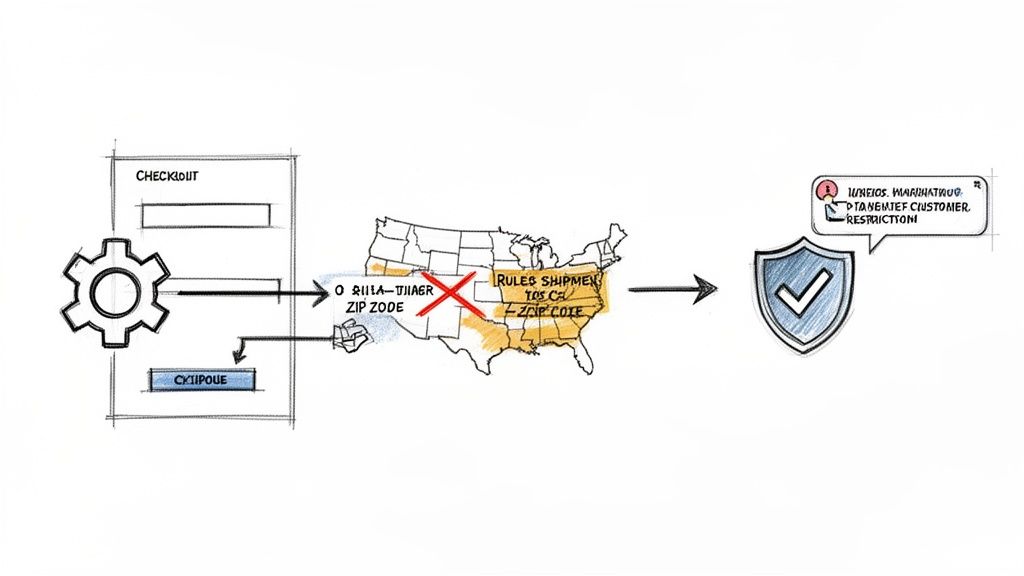
Knowing the tangled web of body armor shipping laws by state is one thing. Actually enforcing them is another battle entirely. For any eCommerce store in this space, the real challenge is turning that legal knowledge into a set of rock-solid, automated rules that protect your business 24/7.
Let's be honest: manually checking every single order against a spreadsheet of restricted states isn't just slow—it's a recipe for expensive mistakes. One slip-up, and you're exposed.
This is where automation becomes non-negotiable. With an automated shipping restriction system, you can flip your compliance strategy from a reactive, manual headache to a proactive, error-proof machine. The idea is simple but powerful: stop a non-compliant order dead in its tracks before it can even be placed.
Building Your Automated Rule Set
The first step is to create a digital rulebook that mirrors the real-world legal landscape. This means setting up specific blocks for states, counties, or even individual ZIP codes where you can't sell or ship your products.
For body armor, the initial setup is pretty straightforward and focuses on neutralizing the biggest legal risks right away.
- Block Prohibited States: Your number one priority. Set up an unbreakable rule that flat-out blocks any shipment going to Connecticut or New York. This is the hard-and-fast line you can't cross.
- Implement Felon Attestations: While you can't run a background check at checkout, you can require a legal attestation. This means tweaking your checkout process to force every customer to check a box, confirming they are legally allowed to own body armor and are not a convicted felon.
- Display Custom Messages: Smart automation isn't just about blocking orders; it's about clear communication. When someone from a restricted state tries to check out, your system should pop up a clear, polite message explaining why the order can't go through. This heads off a ton of customer support tickets and frustration.
For businesses looking to build custom solutions or pull in legal data feeds, getting good with tools for efficient PDF parsing for compliance automation can be a game-changer. It's how you turn dense legal docs into structured data your system can actually use.
A Practical Step-By-Step Workflow
Setting these rules up in a tool like Ship Restrict for WooCommerce is a direct process. You just create a new rule, give it a name like "Block Connecticut Body Armor Shipments," and tell it what conditions to look for.
For a deeper dive into the technical setup, our guide on automated shipping compliance for Woo-Commerce stores breaks it all down.
The Benefits of a Fully Automated System
Switching from manual checks to an automated workflow brings immediate and massive advantages. The impact goes way beyond just stopping a few bad orders.
- Eliminate Human Error: Manual address checks are riddled with potential mistakes. A good automated system checks every single order against your ruleset, flawlessly, 24/7.
- Save Administrative Hours: Think about the time your team wastes double-checking addresses and processing cancellations for orders that never should have been placed. Automation gives you those hours back.
- Reduce Financial Risk: A single illegal shipment can trigger fines from $1,000 to $10,000, not to mention the costs of returns and legal headaches. Automation is a small investment to prevent a huge financial hit.
- Improve the Customer Experience: Instead of canceling an order after someone thinks they’ve successfully bought something, your system tells them about the restriction upfront. That transparency prevents angry customers and protects your brand’s reputation.
At the end of the day, automating your store’s compliance is the only sane way to navigate the shifting landscape of body armor shipping laws by state. It’s the peace of mind that comes from knowing your business is protected, efficient, and 100% compliant.
Common Questions About Body Armor Shipping Laws
Even after getting a handle on the state-by-state rules and federal felon bans, merchants and customers still run into tricky situations. This section tackles some of the most common questions we see, helping you iron out the last few details of your compliance plan and navigate the gray areas of body armor shipping laws.
These are the kind of practical, real-world questions that pop up when you're in the thick of running an eCommerce store that sells regulated gear.
Can I Legally Ship Body Armor to a P.O. Box?
Here's the deal: while no specific state or federal law outright says you can't ship body armor to a P.O. Box, doing so is a massive compliance gamble. The core problem is that you can't verify the customer's actual physical location. Without that, you can't be certain they're even eligible to receive the armor.
This gets particularly risky if the P.O. Box is right on the border of a restricted state like Connecticut or New York. For this very reason, nearly all reputable online sellers and every major shipping carrier will insist on a physical street address for delivery. It's a simple policy that ensures the package is going to a verifiable, compliant destination.
Do the Laws Change for Different Types of Body Armor?
In a word, no. State laws governing the shipping and possession of body armor almost always define it as a single, broad category. They don't get into the weeds of National Institute of Justice (NIJ) protection levels. So, whether you’re selling a Level IIIA soft vest or a Level IV hard plate, the same set of rules applies.
The only factors that really matter when determining if a sale is legal are:
- The buyer’s location: Is the shipping address in a flat-out prohibited state like Connecticut or New York?
- The buyer’s legal history: Is the person a convicted felon? If so, they're barred from owning body armor under federal law, period.
Because these regulations treat all ballistic-resistant products the same, your compliance strategy should, too. Don't create different rules based on protection ratings; it just complicates things and doesn't add any legal protection.
What Happens If I Accidentally Ship to a Restricted State?
An accidental shipment to a place you're not supposed to can bring down a world of hurt on your business. For instance, if you mistakenly send an order to a civilian in Connecticut, you could be looking at everything from hefty fines to misdemeanor charges. A first-offense illegal sale in New York comes with a civil penalty that starts at a cool $5,000.
But it doesn't stop with legal penalties. That shipment will almost certainly be intercepted and seized by law enforcement. You'll lose the product, you'll lose the revenue from the sale, you'll get hit with a customer chargeback, and your brand's reputation will take a serious ding.
This is exactly why trying to verify addresses by hand is such a terrible idea. One simple typo or a moment of distraction can lead to a violation that costs you thousands. The only truly safe way to operate is with an automated system that blocks orders from prohibited locations before you ever see them, guaranteeing 100% compliance.
Stop wasting time on manual checks and eliminate the risk of costly shipping errors. Ship Restrict automates your compliance with body armor shipping laws, blocking prohibited orders by state or ZIP code before they can be placed. Protect your business and streamline your operations by visiting https://shiprestrict.com to get started today.
Automate Shipping Compliance
Stop worrying about restricted states. Ship Restrict handles it automatically.

Cody Yurk
Founder and Lead Developer of ShipRestrict, helping e-commerce businesses navigate complex shipping regulations for regulated products. Ecommerce store owner turned developer.
Automate Shipping Compliance
- Block restricted states
- No more cancellations
- Set and forget
3-day free trial · Card required