Blind Shipment Definition: Legal Risks for Firearm eCommerce
Understand the blind shipment definition and critical legal risks for firearms eCommerce. Learn to mitigate WooCommerce exposure and stay ATF compliant in 2026.
A blind shipment is when a product ships from a third-party supplier but appears to come directly from the retailer, and by 2015, dropshipping, which heavily relies on blind methods, accounted for 23% of global online retail sales. If you're running a WooCommerce firearms store, that simple logistics tactic can create a serious compliance problem the moment supplier identity, FFL traceability, and destination restrictions stop lining up.
A lot of store owners run into this without realizing it. An order comes in, a distributor fulfills it, the label shows your store name, and everyone assumes that's just standard dropshipping hygiene. In most categories, that may be a branding choice. In firearms eCommerce, it's a legal exposure.
Generic logistics articles usually frame blind shipping as a margin-protection tool. That's incomplete for FFL holders. If you sell regulated products through WooCommerce, the key question isn't just "what is a blind shipment?" It's whether your shipping workflow hides information that regulators expect you to preserve.
What Is a Blind Shipment in eCommerce
The plain-English blind shipment definition is straightforward. A blind shipment is a shipment sent by a supplier or manufacturer directly to the customer while the paperwork or label presents the retailer, distributor, or another intermediary as the sender.
Automate Shipping Compliance
Block orders to restricted states automatically. 3-day free trial.
Start Free TrialThat arrangement didn't appear out of nowhere. Blind shipping emerged as a logistics practice in the mid-20th century, and its formalized use took shape in the 1980s, especially as less-than-truckload carriers standardized ways to conceal shipper identity for business reasons, as explained in WWEX's overview of blind shipping. The model became much more visible once eCommerce scaled. The same source notes that dropshipping accounted for 23% of global online retail sales by 2015.
For a new seller, that sounds normal. If you're still mapping out fulfillment strategy, an expert guide for ecommerce startups is useful for understanding the broader operating model before regulated shipping rules complicate it.
For a firearms retailer, the issue is different. You might think you're buying efficiency, but you're also changing who appears on the shipping record, what the customer sees, and what your fulfillment partner can obscure.
Why the term matters more for FFL holders
In apparel or housewares, a blind shipment mostly affects branding and supplier confidentiality. In firearms eCommerce, it can affect traceability, return handling, and who can verify that the shipment was lawful before it moved.
Practical rule: If your supplier ships under your store identity, you need to know exactly which records still disclose the licensed origin and who keeps them.
That's why blind shipment definition articles that stop at "it hides the supplier" miss the point. For FFL holders, the hidden party may be the very party regulators expect to be identifiable in the transaction record.
If you're already reviewing your online transfer and recordkeeping obligations, this guide on ATF Form 4473 and e-commerce for online firearm retailers helps connect front-end orders to downstream compliance responsibilities.
What blind shipping is not
Blind shipping isn't automatically illegal. It also isn't the same thing as using a 3PL. The problem starts when the effort to conceal supplier identity collides with a regulated product workflow that depends on accurate, auditable shipping information.
That distinction matters. Many WooCommerce merchants inherit shipping settings from a distributor and never inspect the underlying documents. That's where risk starts.
Free Shipping Compliance Audit
We'll review your WooCommerce store's shipping compliance for free.
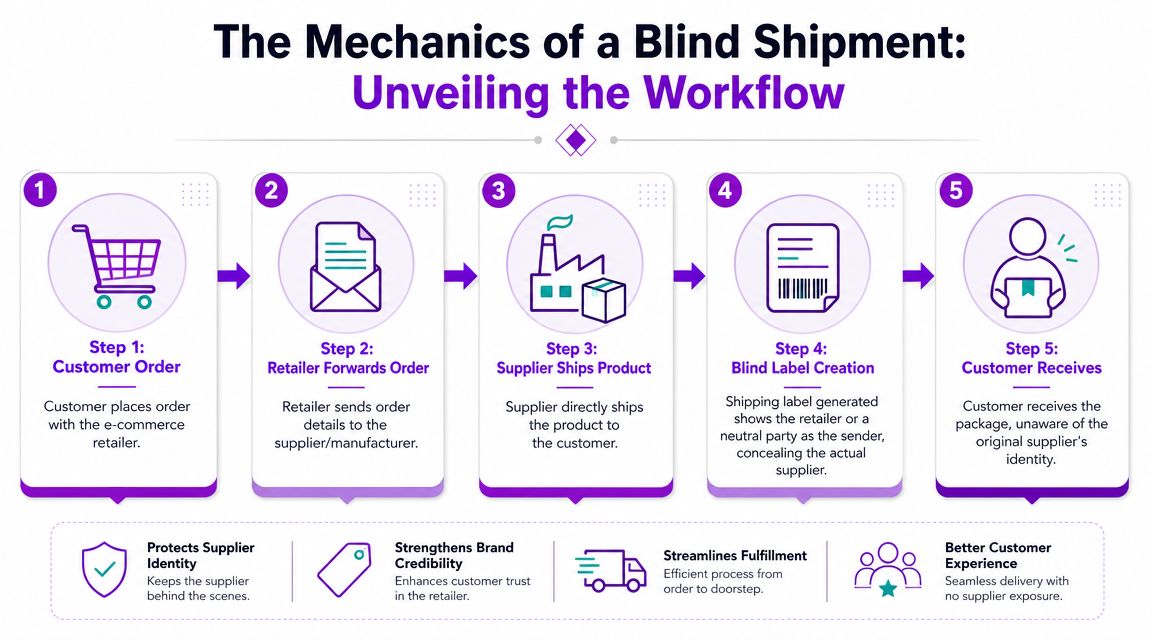
The Mechanics of a Blind Shipment
Blind shipping looks simple from the customer side because the box arrives with the retailer's branding or a neutral sender. Behind the scenes, the paperwork is doing the hard work.
The easiest way to understand it is to separate product flow from information flow. The product may move straight from supplier to customer. The information does not. It gets split, sanitized, and reassigned depending on who is allowed to see what.
The three parties involved
Most blind shipments revolve around three actors:
- The retailer receives the order and controls the customer relationship.
- The supplier or manufacturer actually holds inventory and ships the product.
- The customer receives the package but doesn't see the supplier's identity.
That sounds routine until freight documents enter the picture. In blind shipping, the carrier still needs accurate routing details even when the customer-facing paperwork doesn't show the true shipper.
The Bill of Lading is the control point
The operational core of blind shipping is the Bill of Lading, or BOL. According to GoComet's explanation of blind shipments, execution requires three distinct BOL versions:
| BOL version | Who gets it | What it shows |
|---|---|---|
| Shipper copy | Supplier | Complete origin and destination data |
| Consignee copy | Customer or receiving party | Supplier information redacted |
| Master routing BOL | Carrier | Complete routing information needed for delivery |
That tri-document setup is what creates the "blind" effect. The customer sees a sanitized version. The carrier sees what it needs to complete the route. The supplier retains a full version tied to actual origin.
The shipment is only "blind" to selected parties. It is not blind to the carrier, and it should never be blind to your compliance process.
Where firearms sellers get into trouble
In practice, many WooCommerce store owners never review the BOL hierarchy. They see the final label and assume that's the whole record. It isn't.
For regulated products, the safest checkpoint is before BOL swapping or redaction. If your system validates shipment legality using only customer-facing documentation, you're checking the least reliable version of the data.
What works is validating against the authoritative routing information while the order is still under your control. What doesn't work is assuming a downstream carrier, distributor, or 3PL will catch a destination issue after the shipment has already entered a blind workflow.
Blind vs Double-Blind Shipments in Practice
A standard blind shipment and a double-blind shipment aren't the same risk class. In ordinary retail, people often lump them together. In compliance work, they should be treated very differently.
Start with a simple non-regulated example. A WooCommerce apparel seller takes an order for a jacket. The manufacturer packs it, ships it directly to the buyer, and the label shows the retailer's brand. The customer doesn't know who made or shipped the item. That's a single-blind shipment.
Now increase the opacity.
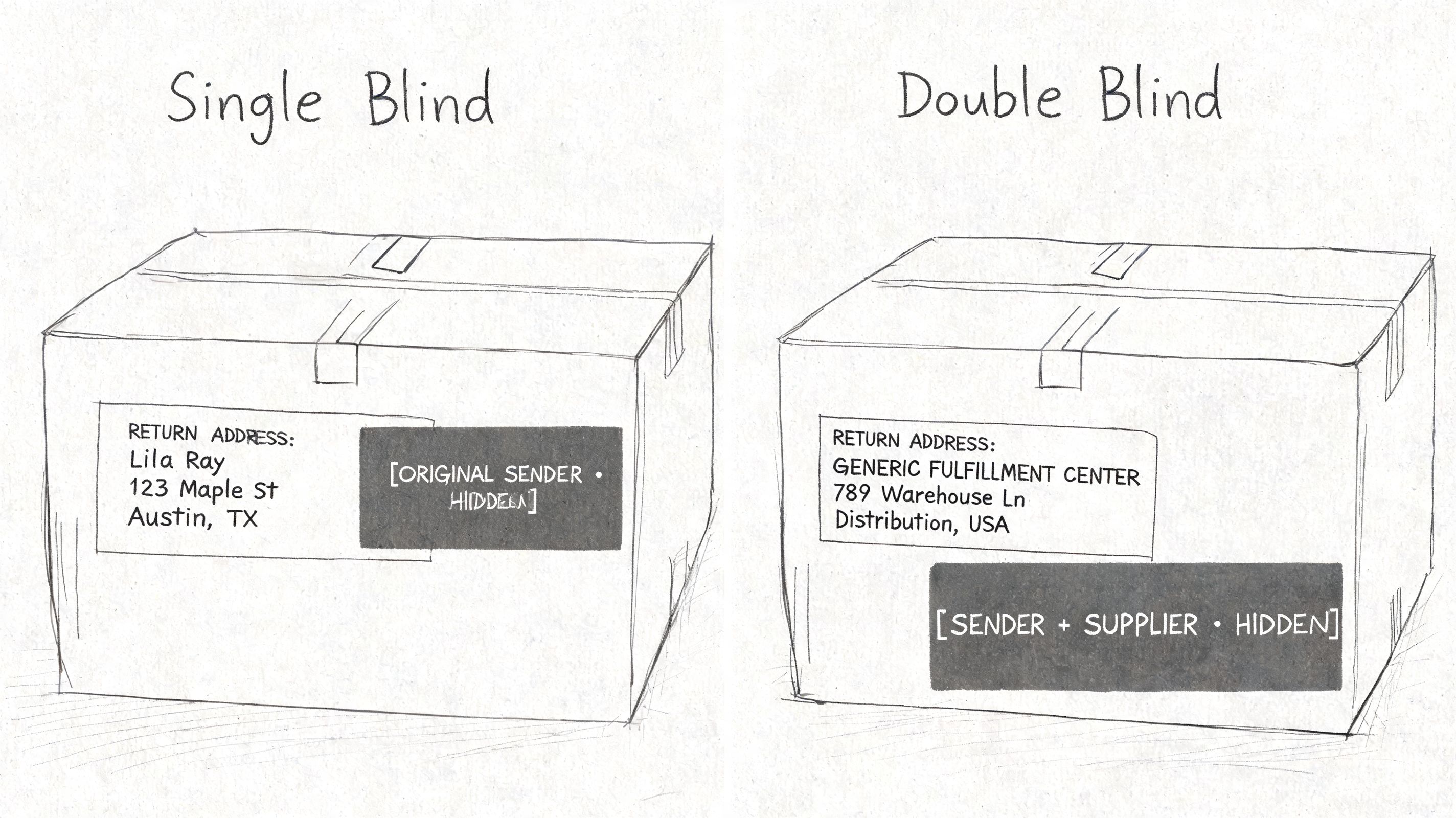
Single-blind in real life
In a single-blind arrangement, the customer is the party kept in the dark. The supplier knows where the item is going. The retailer knows who the supplier is. The customer just sees the retailer or a neutral sender.
That setup is common because it protects supplier relationships without breaking operational visibility between the commercial parties handling the order.
Double-blind changes the chain of knowledge
Double-blind shipment guidance from PackageX describes a more complex setup. In double-blind shipments, both the supplier and end customer are unaware of each other's identities. The shipper receives an incorrect final address from the freight forwarder, while the consignee sees only the 3PL's information.
Here's the practical difference:
| Shipment type | Customer knows supplier | Supplier knows final customer | Main coordinator |
|---|---|---|---|
| Single-blind | No | Yes | Retailer or supplier |
| Double-blind | No | No | 3PL or freight broker |
That sounds efficient on paper. For regulated goods, it creates a serious problem. The party shipping the item may not have direct confirmation of the true destination, and the receiving party may not know the true origin.
If nobody in the physical fulfillment chain can see the full transaction, then compliance has to be locked in before the shipment leaves the order system.
Why this matters for distributors and FFL sellers
Double-blind workflows make sense when a distributor wants to protect both sides of a relationship. They're much harder to defend when the shipment involves products that trigger federal and state restrictions.
For firearms and ammunition sellers, fragmented visibility means responsibility gets spread across parties with incomplete facts. That's exactly the wrong architecture for a product category where the merchant needs confidence about destination legality before fulfillment starts.
Critical Compliance Risks for Firearms eCommerce
Blind shipping is often sold as a clean operational trick. For firearms retailers, it can become a recordkeeping and enforcement problem fast.
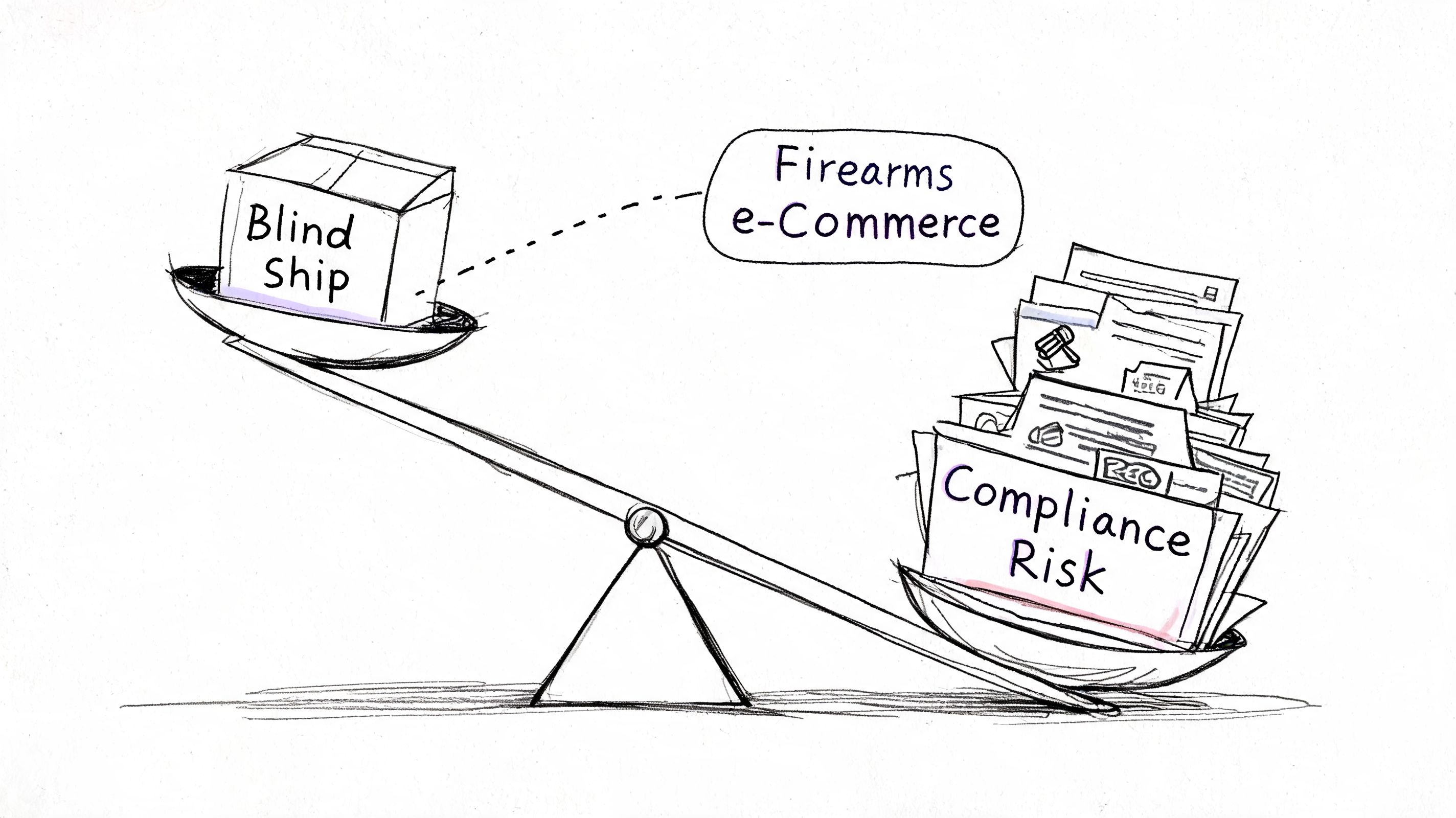
The core issue is simple. Firearms transactions don't just require delivery. They require traceable, defensible handling tied to licensed parties and restricted destinations.
According to ShipBob's blind shipping overview, blind shipping can conflict with the Gun Control Act, 18 U.S.C. § 922, because firearms retailers need transparent FFL-licensed shipment tracking. The same source notes that obscuring the FFL origin on a Bill of Lading can bring ATF scrutiny, with penalties up to $250,000 or license revocation.
Where ordinary blind shipping breaks down
The problem isn't merely that the customer can't see the supplier. The problem is that standard blind shipping habits encourage businesses to hide or sanitize the very shipping information they should be preserving internally.
Three failure patterns show up often:
- Redacted origin data: Your customer-facing label may be harmless, but if internal records stop clearly tying the shipment to the licensed shipper, you've weakened your audit trail.
- Distributor-managed fulfillment with vague paperwork: Many sellers rely on a partner's default freight process without checking whether FFL details remain available in the authoritative documents.
- Late compliance checks: If you wait until packing or pickup to validate destination rules, the order is already too deep in the workflow.
A lot of merchants also underestimate return risk. If a package needs to be rerouted, refused, or investigated, the quality of your shipping records becomes more important than the branding logic that justified blind shipping in the first place.
The legal exposure isn't theoretical
The legal issue is not abstract paperwork hygiene. When licensed origin, destination restrictions, and carrier records don't align, you create a transaction that is harder to defend.
This walkthrough is worth watching because it shows how quickly shipping decisions intersect with firearm compliance obligations:
<iframe width="100%" style="aspect-ratio: 16 / 9;" src="https://www.youtube.com/embed/17TRO52zChM" frameborder="0" allow="autoplay; encrypted-media" allowfullscreen></iframe>If you need a broader operational baseline, this guide on firearms and ammunition shipping compliance for WooCommerce stores is a useful companion to your shipping review.
What works and what doesn't
What works is a partial-blind mindset inside your own operation. Customers may not need supplier-level visibility, but your compliance records do. You need full internal traceability, accurate licensed-origin documentation, and destination checks completed before fulfillment starts.
What doesn't work is treating firearms like ordinary dropship SKUs. In this category, "neutral sender" can be acceptable in a narrow branding sense, but only if it doesn't erase the internal record of who shipped, under what authority, and to which lawful destination.
Auditing Your WooCommerce Supply Chain for Blind Shipments
Many WooCommerce merchants don't choose blind shipping directly. They inherit it from a wholesaler, a 3PL, or a distributor's default process. That's why the first step is an audit, not an assumption.
This matters even more because WooCommerce operates at significant scale. FreightRight's blind shipment overview notes that WooCommerce has over 6 million active sites, and its growth corresponds with a 37% increase in stores adopting dropshipping for regulated goods. In that environment, manual compliance checks break down quickly when fulfillment visibility is limited.
Questions to ask every supplier and 3PL
Don't ask whether they "support blind shipping." Ask how they document it.
Use questions like these:
- Who appears as shipper on the customer-facing label? You need the exact answer, not "it depends."
- Who retains the full Bill of Lading? If they can't identify the authoritative record, that's a problem.
- Does the carrier receive a master routing document with full origin data? If yes, ask who can retrieve it later.
- What return address appears on refused or undeliverable shipments? Returns often expose weak documentation practices.
- Can you provide written workflow details for regulated products? If they only describe general eCommerce procedures, assume the process wasn't designed for firearms.
Ask for sample documents with sensitive details redacted. Verbal reassurance is not a control.
Red flags inside your WooCommerce operation
Some warning signs appear in your own stack, not your supplier's.
| Red flag | Why it matters |
|---|---|
| Order notes use vague fulfillment language | Staff may not know who actually ships the item |
| Shipping plugins only validate carrier methods | They may not validate destination legality |
| Supplier answers differ from 3PL answers | Your audit trail will break under scrutiny |
| Returns go to a neutral warehouse without clear FFL handling | Reverse logistics may be non-compliant |
Store owners also need to inspect communication flows. If your team is coordinating exceptions through email, text threads, and order notes, key shipping facts get scattered. Tools built for multi-channel communications for WooCommerce can help centralize fulfillment conversations, which makes audit work easier even if they aren't compliance tools.
What to document before you trust the workflow
Your internal audit file should include:
- A written supplier shipping map: Who ships, who labels, who appears on documents.
- BOL ownership details: Which party keeps each version and how you retrieve it.
- Destination-check timing: The exact point where restricted addresses are blocked.
- Return-path instructions: Especially for refused, failed, or carrier-damaged firearm-related shipments.
If you need a structured starting point, this WooCommerce shipping compliance audit checklist gives a practical framework for reviewing store settings, workflows, and partner dependencies.
What works here is boring rigor. What fails is informal trust in a supplier's "standard process."
Automating Compliance to Eliminate Shipping Risks
The safest fix isn't better guesswork around blind paperwork. It's stopping unlawful shipments before they ever become shipping records.
That's a key lesson for firearms sellers. Blind shipping creates complexity at the fulfillment stage, but the strongest control sits earlier. If your store can block restricted orders by destination before payment or routing, then the downstream label format becomes a secondary issue instead of the primary risk.
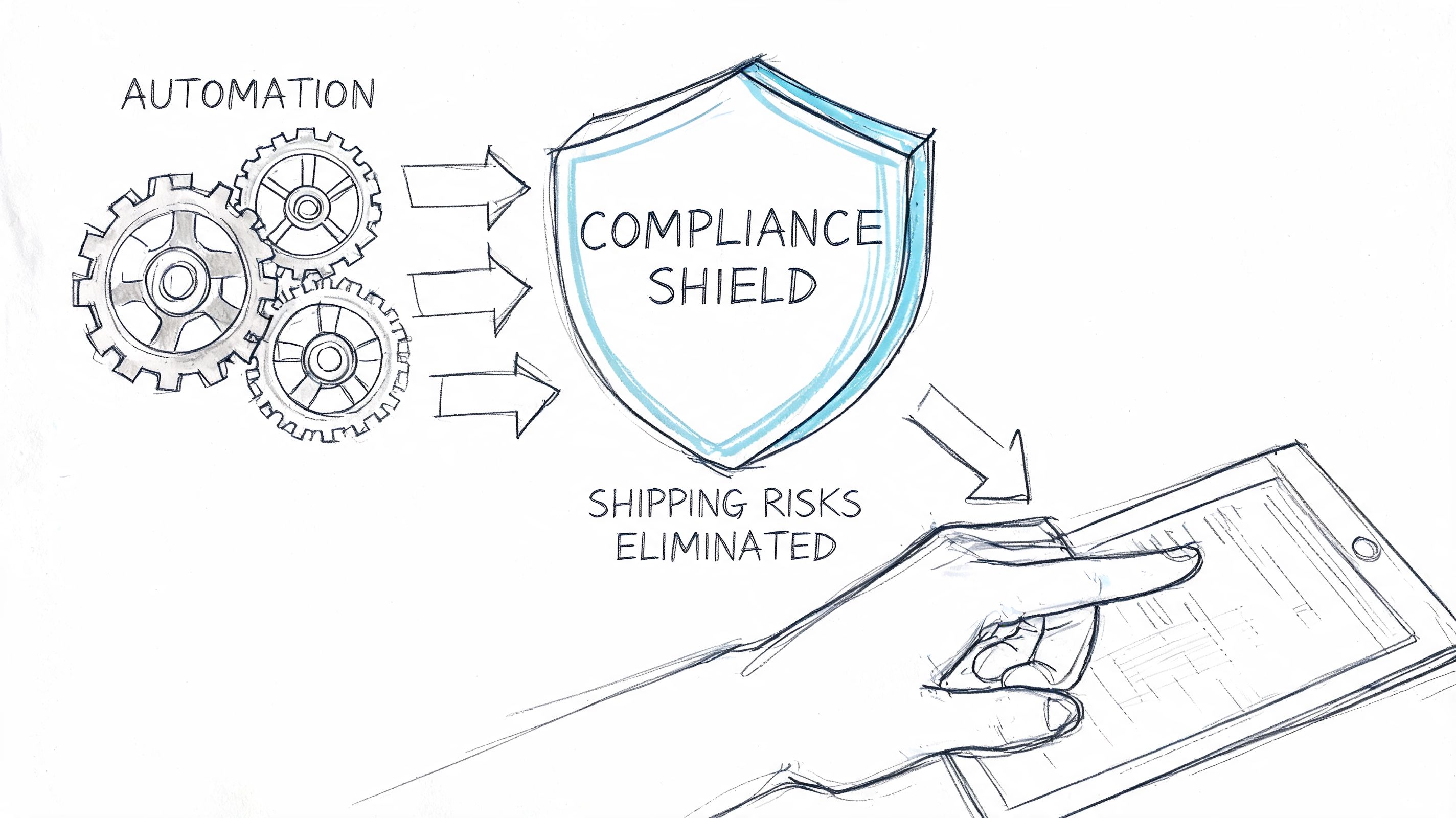
Why pre-checkout enforcement matters
Blind shipments fail compliance reviews when merchants rely on later-stage human intervention. Warehouse staff, carriers, and 3PL coordinators aren't the right line of defense for firearm destination rules.
A stronger model looks like this:
- Checkout blocks the order first: State, county, city, or ZIP restrictions are enforced before fulfillment starts.
- The store keeps the authoritative decision record: You can show why the order was accepted or rejected.
- Shipping becomes execution, not legal analysis: Your warehouse and supplier follow a decision that's already been made.
That's a better operational posture than trying to untangle BOL layers after a risky order enters the system.
Automation removes the weakest link
Manual review can work at very low volume. It doesn't scale well, and it tends to fail on busy days, staff turnover, or edge-case addresses. That's one reason experienced operators study common ecommerce shipping mistakes before they add more complexity to fulfillment.
Compliance should be decided where you still have full visibility into the customer, the cart, and the destination. After that, you're just hoping nobody downstream misses something.
For firearms eCommerce, that's the operational standard worth aiming for. Not perfect paperwork theater. A checkout process that prevents the wrong shipment from existing in the first place.
If you're selling regulated products on WooCommerce, Ship Restrict gives you a cleaner way to control shipping risk before it reaches your supplier, carrier, or blind shipment workflow. You can apply granular shipping restrictions by state, county, city, or ZIP code and stop non-compliant orders at checkout, where your store still has complete destination data and clear decision authority.
Automate Shipping Compliance
Stop worrying about restricted states. Ship Restrict handles it automatically.

Cody Yurk
Founder and Lead Developer of ShipRestrict, helping e-commerce businesses navigate complex shipping regulations for regulated products. Ecommerce store owner turned developer.
Automate Shipping Compliance
- Block restricted states
- No more cancellations
- Set and forget
3-day free trial · Card required