Explore B2B wholesale shipping compliance regulated products: A Fast-Track Guide
Discover how to manage B2B wholesale shipping compliance regulated products, map rules, automate enforcement and safeguard your business with expert guidance.
Shipping regulated products in the B2B wholesale space is a high-stakes balancing act that goes way beyond simple logistics. You're not just moving boxes; you’re navigating a dense web of federal, state, and local laws where one mistake can lead to seized shipments, crippling fines, and serious brand damage. This guide is about moving your strategy from reactive damage control to proactive, automated enforcement.
Untangling the Web of B2B Shipping Compliance
At its core, managing B2B wholesale shipping compliance for regulated products is all about managing risk. I’ve seen countless wholesalers get bogged down by jurisdictional complexities, where the laws can change dramatically from one zip code to the next. It creates a massive operational headache. Think about it: a product that’s perfectly legal to ship to one county might be strictly prohibited in the one right next door.
This legal patchwork makes manual order verification slow, incredibly error-prone, and completely unsustainable for any business that wants to grow.
The financial stakes are sky-high. We're not just talking about the direct costs of fines or seized inventory. Compliance failures eat away at the trust you've built with your business partners and can even get your shipping privileges permanently revoked by major carriers. The true cost of getting it wrong isn't a single penalty but a cascade of operational chaos and reputational harm. We've written before about the full consequences of shipping compliance violations, and it’s not pretty.
Automate Shipping Compliance
Block orders to restricted states automatically. 3-day free trial.
Start Free Trial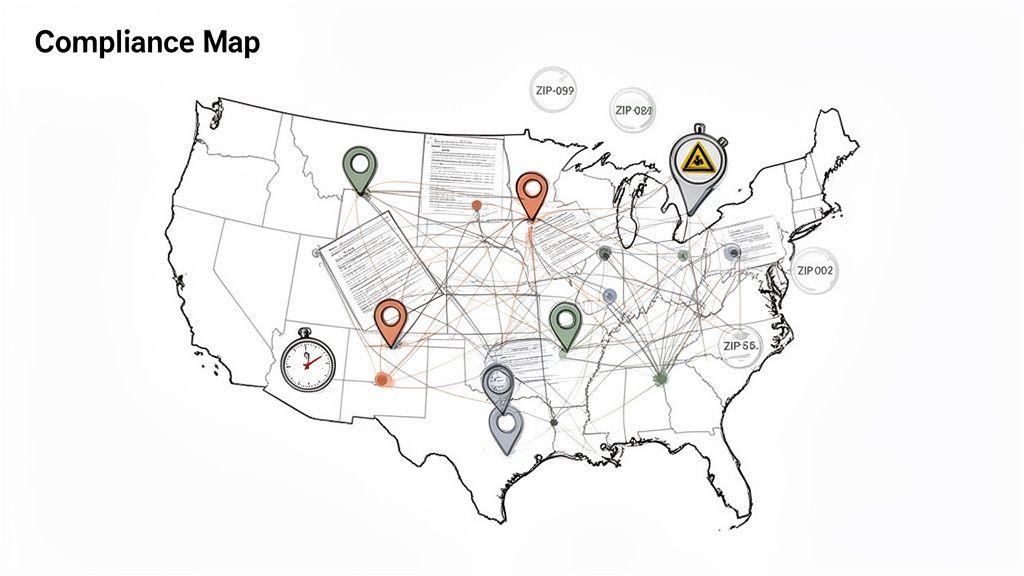
The Shift Toward Proactive Enforcement
Recent global events have only turned up the heat. For instance, when trade tensions peaked in 2025, new tariffs ended up affecting 82% of global supply chains and threw a wrench into nearly 40% of B2B wholesale activity. Penalties for compliance errors shot up to as much as $1 million per violation, forcing a massive strategy shift for B2B shippers. This new reality pushed wholesalers away from their old-school, manual models and toward agile, automated compliance systems.
A proactive framework just makes sense. You get:
- Reduced Risk: Automation all but eliminates the human error that’s unavoidable with manual address checks.
- Increased Efficiency: Your fulfillment team can finally stop the tedious verification steps and just process orders faster.
- Scalable Growth: You can expand into new markets with confidence, knowing compliance is handled automatically.
- Improved Customer Experience: Clear, upfront communication about restrictions prevents checkout friction and cuts down on support tickets.
When you're dealing with specific categories of regulated products, you have to know the little details that matter. For example, there are very specific shipping rules for dangerous goods Class 8, including ADG Code compliance that demand specialized knowledge and handling.
The core principle is simple: build your rules once, then let technology enforce them consistently on every single order. This approach transforms compliance from a constant operational drag into a strategic asset that protects your business and enables confident growth. It’s about building a resilient system for today's complex regulatory environment.
Laying the Groundwork for Compliance
Before you can even dream of automating anything, you have to get your hands dirty and build an unshakable foundation of the rules. This is all about creating your own regulatory map—a clear, actionable blueprint that will guide your entire compliance strategy. I won't lie, it's the most labor-intensive part of the process, but getting this right makes everything else possible.
The goal here is to move from a vague awareness of "the law" to a granular, product-by-product, and location-by-location understanding of what you can and can't do. Don't just focus on federal guidelines. The real landmines are often hidden in the patchwork of state, county, and even city-level ordinances that can easily trip up the most seasoned sellers.
Catalog and Classify Every Single Regulated Product
First things first: you need to conduct a thorough audit of your product catalog. I'm not talking about broad categories. You need to identify every single SKU that falls under any kind of shipping regulation. You have to treat each product as its own unique compliance challenge.
- Firearms: A receiver isn't a complete firearm, and an accessory has its own set of rules. You need to know the difference.
- Ammunition: Restrictions can vary wildly by caliber, type (like armor-piercing), and even by component.
- Vape Products: The rules for e-liquids, devices, and disposable units are often completely different.
- Alcoholic Beverages: Shipping wine, spirits, and beer each comes with its own distinct legal maze.
For every single item, document its specific classification. Is it a hazmat product? Does it demand an adult signature on delivery? Is it subject to strict age verification laws? This deep dive is what gives you the raw data you'll need for the next phase.
The complexity of B2B wholesale shipping compliance for regulated products is magnified by the sheer volume of online trade. The global B2B e-commerce market was projected to hit $32.1 trillion in 2025, yet a staggering 91% of businesses shipping cross-border reported significant compliance hurdles. With issues like HS code classification stumping 75% of them, the risk of fines and delays is enormous. Dive deeper into these global e-commerce market trends to understand the scale of the challenge.
Create Your Regulatory Matrix
Once you’ve got a handle on your regulated products, it's time to map them against every geographic restriction you can find. This is where you create what I call a "Regulatory Matrix"—a centralized spreadsheet or database that becomes your absolute single source of truth for compliance. Think of it less as a list and more as a dynamic tool connecting specific products to specific places.
The firearms industry is a perfect, if painful, example of this jurisdictional nightmare. A certain rifle model might be perfectly fine to ship to most of Texas but is completely banned in cities like Chicago or New York City. Your matrix has to capture that level of detail.
Free Shipping Compliance Audit
We'll review your WooCommerce store's shipping compliance for free.
At a minimum, your matrix should include columns for:
- SKU/Product Name: The specific item in question.
- Restriction Type: Is it an outright ban, a quantity limit, or a licensing requirement?
- Restricted Locations: List every state, county, city, and specific ZIP code where the rule applies.
- Legal Citation (Optional but Recommended): A link to the actual law or ordinance. It's a lifesaver when you need to double-check something.
This document is the cornerstone of your entire system. It’s what transforms vague legal knowledge into a set of precise, actionable instructions. A well-structured matrix is non-negotiable, and you can learn more about how to document shipping restrictions for legal compliance in our detailed guide on the topic.
This matrix becomes the blueprint for your automation. Without this clear, documented foundation, any attempt to implement software-based rules is just guesswork, leaving your business exposed to huge legal and financial risks. It’s the hard work upfront that makes the smart work down the line even possible.
Automating Enforcement in Your WooCommerce Store
You’ve done the hard work: the research is finished, and your regulatory matrix is built. Now it’s time to put that knowledge to work. This is the part where all that manual effort transforms into an automated, hands-off compliance engine right inside your WooCommerce store. The mission is simple: enforce every rule you've documented and stop non-compliant orders before they ever reach your fulfillment team.
Let's be realistic—manually checking every single order against your matrix just isn't going to work. One busy sales day could lead to dozens of mistakes, exposing your business to serious legal and financial heat. For B2B wholesale, automation isn’t a luxury; it’s the only way forward.
Translating Your Matrix into Actionable Rules
The heart of this process is taking the complex data in your matrix and plugging it into a tool that understands nuance. A plugin like Ship Restrict for WooCommerce was built for this exact scenario. It lets you create incredibly precise restriction policies that perfectly mirror your legal research. You can block shipments based on state, county, city, or even down to a specific list of ZIP codes.
Say you sell a regulated chemical solvent. Your matrix shows it’s banned in Cook County, Illinois, but perfectly legal everywhere else in the state. With an automated system, you build a rule that blocks that specific product from shipping to any address in Cook County. Meanwhile, orders from the rest of Illinois sail through without a hitch.
This is all built on the foundation you've already created. The process looks something like this:
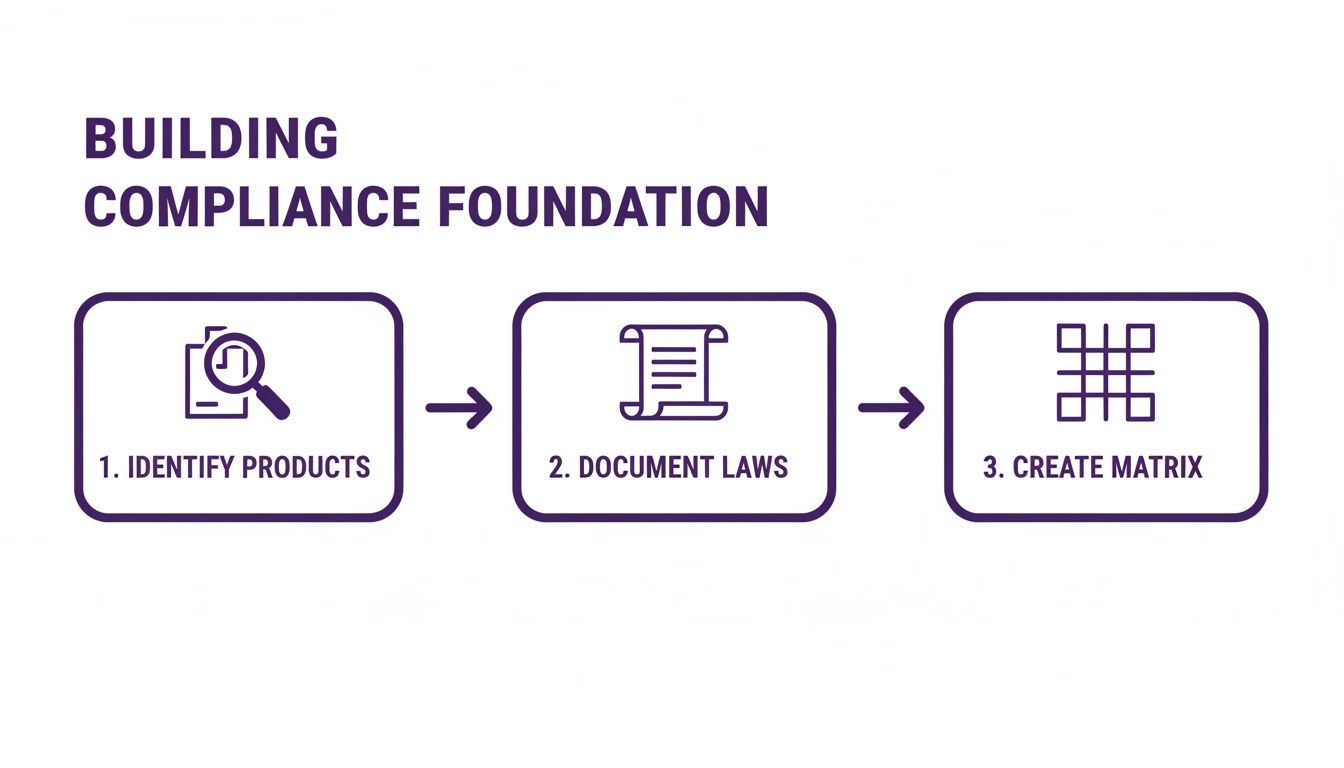
As you can see, a powerful compliance system doesn’t start with software. It starts with meticulous research and solid organization.
Implementing Granular Restrictions at Scale
For many B2B sellers, the number of rules can balloon into the hundreds or even thousands. If you had to create a new rule for each of the 31 "dry" counties in Mississippi where you can't ship alcohol, you'd be there all day. This is where the ability to manage rules in bulk becomes a lifesaver.
Instead of endless clicking, you can create a single rule that applies to a list of all 31 counties at once. It saves a massive amount of time and slashes the risk of human error. Maintenance becomes far more manageable, too. When a law changes, you update one bulk rule instead of hunting down dozens of individual ones.
The real power of automation lies in its consistency. A properly configured system doesn't have "off" days, it doesn't forget a minor local ordinance, and it applies the rules to every single cart, every single time. This is the only way to achieve scalable B2B wholesale shipping compliance.
Some regulations also come with future effective dates. A smart system lets you schedule rule updates ahead of time. If a new state law takes effect on January 1st, you can build and schedule that rule in November. The system activates it on the correct date automatically, so you stay compliant without any last-minute chaos. To see exactly how this works, check out our complete guide to automated shipping compliance for Woo Commerce stores.
Crafting Clear Customer-Facing Messages
Compliance automation isn’t just about blocking orders behind the scenes. It's also about clear communication. A generic "This item cannot be shipped to your location" message is a recipe for frustration, cart abandonment, and a flood of support tickets.
A truly effective system allows you to customize those messages to explain why a product is restricted. This simple step turns a negative experience into a chance to show you're a responsible, law-abiding business.
- Bad Message: "Shipping error."
- Good Message: "Due to state regulations in California, we are unable to ship this specific product to your address. Please remove it from your cart to proceed."
This kind of transparency educates your customers, manages their expectations, and actually builds trust in your brand. It proves you aren't just saying no for no reason—you're following the law. By combining automated rules with clear messaging, you build a resilient e-commerce operation that can grow confidently, even in the most complex regulatory environments.
Validating Your System for Flawless Execution
So, you've built an automated compliance system. That's a huge step forward, but an untested system is just a liability waiting to happen. Real confidence in your B2B wholesale shipping compliance comes from putting that system through its paces with rigorous, end-to-end validation. You have to be absolutely sure that every single rule you’ve so carefully built works exactly as intended, without exception.
Think of it this way: you've constructed a digital fortress to protect your business. Now it's time to hire a team to try and break in. This testing phase is where you find the weak points and shore them up before a real-world compliance failure costs you thousands in fines or seized inventory.
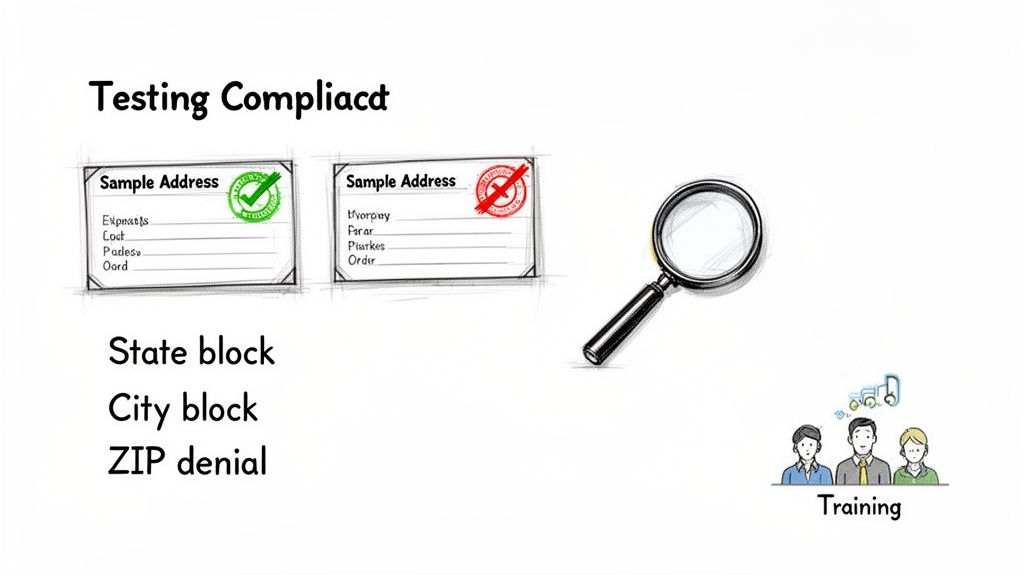
This process isn't just about making sure things break when they're supposed to. It’s also about ensuring they don't break when they shouldn't. A false positive—blocking a legitimate order—costs you a sale and frustrates a good customer. It's a balancing act.
Designing a Comprehensive Testing Protocol
To truly validate your setup, you need to simulate a wide range of real-world scenarios. Don't just test one restricted address and call it a day. That's not good enough. You need a detailed test plan that covers every possible outcome your customers might encounter.
Your protocol should include test cases for:
- The Unrestricted Order: Simulate a simple purchase of non-regulated items shipping to a fully permissible location. The transaction should be completely seamless, with no interruptions or warnings. This confirms you're not over-blocking.
- The State-Level Block: Try to ship a product banned statewide (like a specific firearm accessory to California) to multiple ZIP codes within that state. The system should block the order immediately upon address entry.
- The County-Level Restriction: Test a product that’s legal in a state but banned in a specific county. A classic example is shipping alcohol to a "dry" county in a state that otherwise allows it.
- The ZIP Code Denial: This is your most granular test. Use a specific ZIP code from your regulatory matrix that is explicitly banned and ensure the system catches it, even if surrounding ZIPs are perfectly fine.
For every test, document the expected outcome versus the actual result. Did the right error message appear? Was the block triggered at the correct stage of checkout? This detailed log will be your best friend when it comes to troubleshooting.
The Human Element of Compliance Automation
Technology, no matter how good, is only half the battle. Your team—from customer service reps to the folks on the warehouse floor—needs to be fully aligned and trained on how this new system works. An automated block means nothing if your team doesn't understand why it happened or how to explain it to a frustrated customer.
This is more critical than ever as enforcement tightens. U.S. Customs and Border Protection, for instance, has ramped up its efforts, reviewing over 16,700 shipments valued at nearly $3.7 billion in 2025 alone. For B2B shippers, this meant higher documentation demands and steeper penalties for errors, showing why both automated tools and well-trained teams are non-negotiable. You can explore more about these 2026 global trade compliance trends to see why rigorous validation is no longer optional.
Your customer service representatives are your compliance front line. They need to be equipped to confidently answer questions like, "Why can't you ship this to me?" without escalating the issue or giving incorrect information.
Empowering Your Teams with Knowledge
Your training program has to be practical and role-specific. Don't just give them a software demo; explain the "why" behind it all. Context is everything.
Key Training Modules:
- System Overview: Start with the basics. Explain what the automated system does and why the business invested in it.
- Understanding Restriction Messages: Walk them through the different customer-facing messages and what each one actually means.
- Customer Communication Scripts: Give them clear, professional scripts for explaining shipping restrictions politely and legally. This builds confidence and consistency.
- Escalation Procedures: Define a crystal-clear process for when a customer issue needs to be escalated to a compliance manager.
When your team understands the system, they become advocates for it. They can de-escalate customer frustration, protect the business from risk, and ensure the entire operation runs smoothly. This holistic approach—combining powerful technology with a knowledgeable team—is what creates a truly resilient and flawless compliance strategy.
Maintaining Compliance Through Ongoing Audits
<iframe width="100%" style="aspect-ratio: 16 / 9;" src="https://www.youtube.com/embed/YpZ84bCRj5I" frameborder="0" allow="autoplay; encrypted-media" allowfullscreen></iframe>Getting your automated compliance system built and running is a huge win, but the work doesn't stop there. The world of B2B wholesale shipping compliance for regulated products is always shifting. New laws get passed, old ones are tweaked, and local rules can change with surprising speed.
Think of your compliance system as a living thing, not a static project you can just "set and forget."
A rule set that never gets updated is a ticking time bomb. What was perfectly legal last quarter could be a major violation today. This is where a long-term strategy of constant monitoring and regular audits becomes your best defense against fines, seized shipments, and a damaged reputation.
Set a Proactive Review Cadence
First things first: you need a formal review schedule. Don't leave this to chance or wait until a problem pops up. A structured, recurring audit is the only way to ensure your shipping rules stay perfectly synced with the current legal reality.
Make sure this review schedule is documented and assigned to a specific person or team. This creates clear ownership and keeps everyone accountable.
Some of the most effective monitoring activities we've seen include:
- Legal Update Services: Subscribing to industry-specific legal newsletters or services that track legislative changes is a game-changer. They do the heavy lifting of watching for new laws so you can get ahead of them.
- Government Agency Websites: Make it a habit to regularly check the websites of relevant federal and state agencies (like the ATF for firearms or state liquor authorities for alcohol). They often post updates and new guidance before it hits the news.
- Industry Associations: Stay active in your industry associations. They're often the first to sound the alarm on pending legislation that could directly impact your business.
This external monitoring gives you the raw intelligence you need. The next step is turning that intel into action by systematically checking it against your live shipping rules.
The regulatory landscape is a moving target. Mississippi, for example, recently changed its laws to allow direct-to-consumer wine shipments. However, 31 of its 82 counties remain "dry," meaning state-level permission is not enough. This is why ongoing, ZIP-code-level audits are absolutely essential for maintaining compliance.
Use Your Own Data to Refine the System
While external monitoring tells you what the law is, your internal data shows you how your system is actually performing. Your blocked order logs are a goldmine of insights that can help you sharpen your compliance strategy and even improve your customer experience.
Look at these logs regularly to spot patterns. Are you suddenly seeing a spike in blocked orders from a specific city or state? That could be a flag for a recent regulatory change you missed or a simple misunderstanding by your customers.
Here’s how to turn blocked orders into something you can act on:
- Find High-Volume Block Locations: Export your blocked order data and sort it by location. A sudden surge from one area should trigger an immediate investigation.
- Analyze Customer Behavior: Are customers repeatedly trying to ship the same restricted product to the same place? This could mean your on-site messaging about that specific restriction isn't clear enough.
- Improve On-Site Messaging: Use what you've learned to write more specific, helpful messages. Instead of a generic "cannot ship here," you could create a targeted banner for users in that location, explaining the local law before they even try to add the product to their cart.
This internal audit loop does more than just keep your rules working. It helps you get ahead of customer friction, which cuts down on support tickets and builds trust.
By combining external legal monitoring with internal data analysis, you create a robust, self-improving compliance program. This vigilant, continuous process is the only way to ensure your business stays protected today and is ready for whatever regulatory changes come tomorrow.
Got Questions About Shipping Compliance?
Even with a killer system in place, the day-to-day reality of B2B wholesale shipping compliance can feel like a moving target. Questions are going to pop up—from your team, from your customers. Having clear, confident answers is what separates a smooth operation from a legal and logistical nightmare.
Let's break down some of the most common questions wholesalers run into and get you some practical, real-world answers.
How Do We Handle Regulations That Change at the County or City Level?
This is a massive headache, especially if you're in a highly regulated space like firearms, alcohol, or vaping products. A simple state-level block just doesn't cut it anymore. Real protection means getting granular, and your system has to be able to enforce restrictions down to the county, city, and even specific ZIP code.
It all starts with that meticulous research we talked about—building and maintaining your regulatory matrix. Once you have that map, you need a tool that can turn it into live, enforceable rules. For instance, if a major city inside an otherwise friendly state suddenly bans one of your products, you need the power to create a rule targeting that city's name or its associated ZIP codes immediately.
There's no way to scale this manually. Relying on your team to remember that a product is banned in Cook County but totally fine in DuPage County is a recipe for expensive mistakes. The system has to do the heavy lifting.
What's the Best Way to Manage Frequent Regulatory Updates?
Staying on top of constant legal changes requires a mix of proactive monitoring and a system that can adapt on the fly. You simply can't afford to be reactive here.
First, you need to assign ownership. Make a specific person or team responsible for tracking legislative changes. They should be subscribed to industry newsletters, government agency alerts (like the ATF for firearms or state liquor authorities), and specialized legal update services. This is your early warning system.
Next, your regulatory matrix has to be treated like a living document. The second a new law is confirmed, that matrix gets updated. This keeps your "source of truth" completely accurate.
Finally, and this is the most critical part, your enforcement tool must make updates fast and simple. A platform that supports bulk rule management and scheduled updates is a game-changer. It lets you prep for future changes by setting a rule to go live automatically on its effective date. What was once a constant headache becomes a manageable, scheduled task.
How Can We Implement Strict Rules Without Killing the Customer Experience?
Locking down compliance doesn't have to mean creating a frustrating checkout for your customers. The key to balancing these two worlds is radical transparency.
Forget generic error messages. Use customizable notifications that give a clear, simple explanation.
- Vague Message: "Shipping error."
- Helpful Message: "Due to regulations in California, we cannot ship this product to your address. Please remove it to proceed."
This simple tweak does two powerful things: it educates the customer and it frames your business as a responsible, law-abiding seller. It proves you aren't just being difficult; you're following the rules.
These validation checks need to fire the instant a customer enters their shipping address. Don't let them fill out all their payment details only to get blocked at the final step—that's a one-way ticket to an abandoned cart. By being upfront and efficient, you preserve the user experience, slash customer support tickets, and uphold your legal duties.
Should We Display Restrictions Before Checkout?
Absolutely, whenever possible. The best customer experience is one that stops a problem before it even starts. While that final check in the cart is non-negotiable, giving customers a heads-up earlier in their journey can dramatically reduce frustration.
Consider a few of these proactive moves:
- Product Page Notices: For items with well-known, widespread restrictions, put a clear message right on the product page (e.g., "This item cannot be shipped to CA, NY, or IL.").
- Dedicated Shipping Policy Page: Build out a comprehensive page that details your shipping policies for regulated goods, and link to it from your product pages.
- Geo-Targeted Banners: For a more advanced setup, you can use geo-IP tools to show a site-wide banner to users from a restricted state, letting them know about certain limitations before they even add something to their cart.
The goal is to inform, not overwhelm. A little information upfront goes a long, long way in setting the right expectations.
Navigating the minefield of B2B wholesale shipping compliance for regulated products shouldn't be a manual, error-prone mess. With the right tools, you can automate your rules, protect your business, and get back to focusing on growth. Ship Restrict provides the granular, automated enforcement you need to manage state, county, and even ZIP-code-level regulations right inside WooCommerce. Stop shipping mistakes before they happen and build a compliance strategy that actually works. Learn more about how Ship Restrict can secure your B2B operations.
Automate Shipping Compliance
Stop worrying about restricted states. Ship Restrict handles it automatically.

Cody Yurk
Founder and Lead Developer of ShipRestrict, helping e-commerce businesses navigate complex shipping regulations for regulated products. Ecommerce store owner turned developer.
Automate Shipping Compliance
- Block restricted states
- No more cancellations
- Set and forget
3-day free trial · Card required