Switchblade automatic knife state restrictions: Quick Guide
Learn about Switchblade automatic knife state restrictions and what's legal where you live. Key rules, penalties, and practical tips.
For any online retailer selling automatic knives, figuring out the maze of switchblade automatic knife state restrictions isn't just a good idea—it's absolutely essential. The laws are all over the map. Some states give you the green light for open and concealed carry, while others hit you with strict blade length limits or flat-out bans. This makes shipping orders correctly a massive headache.
This guide is built to be your go-to reference, helping you cut through the confusion and handle these laws with confidence.
A Retailer's Guide to State Switchblade Laws
Selling automatic knives online is about more than having a good-looking website. You've got to know the intricate web of federal, state, and even local rules inside and out. A switchblade's legal status can flip the second a package crosses a state line, and if you're not prepared, you're looking at some serious legal and financial heat. Getting it wrong means returned shipments, unhappy customers, hefty fines, or even criminal charges.
Why You Can't Afford to Get This Wrong
If you're running a WooCommerce store, the stakes are even higher. The law puts the responsibility for a legal sale squarely on you, the seller—not the customer. That means your store needs a rock-solid system to check and enforce shipping rules before you even think about printing a label. Trying to manually check every order against a tangled mess of state laws is a recipe for disaster. It's slow, tedious, and begging for a mistake.
Automate Knife Shipping Restrictions
Block orders to restricted states automatically. 3-day free trial.
Start Free TrialThink of this guide as your primary resource for getting it right. We’re going to break down:
- The Federal Framework: We'll start with the Federal Switchblade Knife Act and what it really means for shipping between states.
- State-by-State Analysis: A deep dive into the possession, carry, and shipping rules for all 50 states.
- Common Exemptions: How to spot legal sales opportunities to law enforcement, military, and other exempt groups.
The real challenge for online sellers is taking dozens of different state laws and turning them into a smart, automated shipping policy. One slip-up can put your entire business on the line.
When you master the details of switchblade automatic knife state restrictions, you're not just protecting your business—you're building trust with your customers. Properly managing compliance for knives and other regulated weapons is fundamental to succeeding in this market for the long haul. This guide gives you the foundational knowledge you need to set up your store correctly and avoid those costly mistakes.
Understanding Federal Automatic Knife Regulations
<iframe width="100%" style="aspect-ratio: 16 / 9;" src="https://www.youtube.com/embed/l1gGwWVL1iA" frameborder="0" allow="autoplay; encrypted-media" allowfullscreen></iframe>Before we dig into the patchwork of individual switchblade automatic knife state restrictions, you have to get a handle on the federal laws. These rules set the baseline for compliance across the country. The big one is the Federal Switchblade Knife Act, officially known as 15 U.S.C. §§ 1241-1245.
A common misconception is that this act makes it illegal for someone to simply own an automatic knife. That's not true. The federal law is laser-focused on one thing: interstate commerce. It prohibits introducing, manufacturing for introduction, transporting, or distributing switchblades across state lines. For anyone running an e-commerce store, this is the single most important federal rule to understand because it directly governs how and if you can ship to your customers.
Key Provisions of the Federal Switchblade Act
So, what exactly is a switchblade according to the feds? The Act defines it as any knife with a blade that opens automatically when you press a button, spring, or similar device in the handle. This covers both out-the-front (OTF) and side-opening automatics.
But the law isn't a total shutdown. It carves out several crucial exemptions that create legal channels for online sales. Retailers are legally allowed to ship automatic knives under a few specific scenarios:
- To Government Agencies: You can sell and ship to federal, state, and local government agencies. This includes military and law enforcement departments.
- To Qualified Personnel: Shipments are also permitted to authorized military personnel and law enforcement officers who will use the knife as part of their official duties.
- For One-Armed Individuals: The law makes a specific exception allowing the mailing of automatic knives to individuals who have only one arm.
It's critical to remember the difference between federal shipping laws and state possession laws. Just because you can legally ship a knife to a police officer in another state under federal law doesn't mean that state's own laws permit them to have it. The federal act provides the framework, but state law is the ultimate authority on what's legal within its own borders.
Free Shipping Compliance Audit
Selling knives online? We'll review your WooCommerce store's shipping compliance for free.
The Evolution of Knife Legislation
The legal landscape for automatic knives has shifted dramatically over the years. When the Federal Switchblade Knife Act was passed back in 1958, it was a reaction to public panic, even though actual crimes involving these knives were rare. For perspective, Kansas City reported only about three dozen switchblade-related misdemeanors in 1956.
Since 2010, however, the tide has turned. A whopping 16 states have repealed their bans, signaling a more modern and practical understanding of these tools. You can explore a more detailed history and see the trends of knife legislation in the United States on Wikipedia.org.
Quick Reference Table of State Automatic Knife Laws
If you're shipping automatic knives, you know that a customer's address changes everything. The patchwork of state laws can be a nightmare to navigate, and one wrong move could mean a returned package, a hefty fine, or worse. This quick-reference table is designed to be your first stop for checking the legality of a switchblade in any of the 50 states.
We've broken down each state's status into three simple categories to give you an immediate feel for the landscape:
- Legal: States where owning and carrying automatic knives is generally good to go, without major hang-ups on blade length or how the knife opens.
- Legal with Restrictions: The most common category. Legality here hinges on specific details like blade length, how the knife is carried (openly vs. concealed), or even the user's intent.
- Illegal: States where possession, sale, or carry of automatic knives is a no-go for the average person.
Think of this table as your starting point. Use it to get a fast read on a customer's state, then jump down to our detailed state-by-state analysis for the full picture.
Heads Up: This table is a summary. It's great for a quick check, but the real devil is in the details. Laws around concealment, specific locations (like schools), and criminal intent add critical layers you need to understand. Always cross-reference with the in-depth state sections below.
State-by-State Automatic Knife Legality Overview
Here’s a simplified breakdown to help you make quick, informed shipping decisions. The "Key Restrictions / Notes" column flags the most common rules you'll run into, like blade length limits or specific carry bans. For the complete story, just use the link in the "Cross-Reference Section" to go straight to that state's detailed legal guide.
| State | Legal Status | Key Restrictions / Notes | Cross-Reference Section |
|---|---|---|---|
| Alabama | Legal | No major restrictions on possession or carry. | Detailed Alabama Laws |
| Alaska | Legal | Legal to own and carry openly or concealed. | Detailed Alaska Laws |
| Arizona | Legal | Legal to own and carry openly or concealed. | Detailed Arizona Laws |
| Arkansas | Legal | Legal to own and carry, blade length must be under 3.5 inches. | Detailed Arkansas Laws |
| California | Legal with Restrictions | Possession and carry are legal if the blade is less than 2 inches long. | Detailed California Laws |
| Colorado | Illegal | Possession, manufacture, and sale are illegal. | Detailed Colorado Laws |
| Connecticut | Legal with Restrictions | Legal to own, but carry is restricted to those with a valid weapons permit. Blade length limit of 1.5 inches. | Detailed Connecticut Laws |
| Delaware | Illegal | Possession, sale, and carry are prohibited. Limited exceptions for law enforcement. | Detailed Delaware Laws |
| Florida | Legal | No major restrictions on possession or open carry. | Detailed Florida Laws |
| Georgia | Legal | Legal to own and carry openly or concealed. | Detailed Georgia Laws |
| Hawaii | Illegal | Possession, manufacture, sale, and transport are prohibited. | Detailed Hawaii Laws |
| Idaho | Legal | Legal to own and carry. | Detailed Idaho Laws |
| Illinois | Legal with Restrictions | Requires a Firearm Owner's Identification (FOID) card to possess or carry. | Detailed Illinois Laws |
| Indiana | Legal | Legal to own and carry. | Detailed Indiana Laws |
| Iowa | Legal | Legal to own and carry. | Detailed Iowa Laws |
| Kansas | Legal | Legal to own and carry. | Detailed Kansas Laws |
| Kentucky | Legal | Legal to own and carry. | Detailed Kentucky Laws |
| Louisiana | Legal with Restrictions | Legal to possess, but illegal to carry concealed on one's person. | Detailed Louisiana Laws |
| Maine | Legal | Legal to own and carry. | Detailed Maine Laws |
| Maryland | Illegal | Possession and carry are generally illegal. Sale is also restricted. | Detailed Maryland Laws |
| Massachusetts | Legal with Restrictions | Legal to possess, but illegal to carry unless for a lawful purpose (e.g., hunting/fishing). | Detailed Massachusetts Laws |
| Michigan | Legal | Legal to own and carry, open or concealed. | Detailed Michigan Laws |
| Minnesota | Illegal | Possession and carry are illegal. | Detailed Minnesota Laws |
| Mississippi | Legal | Legal to own and carry. | Detailed Mississippi Laws |
| Missouri | Legal | Legal to own and carry. | Detailed Missouri Laws |
| Montana | Legal | Legal to own and carry. | Detailed Montana Laws |
| Nebraska | Legal | Legal to own and carry. | Detailed Nebraska Laws |
| Nevada | Legal | Legal to own and carry. | Detailed Nevada Laws |
| New Hampshire | Legal | Legal to own and carry. | Detailed New Hampshire Laws |
| New Jersey | Illegal | Possession, sale, and carry are illegal. | Detailed New Jersey Laws |
| New Mexico | Illegal | Possession, sale, and carry are illegal. | Detailed New Mexico Laws |
| New York | Legal with Restrictions | Possession is legal. Carry is illegal except for licensed individuals (e.g., hunting/fishing). | Detailed New York Laws |
| North Carolina | Legal | Legal to own and carry openly. Concealed carry is generally illegal. | Detailed North Carolina Laws |
| North Dakota | Legal | Legal to own and carry. | Detailed North Dakota Laws |
| Ohio | Legal | Legal to own and carry. | Detailed Ohio Laws |
| Oklahoma | Legal | Legal to own and carry. | Detailed Oklahoma Laws |
| Oregon | Legal with Restrictions | Legal to possess. Illegal to carry concealed. | Detailed Oregon Laws |
| Pennsylvania | Illegal | Possession and sale are illegal. | Detailed Pennsylvania Laws |
| Rhode Island | Legal | Legal to own and carry. | Detailed Rhode Island Laws |
| South Carolina | Legal | Legal to own and carry. | Detailed South Carolina Laws |
| South Dakota | Legal | Legal to own and carry. | Detailed South Dakota Laws |
| Tennessee | Legal | Legal to own and carry. | Detailed Tennessee Laws |
| Texas | Legal | Legal to own and carry. | Detailed Texas Laws |
| Utah | Legal | Legal to own and carry. | Detailed Utah Laws |
| Vermont | Legal with Restrictions | Legal to possess. Illegal to carry with intent to cause harm. | Detailed Vermont Laws |
| Virginia | Illegal | Possession and carry of a switchblade is illegal. | Detailed Virginia Laws |
| Washington | Illegal | Possession, manufacture, and sale are illegal. | Detailed Washington Laws |
| West Virginia | Legal | Legal to own and carry. | Detailed West Virginia Laws |
| Wisconsin | Legal | Legal to own and carry, open or concealed (with CCW permit). | Detailed Wisconsin Laws |
| Wyoming | Legal | Legal to own and carry. | Detailed Wyoming Laws |
This table should help streamline your shipping workflow and give you the confidence to manage regulated knife sales. Remember to always use it in tandem with the detailed state sections to ensure you're fully compliant.
Detailed State-By-State Automatic Knife Restrictions
Navigating the web of switchblade and automatic knife state restrictions means digging into each state's specific rulebook. This section is your go-to reference, breaking down the actual statutes, legal definitions, and carry rules for all 50 states and the District of Columbia. We'll get into the critical details—like blade length limits, the difference between possessing and carrying, and which states have preemption laws that stop local governments from making up their own rules.
This state-by-state guide is built to give e-commerce retailers the precise info needed to lock down their shipping rules and make compliant sales, one state at a time.
First, here's a high-level look at how states generally fall into legal, restricted, or illegal categories.
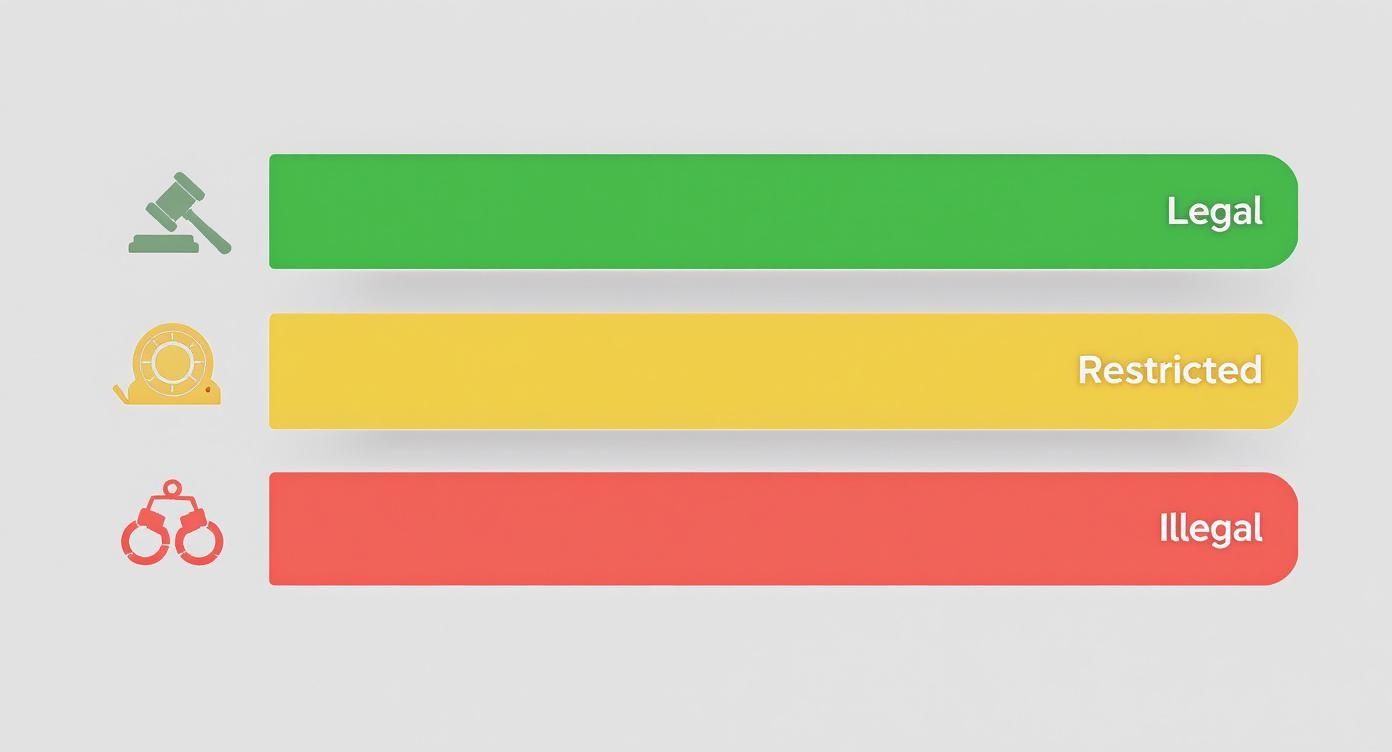
As you can see, a solid majority of states land in the "Legal" or "Legal with Restrictions" camps. It's a clear sign of the nationwide trend away from total bans and toward more practical, detailed regulation.
Alabama Automatic Knife Laws
Alabama is about as friendly to automatic knives as a state can get. You won't find any meaningful state-level restrictions on possessing, openly carrying, or concealed carrying switchblades, provided the person isn't otherwise barred from owning a weapon.
This clean and simple legal framework makes shipping to Alabama a straightforward process for online sellers. The state also has a preemption law, which is great news—it means cities and counties can't throw a wrench in the works with their own, stricter knife ordinances.
Alaska Automatic Knife Laws
Much like Alabama, Alaska takes a very permissive stance on automatic knives. State law is clear: possession and carry (both open and concealed) of switchblades are perfectly legal, with no pesky blade length limits to worry about.
For anyone selling online, that clear legal status makes compliance a breeze when shipping to Alaskan customers. The lack of blade length rules or specific carry bans makes it a low-risk state for your business.
Arizona Automatic Knife Laws
Arizona law is a big win for knife owners. It's completely legal to own, open carry, and concealed carry automatic knives of any blade length. The state's statutes are direct and offer broad protections for knife rights.
Even better, Arizona has strong state preemption laws that keep knife regulations consistent from one end of the state to the other. This prevents a confusing patchwork of local rules, providing total clarity for residents and retailers alike.
Arkansas Automatic Knife Laws
In Arkansas, you can legally own and carry automatic knives, but there's one major catch to be aware of. It's illegal to carry a knife with a blade of 3.5 inches or longer if you intend to use it unlawfully against someone.
While simple possession is legal, that "intent" clause adds a layer of complexity. For retailers, the takeaway is that while the knife itself is legal to sell and ship, its carry and use are conditional.
California Automatic Knife Laws
California has some of the most specific and restrictive automatic knife laws in the entire country. The bottom line: it's illegal to sell, offer for sale, possess, or carry a switchblade if its blade is 2 inches or longer.
Automatic knives with blades shorter than 2 inches are legal to own and carry. This razor-thin blade length distinction is the single most important factor for any retailer.
- Legal: Automatic knives with blades under 2 inches.
- Illegal: Automatic knives with blades 2 inches or longer.
Shipping any switchblade over that limit into California is a direct violation of the law. This makes it a high-risk state that absolutely requires careful product filtering in your store.
Colorado Automatic Knife Laws
Colorado law is cut and dry: it strictly prohibits the possession, sale, and carrying of a "gravity knife" or "switchblade knife." The state defines a switchblade as any knife with a blade that opens automatically via hand pressure on a button or other device in the handle.
This outright ban makes Colorado a "no-ship" state for almost all automatic knives. The only exceptions are for active-duty military and law enforcement personnel.
Connecticut Automatic Knife Laws
Connecticut's laws have some important nuance. While you can legally possess an automatic knife at home, carrying one is a different story. An individual cannot carry an automatic knife with a blade longer than 1.5 inches on their person or in a vehicle.
The only way around that carry restriction is if you have a valid hunting, fishing, or trapping license and are actively engaged in one of those activities. This distinction between home possession and public carry is critical for sellers. Shipping to Connecticut is possible, but you must provide clear disclaimers to customers about these carry laws.
Delaware Automatic Knife Laws
Delaware law is extremely restrictive. It is flat-out illegal to sell, offer for sale, or possess a switchblade knife. The statute offers almost no wiggle room, making it one of the most prohibitive states in the U.S.
Because of this clear ban, Delaware is a "no-ship" state for automatic knives sold to civilian customers.
District of Columbia Automatic Knife Laws
Washington D.C. enforces a complete ban on the possession and sale of switchblades. The law is broad, defining a switchblade as any knife with an automatic opening mechanism.
This ban is strict, applying to residents and visitors alike. For online retailers, the District of Columbia is a definite "no-ship" zone.
Florida Automatic Knife Laws
Florida is generally a permissive state. It's perfectly legal to own and openly carry any type of automatic knife. The restrictions kick in when you talk about concealed carry.
State law makes it illegal to carry a concealed "switchblade knife" unless you hold a valid concealed weapons permit. For anyone without a permit, open carry is the only legal option.
Georgia Automatic Knife Laws
Georgia allows the possession and carry of automatic knives. The state updated its laws to be much more permissive, doing away with many of the old restrictions.
Georgia also has preemption, which prevents local governments from creating stricter laws of their own. This makes it a legally consistent and low-risk state to ship automatic knives to.
Hawaii Automatic Knife Laws
Hawaii has a complete, across-the-board ban on the manufacture, sale, transfer, possession, and transport of switchblades. Their law is one of the strictest in the nation.
This total prohibition means Hawaii is a firm "no-ship" destination for all automatic knives.
Idaho Automatic Knife Laws
Idaho's laws are very permissive when it comes to automatic knives. It is legal to own, open carry, and concealed carry switchblades without any restrictions.
The state’s straightforward legal landscape makes it an easy and compliant destination for online knife retailers.
Illinois Automatic Knife Laws
In Illinois, owning and carrying an automatic knife is legal, but only if you hold a valid Firearm Owner's Identification (FOID) card.
This is a unique and absolutely critical requirement for retailers. An Illinois resident cannot legally possess a switchblade without a FOID card, which means you need a verification step in place before completing any sale into the state.
Indiana Automatic Knife Laws
Indiana has fully legalized the possession and carry of automatic knives. The state repealed its previous bans, transforming it into a knife-friendly state.
You won't find any blade length restrictions or specific prohibitions on concealed carry, making Indiana a low-risk state for e-commerce.
Massachusetts Automatic Knife Laws
Massachusetts law saw a massive shift in August 2024. The state's Supreme Judicial Court, in the case of Commonwealth v. Canjura, ruled that the ban on carrying switchblades was unconstitutional. This decision effectively legalized their possession and carry overnight.
This recent development overturned decades of restrictive policy. However, be aware that restrictions still apply in sensitive locations like schools and government buildings. While legal now, the regulatory landscape is still settling, so retailers should proceed with awareness.
Nevada Automatic Knife Laws
Nevada is exceptionally permissive. Thanks to major legislative changes back in 2015, it's legal to own and carry nearly any kind of knife, including switchblades, both openly and concealed.
The state also has strong preemption laws. The one key exception is Clark County (where Las Vegas is located), which may require a permit for concealed carry of certain knives.
| Location | Open Carry | Concealed Carry | Preemption |
|---|---|---|---|
| Nevada (Statewide) | Legal | Legal | Yes |
| Clark County | Legal | Permit required for blades ≥ 3" | Local exception |
This table shows why it's so important to understand not just state laws, but the occasional local wrinkles, too.
New York Automatic Knife Laws
New York law is famously complex and often misunderstood. While it is legal to possess an automatic knife, it is illegal to carry one on your person.
This creates a "possess-at-home" situation. A person can legally own a switchblade as part of a collection but faces criminal charges if they carry it outside. This makes shipping to New York possible, but your customers must be made aware of the strict carry ban.
Final Thoughts on State-by-State Compliance
As this deep dive shows, there's no single answer to switchblade automatic knife state restrictions. Each state lays out a unique minefield of rules that demand careful attention from any online retailer. From California's 2-inch blade rule to Illinois' FOID card mandate and the recent legal earthquake in Massachusetts, staying compliant requires constant vigilance and a rock-solid system for managing your shipping rules.
Common Legal Exemptions and Special Conditions
Beyond the black-and-white state bans, the world of automatic knife laws is full of gray areas. For an online retailer, these specific exemptions and special conditions are where you'll find legitimate sales opportunities. But capitalizing on them means having a rock-solid verification process. You have to understand these nuances to navigate switchblade automatic knife state restrictions without incorrectly turning away a lawful customer.
The most common carve-outs are for certain professions. Plenty of states that otherwise ban or heavily restrict automatic knives will make an exception for:
- Active-duty military personnel
- Sworn law enforcement officers (LEO)
- Firefighters, paramedics, and other first responders
These professionals often get a pass to buy and carry automatic knives for use on the job. Selling to them, however, demands a serious verification step on your end.
Verifying Customer Eligibility
Taking a customer's word for it just won't cut it. To protect your business, you need a system in place to confirm that a buyer actually qualifies for an exemption. This usually means asking for—and verifying—official identification, like a department-issued ID card or other official documents.
Many of the same principles for verifying professional status apply to age checks. You can get a good overview of the best practices in our guide on age verification for online sales.
It's not just about jobs, though. Some laws have other unique conditions. The Federal Switchblade Act, for instance, has a long-standing exemption that allows automatic knives to be mailed to individuals with only one arm. Other state laws might give a green light for using them during specific activities like hunting and fishing, or for owning them as part of a formal collection.
It's important to recognize that these legal frameworks are not unique to the United States. Globally, regulations on automatic knives vary widely, often reflecting national public safety concerns and crime rates.
This global perspective really shows how different legal systems try to balance individual rights with public safety. For example, you can learn more about the global history and regulation of switchblades on Wikipedia.org. Some countries use a registration system for certain knives, while others have almost no restrictions at all.
Ultimately, for your store, the key is to identify every single applicable exemption and have a bulletproof way to validate it. That's how you legally and confidently serve your customers.
An E-commerce Compliance Checklist for Knife Retailers

Knowing the tangled web of switchblade automatic knife state restrictions is one thing, but actually building a compliant sales process is a completely different challenge. This checklist is designed to bridge that gap, helping you turn legal knowledge into a repeatable workflow for your e-commerce store. Think of it as an audit for your current process to shore up any weak points and minimize your risk.
Your checkout process has to be your first line of defense. The absolute bare minimum is a robust address verification system that automatically flags and blocks orders going to prohibited states, counties, or cities. This is non-negotiable. It stops an illegal sale before it even happens, saving you from expensive shipping mistakes and potential legal headaches down the road.
Core Compliance Actions
To build a truly resilient sales process, you need to focus on a few key areas. Each of these steps tackles a different stage of the customer journey, from the moment they land on a product page to when they finalize their purchase.
- Configure Geolocation Shipping Rules: Get into your WooCommerce or other e-commerce platform and set up rules that automatically restrict shipping options based on the customer’s address. This is, hands down, the most effective way to enforce state-specific bans without needing someone to manually review every single order.
- Add Clear Legal Disclaimers: Every single automatic knife product page needs a legal disclaimer placed where no one can miss it. This notice should clearly state that customers are responsible for knowing and following all local, state, and federal knife laws.
- Establish Exemption Verification: You need a crystal-clear, documented process for customers who qualify for military or law enforcement exemptions. This means they must submit valid credentials for verification before you fulfill their order. This creates a verifiable paper trail that protects you on every exempt sale.
Remember, the burden of compliance is on you, the retailer—not the customer. An automated system that enforces these rules before a payment is even processed is your strongest defense against accidental violations.
Documentation and Ongoing Review
Staying compliant isn't a "set it and forget it" task; it's an ongoing effort. Keeping detailed records of all sales, especially those involving verified exemptions, is absolutely essential. To make managing all of this less of a headache, many retailers are turning to tools like legal document automation software to ensure accuracy and streamline the paperwork.
This need for constant diligence isn't just a U.S. problem, either. The legal landscape in Europe is just as fractured, with countries like Spain having total bans while others, such as the Czech Republic, have very few restrictions. These international differences just go to show that complex, jurisdiction-specific regulations are the norm everywhere, and they demand careful attention.
Finally, make it a habit to regularly review and update your shipping rules to reflect any changes in legislation. This ensures your store stays on the right side of the law. To help with that, check out our detailed guide on knife shipping laws and blade length limits to stay informed.
Resources for Staying Current on Knife Legislation
The world of switchblade automatic knife state restrictions is anything but static. Laws are constantly being debated, amended, and even completely overturned. For any retailer in this space, relying on last year's—or even last month's—information is a huge risk. Staying current means being proactive and knowing where to find reliable, specialized resources that track these moving parts.
Your best allies in this ongoing effort are the advocacy organizations working on the front lines. These groups don't just report on changes; they actively work to reform and clarify the often-confusing statutes that govern knife sales. For any business operating in this regulated market, they're indispensable.
Key Organizations to Follow
Two of the most respected organizations in the U.S. knife community are the American Knife & Tool Institute (AKTI) and Knife Rights. Both are a goldmine of information and are dedicated to protecting the rights of knife owners, makers, and sellers.
- American Knife & Tool Institute (AKTI): Think of AKTI as your go-to source for straight, accurate legal information. They provide incredibly detailed state law guides, legislative news, and definitions that cut through the dense legal jargon.
- Knife Rights: Known for its aggressive and effective advocacy, Knife Rights has been the driving force behind repealing outdated knife bans in numerous states. Their news updates give you a real-time look at pending bills, legal challenges, and legislative wins.
Honestly, one of the easiest and most effective things you can do is subscribe to their newsletters. It’s the best way to get timely alerts about proposed changes that could directly impact your WooCommerce shipping rules.
Staying informed isn't just about day-to-day compliance; it's about seeing what's coming next. A state that’s a "no-ship" zone today could become a brand new market for you overnight after a legislative repeal or a favorable court ruling.
It's also a smart move to set up alerts directly on state legislative websites for keywords like "knife," "weapon," or "switchblade." The language in these bills can be dense and tricky to parse. To get better at interpreting these complex legal texts, looking into general document analysis techniques can be a huge help. It’ll give you the skills to better understand the nuances of what you’re reading, ensuring your compliance strategy stays solid and well-informed.
Frequently Asked Questions About Switchblade Laws
Even with a detailed guide, the patchwork of switchblade automatic knife state restrictions can be confusing. Below are some of the most common, real-world questions retailers ask us, with straightforward answers to help you stay compliant.
Can I Legally Ship Switchblades Through USPS?
Yes, but it's extremely limited. Federal law (18 U.S.C. § 1716) and USPS rules generally forbid mailing switchblades. The key exceptions are for shipments going to military, law enforcement, or other government agencies and their procurement officers.
But here’s the critical part: those federal exceptions don’t give you a free pass. You still have to comply with the destination's state and local laws. If the recipient isn't legally allowed to possess a switchblade in their state, you can't ship it, period—even if they meet the federal criteria.
What's the Difference Between a Switchblade and an Assisted-Opening Knife?
This distinction is everything in the eyes of the law. A switchblade, or automatic knife, deploys its blade from the handle just by pressing a button or switch. No force is applied directly to the blade.
An assisted-opening knife is different. You have to start the opening process manually by pushing on a thumb stud or flipper attached to the blade itself. A spring then kicks in to finish the job. Because it requires you to physically interact with the blade, it's not considered a switchblade in most places and faces far fewer restrictions.
The core legal test is simple: Does opening it rely on pressure on the handle (switchblade) or on the blade (assisted-opening)? Getting this wrong is one of the easiest ways to run into serious compliance trouble.
What Should I Do If a State Law Changes Suddenly?
Knife laws can flip overnight, just like they did in Massachusetts in August 2024 when a court ruling suddenly legalized carrying switchblades. When that happens, you need to act fast.
- Update Your Shipping Rules: This is your first priority. Go into your WooCommerce shipping settings and either open up or block sales to that state based on the new law.
- Tell Your Team: Make sure everyone on your sales and fulfillment teams knows about the change immediately. This prevents someone from overriding the system or making a manual mistake.
- Talk to an Expert: If the new law's language is vague or confusing, don't guess. Check with a legal professional or a compliance consultant to understand exactly what it means for your business.
Trying to manually keep up with these complex rules is a recipe for disaster. Ship Restrict gives you the tools to instantly update and enforce your shipping logic, making sure your store stays compliant with the latest switchblade automatic knife state restrictions without needing constant oversight. See how you can automate your shipping compliance at https://shiprestrict.com.
Automate Knife Shipping Restrictions
Stop worrying about restricted states. Ship Restrict handles it automatically.

Cody Yurk
Founder and Lead Developer of ShipRestrict, helping e-commerce businesses navigate complex shipping regulations for regulated products. Ecommerce store owner turned developer.
Automate Knife Compliance
- Block restricted states
- No more cancellations
- Set and forget
3-day free trial · Card required