Ship Restrict vs Table Rate Shipping regulated products!
Ship Restrict vs Table Rate Shipping regulated products: compare compliance, setup, and cost to pick the best shipping plan.
When you're selling regulated products like firearms, your shipping process has to pull double duty: it needs to manage costs and maintain airtight legal compliance. This is where the core difference between Ship Restrict and Table Rate Shipping comes into sharp focus.
Think of it this way: Ship Restrict is your compliance engine, asking, "Can this legally be shipped?" Table Rate Shipping, on the other hand, is your cost calculator, asking, "How much will this cost?" One manages risk, the other manages your bottom line.
Understanding Your Core Shipping Objectives
Choosing the right tool isn't about picking one over the other; it’s about knowing which problem you’re trying to solve at any given moment. For anyone selling firearms, shipping isn't just a simple logistical step—it's a critical part of your legal and compliance framework. Confusing cost calculation with rule enforcement is a mistake that can have serious consequences.
Ship Restrict essentially acts as your digital compliance officer. Its entire purpose is to enforce a complex, multi-layered web of rules based on the product itself, the customer's location (down to the ZIP code), and even their user role. It’s the gatekeeper that stops an illegal sale dead in its tracks before it can be processed.
Automate Shipping Compliance
Block orders to restricted states automatically. 3-day free trial.
Start Free TrialIn stark contrast, Table Rate Shipping is more like a digital accountant. It figures out the shipping price by looking at variables like package weight, dimensions, destination, and order value, then referencing a rate table. Its only job is to generate an accurate shipping quote, not to validate whether the shipment is even legal in the first place.
Key Functional Differences at a Glance
Let's break down their primary roles to make the distinction crystal clear. Getting this right is the first step to building a shipping operation that protects your business from unnecessary risk.
| Feature | Ship Restrict (Compliance Engine) | Table Rate Shipping (Cost Calculator) |
|---|---|---|
| Primary Goal | Enforce legal and business shipping rules to prevent violations. | Calculate accurate shipping costs based on logistical data. |
| Core Question | "Is this shipment allowed?" | "What is the price for this shipment?" |
| Rule Logic | Based on product type, geography (state, city, ZIP), and user. | Based on weight, dimensions, distance, and cart value. |
| Business Impact | Mitigates legal risk, fines, and license revocation. | Manages shipping profitability and customer cost transparency. |
The fundamental mistake is assuming a cost calculation tool can perform a compliance function. While a Table Rate system can assign different prices to different locations, it cannot inherently block a sale that violates state law, creating a critical vulnerability for regulated product sellers.
This guide will dig into the nuances of the "Ship Restrict vs Table Rate Shipping regulated products" debate, showing how these systems can—and should—work together. And for those who run their own delivery fleet, it's a good idea to incorporate fleet management best practices to optimize operations alongside these digital tools. By understanding what each system does best, you can build a powerful, compliant, and profitable shipping workflow for your store.
Defining Ship Restrict and Table Rate Shipping
Before you can tackle the shipping complexities of regulated products, you have to understand what your tools are actually built for. The entire Ship Restrict vs Table Rate Shipping for regulated products comparison boils down to one simple idea: one tool is a compliance gatekeeper, and the other is just a logistics calculator.
Ship Restrict is purpose-built as a compliance engine. Think of it as your digital compliance officer sitting right at the checkout, asking one critical question: "Is this order even legal to ship?" Its entire job is to stop a violation before it ever becomes a problem.
For instance, it's the tool that automatically blocks a firearm from being shipped to a prohibited state, flags a cart containing both ammo and certain accessories, or stops a sale to a restricted customer group.
The Role of Table Rate Shipping
Table Rate Shipping, on the other hand, is a pricing engine focused purely on logistics. It’s more like a digital accountant, built to answer the question, "How much is this shipment going to cost?" Crucially, it has zero built-in knowledge of legal restrictions.
Its logic is based on a spreadsheet-like grid, where it calculates shipping costs from carrier rate tables. It uses basic variables to find the right price:
- Package weight and dimensions
- Destination shipping zone
- Total order value
- Number of items in the cart
This system is fantastic at creating accurate, tiered pricing for different scenarios. But it has no way of knowing if a product is actually legal to send to that destination. It assumes every order it sees is valid and just spits out a price.
Free Shipping Compliance Audit
We'll review your WooCommerce store's shipping compliance for free.
The core distinction is this: Ship Restrict manages risk, while Table Rate Shipping manages cost. Getting these two mixed up leaves a massive compliance hole in your business, especially when selling firearms.
Understanding Their Core Logic
The internal logic of each system really drives home their different priorities. Ship Restrict operates on a foundation of conditional rules—rules based on product attributes, geographic boundaries, and customer data. It’s designed for surgical precision in rule enforcement, letting you build a truly robust compliance framework. You can see just how deep these rules go by exploring the different restriction types available.
In sharp contrast, Table Rate Shipping’s logic is entirely mathematical. It just matches an order’s data points (like weight and location) to a pre-defined rate chart. This separation of duties is vital to understand. A pure Table Rate system might correctly calculate the shipping cost for an illegal order, setting you up for a catastrophic compliance failure. Recognizing this difference is the first step toward building a secure and efficient shipping operation.
Comparing Shipping Rule Granularity and Control
When you're selling regulated products, the biggest difference between Ship Restrict and Table Rate Shipping comes down to the kind of rules they let you create. It’s less about which tool is "better" and more about which one was built for the job at hand. One is your compliance shield; the other is your logistics calculator. Their specific features make this distinction crystal clear.
Ship Restrict is all about surgical precision. Its entire purpose is to build layered, conditional rules that mirror the complex web of federal, state, and local firearms laws. It’s designed to answer the critical question of "who, what, and where" before a shipping option ever appears at checkout.
On the other hand, Table Rate Shipping is a master of logistical math. It excels at creating intricate pricing tables, adding surcharges for heavy items, and calculating dimensional weight with perfect accuracy. It doesn't ask if a shipment is legal—it only wants the data it needs to calculate a price.
Ship Restrict Rule Granularity
The real strength of Ship Restrict is its ability to stack multiple conditions into a single, powerful rule. For any firearms dealer, this is non-negotiable. You’re not just dealing with 50 different state laws; you’re navigating a patchwork of county and city ordinances, too.
- Geographic Restrictions: Go beyond just blocking a state. You can restrict specific counties, individual cities, or even a list of ZIP codes. This is absolutely essential for handling local laws that are far stricter than state-level regulations.
- Product-Specific Rules: Block individual products by SKU or shut down entire categories. For example, you can prevent high-capacity magazines from shipping to specific states while still allowing compliant accessories to go through.
- User Role Enforcement: Set up rules that only apply to certain customer groups. Think "Law Enforcement Only" or "Wholesale FFL" accounts, making sure specific products are only visible to verified buyers.
- Cart Attributes: Create conditions based on what's in the entire cart, like blocking an order that contains both ammunition and a specific type of firearm.
Seeing how others are implementing location-based shipping restrictions makes it obvious how this level of control translates directly into airtight compliance.
Table Rate Rule Granularity
Table Rate Shipping’s granularity is all about the money and the logistics. It gives you the power to build complex cost structures that simple flat-rate shipping could never handle. It’s a beast when it comes to managing pricing variables.
- Weight-Based Tiers: Charge different rates for different weight brackets (e.g., $10 for 0-5 lbs, $15 for 5-10 lbs).
- Price-Based Tiers: Offer shipping discounts or add surcharges based on the total value of an order.
- Item Count Rules: Adjust shipping fees based on the number of items in the cart.
- Dimensional Weight Pricing: Calculate shipping based on a package's size, not just its weight—a must-have for bulky but light items like gun cases.
While these tools give you some control, they were never designed to be compliance plugins. If you want to dive deeper into how these systems differ, check out our guide on WooCommerce shipping classes vs. restriction plugins to see when a basic setup just won't cut it anymore.
This decision tree shows the fundamental choice you have to make. If your product is regulated, compliance has to come first, making Ship Restrict your gatekeeper.
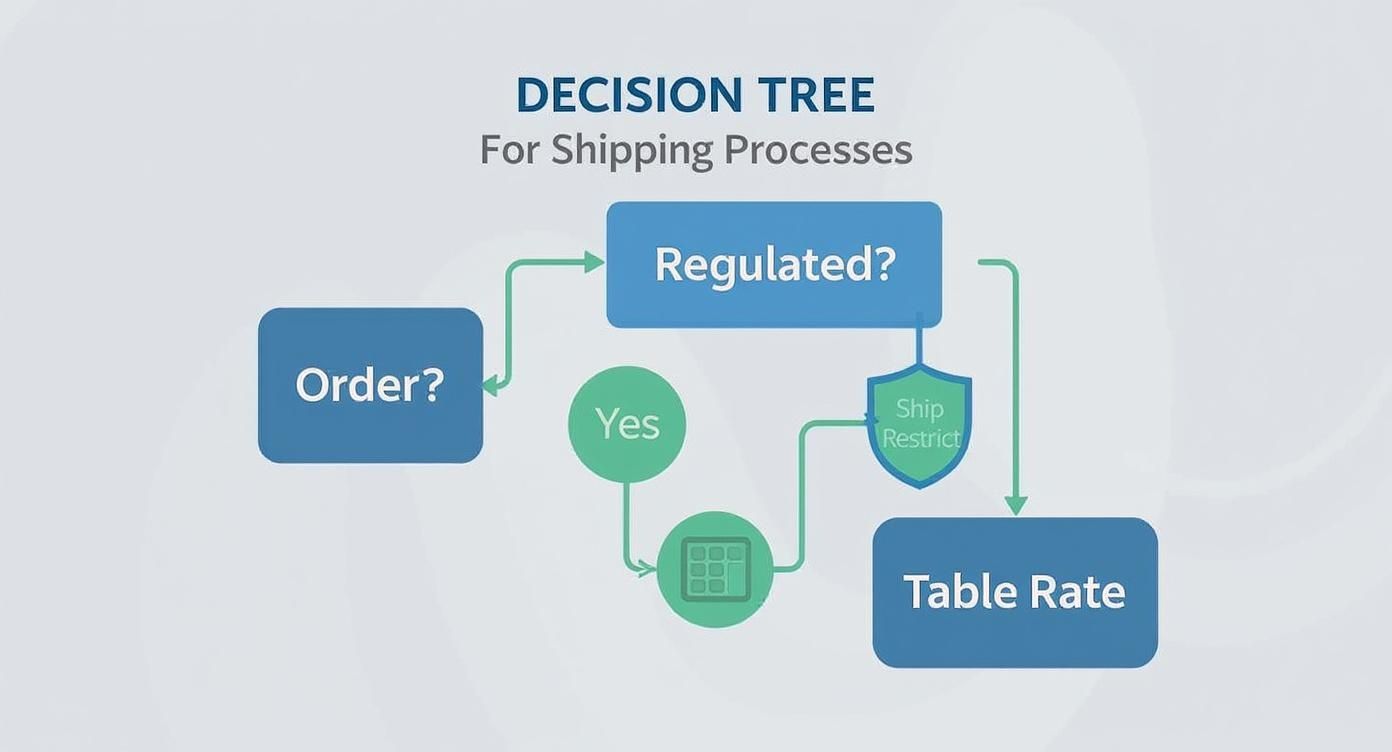
As the graphic shows, the nature of your product—regulated or not—is the first and most important factor in choosing your shipping tools.
The key takeaway is that Ship Restrict offers compliance granularity, letting you control if you can ship, while Table Rate Shipping provides cost granularity, letting you control how much to charge. For regulated products, you must always answer "if" before you answer "how much."
Putting them side-by-side really highlights their unique strengths. One is your legal department, and the other is your accounting department.
Feature Granularity Ship Restrict vs Table Rate Shipping
Here’s a quick breakdown of how their rule-setting capabilities stack up, especially for the needs of a firearms business.
| Feature/Capability | Ship Restrict | Table Rate Shipping |
|---|---|---|
| Geographic Control | High (State, County, City, ZIP) | Moderate (State, ZIP for pricing) |
| Product Control | High (SKU, Category, Attribute) | Low (Mainly via shipping classes) |
| Customer Control | High (User Role) | None |
| Primary Logic | Conditional (IF-THEN) | Mathematical (Lookup Table) |
| Main Goal | Prevent illegal sales | Calculate accurate shipping fees |
As you can see, they are designed for two completely different jobs.
Ultimately, the conversation about Ship Restrict vs Table Rate Shipping for regulated products isn't about picking one over the other. The most bulletproof setup almost always uses both. Ship Restrict acts as your first line of defense, checking if an order is even legal to ship. Once an order passes inspection, Ship Restrict hands it off to your Table Rate system to calculate the final, precise shipping cost. This hybrid approach ensures you are both compliant and profitable.
Analyzing Compliance and Risk Management Impact
When we talk about Ship Restrict vs. Table Rate Shipping for regulated products, the entire conversation has to start and end with compliance and risk. For anyone in the firearms business, this isn't just a simple feature comparison; it's a hard look at your company's legal and financial exposure.
One of these systems is built to protect you, and the other is built to calculate a price. Confusing their roles can have catastrophic consequences for your FFL.

Ship Restrict was designed from the ground up as a compliance engine. Its core job is to actively stop illegal sales by enforcing a complex web of state-specific firearm restrictions and carrier rules before a customer can even complete their purchase. This creates a proactive defense against violations.
A pure Table Rate Shipping system, on the other hand, operates with a dangerous blind spot. It has zero built-in understanding of legal restrictions. It sees an order for a firearm heading to a prohibited state and just does its job—it calculates a shipping cost. That simple action creates a massive compliance failure and puts your business directly in harm's way.
The True Cost of a Compliance Failure
The financial and legal fallout from a single shipping mistake is severe. Fines for violating firearm shipping laws can hit tens of thousands of dollars for just one incident. Even worse, you risk the suspension or complete revocation of your Federal Firearms License (FFL), which is effectively a death sentence for your business.
This isn't a theoretical risk. Regulatory bodies are actively monitoring shipments, and one error can trigger a full-scale audit of your sales records. Without a defensible audit trail showing you took proactive steps to prevent illegal sales, you’re left with little to no legal ground to stand on. Understanding the true cost of shipping compliance violations is absolutely critical for any FFL holder.
A Table Rate system can tell you the cost to ship an item from point A to point B. A Ship Restrict system tells you if you are legally allowed to ship it in the first place. For regulated goods, that second question must always be answered first.
Audit Trails and Defensible Decisions
This is where the risk management side of Ship Restrict really shines. Because it logs every single decision—every time a shipping method is hidden or a sale is blocked because of a specific rule—it builds a clear, defensible audit trail. If regulators ever question a transaction, you can prove your system is designed to enforce the law, not just calculate costs.
A Table Rate system offers no such defense. Its logs only show that a price was calculated, not that a compliance check was ever performed. This leaves you completely vulnerable, as you can’t prove you had a systemic process in place to stop violations before they happened.
Navigating a Complex Regulatory Environment
The regulatory environment for shipping is only getting more complex. A staggering 90% of shipping delays in major ports worldwide are tied to non-compliance with controls on regulated or restricted goods. This just underscores how urgent the need for better systems has become. As you can discover more insights about shipping industry regulations on shipfinex.com, it becomes painfully obvious that manual checks and spreadsheets are no longer scalable or reliable solutions.
Comparing Risk Mitigation Approaches:
| Aspect of Risk | Ship Restrict (Compliance-First) | Table Rate Shipping (Cost-First) |
|---|---|---|
| Legal Exposure | Minimized through automated rule enforcement. | Maximized due to a complete lack of compliance logic. |
| Financial Risk | Reduced by actively preventing fines and penalties. | High, as it doesn't block illegal, costly sales. |
| Audit Trail | Strong and defensible log of compliance checks. | None regarding legal compliance decisions. |
| Business Impact | Protects FFL and ensures long-term viability. | Creates a constant threat of license revocation. |
Ultimately, relying on a Table Rate system for compliance is like asking your accountant to perform a legal review. They're using the wrong tool for a mission-critical job. For any business selling regulated products, a compliance-first tool like Ship Restrict isn’t just a good idea—it’s a foundational piece of a sound risk management strategy.
Real-World Use Cases for Regulated eCommerce
Theory is one thing, but seeing how these tools solve actual problems for firearms dealers is where it all clicks. Let's move past feature lists and into the real world. This is where you see how one tool prevents expensive legal mistakes while the other handles tricky logistical costs.

These scenarios show exactly how each system tackles a specific, high-stakes challenge unique to the firearms industry. Getting this right is fundamental to running a compliant—and profitable—eCommerce store.
Use Case 1: Ship Restrict as a Compliance Gatekeeper
Picture this: a customer in Los Angeles tries to buy a standard 30-round magazine. As you know, California law bans the sale of these magazines. It’s a classic compliance nightmare just waiting to happen.
If a store only uses Table Rate Shipping, the system sees a simple transaction. It checks the ZIP code, calculates the cost for a small, light item, and shows the shipping options. The order processes without a single red flag, creating a direct violation of state law and putting the dealer's FFL in immediate danger.
Now, let's run that again with Ship Restrict. The moment the customer enters their California address, a pre-set rule fires. This rule, designed to enforce California Penal Code 32310, identifies the product as prohibited for that destination. Instead of showing rates, the system hides all shipping options and displays a custom message explaining the restriction. The illegal sale is stopped cold, protecting the business from legal disaster.
Use Case 2: Table Rate Shipping for Logistical Pricing
Let’s switch gears. A gun club in Texas places a bulk order for ten heavy gun safes. Each safe weighs 300 pounds, and the total shipment needs to go out on a pallet via freight. This isn't a compliance problem; it’s a complex pricing puzzle.
This is where Table Rate Shipping shines. Ship Restrict would simply confirm the items are legal to ship to Texas and get out of the way. The Table Rate system then takes over, using its calculation engine to figure out the real cost. It would calculate the total 3,000 lbs weight, flag the need for LTL freight, add a residential surcharge if needed, and factor in any liftgate service fees. The result is a precise shipping quote that actually covers your costs.
The smartest strategy isn't choosing one tool over the other—it's making them work together. A hybrid approach ensures every single order is both legally compliant and logistically profitable.
The Hybrid Approach: Combining Compliance and Cost
The best setup merges both systems into one seamless workflow. Imagine a customer in Florida adds a handgun to their cart and enters their local FFL's address at checkout.
- Compliance First: Ship Restrict instantly validates the order. It checks that the handgun is on Florida's approved roster and confirms the shipping destination is a valid FFL address. The order gets a green light.
- Cost Second: Once validated, the order is passed to the Table Rate system. It calculates the exact cost for expedited, insured, adult-signature-required shipping via the right carrier, presenting the final price to the customer.
This integrated process makes sure you never waste time calculating a shipping price for an illegal order. Ship Restrict is the guard at the gate; Table Rate Shipping is the accountant inside, making sure every legal shipment is also financially sound.
Setup Complexity vs. Total Cost of Ownership
When you’re weighing Ship Restrict against a standard Table Rate Shipping tool for regulated products, you're not just comparing two pieces of software. You're looking at two entirely different business functions. One is a compliance tool built for legal precision; the other is a logistics calculator built for data entry.
Understanding this difference is everything when it comes to setup and the true Total Cost of Ownership (TCO). It’s not about which one is "easier"—it's about what problem you're actually trying to solve.
Setting up Ship Restrict is fundamentally a legal and compliance exercise. The heavy lifting isn't technical; it's the process of translating complex federal, state, and local firearms laws into a digital rule set. This takes deep regulatory knowledge to ensure you're correctly blocking the right products based on a customer's specific address.
In sharp contrast, configuring a Table Rate Shipping system is purely a data entry job. The main task is transcribing carrier rate sheets, weight classes, and destination zones into the system’s tables. It can be tedious, sure, but it doesn't require a lawyer on speed dial—just a sharp eye for detail.
Looking Beyond the Subscription Fee
A real TCO analysis has to go way beyond the monthly price tag. You need to factor in the ongoing labor, the inherent risk, and the potential costs of keeping each system running over time. And this is where the two diverge dramatically.
Ship Restrict's TCO is almost entirely about compliance maintenance. The long-term cost is the time it takes to monitor legislative changes and update your rules. When a new city ordinance or state law passes, your rules need an immediate update to stay compliant. This work, however, directly offsets the catastrophic financial risk of a shipping violation.
Table Rate Shipping’s TCO, on the other hand, is all about logistical maintenance. The ongoing costs here are tied to updating your rate tables whenever carriers change their prices, which usually happens once a year. It's a predictable, if manual, task of updating numbers in a spreadsheet.
When you're calculating TCO for regulated products, you have to account for the cost of a single compliance violation. Fines, legal fees, and the potential loss of your FFL can easily dwarf years of software and maintenance costs. Suddenly, the investment in a dedicated compliance tool doesn't just look smart; it looks essential.
A Practical Cost Breakdown
Let’s break down how these costs really stack up, focusing on what each tool is designed to do.
-
Initial Setup:
- Ship Restrict: A significant upfront investment in time and legal research to build out your initial rule set.
- Table Rate: A moderate time investment for inputting shipping rates and zones.
-
Ongoing Maintenance:
- Ship Restrict: Requires periodic, event-driven updates whenever a law changes.
- Table Rate: Requires predictable, annual updates when carriers adjust their pricing.
-
Hidden Costs (The Risk Factor):
- Ship Restrict: Directly minimizes the risk of massive compliance fines and legal battles.
- Table Rate: If used alone for regulated goods, it carries a constant and enormous financial risk.
Ultimately, while the legal research for Ship Restrict might seem more daunting at first, its true TCO is often far lower once you factor in the astronomical cost of getting compliance wrong. It’s an investment in risk prevention, whereas Table Rate Shipping is purely an operational expense.
Frequently Asked Questions
Got questions about setting up your shipping? You're not alone. Here are direct answers to the most common things FFL dealers ask when comparing Ship Restrict and Table Rate Shipping.
Can I Use Only Table Rate Shipping for My Firearms Store?
In a word: no. Trying to run a firearms store with only table rate shipping is a recipe for disaster. Table rate systems are built for one thing—calculating shipping costs. They have absolutely no ability to understand or enforce the complex web of state and local gun laws.
Relying on them for compliance means you're wide open to massive legal penalties, fines, and even losing your FFL. You need a dedicated compliance tool like Ship Restrict to act as a legal firewall before the checkout ever thinks about calculating a price.
How Do Ship Restrict and Table Rate Shipping Work Together?
They're designed to work as a one-two punch. The best setup uses Ship Restrict as the gatekeeper—the first and most important step in your checkout process. It runs a simple, non-negotiable check: "Is this order legal to ship to this specific address?"
If the answer is "yes," Ship Restrict passes the approved shipping methods over to your Table Rate system. Only then does the table rate engine kick in to calculate the final shipping cost based on weight, distance, or whatever rules you've set. This sequence ensures every single order is compliant before a price is ever shown.
Think of it like this: Ship Restrict answers, "Can I ship this?" and Table Rate Shipping answers, "How much will it cost?" Compliance always comes first.
How Often Should I Update My Ship Restrict Rules?
Your update schedule should be directly tied to how often laws and carrier policies change. For firearms, that means you need to stay on top of it. Regulations shift constantly, and "I didn't know" isn't a defense.
- Best Practice: Do a quick review of your rules every quarter to catch minor legislative updates or policy tweaks.
- Annual Audit: Once a year, set aside time for a top-to-bottom audit of every rule in your system.
- Immediate Updates: When a major law changes, you need to be ready to update your rules the day it goes into effect.
Some solutions can help by offering managed rule sets or alerts, which takes a lot of the manual work off your plate.
Is Ship Restrict Only for Firearms?
Absolutely not. While it's a must-have for any FFL, Ship Restrict's logic is perfect for any business selling products with shipping restrictions. Its rule engine can handle compliance for all sorts of high-risk items.
We see it used for products like:
- Knives and other bladed tools
- Vape and CBD products
- Alcohol and tobacco
- Certain chemicals or hazardous materials
If your product's shipping eligibility depends on where the buyer lives and what's in their cart, an automated compliance engine will save you a world of headaches.
Ready to automate your shipping compliance and stop worrying about costly mistakes? With Ship Restrict, you can build a powerful, automated rule set that protects your business, saves you time, and ensures every order that leaves your shop is 100% compliant. Start your journey with Ship Restrict today!
Automate Shipping Compliance
Stop worrying about restricted states. Ship Restrict handles it automatically.

Cody Yurk
Founder and Lead Developer of ShipRestrict, helping e-commerce businesses navigate complex shipping regulations for regulated products. Ecommerce store owner turned developer.
Automate Shipping Compliance
- Block restricted states
- No more cancellations
- Set and forget
3-day free trial · Card required