Guide: reloading components powder primers shipping and compliance tips
Navigate HazMat rules, carrier policies, and state laws for reloading components powder primers shipping with clear, practical guidance.
Shipping reloading components isn't like sending a t-shirt; one mistake can cost you thousands. For any eCommerce business in this space, one slip-up with smokeless powder and primers can trigger crippling fines, suspended carrier accounts, and legal trouble that could shut you down overnight.
The Hidden Risks of Shipping Reloading Components
Many online retailers seriously underestimate the operational and financial dangers that come with shipping reloading components. Smokeless powder and primers aren't just regulated items; the Department of Transportation (DOT) classifies them as hazardous materials, or HazMat.
That single designation unleashes a torrent of strict rules. It governs every single step of your fulfillment process, from the specific type of box you have to use to the exact labels you apply.
The stakes are incredibly high. A single compliance error—using the wrong packaging, failing to declare a hazardous shipment, or sending an order to a prohibited location—isn't just a simple mistake. It's a federal offense.
Automate Shipping Compliance
Block orders to restricted states automatically. 3-day free trial.
Start Free TrialThe True Cost of a Shipping Mistake
The financial penalties alone can be devastating for a small business. Fines for HazMat violations can easily rocket into the tens of thousands of dollars per incident.
And that's just the government. Carriers like UPS and FedEx will hit you with their own sanctions, which often include massive fines and the immediate termination of your shipping contract. Just like that, your ability to do business is gone.
This complex environment creates a few core headaches for retailers:
- Regulatory Complexity: Trying to navigate the dense web of federal, state, and local laws feels like a full-time job.
- Carrier Enforcement: UPS and FedEx have zero tolerance for non-compliance. They won't hesitate to suspend accounts that put their networks at risk.
- Operational Bottlenecks: Manual address checks and constant compliance verifications grind your fulfillment process to a halt, leading to delays and angry customers.
The real risk isn't just a returned package. It's the very real potential for a single overlooked shipment to jeopardize your entire business. Getting reloading components powder primers shipping right isn't optional—it's essential for survival.
To get ahead of unexpected challenges and cut down your liability when shipping sensitive materials, it's worth exploring essential supply chain risk mitigation strategies. Understanding these principles is a huge part of building a resilient operation. For those looking for a more direct solution, learning more about specialized platforms for shipping hazardous materials can offer a clear path to compliance.
Decoding Federal Hazmat Shipping Regulations
Before a single canister of powder or brick of primers leaves your shop, it enters a world governed by strict federal law. The U.S. Department of Transportation (DOT) lays down the rules for all hazardous materials transport, and make no mistake—smokeless powder and primers are squarely in that category. These regulations live in Title 49 of the Code of Federal Regulations (49 CFR), a document that can feel overwhelmingly dense for a small business owner just trying to get orders out the door.
The core idea is simple: these materials pose a risk in transit, and the rules exist to minimize that risk. For an eCommerce retailer, this means your responsibility starts long before the UPS driver shows up. It begins with getting the classification, packaging, and labeling right. Getting this wrong isn't just a slap on the wrist; it's a serious violation.
ATF reports show that a huge number of recent industry violations are tied to improper HazMat shipping, with fines averaging a painful $10,000. On top of that, small retailers lose an estimated 25% of potential revenue from orders they can't fulfill in restricted areas like NYC or Chicago, where city-level rules kill powder deliveries.
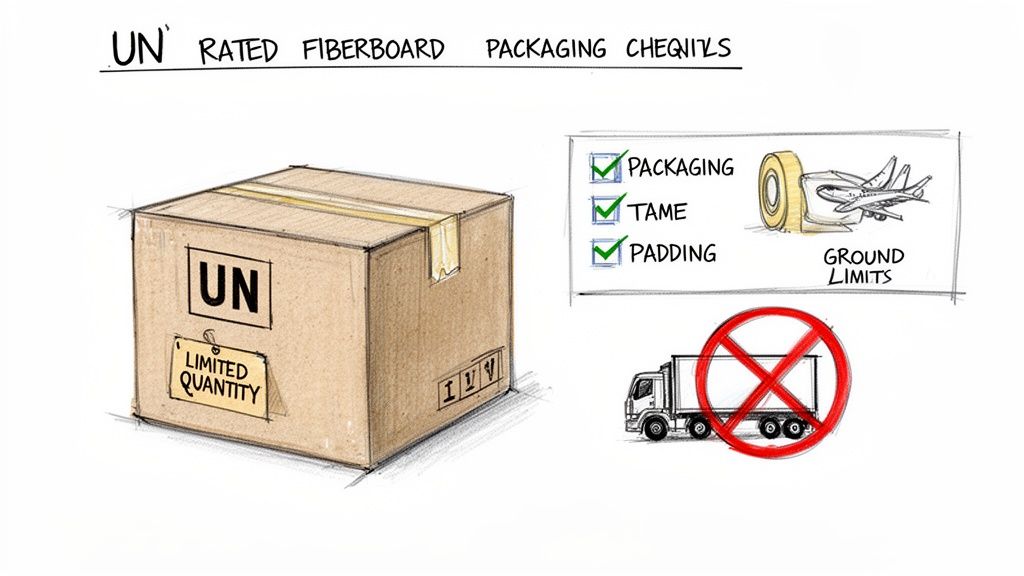
The Foundation: UN-Rated Packaging
Your standard cardboard box from the local supply store won’t cut it. Federal law is crystal clear: smokeless powder and primers must be shipped in UN-rated packaging. This isn't a suggestion. It’s a hard requirement to ensure the container can handle the bumps, drops, and stacking of a typical shipping journey.
Free Shipping Compliance Audit
We'll review your WooCommerce store's shipping compliance for free.
Specifically, you'll need a UN 4G rated fiberboard box. This rating means the box design has survived a battery of brutal tests for strength and durability. But here's the catch: the box is only compliant if you use it exactly as it was tested. That includes the specific inner packaging, the right kind of padding, and even the type of tape used to seal it up.
Think of the UN rating as a complete safety system, not just a box. If you swap out the required inserts for your own packing peanuts, you’ve just invalidated the UN certification and put your business out of compliance.
Labeling for Ground Transport
Proper labeling is how you tell everyone in the supply chain what’s inside and what risks it poses. For ground shipments of reloading components, you will almost always be using the Limited Quantity marking.
This black-and-white diamond label signals that while the material is hazardous, it's being shipped in small enough amounts to present a lower overall risk. Getting this label right is absolutely critical for domestic ground shipping.
- Placement: The Limited Quantity mark has to be clearly visible on the outside of the box. No hiding it on the bottom.
- Size: The diamond has specific size requirements so it can be identified at a glance.
- Other Markings: The box needs to be clean. You can't have old, conflicting labels on there from a previous use. Only the required markings for the current shipment should be visible.
If you mess this up, a carrier can—and will—reject the shipment. Worse, you could face fines if it's discovered during a random DOT inspection.
Why Air Shipping Is Off the Table
One of the first questions new retailers ask is about expedited shipping. Can they offer overnight or 2-day air to customers, especially those in places like Alaska or Hawaii?
The answer is a hard no.
Federal regulations and carrier policies are ironclad on this. The changes in air pressure and temperature at altitude create unacceptable risks for Division 1.3 and 1.4 explosives, which are the classifications for smokeless powder and primers.
This ground-only restriction has some major impacts on your business:
- Slower Delivery Times: You have to be upfront with customers that all orders will take longer. Manage those expectations from the start.
- Geographic Limitations: You simply cannot serve customers in locations only accessible by air, like Hawaii, Alaska, or U.S. territories. This is a non-negotiable rule.
- No International Shipping: The combination of the air transport ban and the sheer complexity of international HazMat rules makes selling these components overseas nearly impossible for a small retailer.
Here’s a quick-glance table to help you keep the main federal and carrier requirements straight.
Key HazMat Shipping Requirements at a Glance
| Requirement | Smokeless Powder | Primers | Key Regulation/Policy |
|---|---|---|---|
| Packaging | UN 4G Rated Box | UN 4G Rated Box | 49 CFR §173.62 |
| Max Weight (per package) | 8 lbs | 25 lbs | 49 CFR §173.63(b) / Carrier Policy |
| Shipping Method | Ground Only | Ground Only | 49 CFR & Carrier Policy |
| Primary Label | Limited Quantity Diamond | Limited Quantity Diamond | 49 CFR §172.315 |
| Air Transport | Strictly Prohibited | Strictly Prohibited | IATA Dangerous Goods Regulations |
| Carrier Contract | HazMat Contract Required | HazMat Contract Required | UPS/FedEx Policy |
This table provides a solid starting point, but remember it’s not a substitute for reading the actual regulations.
Understanding these foundational DOT rules is the first, non-negotiable step to building a compliant shipping operation. To dig deeper into the world of transporting dangerous goods, you might find it useful to check out resources that offer a comprehensive ADR Training overview, which gives a broader context on HazMat handling.
Mastering Carrier Rules for UPS and FedEx
Once you’ve navigated the maze of federal DOT regulations, you hit the next critical gatekeeper: the shipping carriers themselves. While federal law sets the baseline, companies like UPS and FedEx build their own, often stricter, policies on top of it.
Thinking you can just drop off a properly labeled box of primers at a UPS Store is a fast track to a rejected shipment and a flagged account. It's just not that simple.
First, let's clear up a common question: Why not just use USPS? The answer is simple and absolute. The United States Postal Service does not accept shipments of smokeless powder or primers from consumers or retailers under any circumstances. Trying to ship them through the mail isn't just a bad idea—it's a federal crime.
This leaves eCommerce businesses with two main options for shipping reloading components: UPS and FedEx.
Becoming an Approved Hazmat Shipper
Neither UPS nor FedEx will let you ship hazardous materials without a formal agreement. You can't just open a standard business account and start sending out boxes of powder. You must apply for and be granted a specific Hazardous Materials Contract.
This process is more than just signing a piece of paper. The carriers need to know you understand the risks and are equipped to handle these materials safely.
- Formal Application: You’ll need to contact your carrier representative and explicitly request to become a HazMat shipper.
- Business Verification: They will review your business operations to ensure you are a legitimate commercial entity.
- Required Training: Both carriers mandate that your employees who handle and prepare HazMat shipments complete certified training. You must keep these training records on file and be ready to present them.
Without this contract, any attempt to ship powder or primers is a direct violation of your terms of service. If you get caught, the consequences are immediate: the package gets returned, your account is suspended, and you could face substantial fines directly from the carrier.
Comparing UPS and FedEx Policies
While both carriers require a HazMat contract, their specific rules and fee structures have some key differences. For instance, both only permit ground transport for these items, and you have to use their scheduled pickup services. Dropping these packages at a retail location like a FedEx Office or UPS Store is strictly forbidden.
Understanding their individual nuances is crucial for a smooth operation. For a detailed breakdown, you can learn more by comparing UPS vs FedEx vs USPS shipping rules for ammunition and components. Digging into this comparison is essential for making an informed choice for your business.
A common pitfall for new sellers is underestimating the HazMat Surcharge. This is a non-negotiable fee applied to every single package containing hazardous materials. It is not part of the base shipping rate and must be factored into your pricing.
This surcharge is where costs can quickly spiral. Smokeless powder and primers face stringent HazMat rules. In the US, UPS and FedEx both mandate specific labeling, even for small quantities. Regulatory changes have largely eliminated air shipping options, forcing sellers to use expensive ground services that can add $50-100 per order in fees. You can find more insights on the reloading equipment market at dataintelo.com.
A Real-World Scenario Gone Wrong
Imagine a small online store gets a big order for eight pounds of powder and 5,000 primers. Eager to fulfill it, the owner puts everything into one large, sturdy box, slaps a Limited Quantity label on it, and schedules a pickup.
The UPS driver immediately spots the problem. He knows that powder and primers can never ship in the same box. They are classified under different UN numbers and must be packaged separately. Period.
The driver refuses the shipment. Now the retailer has to scramble.
- Repackage Everything: They have to find two separate, compliant UN 4G boxes.
- Pay Double the Fees: The single order now requires two distinct shipments. That means paying two separate HazMat surcharges, effectively doubling the handling cost.
- Explain the Delay: The customer, who was expecting their order, now has to be told about a shipping delay caused by an internal compliance failure.
This single mistake completely erodes the profit margin, damages customer trust, and flags the retailer's account for closer scrutiny from the carrier. Mastering these carrier-specific rules isn't just about compliance—it's about protecting your business's bottom line and reputation with every single package you send.
Don't Get Tripped Up by State and Local Shipping Bans
Getting a handle on federal regulations and carrier policies is a huge step, but it’s only half the battle. The moment a customer places an order, you’re dealing with a tangled web of state, county, and even city laws that can stop a shipment cold. This patchwork of local rules is a minefield for anyone trying to ship reloading components like powder and primers.
You can have a package that's perfectly legal under DOT rules and good to go with FedEx, but the second it crosses a specific state or city line, it becomes contraband. These restrictions aren't always well-publicized and they change far more often than federal laws, making them a nightmare to track by hand.
For instance, states like Massachusetts and New York are notoriously strict about shipping reloading components directly to consumers. It's not just at the state level, either. Big cities like Chicago, Washington D.C., and New York City have their own ordinances that outright ban the delivery of smokeless powder and primers to residential addresses.
Why Manual Checks Just Don't Cut It Anymore
Think about your daily workflow for a minute. An order for a pound of Varget powder comes in from Illinois. You know Illinois is generally okay. But the shipping address is inside Chicago city limits. Unless you or your staff know to catch that specific city-level ban, you're shipping a package that will get rejected or, even worse, confiscated.
This is where trying to do it all manually falls apart. It banks on your team remembering a constantly shifting map of thousands of different jurisdictions. A single slip-up can cause a cascade of problems:
- Costly Returns: The carrier sends the package back on your dime. Now you've paid for shipping and a return fee for a sale you didn't even make.
- Lost Inventory: In some cases, a prohibited shipment isn't returned. It's seized and destroyed by the authorities. That's a total loss.
- Unhappy Customers: Nothing kills a customer relationship faster than a canceled order or a failed delivery because of a compliance issue you were supposed to catch.
This manual approach isn't just inefficient; it's a massive business risk. Those constant state and ZIP code checks eat up hours every single week. They also expose your business to fines that can reach up to $75,000 per violation under federal HazMat laws if something goes wrong.
The market for reloading equipment is growing fast, as detailed by a recent GlobeNewswire report, which means more orders and more chances for error. Automating your compliance is the only way to keep up.
Automation Is No Longer a "Nice-to-Have"
Given the sheer complexity and ever-changing nature of local laws, automated enforcement has become a basic business necessity. Manually checking every single order against an endless list of state, county, and ZIP code rules is a recipe for disaster. One tired employee or one outdated spreadsheet is all it takes to trigger a costly violation.
Relying on manual checks is like navigating a maze blindfolded. You might get through it a few times by luck, but eventually, you're going to hit a wall. An automated system gives you the map and the guardrails to stop those costly errors before they happen.
The only scalable solution is a system that automatically checks a customer’s shipping address against a database of known restrictions before they can even complete their checkout. This flips the switch, turning your store from reactive to proactive. It blocks illegal orders at the source, protecting your business from fines and carrier penalties while giving your customers clear, instant feedback on what you can and can't ship to them.
How to Automate Shipping Compliance in WooCommerce
Trying to manually keep up with shipping compliance is a losing game. Expecting your team to memorize an ever-shifting list of state, county, and ZIP code bans for every order isn’t just slow—it’s a direct path to expensive mistakes, angry carriers, and legal headaches. This is where you stop reacting to problems and start building a smart, automated system right inside your WooCommerce store.
Automating the rules for reloading components powder primers shipping turns a massive operational risk into a seamless, protective layer for your business. Instead of putting out fires, you prevent them from ever starting. The right tools act as a digital gatekeeper, automatically checking every customer's address against your shipping rules before they can even complete their purchase.
This proactive setup stops illegal orders cold. It shields you from fines, protects your carrier accounts, and creates a much smoother customer experience by giving people clear, instant feedback at checkout.
Building Your Rule-Based System
The heart of this system is a set of specific, granular rules that mirror the messy legal landscape. With a plugin like Ship Restrict, you can go way beyond simple state-level blocks and enforce the tricky local ordinances that trip up so many online sellers. The goal is to build a defense that’s as detailed as the laws you’re up against.
This means translating all those layers of regulations—federal, carrier, and local—into a logical set of instructions for your store to follow.
This flowchart shows the compliance journey every shipment has to navigate, from broad federal laws down to specific city or county rules.
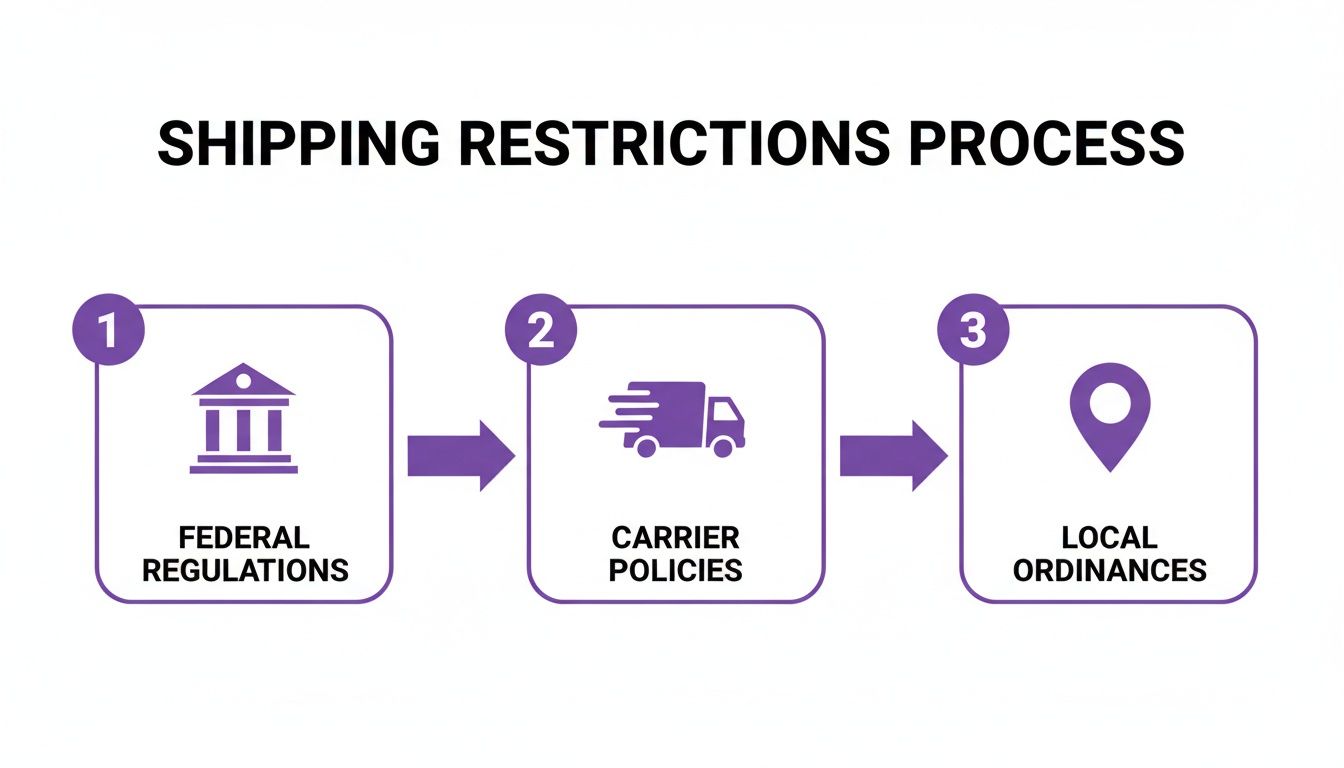
As you can see, an order can be perfectly fine at the federal and carrier level but still get blocked by a local ordinance. That’s exactly why you need a system that can handle this level of detail.
When building out your rules, it’s best to start broad and then get more specific. Here’s a practical way to approach it:
- Start with Product Categories: First, group your sensitive items together. Create a "Smokeless Powder" category for all powder products and a separate "Primers" category. This lets you apply different rules to each group.
- Implement State-Level Blocks: Next, add rules that block shipments of both categories to states where they are completely prohibited, like Massachusetts. This is your first line of defense.
- Drill Down to Local Restrictions: This is the most important part. For states that generally allow these components, you need to add more specific rules for cities or ZIP codes that have their own local bans. A perfect example is blocking all powder and primer shipments to the five boroughs of New York City or to any address within Chicago's city limits.
Pro Tip: Don't forget about places that can only be reached by air. Since smokeless powder and primers can only ship via ground, you’ll need to create rules blocking shipments to Alaska, Hawaii, and U.S. territories like Puerto Rico and Guam.
Configuring Rules and Customer Messages
Once you’ve mapped out your strategy, the technical side is pretty straightforward. A dedicated plugin lets you build these rules directly into your WooCommerce dashboard, creating a powerful and automated compliance engine. For a more technical breakdown, you can check out detailed guides on managing HazMat shipping restrictions in WooCommerce.
But just blocking a sale isn't enough. You have to tell the customer why it's blocked. A vague error message just leads to frustrated customers and a flood of support tickets.
Your system should let you write custom, user-friendly messages that explain the situation clearly and professionally.
- For State-Level Blocks: A message like, "Due to state regulations, we are unable to ship smokeless powder to your location in Massachusetts."
- For City-Level Blocks: Get more specific for better clarity: "Unfortunately, city ordinances in Chicago prevent us from shipping primers to your ZIP code."
These clear, upfront messages manage customer expectations, cut down on confusion, and show that your business is a responsible, law-abiding retailer. This transparent, automated approach is the key to safely navigating the complexities of reloading components powder primers shipping.
Common Questions About Shipping Reloading Components
Even seasoned retailers get tripped up by the details of shipping reloading components. The rules can be specific and unforgiving. Let’s clear up some of the most common—and critical—questions we see.
Can I Ship Powder and Primers in the Same Box?
Absolutely not. This is a non-negotiable rule you can't afford to get wrong. Federal regulations and carrier policies strictly forbid shipping smokeless powder and primers in the same package.
Each must go in its own separate, UN-rated box. That means each one needs its own distinct packaging, its own proper labeling, and will get hit with its own separate HazMat fee. Trying to combine them is a serious violation that can get your shipping account shut down in a heartbeat, not to mention the hefty fines that follow.
What Happens If I Ship to a Prohibited State?
The consequences here range from a financial headache to a business-ending disaster. In the best-case scenario, the carrier's sorting hub catches the error and the package gets sent back to you—on your dime. You’re out the original shipping cost and you have to pay for the return trip.
Worst case? The package is confiscated by authorities. Now you're not just dealing with lost product and an angry customer. You're facing potential carrier fines and federal penalties that can climb into the tens of thousands of dollars per violation. A single shipment to a banned location puts your entire business at risk.
Shipping to a restricted state is a bad bet. The best you can hope for is to lose money, and the worst is to lose your business. It's a risk that's never, ever worth taking.
Do I Need an FFL to Ship Reloading Components?
No, you don't need a Federal Firearms License (FFL) to sell or ship components like powder, primers, or bullets. The ATF doesn't classify these items as "ammunition" in the legal sense.
But don’t let that fool you into thinking it’s a free-for-all. You are still required to follow all DOT HazMat regulations to the letter, become an approved HazMat shipper with your chosen carrier (UPS or FedEx), and comply with every state and local law governing the sale and transport of these materials.
How Should I Handle Hazmat Fees at Checkout?
Carriers charge a mandatory HazMat fee for every single package containing smokeless powder or primers. This fee is non-negotiable, separate from the standard shipping rate, and it can be substantial.
The industry-standard approach is to pass this fee directly to the customer at checkout. If you're using WooCommerce, you can set this up as a special handling fee or a dedicated shipping charge that only appears when a HazMat-classified product is in the cart. This keeps your pricing transparent for the customer while ensuring you're not eating that significant cost yourself.
You can automate all of these complex rules and protect your business with Ship Restrict. Stop losing sleep over state bans and carrier policies, and start blocking restricted orders before they turn into expensive mistakes. Learn more about how Ship Restrict can help.
Automate Shipping Compliance
Stop worrying about restricted states. Ship Restrict handles it automatically.

Cody Yurk
Founder and Lead Developer of ShipRestrict, helping e-commerce businesses navigate complex shipping regulations for regulated products. Ecommerce store owner turned developer.
Automate Shipping Compliance
- Block restricted states
- No more cancellations
- Set and forget
3-day free trial · Card required