A Merchant's Guide to Oregon Firearms Ammunition Shipping Laws
Struggling with Oregon firearms ammunition shipping laws? Our guide simplifies FFL transfers, prohibited persons, and carrier rules for eCommerce compliance.
For eCommerce merchants, Oregon's gun and ammunition shipping laws can feel like a trap. The state mixes tough gun control with surprisingly few rules for ammo, creating a confusing setup where one wrong move can lead to hefty fines, a revoked license, or even criminal charges. This guide will give you a clear path to staying compliant and protecting your business.
Your Guide to Oregon Shipping Compliance
Selling firearms and ammunition online is all about knowing the rules, and Oregon is a special case. The state is known for strict gun control, but its laws for shipping ammunition directly to customers are much looser than those for firearms. This mismatch trips up a lot of online sellers, leaving them open to expensive mistakes. The risks aren't just about money—a single compliance slip-up could put your Federal Firearms License (FFL) and your entire business on the line.
Think of this guide as your playbook for making sure every shipment to Oregon is safe, legal, and straightforward. We'll break down the key differences between federal and state laws, explain the must-follow FFL transfer process, and clarify what you need to do as a seller. It's a step-by-step manual for building a shipping strategy that's both compliant and easy to defend.
Protecting Your Business from Liability
Beyond shipping rules, managing risk is a huge part of selling regulated products. A single incident with something you sold can have devastating legal fallout. To protect your business when selling high-risk items, it’s crucial to check out a comprehensive insurance product liability guide. The right insurance isn't just a good idea; it's a core part of running a responsible business in this industry.
Automate FFL Shipping Compliance
Block orders to restricted states automatically. 3-day free trial.
Start Free TrialHere's what we'll cover to get you up to speed:
- Federal vs. State Laws: How national rules and Oregon-specific laws fit together.
- The FFL Transfer Process: A simple breakdown of the required steps for legally shipping firearms.
- Ammunition Shipping Rules: Getting clear on what is—and isn't—required when shipping ammo to Oregon.
- Common Legal Pitfalls: How to spot and steer clear of the most frequent and costly mistakes sellers make.
The heart of Oregon compliance is simple: firearms and ammunition are treated completely differently. Firearms always go through an FFL dealer for a background check. Ammunition sales, on the other hand, are mostly governed by federal rules about who is prohibited from buying it.
Once you get these areas down, you can turn a legal headache into a smooth, automated process that protects your store and serves your customers the right way.
How Oregon's Two-Layer Legal Framework Works
Shipping firearms and ammunition to Oregon isn't about following one set of rules, but two. It’s a lot like building a house: federal law is the mandatory foundation you have to pour first, while Oregon’s state laws are the specific framing and codes you build on top of it. Get this structure right, and you're compliant.
The bedrock of every interstate firearm sale is federal law, specifically 18 U.S.C. § 922. This statute is non-negotiable and crystal clear: any firearm you sell to a customer in another state must be shipped to a Federal Firearms License (FFL) holder. You can never ship it directly to the buyer's home.
Think of this federal rule as a universal safety net. It guarantees a licensed professional is always involved in the final transfer, acting as the legally required intermediary who handles the crucial, in-person steps of the transaction.
The Role of Oregon State Law
Oregon state law adds a second, critical layer on top of this federal foundation. While federal law dictates where the gun must be shipped (an FFL dealer), Oregon law specifies how the final transfer must happen.
Under Oregon Revised Statute (ORS) 166.412, every single firearm transfer in the state—including those that started with an online purchase—has to go through a background check.
So, when your customer in Portland orders a handgun from your store, the local FFL they choose isn't just a pickup spot. That dealer is legally obligated to run a background check through the Oregon State Police before they can hand over that firearm. This state-level requirement closes potential loopholes and reinforces the federal framework.
Free Firearms Compliance Audit
Selling firearms or ammunition? We'll review your WooCommerce store's shipping compliance for free.
For an eCommerce merchant, the process is straightforward:
- Federal Compliance: You ship the firearm directly to a valid FFL holder in Oregon.
- State Compliance: The FFL dealer you ship to handles the state-mandated background check.
Nailing this interplay is the key to mastering firearm sales to Oregon. Your job is the proper shipment; the FFL's job is the proper transfer.
The Critical Distinction for Ammunition
Now, here’s where a lot of sellers get tripped up and make expensive mistakes: the rules for ammunition are completely different. While firearms are heavily regulated at both the federal and state levels, Oregon’s approach to ammo shipping is surprisingly hands-off.
The single most important takeaway for any online seller is this: Oregon has no state-specific licensing requirements for buying or selling ammunition. There's no state permit needed for a customer to purchase ammo, and no special state-level license required for you to sell it to them.
This creates a totally different compliance picture. Oregon's firearms and ammunition shipping laws are much more permissive than some of its other gun control measures might suggest. While firearms must follow federal rules under 18 U.S.C. § 922 and state laws like ORS 166.412 (which has required background checks for all sales since 2015), ammunition shipments face no such state-level hurdles. You can read more about how Oregon's various gun laws interact on the La Grande Observer's website.
For ammunition, your compliance focus shifts almost entirely to federal restrictions, which boil down to not knowingly selling to prohibited persons. This group includes convicted felons, individuals under certain restraining orders, and others barred by federal law from owning firearms or ammo. You're also on the hook for following carrier policies and age verification rules.
The table below breaks down these fundamental differences, giving you a quick snapshot of your obligations for each product type.
Oregon Firearms vs. Ammunition Shipping Requirements at a Glance
This table provides a clear comparison of the key legal requirements for shipping firearms versus ammunition to Oregon, helping merchants quickly understand the different compliance obligations.
| Requirement | Firearms Shipping | Ammunition Shipping |
|---|---|---|
| Ship-To Address | Must be a valid Federal Firearms License (FFL) holder. | Can be shipped directly to the customer's residence (with exceptions). |
| State-Level Permit | No purchase permit is required for the buyer. | No purchase permit is required for the buyer. |
| Background Check | Required. Performed by the FFL dealer upon pickup. | Not Required by Oregon state law for the sale itself. |
| Seller Licensing | Must have a Federal Firearms License (FFL). | No specific Oregon state license is required to sell ammunition. |
| Primary Legal Focus | Federal interstate transfer laws and Oregon background check laws. | Federal laws concerning prohibited persons and carrier regulations. |
Recognizing this sharp divide between firearms and ammo is the first and most critical step toward building a compliant and error-free shipping strategy for Oregon.
Mastering the FFL Transfer Process
If you sell firearms online, the Federal Firearms License (FFL) transfer is the bedrock of every single sale to Oregon. This isn’t just a "best practice"—it's a legal requirement that underpins your entire operation. Getting this process wrong can bring swift and severe penalties, including hefty fines and the potential loss of your own license.
Think of an FFL dealer as the legally required closing agent for a gun sale. Just like you can't finalize a home sale without a title company, you can’t complete a firearm transaction without a local FFL. They are the only ones authorized by federal law to receive an interstate firearm shipment, run the mandatory background check, and legally hand the firearm over to your customer.
The Merchant's Step-by-Step Responsibilities
For you, the seller, the process boils down to a clear sequence of verification and shipping. Shipping a firearm directly to a customer's house or an unverified address is a serious federal crime, which makes every step in this chain absolutely critical for complying with Oregon firearms ammunition shipping laws.
Here’s what you need to do for every order:
- Customer Selects an FFL: During checkout, your customer must choose a local FFL dealer. This is where they'll go in person to pick up their firearm.
- License Verification: Before a single roll of packing tape comes out, you have to verify that the dealer’s license is active and valid. You'll use the ATF's FFL eZ Check system, a free online tool that should become your best friend.
- Address Confirmation: You can only ship the firearm to the official "premises address" listed on the FFL's license. Sending it to a different mailing address or a P.O. Box is a hard no and strictly illegal.
This tightly controlled process creates an unbroken chain of custody and legal accountability from your warehouse all the way to the final transfer. To get a better handle on the different license types and what they mean for your business, check out our detailed guide on understanding FFLs for eCommerce.
This flowchart maps out the compliance journey, showing how a customer's order moves through both federal and state legal hoops.
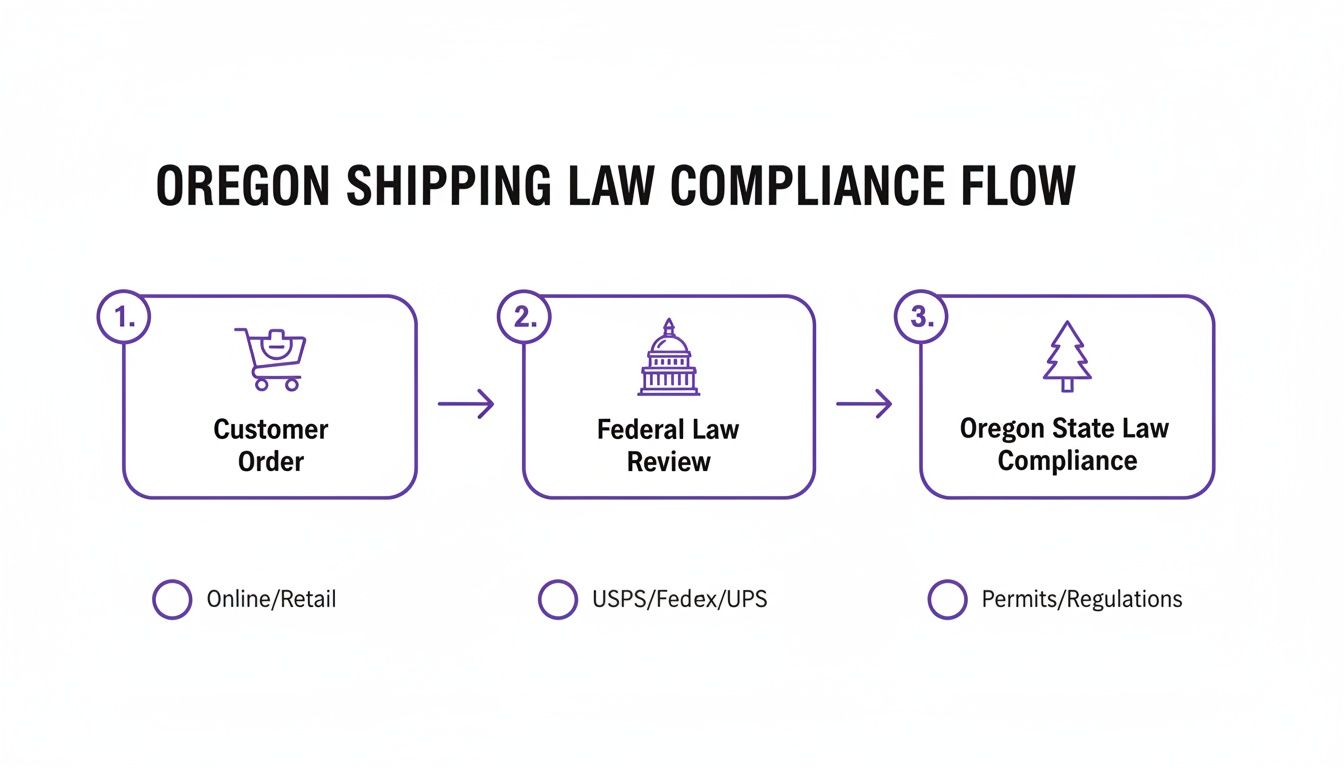
The key takeaway here? Federal law tells you where to ship the gun (the FFL), while Oregon state law dictates what happens next (the background check and final transfer).
Avoiding Common and Costly Pitfalls
While the FFL transfer process seems simple on paper, a few common mistakes can put your business in serious legal jeopardy. Being proactive about these issues is non-negotiable for staying compliant and protecting your license.
One of the most frequent errors is failing to verify an FFL's status before every single shipment. Licenses expire. Dealers have their licenses revoked. Simply assuming that an FFL you've used before is still good to go is a gamble you absolutely cannot afford to take.
Another classic mistake involves shipping addresses. The address on the FFL certificate is the only one you can legally ship to, period. A dealer might ask you to send a firearm to a different "shipping" location for their convenience, but doing so is a violation of federal law. Stick to the address verified in the FFL eZ Check system, no exceptions.
Crucial Takeaway: The burden of verification falls squarely on you, the seller. Never take an FFL's status for granted. A quick check on the ATF's FFL eZ Check system before every shipment is your best defense against shipping to an invalid or expired license holder.
By developing a rigid, documented procedure for verifying every FFL and shipping address, you can turn this complex legal requirement into a routine part of your fulfillment process. It's how you ensure every firearm you ship to Oregon is handled correctly and lawfully, every time.
Screening for Prohibited Persons and Restricted Locations

True compliance with Oregon firearms ammunition shipping laws goes way beyond just nailing the FFL transfer process. It's about building a proactive defense against illegal sales by actively screening for prohibited individuals and restricted delivery locations. This is especially critical for ammunition sellers, who don't have an FFL's background check to serve as that final safety net.
Think of it this way: the FFL transfer is a locked gate at the end of a long road. But your job as the merchant is to check the driver’s credentials before they even start the journey. This means you have to make a reasonable effort to ensure you aren’t knowingly selling to someone legally barred from owning your products.
Both federal and Oregon state laws lay out who fits into the "prohibited person" category. While the legal definitions get complicated, this group generally includes anyone convicted of a felony, individuals subject to certain domestic violence restraining orders, or those who have been legally declared mentally defective.
Identifying Prohibited Purchasers
For firearm sales, the FFL’s mandatory background check is the final, non-negotiable verification step. When it comes to ammunition, however, the legal burden lands squarely on your shoulders. Federal law makes it illegal to sell ammo to anyone you know or have "reasonable cause to believe" is a prohibited person. That's a huge distinction that requires you to build some vigilance into your sales process.
Now, you aren't expected to run your own background checks. But you absolutely must pay attention to red flags. Putting a few basic screening measures in place can help demonstrate your due diligence and protect your business from serious trouble.
Here are a few practical steps you can take:
- Customer Affirmation: Add a mandatory checkbox at checkout where customers must attest that they are legally allowed to buy ammunition and meet all age requirements. This creates a documented record of their self-certification.
- Address Verification: Use an Address Verification Service (AVS) to make sure the billing and shipping addresses match. Mismatched info can sometimes be a sign of a fraudulent or suspicious order.
- Order Review: Manually review orders that just feel off—like unusually large quantities or multiple orders going to the same address but under different names.
A core principle of ammunition compliance is avoiding "willful blindness." You can't just ignore obvious warning signs. If an order feels wrong or raises questions about the buyer's eligibility, the safest move is always to cancel the sale and issue a refund.
Blocking Shipments to Restricted Locations
Beyond screening individuals, you also have to block shipments to specific "no-ship" zones where firearms and ammunition are flat-out not allowed. Shipping to these places is a common—and costly—mistake that an automated system can easily prevent.
In Oregon, like in most states, certain sensitive locations are completely off-limits for firearm and ammo deliveries. Trying to ship to these addresses will lead to returned packages, carrier fines, and potentially serious legal headaches. Your store’s shipping logic needs to be smart enough to automatically identify and block these destinations at checkout.
Key restricted locations to block include:
- P.O. Boxes: You can't ship firearms or ammunition to a Post Office box. Period.
- Government Buildings: This covers all federal, state, and local government facilities.
- Schools and Universities: All K-12 schools, colleges, and university campuses are restricted zones.
- Correctional Facilities: Any prison, jail, or detention center is a prohibited destination.
- Airports: Secured areas of airports are strictly off-limits.
Trying to manually check every single address against a list of restricted spots is a recipe for disaster. It's slow and leaves way too much room for human error. A much smarter approach is to set up shipping rules in your eCommerce platform that automatically block these zones. By using ZIP code-based rules or keyword filters (like "PO Box," "School," or "Courthouse"), you create an automated compliance shield that protects your business 24/7. For any serious merchant, this isn't just a good idea—it's essential.
Navigating Carrier Rules and Recordkeeping Essentials
<iframe width="100%" style="aspect-ratio: 16 / 9;" src="https://www.youtube.com/embed/LtCkkhOGm6Y" frameborder="0" allow="autoplay; encrypted-media" allowfullscreen></iframe>Staying compliant with Oregon firearms ammunition shipping laws isn't just about following government statutes. You also have to play by the rules set by the shipping carriers themselves. Think of companies like UPS, FedEx, and USPS as the final gatekeepers—their internal policies are often much stricter than the actual law.
Ignore these carrier-specific rules at your own peril. Doing so can lead to refused shipments, a suspended account, or seeing your products seized. It’s like this: federal and state laws might give you a driver's license, but the carrier owns the road and decides who gets to drive on it. Violating their terms is the fastest way to get kicked off for good.
Each major carrier has its own unique playbook for shipping regulated items. What's perfectly fine with one might be strictly forbidden by another. Mastering these differences isn't just a good idea; it's a non-negotiable part of any compliant fulfillment strategy.
A Breakdown of Major Carrier Policies
The big three—UPS, FedEx, and USPS—have wildly different approaches, especially when it comes to ammunition versus firearms. Understanding their policies is critical, because using the wrong carrier for the wrong product is one of the most common and costly mistakes a business can make.
For starters, USPS is an absolute no-go for shipping ammunition. While they do handle certain firearm shipments between FFLs, they classify ammunition as a hazardous material and completely prohibit it from their network.
UPS and FedEx, on the other hand, will ship ammunition, but only if you follow their very specific conditions. Both require that ammo be shipped exclusively via their ground services; putting it on a plane is strictly forbidden. They also have strict packaging and labeling mandates to keep everything safe and compliant.
- UPS Requirements: Ammunition must be shipped in new, strong corrugated boxes. You have to schedule a pickup or drop the package off at a designated UPS Customer Center—not a UPS Store or a drop box.
- FedEx Requirements: You must be an approved hazardous materials shipper before you can send your first package of ammo. Just like with UPS, you have to drop packages at specific staffed FedEx locations, not at a FedEx Office or an unstaffed drop box.
Crucial Insight: The single most common carrier compliance mistake is improper package drop-off. Dropping an ammunition shipment at a third-party retail store like a UPS Store or FedEx Office is a direct policy violation and can get your account suspended immediately.
To get a more detailed look at these carrier-specific rules, you can explore our comprehensive guide comparing UPS vs. FedEx vs. USPS for ammunition shipments.
Essential Recordkeeping for ATF Compliance
Your job isn't over once the package is out the door. Meticulous recordkeeping is your single best defense if the ATF ever decides to audit your business. It's the undeniable proof that you're committed to lawful commerce and followed every step of the legal process correctly.
Think of your records as your business's black box. If something ever goes sideways, a complete and accurate log of every transaction is the only thing that can show what really happened and prove you acted in good faith. Without it, you’re left with no defense.
Your documentation needs to paint a complete picture of every transaction, from the moment an order is placed to the moment it's delivered.
Your recordkeeping system should include:
- A copy of the receiving dealer's FFL: This is a must-have, and you need to keep one on file for every single firearm shipment.
- Order Details: Keep records of the customer's order, including their name, address, and the specific items they bought.
- Shipping Manifests and Tracking: Hold onto all shipping documentation, like carrier receipts and tracking numbers, to prove where and when the package was sent.
- Customer Communications: Save any relevant emails or messages, especially anything related to FFL selection or verifying order details.
Under ATF regulations, you are required to hang onto these records for at least 20 years. This long-term requirement drives home the seriousness of firearms commerce and shows why an organized, digital recordkeeping system isn't just a nice-to-have—it's essential for survival in this industry.
How to Automate Oregon Shipping Compliance in WooCommerce
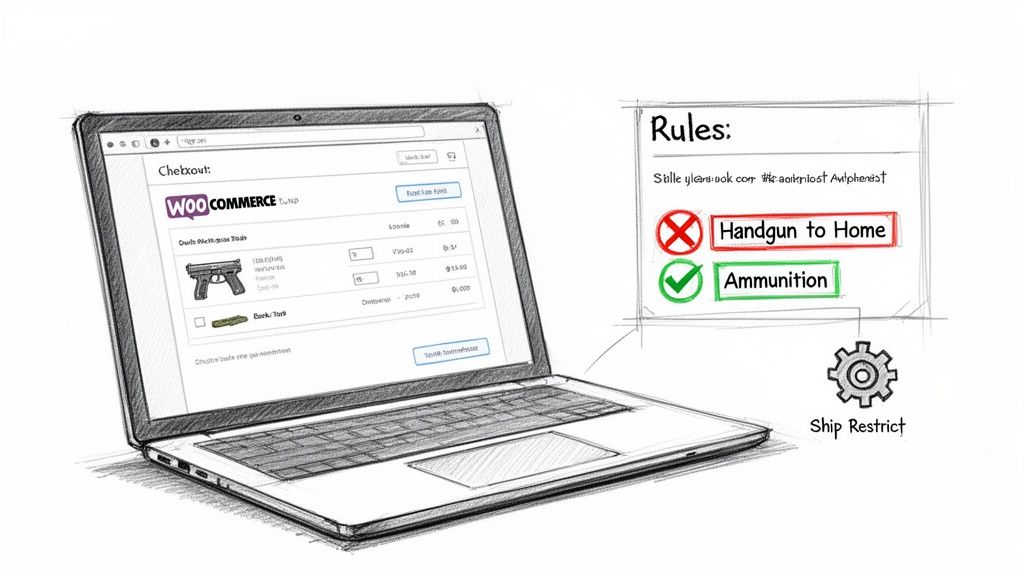
Trying to translate complex legal requirements into your daily fulfillment process is where things often fall apart. Manually checking every single order against Oregon firearms ammunition shipping laws isn't just slow—it's a gamble. One simple mistake from human error can spiral into serious legal and financial trouble.
This is where automation becomes your most critical asset. Instead of running your business on checklists and memory, you can put a system in place that acts as a tireless, around-the-clock compliance officer for your store. It’s a fundamental shift from reactive damage control to proactive, airtight prevention.
From Manual Checks to Automated Rules
Picture the typical manual workflow. A customer in Portland adds a handgun and a box of ammunition to their cart. Now it’s on you or your staff to know the handgun can't go to their home address and needs an FFL. Then you have to manually verify their chosen FFL, double-check for any weird local rules, and hope the order is processed correctly.
Now, let’s look at the automated alternative. A tool like the Ship Restrict plugin for WooCommerce handles that entire validation process in the blink of an eye. The second a customer hits the checkout, your pre-set rules are instantly enforced.
The real power of automation is consistency. A well-configured system applies the exact same rules to every single order, 24/7, without exception. It gets rid of all the "what if" scenarios that keep FFLs up at night.
For merchants who need to nail this every time, our complete guide on firearms and ammunition shipping compliance for WooCommerce stores breaks down exactly how these systems operate.
Building Your Digital Compliance Shield
Setting up automated rules is like programming your store's legal DNA. You do the work once, and it protects you from that point forward. You can build out granular rules that perfectly match Oregon's specific legal landscape, making smart distinctions between firearms and ammunition.
Here are a few essential rules you can build in minutes:
- Firearm FFL Requirement: Create a rule that blocks any firearm from being shipped to a residential address in Oregon, forcing the customer to select a verified FFL dealer to proceed.
- Statewide Ammunition Access: Set up another rule that allows ammunition to ship to most residential addresses across Oregon, reflecting the state's more relaxed ammo laws.
- Restricted Location Blocking: Automatically block all shipments to known "no-ship" zones like government building ZIP codes, schools, or any P.O. boxes.
This level of control turns your checkout into an active line of defense. It stops non-compliant orders before they’re even placed, saving you headaches, preventing expensive shipping mistakes, and protecting your FFL. For deeper dives into this topic, other merchant blogs offer valuable Insights on compliance automation.
A Practical Before-and-After Scenario
Let's walk through a real-world example to see the difference automation makes.
Before Automation (The Manual Method):
- A customer orders a handgun and enters their home address for shipping.
- The order gets processed and lands in your fulfillment queue.
- Hours—or even a day—later, an employee finally reviews the order and flags the illegal shipping address.
- Now you’re on the hook to contact the customer, explain the mistake, cancel the order, and try to salvage the sale by helping them find an FFL. The whole process is slow, frustrating for the buyer, and creates a massive risk that the firearm could be shipped by mistake.
After Automation (The Ship Restrict Method):
- A customer adds a handgun to their cart and heads to checkout.
- The moment they enter their home shipping address, a custom message instantly appears: "Firearms cannot be shipped to residential addresses in Oregon. Please select a valid FFL dealer to continue."
- The system physically blocks them from completing the order until a valid FFL is chosen from your list.
The difference is night and day. The automated system educates the customer in real time, enforces the law at the point of sale, and completely eliminates the chance of a catastrophic shipping error. This isn't just about making things easier; it's a fundamental layer of legal protection for your entire business.
Common Questions About Shipping to Oregon
When you're dealing with the specifics of Oregon's firearm and ammunition laws, a few key questions always come up. Let's clear the air on the most common ones we hear from eCommerce sellers.
Can I Ship Ammunition Directly to a Customer in Oregon?
Yes, you can. Oregon state law is pretty straightforward here—it doesn't add extra hurdles for direct-to-consumer ammunition sales. This means you can ship ammo right to a customer's doorstep without having to go through an FFL dealer.
But that doesn't mean it's a free-for-all. You still have to play by the rules, which include:
- Following federal laws that bar you from knowingly selling to a prohibited person.
- Making sure you have solid age verification in place—typically 18 for rifle/shotgun ammo and 21 for handgun ammo.
- Abiding by all carrier policies. That means using approved services like UPS or FedEx Ground and following their specific rules for packaging and drop-off.
Do I Need a Special License to Sell Ammo to Oregon Residents?
Nope. Oregon doesn't make you jump through hoops to get a state-specific license just to ship ammunition there. Your primary responsibilities are federal, centering on proper customer screening and following carrier regulations. If you already have your Federal Firearms License, you're good to go.
The Bottom Line: The main thing to remember about Oregon law is the split between firearms and ammo. Firearms must be sent to an FFL for a background check. Ammunition, on the other hand, faces far fewer state-level restrictions.
Is a Background Check Required for Ammunition Purchases in Oregon?
No, a background check isn't required for buying ammunition in Oregon. The state's background check law, found in ORS 166.412, is specifically for firearm transfers.
For ammunition sellers, your legal duty is simpler but just as important: you must take care not to knowingly sell to anyone who is federally prohibited from owning ammunition.
Trying to keep all these rules straight manually is a recipe for disaster. Automating your shipping logic is the only reliable way to stay compliant and protect your business. Ship Restrict gives you the power to build these complex legal requirements right into your WooCommerce store, so you can ship every order with confidence. Find out more at shiprestrict.com.
Automate FFL Shipping Compliance
Stop worrying about restricted states. Ship Restrict handles it automatically.

Cody Yurk
Founder and Lead Developer of ShipRestrict, helping e-commerce businesses navigate complex shipping regulations for regulated products. Ecommerce store owner turned developer.
Automate FFL Compliance
- Block restricted states
- No more cancellations
- Set and forget
3-day free trial · Card required