A Guide to Hawaii Firearms Shipping Restrictions for FFLs
Understand Hawaii firearms shipping restrictions. This complete guide for FFLs covers state laws, carrier rules, and how to stay compliant with WooCommerce.
Shipping firearms to Hawaii comes with a unique, non-negotiable rule: every single firearm must be shipped to a registered Federal Firearms Licensee (FFL). Direct-to-consumer shipments are completely off the table, making Hawaii one of the most regulated states for firearm eCommerce. Getting this one rule right is the first and most critical step to making a legal sale.
Why Shipping Firearms to Hawaii Is Different
Sending a firearm to Hawaii isn't like shipping to the mainland. You're dealing with a unique mix of geography, federal law, and tough state regulations. The Aloha State's island nature creates a natural barrier that has shaped its approach to gun control for decades. This isolation means every firearm has to arrive via a commercial carrier under heavy oversight.
For an FFL dealer, this creates a specific set of challenges. You can't just box up a handgun and send it to a customer's home. Instead, every transaction has to follow a strict, regulated chain of custody. Think of it less like a delivery and more like a legal handoff from one licensed professional to another. Your job isn't done until that firearm is safely in the hands of a verified FFL in Hawaii.
The Core Compliance Framework
The whole system is built on a partnership between federal and state law. The federal Gun Control Act of 1968 requires that interstate firearm sales go through an FFL. But Hawaii adds its own layers on top of that. Its geography has directly influenced its shipping restrictions, making it a standout case in American gun control. Since 1981, every firearm acquired in the state must be registered with the local police—a rule that highlights the state's tight oversight and affects what your customer has to do after the firearm leaves your shop. You can learn more about Hawaii's unique firearms legislation and its historical context.
Automate FFL Shipping Compliance
Block orders to restricted states automatically. 3-day free trial.
Start Free TrialThis strict approach has helped Hawaii maintain one of the lowest gun death rates in the country, at roughly 3.5 per 100,000 people, compared to the U.S. average of 14.2. For eCommerce sellers, these facts boil down to three simple, non-negotiable rules for any order going to Hawaii:
- No Direct-to-Consumer Shipments: All firearms must be addressed to a licensed FFL dealer.
- Mandatory FFL Verification: You must confirm the receiving FFL’s license is valid before you ship.
- Carrier Policy Adherence: You have to follow the specific shipping rules set by carriers like FedEx or UPS for transporting firearms.
Before we dive deeper, it helps to see the big picture. Here’s a quick summary of the essential rules for shipping firearms to Hawaii.
Hawaii Firearms Shipping Compliance at a Glance
| Compliance Checkpoint | Requirement | Why It Matters |
|---|---|---|
| Shipment Destination | Must be a valid FFL address. No residential or P.O. Box addresses. | Prevents illegal direct-to-consumer transfers and ensures a licensed professional handles the final transfer. |
| License Verification | Verify the recipient's FFL using the ATF's FFL eZ Check system before shipping. | Protects you from shipping to a fraudulent or expired FFL, which is a serious federal offense. |
| State Registration | The buyer must register the firearm with their county police department within 5 days of acquisition. | This is Hawaii's mandatory registration law. While it's the buyer's duty, it underscores the state's strict control. |
| Carrier Rules | Follow all carrier-specific policies (e.g., UPS Next Day Air for handguns). | Non-compliance can lead to shipment refusal, account suspension, and potential legal issues with the carrier. |
| Ammunition | Ship separately from the firearm. Never package ammo and a gun in the same box. | A universal safety and legal requirement for all firearm shipments. |
This table covers the fundamentals, but the details are where compliance can get tricky. Getting it right every time is crucial.
Navigating Hawaii's firearms shipping restrictions demands a zero-tolerance policy for mistakes. A single slip-up, like sending a package to a residential address, can trigger severe legal penalties. We're talking fines up to $10,000, your shipment being seized, and even the risk of losing your FFL.
This guide will break down each of these components, giving you a clear roadmap to ensure every shipment to Hawaii is 100% compliant.
The Mandatory FFL Transfer Process Explained
Shipping a firearm to Hawaii isn't like sending a t-shirt. You can't just box it up and mail it directly to your customer's doorstep. The only legal way to do it involves a regulated handoff to a local Federal Firearms Licensee (FFL) who handles the final, in-person sale. Getting this process right isn’t just good practice—it's a non-negotiable part of the business.
Think of it as a compliance relay race. You, the seller, are holding the baton (the firearm). Your first job is to make sure you pass it securely and legally to the next runner in line, the receiving FFL. This race starts the second your Hawaiian customer clicks "buy."
The Customer's First Step: Selecting a Local FFL
The entire transfer process kicks off with your customer. During checkout, they have to choose a licensed FFL dealer in their area to receive the firearm for them. This local dealer is the one who will perform the background check and legally transfer ownership.
Your online store needs to be built for this. Most successful online gun stores use an FFL locator tool or require customers to enter their chosen dealer’s information before they can even complete the purchase. This is a critical first step because it establishes the firearm's legal destination before it ever leaves your shop.
Free Firearms Compliance Audit
Selling firearms or ammunition? We'll review your WooCommerce store's shipping compliance for free.
Once the customer gives you their FFL’s details, the baton is in your hands. Now it's your job to verify that the dealer is legitimate, their license is active, and they're legally allowed to handle the transfer. This is where your due diligence really matters.
Your Critical Role: Verifying the Receiving FFL
Before you even think about grabbing a box and packing tape, you have to get a copy of the receiving dealer’s FFL certificate. Most dealers are happy to email or fax it to you. But just having the piece of paper isn't enough. You are legally required to verify it's authentic.
Crucial Takeaway: Never ship a firearm based on an FFL document alone without verifying it independently. Fake licenses are a real threat, and the consequences of shipping to an unauthorized person are devastating. We're talking steep fines and potentially losing your own FFL for good.
The only acceptable way to do this is with the Bureau of Alcohol, Tobacco, Firearms and Explosives (ATF) official FFL EZ Check system. It's a free online tool that lets you punch in the license number and confirm its status instantly. It will tell you three things you absolutely need to know:
- License Validity: Is the FFL number real and currently active?
- Dealer Name: Does the name on the license match the dealer your customer picked?
- Registered Address: Does the shipping address exactly match the address the ATF has on file?
This simple check protects you from fraud and creates a solid compliance record. You can get a deeper dive by reading our guide on understanding FFLs types, requirements, and their eCommerce implications.
The infographic below shows the strict, one-way path a firearm has to follow when it's shipped to Hawaii.
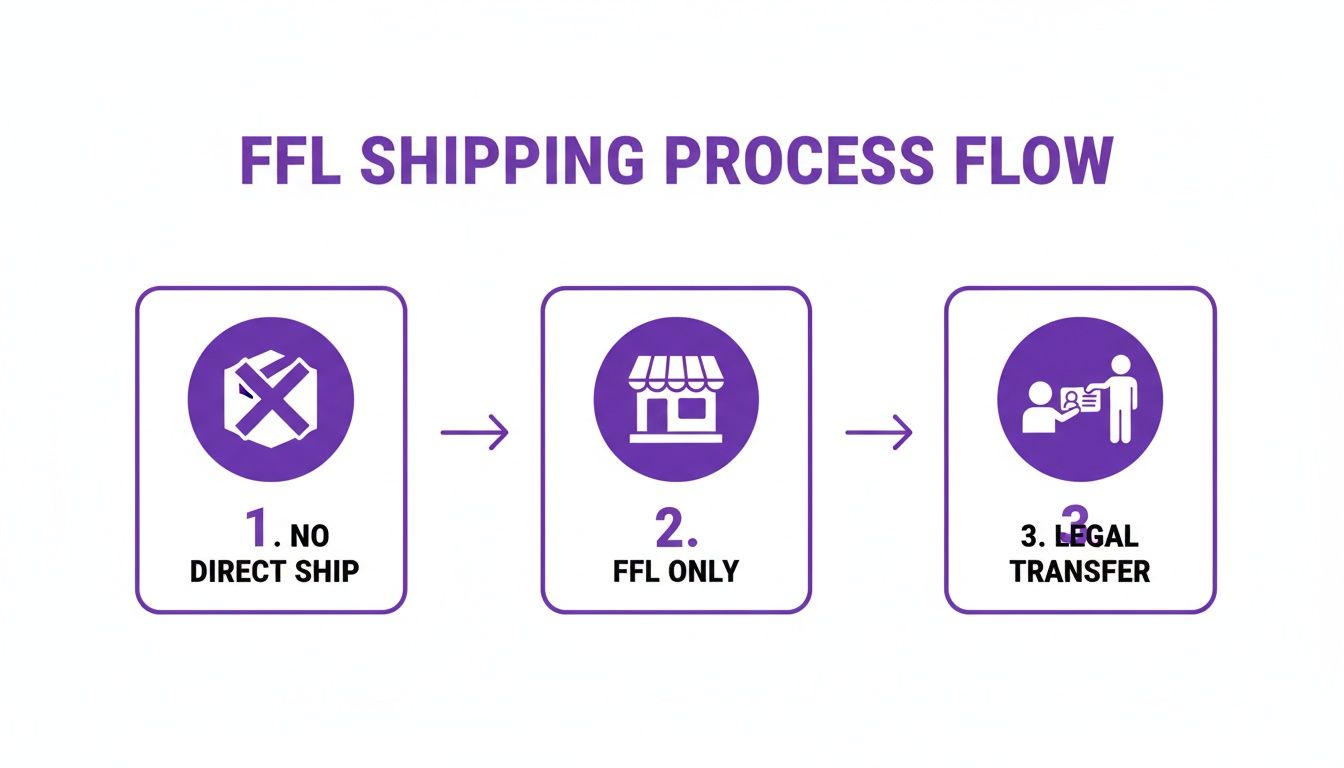
This process hammers home the core principle of Hawaii’s shipping laws: a firearm can only travel from one FFL to another. The final legal transfer always happens face-to-face.
The Final Handoff: Your Responsibility Ends at Shipment
Once you’ve successfully verified the receiving FFL’s license, your leg of the relay race is almost over. Your last steps are to package the firearm according to carrier rules and ship it directly to the verified FFL's address—and only that address.
The moment you hand that securely packaged firearm to an approved carrier like UPS or FedEx, your direct legal role in the transfer is done. The baton has been passed. The receiving FFL in Hawaii is now on the hook for logging the firearm into their books, calling the customer, and running all the necessary state and federal background checks before the buyer can legally take it home.
Diving Into Hawaii’s State and County Gun Laws
While federal law gets your shipment to a Hawaiian FFL, that’s just the first leg of the journey. Once it lands, the Aloha State’s own strict, layered regulations take over. As an online seller, knowing this landscape is crucial for keeping your customers informed and ensuring your business stays clear of any compliance headaches.
Think of it like this: federal law is the main highway that gets your package to the island. But to get it to your customer's hands, their local FFL has to navigate a series of state and county roads, each with its own specific rules of the road.
The Permit to Acquire System is a Big Deal
The absolute cornerstone of Hawaii's firearm laws is its permit-to-acquire system. A customer in Hawaii can't just stroll into their local FFL, pass a background check, and walk out with the firearm you shipped. It’s not that simple. They first have to get a permit from their county's chief of police before the transfer process can even begin.
This is a major step and it's not quick. Applying for a permit usually involves:
- Submitting a formal application.
- Getting fingerprinted and photographed.
- A thorough background check that includes a review of mental health records.
- Completing a state-certified firearm safety course.
This pre-approval process can add weeks to the timeline. It's a critical piece of information to share with your Hawaiian customers, as it sets a very different expectation for how quickly they'll get their hands on their purchase after it arrives at the FFL.
Key Insight: The permit-to-acquire system puts a huge piece of the compliance puzzle on the buyer before the final transfer. A Hawaiian FFL is legally barred from transferring a firearm to anyone who doesn't show up with a valid, unexpired permit from their local police department.
Get Ready for Waiting Periods and Registration
Even after a customer has their permit and the firearm is at the FFL, Hawaii’s rules aren't done. The state mandates a 14-day waiting period for every firearm purchase, which starts when the permit application is first submitted. This is a non-negotiable "cooling-off" measure.
Once the waiting period is over and the FFL completes the transfer, the clock starts on another key requirement: registration. The buyer has just five days to take their new firearm to the county police department for an in-person inspection and to get it officially registered. This final step links the firearm's serial number to the owner's name, locking in Hawaii’s complete, cradle-to-grave oversight.
Know Your Prohibited Firearms and Accessories
Beyond all the procedural hoops, Hawaii firearms shipping restrictions also include straight-up bans on certain types of firearms and accessories. This is where your product catalog and your shipping rules have to be perfectly in sync. Shipping a banned item, even to a licensed dealer, is a recipe for legal trouble for everyone involved.
Hawaii law specifically prohibits:
- Assault Pistols: This is a category of semi-automatic pistols defined by features like a threaded barrel, a second handgrip, or a barrel shroud.
- Large-Capacity Magazines: The state generally bans magazines that can hold more than 10 rounds for pistols.
These prohibitions mean you absolutely have to configure your eCommerce store to block sales of these items to anyone in Hawaii. A slip-up here isn't just a customer service issue that requires a return—it's a serious compliance failure. The local FFL won't be able to transfer the item, forcing a costly return shipment and inviting potential legal scrutiny.
County-Level Rules Can Vary
While state law sets the big picture, the day-to-day enforcement happens at the county level. Hawaii has four main counties, and each one’s police department is in charge of issuing permits and handling registrations:
- City and County of Honolulu
- Maui County
- Kauai County
- Hawaii County
The core requirements are the same across the islands, but you might find small procedural differences in how each county police department processes applications, conducts inspections, or handles paperwork. This is another reason why the local FFL is so important—they know the specific nuances of their county's system inside and out.
How to Comply with Carrier Shipping Policies
Getting through Hawaii’s state laws and the federal FFL transfer process gets your firearm ready to go, but it doesn't actually get it on the plane. For that, you have to master the rules set by the major carriers like FedEx and UPS. These corporate policies are just as binding as any law, and ignoring them will stop your shipment in its tracks.
Think of it this way: federal and state laws give you a license to drive, but carrier policies are the specific rules of their private road network. You have to follow their rules—from the type of "vehicle" (shipping service) you use to the "road signs" (labels) on your package—or you'll get pulled over. And "pulled over" in this case often means having your shipping account terminated and the firearm seized.
Understanding Key Carrier Restrictions
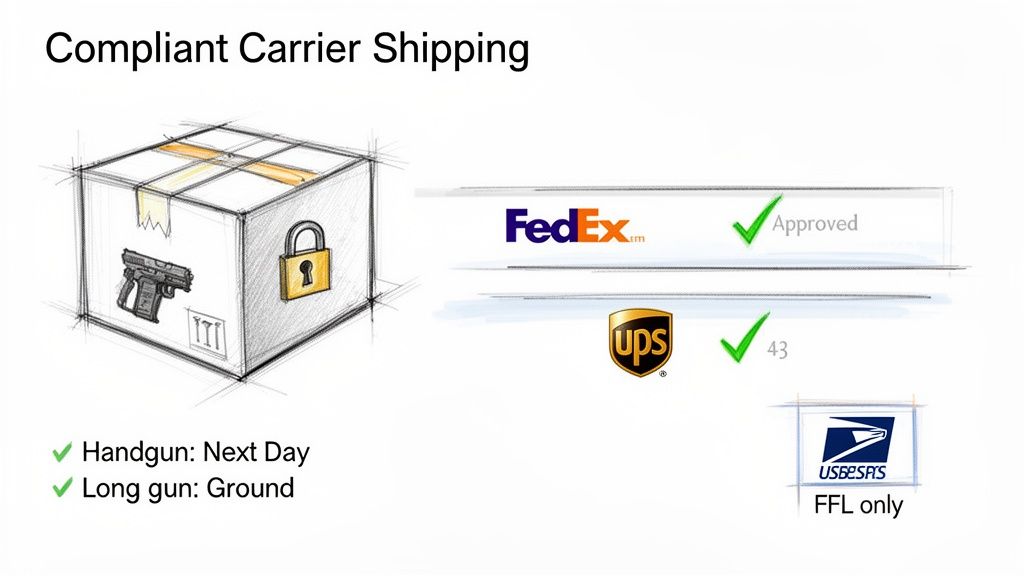
The first and most important rule to burn into your memory is that the United States Postal Service (USPS) is a no-go for shipping handguns for most FFLs. Only certain licensed manufacturers and dealers can mail handguns to other specific licensees. For the average dealer-to-dealer transfer, you’ll be relying exclusively on private carriers.
This leaves FedEx and UPS as your go-to options for shipping firearms to Hawaii. Both have detailed, non-negotiable policies designed to ensure safety and legality. A core requirement for both is that you must declare all firearm shipments when you drop them off. This isn't optional; it's how they ensure their staff handles the package correctly from start to finish.
Critical Takeaway: Never, ever try to ship a firearm undeclared or hide what it is. This is a direct violation of carrier policy and federal law. It can lead to immediate account suspension, shipment confiscation, and serious legal trouble. Be transparent with your carrier, every single time.
Comparing FedEx and UPS Policies for Hawaii Shipments
While both FedEx and UPS will get your firearms to Hawaii, they have slightly different playbooks, especially when it comes to handguns versus long guns. Handguns are universally treated with the highest level of security and must be shipped via premium, expedited air services. Long guns like rifles and shotguns often have more flexible and affordable options.
To make sure you're picking the right service every time, let's break down a side-by-side comparison of their main requirements for shipping to a Hawaiian FFL.
FedEx vs UPS Firearms Shipping Policy Comparison for Hawaii
| Policy Feature | FedEx Requirements | UPS Requirements |
|---|---|---|
| Handguns | Must use FedEx Priority Overnight. This is the only approved service for shipping handguns to Hawaii. | Must use UPS Next Day Air® services. Standard ground shipping is not permitted for handguns. |
| Long Guns | Can be shipped via FedEx Ground or other FedEx air services to Hawaii. | Can be shipped via UPS Ground or any of its air services. |
| Declaration | You must verbally declare the package contains a firearm to the FedEx employee at the counter. | You must verbally declare that the package contains a firearm to the UPS employee at a Customer Center. |
| Packaging | Must be in sturdy, unmarked outer packaging. No labels or branding that indicate the contents are a firearm. | Must be in new, rigid corrugated boxes. Ammunition and firearms must never be in the same package. |
| Drop-Off | Only accepted at staffed FedEx Ship Center locations. Drop boxes are strictly prohibited. | Only accepted at a UPS Customer Center or through a scheduled pickup. Drop boxes and third-party stores are prohibited. |
As you can see, the rules are similar but have critical differences, especially the required service levels for handguns. Both carriers also have strict rules for ammunition, which always has to be shipped separately from the firearm.
For a deeper dive, check out our detailed comparison of UPS vs FedEx vs USPS for shipping regulated items. Choosing the correct carrier and service isn't just a suggestion—it's a fundamental step to ensure your Hawaii-bound shipment gets there legally and without a hitch.
Automating Shipping Compliance in Your WooCommerce Store
Let’s be honest: manually checking every single order against Hawaii firearms shipping restrictions is a disaster waiting to happen. It's not just slow; it's a huge business risk. All it takes is one tired employee on a busy afternoon to make an oversight, leading to a seized package, a hefty fine, or worse.
When the rules are this complex, human error isn't a possibility—it's an inevitability. This is exactly why automation isn't a luxury for an FFL e-commerce store; it's a core operational necessity. For anyone running on WooCommerce, the right tool can act as a tireless digital gatekeeper, enforcing your shipping rules 24/7 right at the checkout.
You get to stop catching mistakes after the fact and start preventing them from ever happening.
The Power of an Automated Gatekeeper
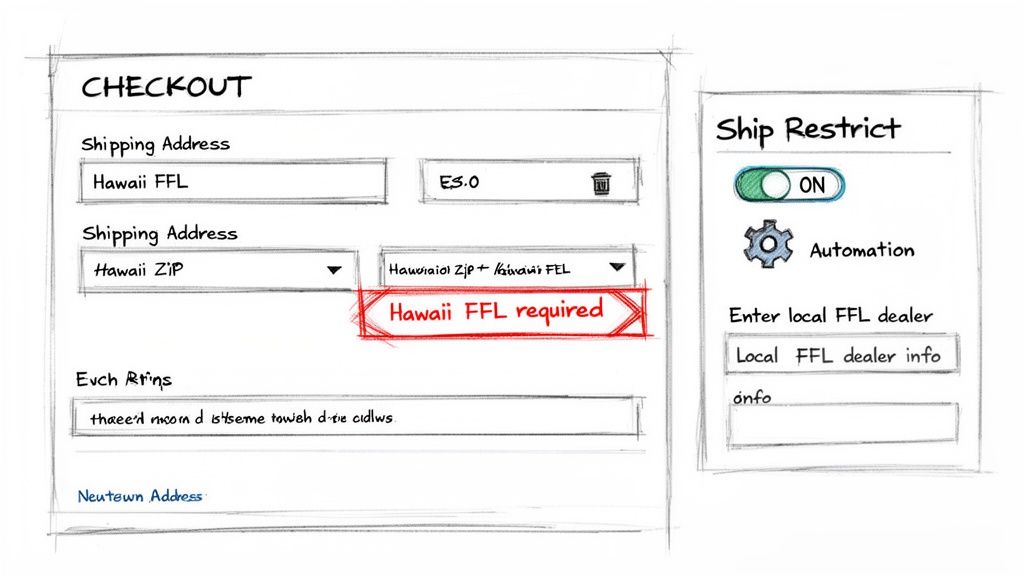
Think of it like having a bouncer for your checkout page. This bouncer has a complete, up-to-the-minute list of every shipping rule for Hawaii and instantly checks the customer's address. If someone in Honolulu tries shipping a firearm straight to their house, the bouncer steps in, politely stops the transaction, and explains the rules before the purchase is finalized.
This is precisely what a tool like Ship Restrict for WooCommerce does. It plugs directly into your checkout process, instantly validating addresses against the rules you set. That simple function eliminates countless hours of manual work and all but erases the risk of accidentally sending a firearm to a non-FFL address in Hawaii.
Building Your Hawaii Shipping Rule
Setting up an automated rule is far easier than trying to memorize Hawaii’s entire legal code. The goal is simple: create one powerful restriction that blocks all direct-to-consumer firearm shipments to Hawaii but allows legal FFL-to-FFL transfers to go through without a hitch.
Here’s the basic logic you’d follow:
- Define the Restricted Product: First, you tell the system which products the rule applies to. This is as easy as selecting your entire "Firearms" category.
- Set the Location: Next, you target the state of Hawaii. For even greater precision, you could paste in a list of all Hawaiian ZIP codes if needed.
- Create the Restriction: The system will now automatically block any order containing a firearm from being shipped to any address in Hawaii.
This setup prevents the sale from going through, stopping a compliance breach before it starts.
Key Insight: The real magic of automation isn't just blocking bad orders; it's educating your customers at the moment of purchase. A well-written restriction message transforms a frustrating error into helpful guidance, saving the sale and building trust.
Customizing the Customer Experience
Nothing kills a sale faster than a generic "Shipping not available" message. It leaves customers confused, frustrated, and ready to click away to a competitor. Good automation lets you replace that dead end with a clear, helpful explanation.
For FFLs on WooCommerce, it's critical to customize your WooCommerce checkout page to guide customers through these complex legal hoops smoothly.
Instead of a vague error, you can create a custom message that pops up the moment a customer enters a restricted Hawaiian address. Something like this:
"Due to Hawaii state law, we cannot ship firearms directly to your home. Please enter the address of your chosen local FFL dealer to proceed. If you need help finding an FFL, please use our dealer locator tool."
This short message nails three critical goals:
- It explains the "why": The customer knows it’s the law, not just your store being difficult.
- It provides a solution: It tells them exactly what to do next—use their FFL’s address.
- It offers help: It points them to a resource if they're stuck, keeping them on your site and moving toward a successful purchase.
By turning a hard stop into a helpful nudge, you transform a potential lost sale into a compliant, positive customer interaction. For a deeper dive, check out our full guide on automated shipping compliance for WooCommerce stores. This approach ensures you nail your compliance with Hawaii firearms shipping restrictions while actually improving the shopping experience.
Penalties, Risks, and Essential Best Practices
<iframe width="100%" style="aspect-ratio: 16 / 9;" src="https://www.youtube.com/embed/YONGuzom8VM" frameborder="0" allow="autoplay; encrypted-media" allowfullscreen></iframe>Getting Hawaii's firearms shipping restrictions right is a high-stakes game. Let's be clear: a mistake here goes way beyond a returned package or a grumpy customer. If you violate state or federal firearms laws, you're looking at severe criminal and commercial penalties that can—and will—put you out of business for good.
Just one non-compliant shipment can set off a chain reaction of disasters. We're talking about potential felony charges, huge fines that easily run into the thousands of dollars, and even prison time. But for any FFL holder, the ultimate nightmare is the permanent revocation of your license. That one action immediately ends your career in the firearms industry.
Understanding the Commercial Consequences
Even if you sidestep the legal landmines, the business risks are just as deadly. Carriers like FedEx and UPS have zero-tolerance policies for anyone caught breaking their rules. One bad shipment can get your package seized on the spot—with no compensation—followed by the swift termination of all your shipping accounts.
Losing your ability to ship with major carriers will cripple an eCommerce business. You’re cut off from your customers, and your operations grind to a screeching halt. The financial fallout and damage to your reputation can be impossible to recover from, making strict compliance an absolute necessity for survival.
The bottom line is that compliance isn't optional. The ATF and carriers take violations seriously, and a single mistake can put your entire livelihood on the line. A proactive, zero-tolerance approach to compliance is the only way to protect your business.
A Checklist for Bulletproof Compliance
To protect your FFL and keep your business healthy, you need a rock-solid set of best practices. These steps create a dependable system that minimizes human error and builds a strong foundation of compliance for every single order you ship to Hawaii.
- Always Verify with FFL EZ Check: Before a single box gets packed, you must verify the receiving dealer’s license using the official ATF FFL EZ Check system. This is your first and best defense against a fraudulent or expired license.
- Maintain Immaculate Records: Keep detailed, organized records of every single transaction. This means saving a copy of the receiving FFL’s license and your verification confirmation. These documents are your proof of due diligence when the auditors show up.
- Train Your Staff Continuously: Every employee involved in packing and shipping has to be thoroughly trained on Hawaii firearms shipping restrictions and carrier policies. Hold regular training sessions to make sure everyone is up-to-date on the rules.
- Leverage Shipping Automation: Think of a tool like Ship Restrict as your digital compliance officer. By automating your shipping rules, you can stop illegal orders from ever being processed, virtually eliminating the risk of human error at checkout.
Another crucial best practice is taking proactive security measures to protect your digital storefront. To learn more about this, check out this guide on how a website security audit can prevent common cyber threats.
Frequently Asked Questions
When you're dealing with a state as unique as Hawaii, a few common questions always pop up. Here are some quick, straight-to-the-point answers to help you ship with confidence.
Can I Ship Ammunition Directly to a Customer in Hawaii?
Yes, you usually can, but you have to follow some strict rules. While all firearms absolutely must go to a licensed FFL dealer, ammunition can often be shipped right to a customer's door. The key is that you have to comply with all carrier policies, which always means shipping it as a hazardous material via ground transport only.
Also, your store's logic needs to be smart enough to tell the difference between ammo and other regulated items. For example, Hawaii prohibits high-capacity magazines, so your system has to be set up to block those sales to Hawaiian addresses entirely.
What Is the Best Way to Verify a Hawaiian FFL Before I Ship?
There's only one right answer here: use the ATF's official FFL EZ Check online system. Never, ever take a customer's word for it or rely on a scanned copy of a license they email you. That's a recipe for disaster.
Before you print a shipping label, pull up the FFL EZ Check tool and confirm the license number is valid, active, and—this is critical—that the shipping address is a perfect match for what the ATF has on file. This isn't just a good idea; it's a mandatory step for every single firearm you ship.
Pro Tip: Make the FFL EZ Check a non-negotiable part of your fulfillment process. Take a screenshot of the verification for every order and save it. If you ever face an audit, that simple record proves you did your due diligence and can be a lifesaver.
How Do I Keep My Shipping Rules Updated with Changing Laws?
Staying current with regulations is ultimately your responsibility as the FFL holder. While a tool like Ship Restrict gives you the power to enforce the rules, it's up to you to know what those rules are.
A good practice is to subscribe to legal updates from firearms industry groups and set a calendar reminder to review Hawaii's state statutes a few times a year. When a law does change, you can jump into the plugin and tweak your rules in minutes, ensuring your store never misses a beat.
Don't let Hawaii's complex shipping laws become a bottleneck for your business. Ship Restrict puts compliance on autopilot, enforcing your rules at checkout to save you time and prevent expensive slip-ups. See how Ship Restrict can protect your WooCommerce store today.
Automate FFL Shipping Compliance
Stop worrying about restricted states. Ship Restrict handles it automatically.

Cody Yurk
Founder and Lead Developer of ShipRestrict, helping e-commerce businesses navigate complex shipping regulations for regulated products. Ecommerce store owner turned developer.
Automate FFL Compliance
- Block restricted states
- No more cancellations
- Set and forget
3-day free trial · Card required