Crossbow Archery Equipment Shipping Restrictions: A Quick Compliance Guide
Learn how to handle crossbow archery equipment shipping restrictions safely with our actionable tips to stay compliant and avoid costly errors.
Shipping a crossbow isn't like sending a t-shirt. Navigating crossbow archery equipment shipping restrictions is a complex puzzle of local, state, federal, and carrier rules that can change from one town to the next. Get it wrong, and you’re looking at seized packages, angry customers, and serious financial penalties for your online store.
The Hidden Risks of Shipping Crossbows and Archery Gear
For WooCommerce merchants in the archery niche, a simple sale can quickly unravel into a logistical and legal nightmare. This tangled web of regulations isn't just arbitrary red tape; it's rooted in genuine public safety concerns and wildlife conservation laws. But for sellers, it creates a high-stakes environment where one small oversight has major consequences.
Here’s a scenario I’ve seen play out too many times: a customer in another state orders a high-powered crossbow. You pack it, ship it, and move on to the next order. Days later, you get a notice that the package was confiscated at a sorting facility because it violated a local ordinance you didn't even know existed.
Now you’re dealing with a lost product, a customer demanding a refund, and a potential fine. This isn't a hypothetical—it's a daily reality for many online sellers in this space.
Automate Shipping Compliance
Block orders to restricted states automatically. 3-day free trial.
Start Free TrialWhy Manual Compliance Fails
Trying to keep up with these rules manually is a losing battle. The sheer volume and complexity are overwhelming. One state might classify a crossbow as a firearm, while its neighbor sees it as standard sporting goods. Some cities or counties have outright bans on specific gear, like mechanical broadheads or crossbows exceeding a certain draw weight.
The core problem is the lack of a single, centralized, and up-to-date database for all these ever-changing rules. It forces businesses into a reactive position, often discovering a violation only after it’s too late.
Even though the North American market accounts for a massive 36.4% of global archery revenue in 2023, the regulatory landscape is completely fractured. Many states treat powerful crossbows like restricted weapons. While federal rules might let you drive across a national park with your gear cased or disassembled, commercial shipping is a whole different ballgame.
Trying to ship into states like California or New York requires navigating strict guidelines that can spike carrier surcharges by as much as 25%.
Before we dive into solutions, let's break down the most common hurdles crossbow retailers face every day. These challenges go far beyond just reading a list of rules; they impact every part of the business, from customer service to the bottom line.
Common Shipping Challenges for Crossbow Retailers
| Challenge Type | Description | Impact on Business |
|---|---|---|
| Legal & Regulatory Complexity | Constantly changing patchwork of city, county, state, and federal laws. Rules often differ based on crossbow draw weight, velocity, or specific features. | High risk of non-compliance, leading to fines, seized inventory, and potential legal action. |
| Carrier Policy Conflicts | Major carriers (UPS, FedEx, USPS) have their own internal policies for shipping items classified as weapons, which may be stricter than state law. | Packages can be refused, returned, or confiscated by the carrier, even if the destination is legal. This can lead to account suspension. |
| Operational Inefficiency | Staff must spend hours manually verifying each order's shipping address against a complex, often outdated, list of restricted locations. | Wasted labor hours, slow fulfillment times, and high potential for human error. This directly impacts scalability. |
| Negative Customer Experience | Canceled orders, delayed shipments, and confiscated packages create frustrated customers who are likely to leave negative reviews and initiate chargebacks. | Damage to brand reputation, loss of repeat business, and increased customer service overhead. |
As you can see, simply "being careful" isn't enough. These interconnected problems create a ripple effect that can seriously hinder growth.
The Ripple Effect of a Single Mistake
A shipping error isn’t just a one-off problem. It kicks off a chain reaction that can seriously damage your business's reputation and financial health. The only way to truly protect your operations is by implementing robust risk management practices.
Think about the cascading effects:
- Carrier Fines and Account Suspension: Major carriers like FedEx and UPS don't mess around. Repeatedly shipping prohibited items, even by accident, can get you fined or, worse, have your shipping account terminated entirely.
- Wasted Labor and Resources: Every minute your team spends cross-referencing addresses with a spreadsheet of rules is a minute not spent on marketing, customer service, or growing the business. It’s a costly and inefficient use of time.
- Negative Customer Experiences: Nothing kills a customer relationship faster than a canceled order or a confiscated package. This is a direct path to bad reviews, painful chargebacks, and a brand image that’s hard to repair.
Ultimately, these hidden risks threaten the very sustainability of your business. A proactive, automated approach isn't just a nice-to-have; it's a fundamental requirement for any serious retailer in this competitive market.
Free Shipping Compliance Audit
We'll review your WooCommerce store's shipping compliance for free.
Unpacking Domestic and International Shipping Laws
Alright, let's move from theory to the messy reality of shipping crossbows. The regulatory landscape is a wild patchwork of rules that changes dramatically depending on where you're sending a package. Getting a handle on these differences isn't just good business—it's the only way to operate legally and avoid having your shipments seized, facing legal trouble, or trashing your company's reputation.
In the United States, there's no single federal law that standardizes how crossbows are sold and shipped. That means the rule-making gets pushed down to individual states, counties, and sometimes even specific cities. For an online seller, this creates a confusing and often contradictory web of regulations you absolutely have to get right.
The Maze of US State and Local Laws
Here's a real-world example: a crossbow that’s perfectly legal to sell and ship to a customer in Texas might be heavily restricted or even banned in parts of New York or California. These restrictions aren't always a simple "yes" or "no," either. They often drill down into specific attributes like draw weight, velocity, or physical dimensions.
Some jurisdictions pile on even more complexity by dictating how the crossbow is shipped. You might be required to disassemble it—separating the prod and stock—or ship it only in a hard-sided, lockable case. The real headache is that these local ordinances can be incredibly difficult to find and track.
Just take a look at the ATF's compilation of state and local firearms ordinances to get a sense of the sheer volume of localized rules that can exist.
Now, this resource is for firearms, but it paints a perfect picture of how regulations can splinter from one county or city to the next. It creates a compliance map for archery gear that's nearly impossible to follow manually.
A common and costly mistake is assuming that if a state allows crossbow hunting, it automatically allows unrestricted shipping of all crossbow models. This is a dangerous assumption that can lead to major compliance failures.
Navigating International Shipping Curbs
If you thought domestic rules were a handful, international crossbow shipping is a whole different beast. Selling to customers overseas throws customs agents, obscure import laws, and strict product classifications into the mix.
Europe's archery market is a classic example of this complexity. Despite deep-rooted hunting and archery traditions in countries like Germany, France, and the UK, severe shipping curbs hamstring growth. Crossbow hunting is outright banned in France and Germany, and their transport laws require complete disassembly—string off, limbs detached—to sidestep severe penalties. In the UK, post-2021 amendments now classify some high-powered crossbows as Section 5 firearms, making a special certificate mandatory for possession and shipping.
These international rules effectively make direct-to-consumer shipping a non-starter for many products. You’re left with two choices: either reject international orders entirely or partner with specialized in-country distributors who can navigate the labyrinth of import requirements. For a deeper look at this, check out our guide on international shipping restrictions for sporting goods and outdoor equipment.
This tangled web of domestic and global rules drives home a critical point: manually keeping up with this legal maze isn't scalable or reliable. A single outdated spreadsheet or one moment of human error can put your entire business at risk. The only practical solution is to build a system that automates these compliance checks, ensuring no prohibited order ever slips through your checkout. It's not about being fearful; it's about being prepared and protecting your business with the right tools.
Automating Your Shipping Compliance in WooCommerce
Knowing the tangled web of crossbow archery equipment shipping restrictions is one thing, but actually enforcing them on every single order is a completely different beast. Trying to manually check each purchase against a constantly shifting list of banned states, counties, and cities isn't just a time sink—it’s a recipe for expensive mistakes. This is exactly why automation is no longer a luxury, but a necessity for any serious WooCommerce merchant in the archery world.
A dedicated plugin like Ship Restrict can completely transform your approach. It shifts you from a reactive, manual process (catching mistakes after an order is placed) to a proactive, automated one. You stop illegal sales before they even happen. That shift is critical for protecting your business and scaling up without the constant headache of legal exposure.
Translating Laws into Actionable Rules
The first step in building an automated system is turning all that legal jargon into simple, effective rules your store can understand. You don't need a law degree for this, just a clear process for figuring out which products need restrictions and where they apply.
Start by grouping your inventory. Not all your gear is under the same microscope. A high-powered crossbow is going to face way more shipping roadblocks than a basic set of target arrows.
Your product categories might look something like this:
- High-Risk Crossbows: These are the models over a certain draw weight or velocity that pop up on restriction lists most often.
- Standard Crossbows: Lower-powered models with fewer, but still important, shipping bans.
- Restricted Accessories: Think mechanical broadheads or specific types of arrows that are illegal in certain places.
- Unrestricted Gear: All the general stuff like quivers, cases, and apparel that can ship anywhere without issue.
Once your products are sorted into these buckets, you can start building rules. For instance, you could create a rule that says, "Block any product in the 'High-Risk Crossbows' category from being shipped to any address in New York City." Simple, direct, and effective.
This diagram shows the layered approach you need to take, starting with broad state-level rules and drilling down to specific international ones.
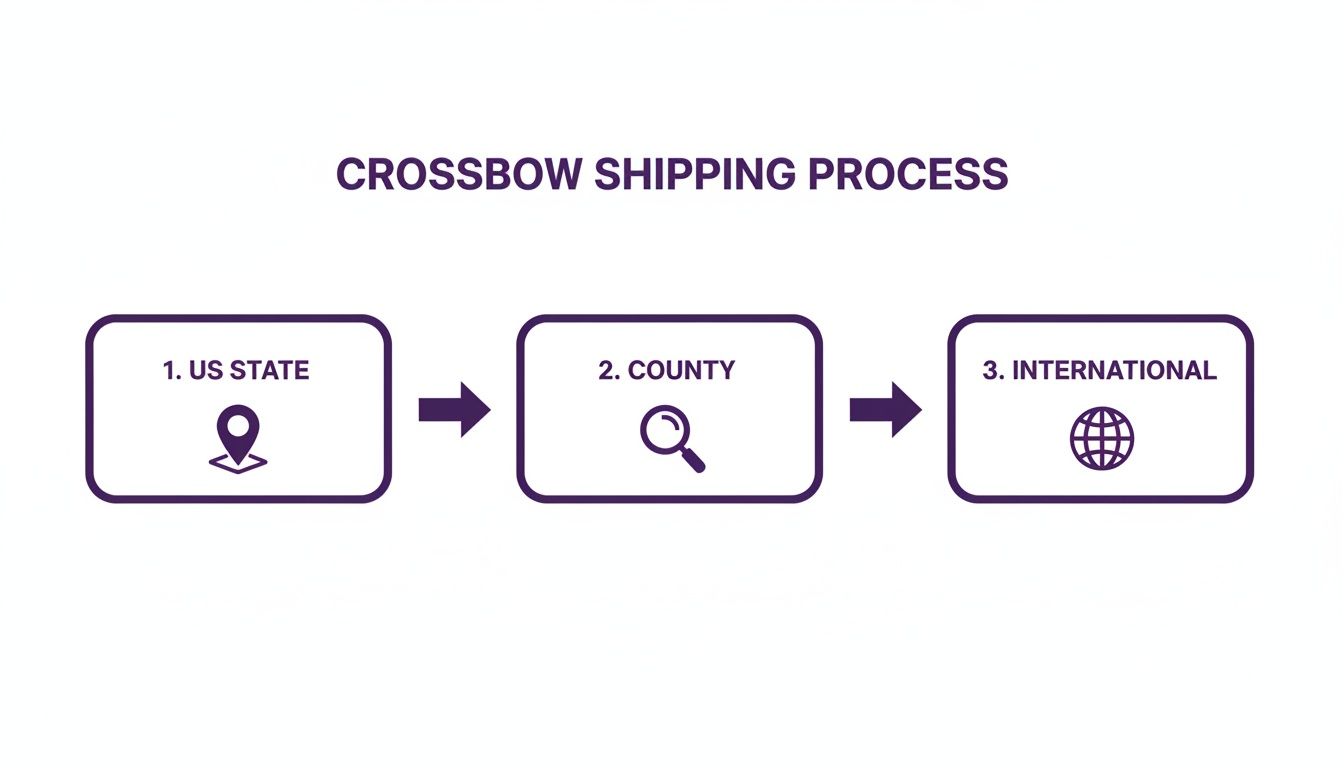
As you can see, a truly solid system has to account for rules at every level of government to be completely airtight.
Configuring Granular Location-Based Restrictions
Modern compliance tools let you go way beyond just blocking an entire state. The real power is in the details—creating granular rules that target specific jurisdictions. This way, you stay compliant without turning away legitimate customers.
A plugin like Ship Restrict lets you get incredibly specific, setting up rules based on:
- State: The broadest level, for blocking entire states where your gear is illegal.
- County: Perfect for targeting specific counties that have their own local ordinances.
- City: Drill down even further to restrict sales to individual cities with their own bans.
- ZIP Code: Get ultra-precise by blocking postal codes, which is a lifesaver for areas where city lines are blurry.
Pro Tip: When you're setting up your rules, always start with the biggest restriction first (like a statewide ban). Then, layer in more specific rules for counties or cities as needed. It creates a clean hierarchy that’s much easier to manage and double-check later.
Imagine a customer from a restricted county tries to buy a crossbow. With an automated system in place, they get an instant, clear message at checkout explaining exactly why that item can’t ship to them. The order is stopped cold before any payment goes through. This prevents a logistical nightmare of refunds, returns, and unhappy customers. This kind of automation is a cornerstone of modern e-commerce, and our guide on automated shipping compliance for WooCommerce stores dives deeper into how it all works.
The Importance of the Right Platform
Of course, your ability to implement these sophisticated rules hinges on the flexibility of your e-commerce platform. For merchants weighing their options, checking out a comparison of e-commerce platforms like WooCommerce can shed light on which system is best built for this level of customization. With its open-source nature, WooCommerce is uniquely suited for powerful plugins that give you this kind of deep control.
Ultimately, automating your shipping compliance is about building a digital gatekeeper that works for you 24/7. It tirelessly checks every single order against the rules you’ve set, freeing you from the high-stakes, manual grind. This lets you focus on growing your business, confident that you’re protected from costly compliance slip-ups.
Keeping Your Rules and Customers Up to Date
<iframe width="100%" style="aspect-ratio: 16 / 9;" src="https://www.youtube.com/embed/bOk_mDwaCTE" frameborder="0" allow="autoplay; encrypted-media" allowfullscreen></iframe>Getting your automated system up and running is a huge win, but it’s not a "set it and forget it" kind of deal. The world of crossbow and archery equipment shipping restrictions is always shifting. Laws get rewritten, carrier policies get an overhaul, and new local rules can pop up out of nowhere.
Your automated system is only as smart as the rules you give it. That's why staying on top of rule management—and communicating those rules clearly to your customers—is just as crucial as the initial setup. This is where you master the human side of compliance. A well-oiled system keeps you out of legal trouble, but thoughtful messaging turns a frustrating checkout into a chance to build real trust.
Why Periodic Rule Audits Are Non-Negotiable
Think of your shipping rules as a living document, not something carved in stone. What was perfectly legal last year might be a costly violation today. Running a periodic audit is your single best defense against an outdated rule causing a massive shipping headache.
I suggest setting aside time for a quarterly review of all your shipping rules. This doesn't have to be a week-long project. Just focus on the hot spots first—states or cities known for frequent legislative updates.
During your audit, keep an eye out for:
- New State Laws: Have any states passed new legislation affecting crossbow draw weight, velocity, or specific features?
- Carrier Policy Changes: Have carriers like UPS or FedEx updated their terms for items they classify as "sporting goods" or "weapons"?
- Fresh Local Ordinances: These are tougher to track, but a quick search for your top-selling states can often uncover new county or city-level restrictions.
This proactive habit ensures your automated gatekeeper is working with the latest information, stopping problems long before they land on your fulfillment team's desk.
Crafting Customer Messages That Actually Help
When a customer’s order gets blocked at checkout, the message they see is the voice of your company. A vague, robotic alert like "This item cannot be shipped to your location" is an instant recipe for frustration. It usually leads straight to an abandoned cart or an angry support email.
The goal is to be clear, concise, and genuinely helpful. You need to explain why the restriction is in place without getting too technical or sounding alarmist. A great message educates the customer and shows that you're a responsible, professional retailer.
The best messages are transparent. They don't just say "no." They briefly explain the reason for the restriction, helping the customer understand it's a law or regulation, not just some arbitrary company policy. This simple act of explaining can slash your support tickets and customer complaints.
For instance, instead of that generic blocker, your message could say something like this:
"Unfortunately, we can't ship this crossbow to your address in Boulder, CO, due to a local ordinance restricting crossbows over a certain draw weight. We apologize for the inconvenience and invite you to check out our other gear that is eligible for shipment to your location."
This message nails three key things:
- It’s Specific: It points to "a local city ordinance" as the reason.
- It Shows You’re an Expert: You know the local rules and you're following them.
- It Tries to Save the Sale: It nudges them toward other products you can ship.
Communicating restrictions effectively is a skill, and it has a direct impact on customer perception. The difference between a lazy message and a helpful one is stark.
Effective Customer Messaging for Shipping Restrictions
| Scenario | Poor Message (Vague & Frustrating) | Effective Message (Clear & Helpful) |
|---|---|---|
| State-Level Ban | "Product cannot be shipped to your state." | "Due to state regulations in New York, we are unable to ship this item to your address. We can ship all other accessories to you." |
| Carrier Restriction | "Shipping method unavailable." | "Our shipping carriers do not permit air transport for this item. Please select a ground shipping option to proceed with your order." |
| Local Ordinance | "Invalid shipping address." | "We can't ship this crossbow to Boulder, CO, due to a local city ordinance. We apologize for the inconvenience." |
Good messaging transforms a negative experience into one where the customer feels informed, not just rejected.
Creating these customer-friendly notifications is a critical part of running a smooth operation. To help you get started, we've put together a detailed guide with customer service scripts for explaining shipping restrictions that you can adapt for your store.
When you pair diligent rule management with thoughtful communication, your compliance system becomes more than a simple blocker. It becomes a tool for building brand trust. It shows customers you’re a professional outfit that takes its legal duties seriously, making them more confident about buying from you now and in the future.
Turning Compliance Into a Competitive Advantage
It’s easy to look at shipping compliance as just another frustrating chore—one more expensive box to check off the list. But if that’s all you see, you're missing a massive opportunity. A smart, automated approach to managing crossbow and archery equipment shipping restrictions does more than just keep you out of hot water. It actually builds a stronger, more profitable business.

Think about what happens when you automate the tedious, high-stakes job of verifying every single address. You get your most valuable asset back: time. Every hour your team isn't manually checking orders against spreadsheets is an hour they can pour into things that actually grow the business, like running marketing campaigns, finding new products, or just providing killer customer service.
The Financial Upside of Smart Compliance
The ROI on an automated system isn't just about saving labor. It's about plugging the financial leaks that can slowly sink an otherwise healthy business. A single shipping mistake isn't just one problem; it sets off a whole chain reaction of expensive consequences.
Let's break down the direct financial wins:
- No More Return Fees: When a carrier sends back a prohibited package, you’re on the hook for shipping both ways. Automation stops these orders cold before they ever leave your warehouse, saving you from burning money on pointless postage.
- Dodge Carrier Fines: Carriers like UPS and FedEx don’t mess around. They can and will levy hefty fines for repeatedly trying to ship restricted items to places they shouldn't go.
- Prevent Lost Inventory: A confiscated package is a 100% loss. You're out the cost of the product, the shipping, and any potential profit from that sale. It just vanishes.
These savings add up fast, quickly turning a compliance tool from an expense into an asset that actively protects your bottom line.
Building Unbreakable Brand Trust
In a market this crowded, trust is everything. Customers are sharper than ever and can spot an amateur or careless operation a mile away. Having a rock-solid, transparent compliance system sends a clear signal: you're a serious, professional, and trustworthy business.
When a customer sees a clear, helpful message explaining why an item can't be shipped to them, they don't see a barrier. They see a company that understands and respects the law, which builds immense confidence in your brand.
This professionalism has a ripple effect. You’ll see fewer chargebacks from frustrated customers, more positive word-of-mouth, and a lot more repeat business. When given a choice, people will always go with the retailer who demonstrates they know what they’re doing. This is especially true in the global compound bow and crossbow market, where shipping rules are a major headache.
In fact, complex regulations can inflate logistics costs by 15-30% and have slowed crossbow e-commerce penetration to just 28% of sales, compared to 45% for traditional bows. Those numbers tell a story: mastering compliance is a powerful way to get ahead of the competition. You can dive deeper into these market challenges in this full market report.
From Risk Mitigation to Operational Excellence
At the end of the day, automating your shipping rules with a tool like Ship Restrict fundamentally changes your business for the better. It takes compliance from a constant source of anxiety and turns it into a quiet, efficient process that just works in the background. That operational stability is the foundation you need to really scale.
With an automated system safeguarding every single transaction, you can confidently expand your product lines, test new marketing channels, and grow your business without the nagging fear that one shipping error could derail everything. It’s not just about avoiding penalties anymore; it’s about creating a streamlined, risk-free operation built for long-term success.
Frequently Asked Questions
Even with a solid plan, specific questions always pop up. Getting the details right on crossbow and archery equipment shipping restrictions can feel tricky, so here are some quick, clear answers to the questions we see most often from WooCommerce merchants.
Can I Ship a Crossbow Through USPS, UPS, or FedEx?
This is a classic "it depends" situation. While UPS and FedEx generally allow you to ship crossbows, their policies are strict and can change without much warning. They often have specific packaging requirements, might require an adult signature on delivery, and will refuse to knowingly transport a package to a place where the item is illegal.
USPS, on the other hand, is usually much more restrictive with anything that could be considered a weapon. The safest bet is to always check the latest terms of service for each carrier, digging into the sections on "archery equipment," "weapons," or "sporting goods." Honestly, a much better approach is to use an automated tool that just blocks a carrier at checkout if the product and address don't match their rules.
What Happens If I Accidentally Ship to a Restricted Area?
The fallout can range from a minor headache to a major business risk. In the best-case scenario, the carrier's sorting facility catches the mistake, flags the package, and sends it back to you. You've avoided a legal violation, sure, but you're still out the cost of shipping both ways and have to explain the situation to a disappointed customer.
The worst-case scenario is far more serious. If the package makes it all the way to the destination, local law enforcement could confiscate it. This means you’ve lost your product completely and could be facing significant fines or even legal action for breaking state or local laws. This is exactly the kind of mess that automated shipping restriction tools are designed to prevent.
Do I Need to Restrict Accessories Like Broadheads?
Absolutely. It’s a common blind spot for sellers to focus only on the crossbows themselves and forget about the accessories. Certain types of broadheads—especially mechanical or barbed designs—are often hit with their own set of restrictions.
Some states and even specific cities have outright bans on certain designs because of their effects on wildlife. Overlooking these smaller items can still lead to returned packages, confiscated gear, and compliance headaches. The smart move is to research the rules for every potentially regulated product you sell and set up specific shipping rules for each one.
How Often Do Crossbow Shipping Laws Actually Change?
More often than most people think. State legislatures tend to review and update their regulations annually. What’s less predictable are the local city or county ordinances, which can be amended at any time of year without much fanfare.
On top of that, carrier policies are also tweaked periodically. Trying to manually keep track of all these updates across thousands of jurisdictions is basically a full-time job. This constant state of change is why having a flexible compliance solution you can update in a few clicks is so critical for long-term protection. It saves you from drowning in endless research.
Stop wasting hours on manual address checks and eliminate costly shipping errors for good. With Ship Restrict, you can build an automated compliance system that protects your business 24/7. Discover how Ship Restrict can safeguard your WooCommerce store today.
Automate Shipping Compliance
Stop worrying about restricted states. Ship Restrict handles it automatically.

Cody Yurk
Founder and Lead Developer of ShipRestrict, helping e-commerce businesses navigate complex shipping regulations for regulated products. Ecommerce store owner turned developer.
Automate Shipping Compliance
- Block restricted states
- No more cancellations
- Set and forget
3-day free trial · Card required