Compliance Documentation: Regulated Shipping Guide 2026
Master compliance documentation for regulated shipping & firearms eCommerce. Ensure audit-readiness, automate, and avoid costly errors with our 2026 guide.
You already know the drill. An order comes in, the cart looks clean, payment clears, and then someone on your team opens three browser tabs to verify whether that SKU can ship to that address. One state page says one thing, a county rule says another, and your internal spreadsheet was last updated by a manager who left six months ago.
That isn't just inefficient. It's a documentation problem.
For firearms retailers, compliance documentation isn't a filing cabinet issue. It's the record of how your store decides what can ship, where it can ship, who approved the process, what rule applied at the moment of sale, and what happened when an order hit a restriction. If that chain breaks, you're left arguing from memory. Regulators, carriers, processors, and internal reviewers don't want memory. They want records.
Most stores don't fail because they had no policies. They fail because the policy on paper drifted away from what the website, staff, and shipping flow were doing. In regulated shipping, static paperwork creates false confidence. A printed SOP that no longer matches current rules is worse than thin documentation, because it tells your team they're covered when they aren't.
Automate Shipping Compliance
Block orders to restricted states automatically. 3-day free trial.
Start Free TrialThe Hidden Risk of Manual Compliance
A typical WooCommerce firearms store starts with good intentions. Someone builds a restriction sheet by state. Then special cases pile up. A city restriction gets added in a note. A county exception lives in a team chat. A staff member creates a workaround for one product category but doesn't update the master file. Before long, the "system" is a patchwork of spreadsheets, bookmarks, memory, and checkout notes.
That's where manual compliance breaks down.
Why static records fail in daily operations
The problem isn't just volume. It's synchronization. Many compliance guides miss the harder operational issue of keeping policies aligned with changing requirements across locations. Federal audit guidance highlights how tightly documentation is expected to map to the underlying requirement, and in practice there is often a gap between written rules and implementation. In one cited finding, 94% of compliance officers agreed that if an action is not documented, it is not done in the discussion summarized around the 2023 Compliance Supplement framework.
For a firearms retailer, that hits close to home. If your checkout logic blocks an order but you keep no record of why, you're exposed. If your written policy says a product can't ship to a location but your store allows it, you're exposed in a different way. Both failures come from the same root issue. Your policy and your live enforcement aren't tied together.
Practical rule: If your team has to "double-check the spreadsheet" before every questionable order, your documentation system isn't controlling risk. Your staff is.
Manual review also creates inconsistent evidence. One employee takes screenshots. Another writes notes in the order record. A third keeps a local file. When you need to reconstruct what happened, you don't have one timeline. You have fragments.
The operational drag is real too. If you want a grounded breakdown of how much labor and error risk that creates, this comparison of manual order screening versus automated restrictions is worth reviewing.
What this looks like during an audit or dispute
The weak point usually shows up after the fact. A return, chargeback, blocked shipment, customer complaint, carrier question, or internal review forces you to prove the decision path. That's when stores discover they documented intent, not execution.
The stores that stay out of trouble don't treat compliance documentation as an annual cleanup project. They build it into order flow, rule maintenance, staff actions, and exception handling. In other words, they stop treating documentation as paper and start treating it as infrastructure.
Free Shipping Compliance Audit
We'll review your WooCommerce store's shipping compliance for free.
What Is Compliance Documentation in Regulated Shipping
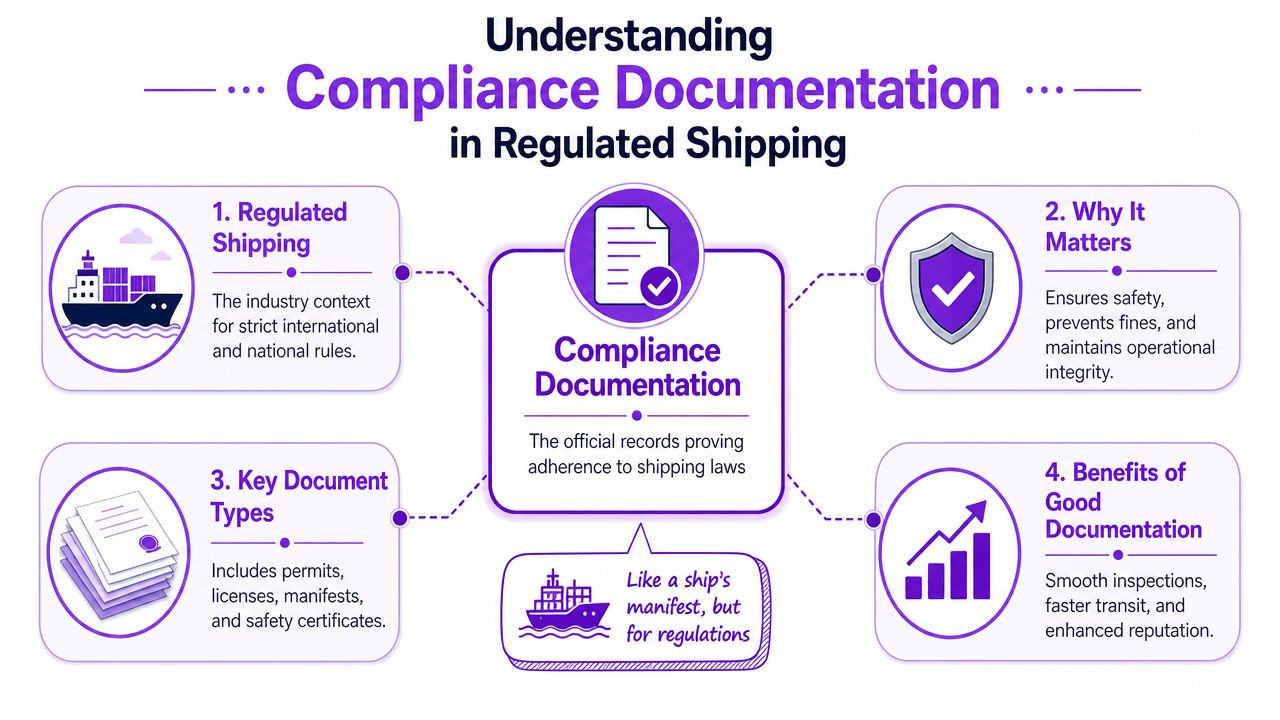
Think of compliance documentation as the black box for your shipping operation. After any decision, especially a disputed one, it should answer four questions without guesswork: what rule applied, who acted, when it happened, and what evidence supports it.
That's broader than a policy manual. In a firearms eCommerce business, compliance documentation includes written rules, workflow instructions, approval records, exception logs, customer communications, transfer procedures, and system-generated records tied to transactions.
Proof of process, not just proof of policy
A lot of retailers keep policies that read well and prove almost nothing. "We comply with all applicable shipping restrictions" is not useful by itself. An auditor or investigator wants to see the process behind that statement. How did you determine applicability? What controls stopped a prohibited shipment? What did staff do with exceptions? Where is the record?
That expectation didn't appear out of nowhere. The HIPAA Security Rule framework became one of the foundational models for modern compliance recordkeeping by making documentation of safeguards, policies, and procedures central to demonstrating control over regulated electronic information. The larger lesson applies well beyond healthcare. Good documentation doesn't just describe a safeguard. It proves the safeguard existed and was maintained.
Good compliance documentation reads like an operating history, not a legal disclaimer.
The core layers you need
A practical regulated shipping documentation system usually has four layers:
- Policy layer. Your written rules. This includes who you ship to, what products are restricted, how age and transfer requirements are handled, and who owns rule updates.
- Procedure layer. The actual steps staff follow. How orders are reviewed, how exceptions are escalated, how customer-facing notices are issued, and how denied shipments are logged.
- Transaction layer. The record created when a real order moves through the system. This is where facts matter most because this is what you'll rely on later.
- Audit layer. Version history, approvals, access records, and evidence that the system itself is controlled.
What a complete record should tell
If you pick one order from six months ago, a strong documentation set should let you reconstruct the event without calling the employee who handled it. You should be able to see:
- Which product was ordered.
- Which destination data was evaluated.
- Which policy version was active at that time.
- Whether the order was allowed, blocked, or routed for review.
- What follow-up communication or transfer handling occurred.
That is what separates an audit-ready business from a business with lots of PDFs.
Essential Documents for Firearms eCommerce
Firearms eCommerce creates two documentation tracks that have to match. One is the regulated firearms recordkeeping side. The other is the shipping and business-operations side. Most trouble starts when one track is maintained carefully and the other is treated as informal.
The records you can't afford to treat casually
Start with the records directly tied to firearms transfers and inventory. For many retailers, that means keeping the A&D book accurate, handling ATF Form 4473 correctly where a transfer is involved, and maintaining clean verification records when shipping to other licensees. If your online team treats these as "store side" responsibilities instead of eCommerce responsibilities, you'll create gaps between the website, fulfillment process, and transfer records.
This is especially important for teams that separate online operations from counter operations. The web side may think the local receiving FFL or transfer step solves the issue. It doesn't. The eCommerce side still needs a documented process that shows how the order was classified, routed, and handed off.
For a plain-English walkthrough of where online sales intersect with transfer paperwork, this guide to ATF Form 4473 and eCommerce is a useful reference.
Audit-ready checklist for store operations
The list below combines firearms recordkeeping needs with practical shipping compliance records that eCommerce teams often overlook.
| Document/Record | Purpose | Retention Period |
|---|---|---|
| A&D book entries | Tracks firearm acquisition and disposition activity | Keep according to applicable legal requirements and your recordkeeping policy |
| ATF Form 4473 for applicable transfers | Documents transferee information and transfer review process | Keep according to applicable legal requirements and your recordkeeping policy |
| Receiving FFL verification records | Confirms the destination licensee before interstate shipment | Keep according to your regulatory and operational retention policy |
| Product restriction matrix | Maps product categories to shipping limitations by location | Keep current version plus archived prior versions |
| Order-level restriction decision logs | Shows why an order was allowed, stopped, or escalated | Keep according to your audit and dispute resolution policy |
| Customer communication records | Preserves notices about blocked orders, transfers, or required documentation | Keep according to your customer service and compliance policy |
| Carrier agreements and service rules | Documents shipping terms for regulated products | Keep active versions and archived superseded versions |
| SOPs for order review and exception handling | Tells staff how to apply rules consistently | Keep current version plus revision history |
| Staff training records | Proves employees were trained on documented procedures | Keep for the duration required by your policy and any applicable rules |
| Incident and corrective action logs | Captures errors, near misses, and process fixes | Keep according to your risk management policy |
Business records that matter more than people think
Retailers often focus on transfer paperwork and ignore the operational records that explain how the website behaves. That's a mistake. If your checkout blocks certain shipments, document the rule logic. If staff can override a restriction, document when that's allowed, who can do it, and where the approval is recorded.
Keep these records current:
- Restriction update logs that show what changed and who approved it.
- Denied shipment logs that preserve the address, product, rule triggered, and customer notice.
- Exception approvals for unusual orders that required management review.
- Training acknowledgments so you can show that staff weren't improvising.
If an order decision depends on tribal knowledge, it isn't controlled.
The practical standard is simple. Your firearms records, eCommerce workflow records, and shipping restriction records should tell the same story. If they don't, an auditor will notice.
Best Practices for Documentation Management
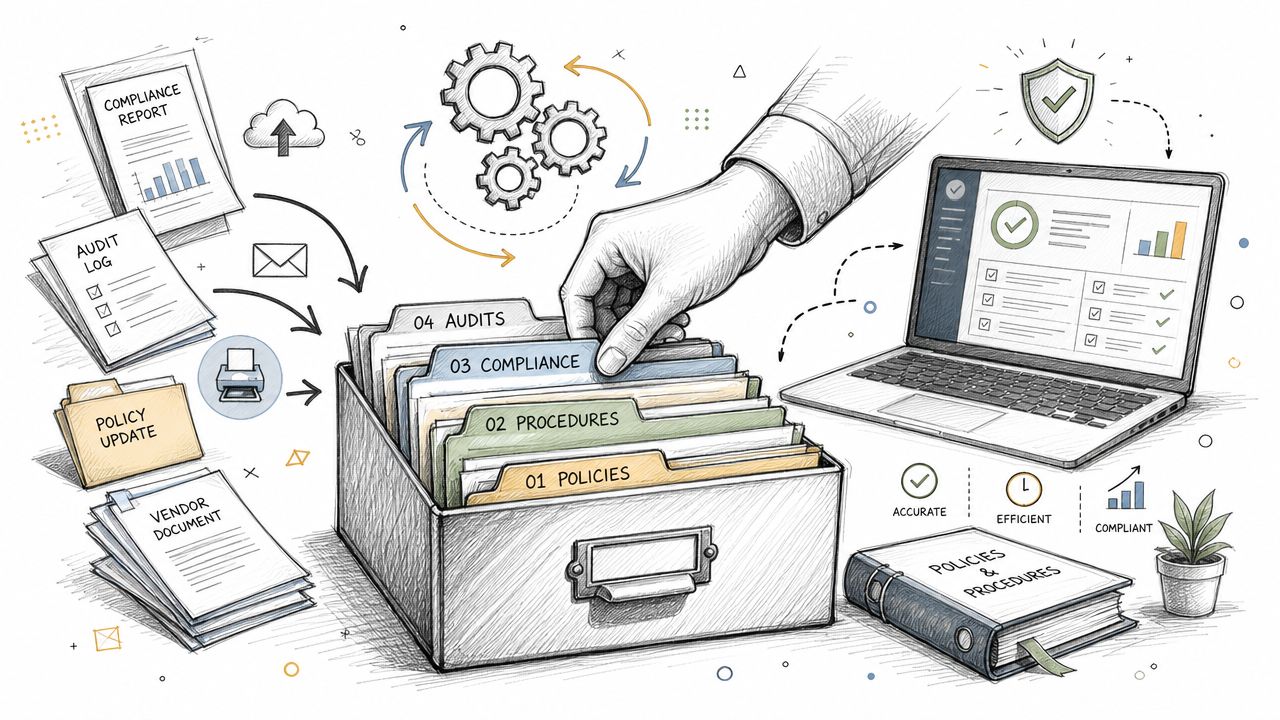
Most small and mid-sized retailers don't need more documents. They need cleaner controls around the documents they already have. The fastest way to make a messy system defensible is to apply ALCOA thinking across your records, even if you're not a large enterprise.
The principle comes from data integrity practice. Records should be attributable, legible, contemporaneous, original, and accurate, as explained in this overview of effective documentation systems and ALCOA. In plain language, you should be able to show who made a record, when they made it, what original source supports it, and whether the record remained intact.
What ALCOA looks like in a firearms store
A lot of retailers hear data-integrity language and assume it's for pharma or big health systems. It isn't. It fits firearms eCommerce perfectly because your risk lives in transaction history and rule application.
Use the standard this way:
- Attributable means every policy change, order note, and exception approval is tied to a named user.
- Legible means staff don't bury key decisions in vague comments like "checked and okay."
- Contemporaneous means the record is created when the action happens, not reconstructed at the end of the week.
- Original means you preserve the source record or a controlled original digital version.
- Accurate means the record reflects what really happened in the system and in fulfillment.
Management habits that keep records usable
Strong compliance documentation depends less on heroic effort and more on boring discipline. These habits work:
- Assign document owners. Every policy, form, and workflow should have one accountable owner, even if several people contribute.
- Control versions tightly. Staff should never have to wonder whether they are looking at the current shipping rule file.
- Set review cadences. Rules change. Carrier terms change. Internal processes drift. Put every critical document on a recurring review schedule.
- Archive, don't overwrite. When a rule changes, keep the prior version so you can prove what was in force on a past order.
- Separate reference copies from controlled copies. A PDF downloaded to someone's desktop becomes a problem fast.
Records fail audits for simple reasons. No owner, no date, no version, no source, no way to prove who changed what.
Usability matters too
A compliant record that nobody can find or understand won't help your operation. Front-line employees need documentation that's searchable, current, and written in plain language. That matters in every regulated business, not only firearms. For example, employers dealing with multi-jurisdiction requirements often run into the same issue with labor documentation, such as these new Ontario job posting requirements, where the obligation isn't just knowing the rule but maintaining current, usable internal guidance as practices change.
That same lesson applies to order review teams. If your documentation only works for legal counsel and not for the person processing a restricted order at 4:45 p.m., it isn't finished.
How to Automate Your Compliance Documentation Burden
Manual documentation creates lag. Automation closes the gap between what your policy says and what your store does.
That matters because technical value in compliance documentation comes from log-based enforcement and policy mapping, not static manuals. This approach is outlined in this discussion of compliance documentation, immutable logs, and declarative rules. The key idea is straightforward. Compliance works better when rules are enforced at the point of action and the system creates evidence as it goes.

The shift from documents to systems
A static SOP says, "Do not ship restricted products to prohibited locations."
An automated system says, "If this product category is ordered to this state, county, city, or ZIP code, block checkout, preserve the event, and display the correct message."
Those are not the same thing. The first is guidance. The second is control.
For firearms retailers on WooCommerce, a rule engine plays an integral role in your documentation architecture. The rule itself is documented. The order attempt is documented. The triggered restriction is documented. The customer-facing result is documented. Your team no longer has to create a separate paper trail after the fact because the operational event already generated one.
One example is automated shipping compliance for WooCommerce stores. In practical terms, a tool like Ship Restrict can block products by state, county, city, or ZIP code before checkout completes. Used correctly, that doesn't just reduce manual screening. It creates a cleaner record of what rule was enforced at the time of the transaction.
What should be automated first
Don't try to automate everything at once. Start where staff currently make repetitive, high-risk decisions.
Focus on these areas:
- Restriction enforcement for products and destinations.
- Denied order logging so every blocked transaction leaves a record.
- Rule version tracking when restrictions are added, removed, or revised.
- Exception routing when an order needs manager review instead of a hard block.
- Customer notices so the explanation shown at checkout matches the underlying rule.
What good automation produces
The point isn't fewer PDFs. The point is better evidence with less manual effort.
A useful automated trail should preserve:
| Event | Evidence you want |
|---|---|
| Rule creation or update | User, date, version, affected products or locations |
| Blocked checkout | Product, destination, timestamp, rule triggered |
| Manual exception review | Reviewer, reason, approval or rejection outcome |
| Customer communication | Message shown or sent, date, order reference |
| Final fulfillment path | Whether the order was canceled, rerouted, or completed under approved process |
A short product demo helps make this operational model easier to visualize:
<iframe width="100%" style="aspect-ratio: 16 / 9;" src="https://www.youtube.com/embed/A-Sa6pOAsvQ" frameborder="0" allow="autoplay; encrypted-media" allowfullscreen></iframe>Where stores get automation wrong
The common mistake is automating enforcement but not governance. A plugin can block shipments, but you still need ownership over rule updates, testing before major catalog changes, and a documented review process when laws or platform settings change.
Automation is strongest when three parts stay linked:
- Policy that defines what the business intends.
- System rules that apply the policy in real time.
- Logs that prove the rule was enforced or escalated.
If one of those parts is missing, you don't have a living compliance documentation system. You have a partial control.
Common Pitfalls and Audit Readiness FAQs
The biggest documentation failures in firearms eCommerce are rarely dramatic. They're mismatches.
Your A&D records say one thing, your order notes say another, and your store settings allow something your written policy prohibits. That inconsistency creates risk because every review turns into a reconciliation exercise instead of a straightforward proof exercise.
The mistakes that cause the most trouble
These are the issues I see most often in practice:
- Inconsistent source records. Inventory, order data, and transfer paperwork don't align.
- Outdated restriction files. The team still relies on an old matrix after a rule change.
- Uncontrolled staff overrides. Someone makes an exception and leaves no approval trail.
- Weak training records. The business assumes staff know the process but can't show who was trained on which version.
- Scattered evidence. Emails, screenshots, order notes, and spreadsheets live in separate places.
Poor documentation isn't just an audit issue. It affects speed and decision quality. In a 2026 compliance statistics summary discussed by SafetyCulture, 64% of organizations cited better visibility into risks and risk management activities as a leading benefit of compliance efforts, and 53% reported faster identification and proactive response to compliance issues in the referenced reporting on compliance documentation and management.
Audit readiness isn't a stack of forms. It's the ability to answer hard questions quickly with records that agree.
FAQ for firearms retailers
How long should I keep firearms-related records?
Follow the legal retention rules that apply to each record type and document that retention policy internally. Don't guess, and don't use one blanket retention period for everything.
What's the first thing a reviewer will notice?
Usually, whether your records tell a consistent story. Reviewers spot contradictions fast.
Can I store compliance documents digitally?
Often yes, but only if the records are controlled, retrievable, legible, protected from improper change, and backed by a documented process.
Should denied shipments be logged even if the order never shipped?
Yes. A blocked order is evidence that your controls operated. If you don't keep that record, you lose proof that the restriction worked.
How often should I review shipping restrictions? On a recurring schedule and whenever a legal, catalog, carrier, or workflow change affects destination eligibility. The exact cadence matters less than proving that someone owns it and carries it out.
What's the simplest sign that my documentation process needs work?
If your team answers compliance questions by asking who handled the last similar order, your process depends too much on memory.
If you're selling regulated products on WooCommerce, the safest documentation system is the one that records enforcement while the order is happening. Ship Restrict is built for that workflow. It lets firearms retailers apply location-based shipping restrictions inside checkout, which helps turn policy into live control and creates a clearer record of blocked or redirected orders without relying on manual screening.
Automate Shipping Compliance
Stop worrying about restricted states. Ship Restrict handles it automatically.

Cody Yurk
Founder and Lead Developer of ShipRestrict, helping e-commerce businesses navigate complex shipping regulations for regulated products. Ecommerce store owner turned developer.
Automate Shipping Compliance
- Block restricted states
- No more cancellations
- Set and forget
3-day free trial · Card required