A Guide to Black Powder Muzzleloader Shipping
Master black powder muzzleloader shipping. Our guide demystifies federal laws, carrier rules, and state restrictions for eCommerce firearm retailers.
To ship a black powder muzzleloader, you have to grasp one critical distinction: the muzzleloader itself is often treated like an antique firearm, but the black powder that fuels it is a regulated hazardous material. This single difference is the root of almost all the confusion, creating a tangled web of federal, carrier, and state rules that can easily trip up an eCommerce seller.
Navigating Muzzleloader Shipping Challenges
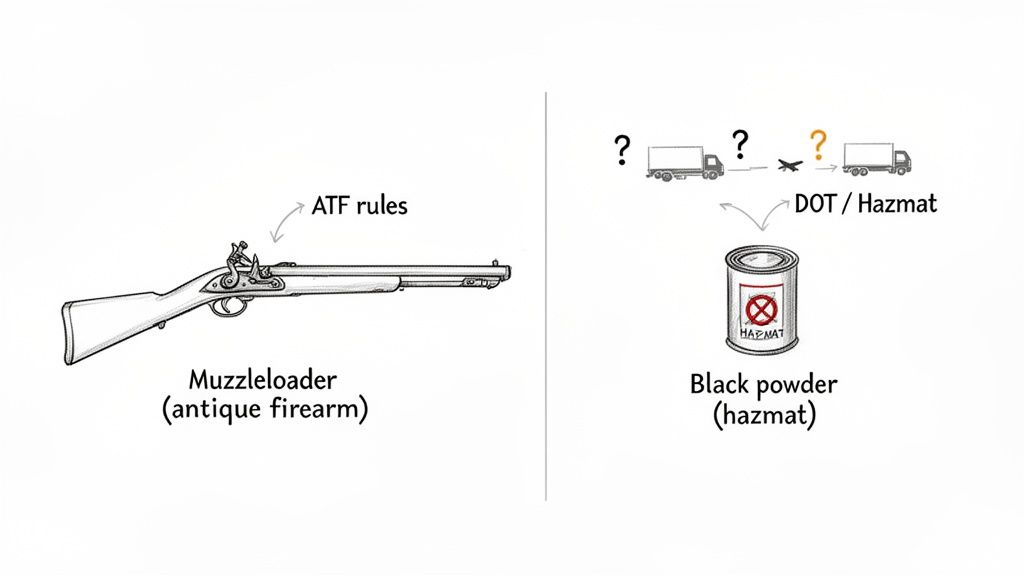
Selling muzzleloaders online seems simple enough—until a customer tries to check out. The whole process is a puzzle, with different government agencies holding different pieces. On one side, you have the Bureau of Alcohol, Tobacco, Firearms and Explosives (ATF), which generally classifies muzzleloaders as "antique firearms." This exempts them from many of the tough regulations that apply to modern guns.
This federal classification is a huge plus. It often means you can ship a muzzleloader straight to a customer's door, no Federal Firearms License (FFL) holder needed for the transfer. It helps to think of it like shipping a historical replica; the government just sees it differently than it does a modern rifle.
The Black Powder Problem
But the second you add black powder or other propellants to that same order, the game completely changes. Suddenly, the Department of Transportation (DOT) gets involved, classifying black powder as a hazardous material—a Class 1 Explosive, to be exact. This kicks off a totally separate and much stricter set of shipping rules.
Automate FFL Shipping Compliance
Block orders to restricted states automatically. 3-day free trial.
Start Free TrialThis two-headed regulatory system creates some serious headaches for sellers:
- Separate Shipments: You can never pack the muzzleloader and its propellant in the same box. They have to be handled as two completely different shipments, each with its own compliance checklist.
- Carrier Restrictions: Big carriers like UPS and FedEx have their own ironclad policies for hazardous materials. This means you’ll need special contracts, specific packaging, and precise labeling. USPS, on the other hand, just says no—they prohibit black powder shipments altogether.
- State and Local Laws: Layered on top of everything else is a patchwork of state and local laws. A state might reclassify an "antique" firearm under its own rules or completely ban direct-to-consumer shipments of propellants.
Keeping up with these rules is more critical than ever, especially with the growing interest in the niche. The global black powder market hit USD 1.2 billion in 2024 and is expected to reach USD 1.8 billion by 2033. This boom is driven by a resurgence in shooting sports, but it also means more retailers are running into the complex hazmat rules that make direct delivery a logistical nightmare. You can learn more about the market's trajectory and the unique shipping challenges involved.
To help you keep these rules straight, here's a quick side-by-side comparison.
Muzzleloader vs Black Powder Shipping At-a-Glance
| Item | Federal Classification | FFL Required? | Primary Carrier Restrictions |
|---|---|---|---|
| Muzzleloader | Antique Firearm (ATF) | Generally No | Few; can ship via most carriers |
| Black Powder | Class 1 Explosive (DOT) | No | Yes; requires Hazmat contract (UPS/FedEx) or is prohibited (USPS) |
As you can see, the firearm itself is relatively straightforward, but the propellant is where the real complexity lies.
Key Takeaway: The central challenge of black powder muzzleloader shipping isn't the firearm—it's the hazardous propellant. Successful online retailers must master two separate sets of regulations: one for the antique firearm and a completely different one for the explosive powder. Get that right, and you're well on your way to staying compliant and avoiding costly penalties.
Understanding Federal and Carrier Shipping Rules
When you get into shipping black powder and muzzleloaders, you're not just dealing with one set of rules—you're navigating two, and they operate in tandem. Think of it as a two-layer security system. First, you have the big-picture federal laws that lay down the baseline for what's legal. Then, you have the specific policies from shipping carriers, which often bolt another layer of requirements right on top.
For any eCommerce business in this niche, getting a firm grip on both layers isn't just a good idea; it's non-negotiable. Federal law might give you the green light to ship, but it's the carrier’s rulebook that dictates how you can actually get an order from your warehouse to a customer's front door. Get either one wrong, and you’re looking at returned packages, painful fines, or even losing your shipping accounts for good.
The Federal Foundation: ATF and DOT
At the federal level, two main agencies are calling the shots: the Bureau of Alcohol, Tobacco, Firearms and Explosives (ATF) and the Department of Transportation (DOT). Each one governs a different piece of your shipment.
The ATF is primarily concerned with the firearm itself. Luckily for muzzleloader sellers, the agency classifies most of these firearms as “antique firearms,” which pulls them out from under the heavy thumb of the Gun Control Act (GCA). This is a huge deal—it means no FFL is typically required for the sale, letting you ship directly to your customer. It dramatically simplifies the firearm side of the transaction.
But the moment black powder enters the equation, the DOT steps in and takes the lead. The DOT classifies black powder as a Division 1.1 or 1.3 Explosive, which immediately puts it under their most stringent hazardous materials (hazmat) regulations. This completely changes the game. Suddenly, you're dealing with special handling, packaging, and paperwork that go far beyond what's needed for the muzzleloader alone.
Free Firearms Compliance Audit
Selling firearms or ammunition? We'll review your WooCommerce store's shipping compliance for free.
The sheer volume of this market is exactly why these rules are so locked down. In 2021 alone, the ATF reported that over 25 million pounds of black powder were sold in the United States. That's a staggering amount of explosive material moving through the supply chain. You can dig into more market insights on Verified Market Reports.
How Carriers Add Their Own Rules
While federal law sets the legal framework, it’s the carriers—UPS, FedEx, and USPS—that create the real-world logistical rules you have to live by every day. Their policies are often even stricter than federal mandates because they're built to manage their own operational risk.
Here’s a quick rundown of how the big three handle black powder:
- USPS: The United States Postal Service keeps it simple: it's a hard no. You cannot ship black powder through the mail under any circumstances. End of story.
- UPS & FedEx: Both of these carriers will move black powder, but only if you jump through some very specific hoops. They require sellers to get a special hazmat shipping contract, which involves a whole application process and, of course, extra fees.
Getting that contract is just the beginning. Once you're approved, you're on the hook to follow their strict protocols for packaging, labeling, and documentation for every single hazmat shipment. This means using specific UN-rated boxes and slapping the correct hazmat diamonds on the outside. For a deeper look at how carriers differ, our guide on which carriers allow ammunition shipping offers some valuable parallels.
This dual-rule system gives you a clear mental model for staying compliant. Federal law tells you what is fundamentally legal on a national scale. But it's carrier policy that dictates the practical, day-to-day actions you have to take to get your products to your customers safely and legally. Both are equally critical for successful black powder muzzleloader shipping.
Navigating the Maze of State and Local Shipping Laws
While federal and carrier rules give you the basic road map, the real challenge begins where the pavement ends: the tangled mess of state and local laws. This is precisely where most online sellers get tripped up. A muzzleloader that the ATF considers a perfectly legal "antique firearm" can be instantly reclassified as a modern firearm by a state, completely changing how—and if—you can ship it.
Imagine this: an order comes in for a muzzleloader and some black powder from a customer in Chicago. On the federal level, you're in the clear. But the city of Chicago has its own strict ordinances, and Illinois piles on another layer of complex rules. If you ship that package without knowing the local landscape, you’re not just breaking a rule. You're setting yourself up for a returned shipment, lost revenue, and a customer you’ll never see again.
This patchwork of regulations creates a compliance minefield that is flat-out impossible to navigate by hand. The rules aren't just different from one place to the next; they're constantly in flux as new laws are passed.
Understanding Hotspot Jurisdictions
Certain states and cities are notorious for having regulations that are far stricter than federal standards. For any e-commerce retailer, these "hotspot" areas demand extreme caution. Trying to manually cross-reference every shipping address against a constantly shifting legal map isn’t just inefficient—it’s a losing game.
Here are just a few examples that show you what you're up against:
- New Jersey: This state has a much broader definition of what qualifies as a "firearm." Muzzleloaders you could ship directly to a customer's door in other states might fall under New Jersey's tighter regulations, suddenly requiring an FFL transfer.
- Illinois: Shipping into Illinois is a headache. The rules change depending on where you are in the state. Cook County (where Chicago is) has its own ordinances that are even tougher than state law.
- New York City: The five boroughs have some of the most restrictive gun laws in the entire country. Shipping a muzzleloader directly to a customer within city limits is almost always a non-starter, regardless of its federal "antique" status.
- Washington D.C.: The District of Columbia operates under its own set of highly restrictive firearm laws that can block the direct shipment of muzzleloaders and related gear.
And that’s just scratching the surface. States like California, Massachusetts, and Hawaii also have their own unique laws that impact both muzzleloaders and the shipment of black powder. The core problem is that compliance isn't just about knowing state law; it's about drilling down to the county, city, and sometimes even the specific ZIP code.
A common mistake is assuming federal law trumps state or local rules for antique firearms. The reality is, states have significant power to regulate firearms within their borders, and these local rules are what trip up online retailers and lead to costly shipping errors and legal trouble.
Why Manual Checks Are a Dead End
Trying to keep up with these diverse and ever-changing regulations is a recipe for disaster. That spreadsheet of restricted locations you're maintaining? It was outdated the second a new ordinance was passed. This manual approach leaves your business wide open to major risks.
For a growing WooCommerce store, the only realistic way to manage this complexity is with automation. A system that can enforce rules at the state, city, and ZIP code level isn't a luxury anymore—it's a fundamental necessity for anyone in the business of black powder muzzleloader shipping. Without it, you are always just one order away from a painful compliance violation.
Examples of State-Level Shipping Restrictions
This table shows just how wild the variations can be from one state to the next. It’s a perfect illustration of why a precise, automated system is so critical.
| State/City | Muzzleloader Restriction Example | Black Powder Restriction Example |
|---|---|---|
| New Jersey | Certain models may be classified as modern firearms, forcing a transfer through an FFL. | Direct-to-consumer shipments are heavily regulated and often outright prohibited. |
| Illinois | Shipping to cities like Chicago or Aurora is highly restricted or completely banned. | Must follow state-specific transport and storage laws, which severely limit direct shipping. |
| New York City | It's generally illegal to ship directly to a consumer living anywhere in the five boroughs. | Banned for direct-to-consumer shipment into the city. |
This variability drives home a critical point: you can’t use a one-size-fits-all shipping policy. Every single transaction has to be checked against the specific laws governing your customer's exact address. Anything less is just gambling with your business.
How to Automate Shipping Compliance in WooCommerce
Trying to manually keep up with the tangled web of federal, carrier, and state shipping laws is a recipe for stress. For anyone running a WooCommerce store, this reactive approach isn't just inefficient—it's a direct threat to your bottom line and your legal standing. The only real way to get ahead of the problem is to stop chasing compliance and start automating it.
This is where a purpose-built tool becomes non-negotiable. Instead of juggling spreadsheets and trying to remember dozens of obscure rules, you can install a system that acts as a digital gatekeeper. It checks every single order against your specific rules before the customer can even complete the purchase. This simple shift turns compliance from a constant headache into a quiet background process that protects your business 24/7.
Introducing Ship Restrict for WooCommerce
For retailers dealing with the tricky rules of black powder muzzleloader shipping, the Ship Restrict plugin is the answer. It was built from the ground up to solve the core problem of selling regulated products online by giving you total control over where your items can be shipped.
Think of it as a smart filter for your checkout page. You set the rules—for instance, "block all black powder shipments to New York City"—and Ship Restrict enforces them instantly. When a customer from a restricted area tries to buy a banned item, the plugin simply stops the checkout and shows them a clear, helpful message explaining why.
Of course, before you can start automating, you need a solid foundation. Following an ultimate guide to WooCommerce website design ensures your store is built correctly, making it much easier to integrate powerful tools like Ship Restrict.
Setting Up Your First Essential Shipping Rules
Getting started with automation is a lot easier than you might think. With Ship Restrict, you can put your most critical protections in place in just a few minutes, immediately shielding your business from common and costly compliance mistakes.
Here’s how simple it is to create a basic rule:
- Select the Product: Pinpoint the specific product or category you need to control, like "Black Powder."
- Define the Location: Tell the system where it can't go. This can be as wide as an entire state (like Hawaii) or as narrow as a single ZIP code in Chicago (like 60601).
- Create a Custom Message: Write a straightforward, customer-facing note. Something like, "Unfortunately, we cannot ship black powder to your location due to state regulations."
This three-step process creates a powerful safety net. This decision tree shows you exactly how the compliance layers work, starting with federal law and drilling all the way down to local rules.
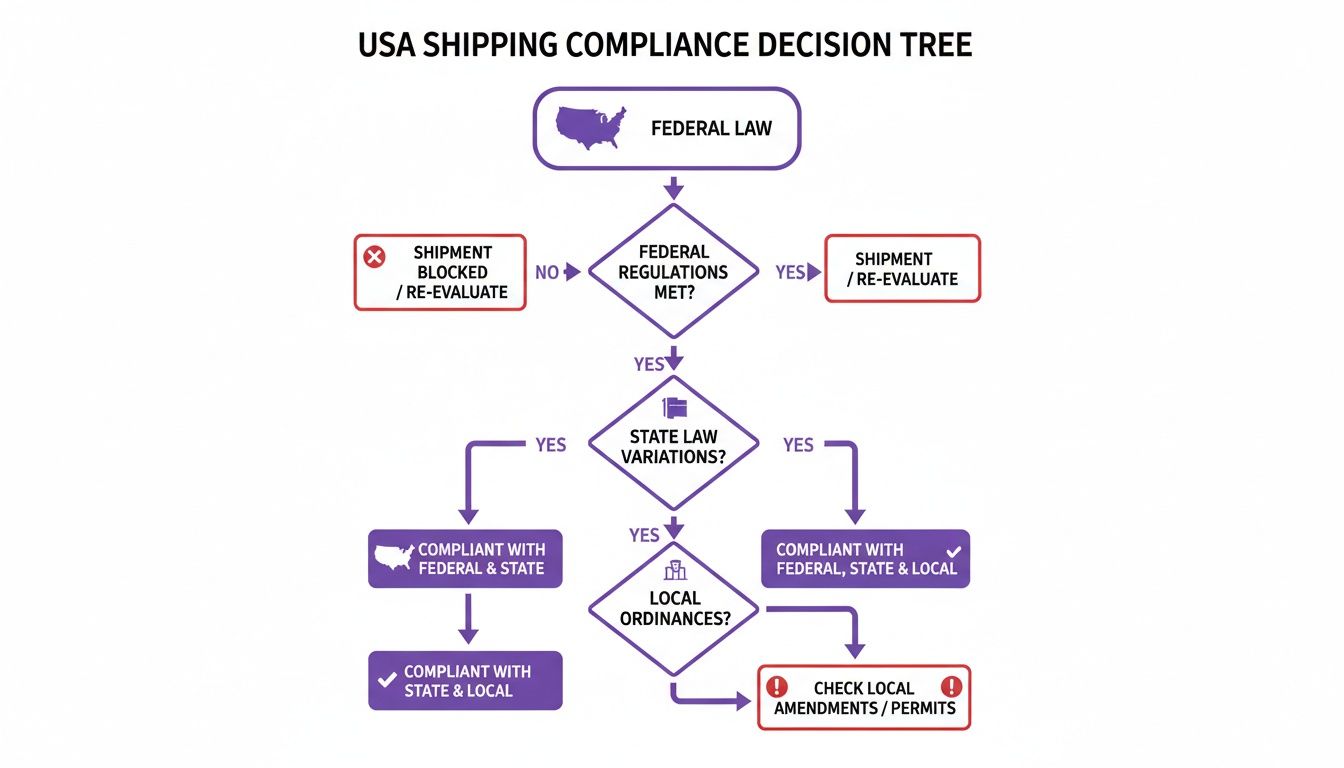
As the flowchart makes clear, compliance isn't just one checkpoint. It’s a multi-layered process that automated tools are perfectly designed to manage.
Key Takeaway: Automation stops compliance problems before they ever begin. By preventing a restricted order from being placed in the first place, you wipe out the costs and hassles of dealing with returned packages, carrier fines, and angry customers down the line.
Powerful Features That Eliminate Manual Work
Beyond the basics, a good automation tool should be a massive time-saver. One of the biggest wins is bulk rule creation. Instead of sitting there manually entering hundreds of restricted ZIP codes one by one, you can upload a single file and have every rule created in seconds.
The clear, organized dashboard makes it simple to see exactly what’s restricted and where, taking all the guesswork out of your shipping operations.
This feature is a total game-changer. What used to be a full day of mind-numbing data entry can now be finished in the time it takes to make a cup of coffee. You can get a deeper look into how automated shipping compliance for Woo Commerce stores works and see these features in action.
Ultimately, automation isn't just about blocking bad orders. It's about building a smarter, more efficient, and legally sound business. By letting technology handle the regulatory chaos, you free up your team to focus on what really matters: growing the business and taking care of your customers.
Correctly Packaging and Labeling Your Shipments
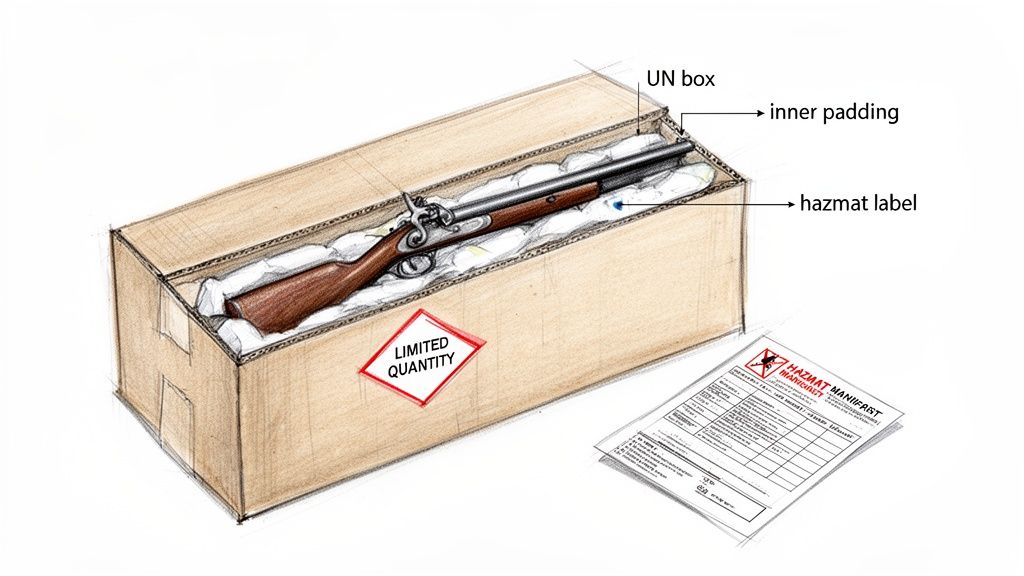
Automating your compliance rules is a huge step, but the job isn't done until the product is physically out the door. Think of your packaging and labeling as the final, hands-on checkpoint in the whole process. Get it right, and your packages arrive safely, keeping you on good terms with your carriers. Get it wrong, and you're looking at damaged goods, rejected shipments, and even serious fines.
Just like the shipping rules, the physical packaging needs for muzzleloaders and black powder are worlds apart. The muzzleloader itself is pretty straightforward—it just needs a sturdy box. The black powder, however, is where you need real precision, since it falls under strict DOT hazardous material protocols.
Packaging the Muzzleloader Securely
Packing a muzzleloader is mostly about common sense and brute-force protection. The goal is simple: immobilize the firearm inside a tough box so it can't shift, slide, or get banged up if the package gets dropped or tossed around in transit.
- Use a sturdy, new corrugated box with at least a few inches of clearance around the rifle.
- Wrap the muzzleloader in a protective layer like bubble wrap or a foam gun sock to head off scuffs and scratches.
- Fill every bit of void space with quality packing material—foam inserts, packing peanuts, or dense kraft paper work well to hold the firearm firmly in place.
- Seal the box like you mean it with strong packing tape across all the seams.
This careful approach does more than just protect the product; it makes sure your customer gets their purchase in perfect condition, which is exactly the experience you want to provide.
The Specifics of Packaging Black Powder
This is where things get much more technical. Because black powder is a Class 1 Explosive, you can’t just toss it in any old box. You have to use packaging that meets specific DOT and carrier standards designed for hazardous materials.
The key to shipping black powder in small parcels is leveraging the "Limited Quantity" exemption. This is a provision that lets you ship small amounts of certain hazmat products via ground without all the complex placarding required for big freight shipments. For eCommerce, it’s a lifeline. If you want to dive deeper into the nuances, our guide on managing hazmat shipping restrictions in Woo Commerce is a great resource.
To stay compliant, your package needs two main things:
- Sturdy Outer Packaging: This must be a UN-rated 4G combination packaging. It's usually a heavy-duty fiberboard box that’s been officially tested and certified to handle drops, stacking, and vibration.
- Secure Inner Packaging: Inside that 4G box, the individual containers of black powder must be packed so they can't shift or break. This usually means using cardboard partitions or custom foam inserts.
The total weight of the black powder in a single Limited Quantity package can't go over a certain limit, which for carriers like UPS is typically 25 pounds (11.3 kg). You should always double-check the exact weight limits with your specific carrier.
Finally, you have the most visible part of compliance: the label. Every single black powder shipment sent under this exemption must display the square-on-point "Limited Quantity" mark. This diamond-shaped label is a universal sign to carrier staff that the box contains a small amount of hazardous material and must be handled accordingly—most importantly, it can only travel by ground. You'll also need to slap on a carrier-specific shipping label and have a hazmat manifest ready for your driver, ensuring total transparency from your warehouse to the customer's doorstep.
Choosing the Right Shipping Carrier
<iframe width="100%" style="aspect-ratio: 16 / 9;" src="https://www.youtube.com/embed/08Lqiz4K2JE" frameborder="0" allow="autoplay; encrypted-media" allowfullscreen></iframe>Picking a shipping carrier for your business is about more than just finding the lowest price. It's a partnership. And when it comes to black powder muzzleloader shipping, your options get real narrow, real fast. Not every carrier is willing—or legally able—to handle hazardous materials like black powder.
The first step is easy: take the United States Postal Service (USPS) completely off your list. USPS has a strict, zero-tolerance policy against shipping anything explosive. That includes all types of black powder and its substitutes. Trying to sneak it through the mail isn’t just a bad idea; it’s illegal and comes with some pretty severe penalties.
So, where does that leave you? With two main players: UPS and FedEx. Both have established programs for shipping hazardous materials, but they are not created equal. Their requirements, costs, and internal processes are worlds apart, and the right choice for your store will depend on your order volume, budget, and how much administrative work you can handle.
Comparing UPS and FedEx Hazmat Programs
Before you can ship a single grain of black powder with either UPS or FedEx, you need a specific hazmat contract. This isn't just a box you check online. It's a full-on application process where the carrier vets your business to make sure you have the knowledge and procedures to handle these materials safely and legally.
Once you're approved, get ready for some new line items on your shipping invoices:
- Account Fees: You might run into setup fees or ongoing monthly charges just to maintain your hazmat shipping account.
- Per-Package Surcharges: This is the big one. Expect to pay a hefty hazmat surcharge—often $40 or more—on top of the base shipping rate for every single package containing black powder.
- Required Training: The staff members who package and process these shipments must complete formal hazmat training. It's another investment of both time and money.
The U.S. is the biggest consumer in the global gun powder market, fueled by over 15 million recreational shooters. After regulations tightened up post-2010, UPS went to ground-only transport for powder, and FedEx rolled out its own special packaging rules. One slip-up can cost a retailer over $500 per incident, which is why automated tools that give you granular control are no longer a luxury—they’re essential for survival. You can learn more about the global gun powder market dynamics on dataintelo.com.
Crucial Insight: Black powder is almost exclusively restricted to ground transport with these carriers. The risk profile for air travel is just too high, which means it’s a non-starter. This will limit your shipping speed and how far you can realistically send orders.
Making an Informed Decision
Your final choice between UPS and FedEx really comes down to balancing cost against reliability and support. UPS is often viewed as having a more mature, well-documented hazmat program, which can be a huge help for businesses just dipping their toes into shipping regulated goods.
That said, FedEx also runs a solid service. Your best bet is to get on the phone with sales reps from both carriers, get quotes, and compare the nitty-gritty details of their programs.
Ultimately, the best carrier is the one that fits your business model and has a support team you can count on to guide you through the inevitable complexities. Making this decision carefully is a foundational step in building a compliant and profitable black powder muzzleloader shipping operation.
Frequently Asked Questions
Even with a detailed guide, a few specific questions always seem to pop up when you're dealing with something as nuanced as shipping muzzleloaders and black powder. Let's tackle the most common ones head-on.
Do I Need an FFL to Ship Muzzleloaders?
Generally, no. Under federal law, the vast majority of muzzleloaders are classified as "antique firearms" and fall outside the scope of the Gun Control Act (GCA). This means you typically don't need a Federal Firearms License (FFL) to sell or ship them, and they can usually go straight to your customer's door.
But here's the catch: you absolutely have to check state and local laws. Some states, like New Jersey, have their own, stricter definitions. They might treat certain muzzleloaders just like modern firearms, which would bring an FFL transfer right back into the picture.
Can I Ship a Muzzleloader and Black Powder in the Same Box?
Absolutely not. This is a common but extremely dangerous mistake that violates both federal law and every carrier's policy. Muzzleloaders themselves are relatively simple to ship, but black powder is a different beast entirely. It's a DOT-regulated hazardous material (Class 1 Explosive).
Black powder has to be shipped all by itself in special UN-rated packaging, plastered with the correct hazmat labels. It can only travel via an approved ground carrier like UPS or FedEx, and only if you have a specific hazmat contract with them. Tossing them in the same box is a massive compliance failure waiting to happen.
Key Insight: Always treat the firearm and the propellant as two completely separate shipments. The muzzleloader is a regulated item, but the black powder is a hazardous material. The rules are not interchangeable.
How Does Ship Restrict Handle Mixed Carts?
This is where smart automation saves the sale. Ship Restrict works at the individual product level, not the entire cart.
Imagine a customer in a restricted state adds a cleaning kit and a can of black powder to their cart. Instead of just blocking the whole order, the plugin intelligently flags the problem item. It will stop the checkout and display a customizable message explaining that the black powder can't be shipped to their location, while the cleaning kit is good to go.
This prevents you from losing the entire sale, educates the customer on why the order was blocked, and dramatically cuts down on confused emails and phone calls.
Stop losing sales to shipping confusion. Ship Restrict automates your compliance, blocks restricted orders before they become problems, and protects your business. Get started at shiprestrict.com.
Automate FFL Shipping Compliance
Stop worrying about restricted states. Ship Restrict handles it automatically.

Cody Yurk
Founder and Lead Developer of ShipRestrict, helping e-commerce businesses navigate complex shipping regulations for regulated products. Ecommerce store owner turned developer.
Automate FFL Compliance
- Block restricted states
- No more cancellations
- Set and forget
3-day free trial · Card required