Airsoft replica firearm shipping restrictions: Seller Guide
Learn Airsoft replica firearm shipping restrictions and how federal, state, and carrier rules affect your e-commerce shipments.
If you're selling airsoft gear online, you already know that shipping is one of your biggest headaches. The problem isn't just one single law; it's a tangled web of federal, state, and even carrier-specific rules. One wrong move can lead to seized packages, furious customers, and legal trouble you don't need.
Navigating the Maze of Airsoft Shipping Rules
This guide is for merchants who are tired of the guesswork. We're going to cut through the noise and give you clear, practical steps to stay compliant. We’ll break down the legal landscape, look at the real-world restrictions you'll face, and show you exactly how to build a system that shields your business from expensive mistakes. Think of this as your roadmap to getting airsoft replicas shipped safely and legally, every single time.
Successfully shipping airsoft replicas means you have to understand a multi-layered compliance puzzle. Just knowing about the federal orange tip requirement is nowhere near enough to protect your online store. The rules can change dramatically based on your customer's zip code—what's perfectly legal in one state might be banned one city over.
Why a Simple Policy Always Fails
Trying to use a one-size-fits-all shipping policy is a recipe for disaster. The second an order is placed, a whole set of invisible legal tripwires come into play. Ignoring them has very real consequences.
Automate FFL Shipping Compliance
Block orders to restricted states automatically. 3-day free trial.
Start Free TrialA smart compliance strategy isn't just about dodging legal bullets; it's about building a business that lasts. Seized shipments and angry customers will wreck your reputation far more than the cost of a lost product.
Just to give you an idea, here are a few common pitfalls that a generic shipping policy misses completely:
- City-Level Bans: Both New York City and Chicago have outright bans on airsoft sales, even though they're allowed elsewhere in their states.
- Unique Marking Requirements: California demands specific colored markings on the trigger guard and grip—a rule that doesn't exist anywhere else.
- Carrier Rules: Shipping carriers like USPS, FedEx, and UPS have their own internal policies that are often stricter than the law, which can lead them to refuse your packages.
This guide will peel back each of these layers, starting with the big federal rules and drilling down into the nitty-gritty of state, city, and carrier policies. Getting a handle on this framework is the first step toward building an automated, error-proof shipping process that lets your business grow without the constant worry.
Understanding the Three Layers of Compliance
Shipping airsoft replica firearms can feel like trying to solve a puzzle with pieces from three different boxes. To build a shipping strategy that actually works, you have to understand that the rules aren't just one document—they're a stack of interconnected layers. Think of it like a hierarchy, where you have to satisfy each level to get an order out the door.
These three layers are Federal, State/Local, and Carrier. Each one has its own set of concerns, and they all build on one another. If you ignore even one, you're looking at seized packages, angry customers, and a massive headache for your business. Getting a handle on how these layers interact is the first real step to creating a bulletproof shipping operation.
This flowchart breaks down the top-down flow of regulations, showing how each layer adds another compliance check to the process.
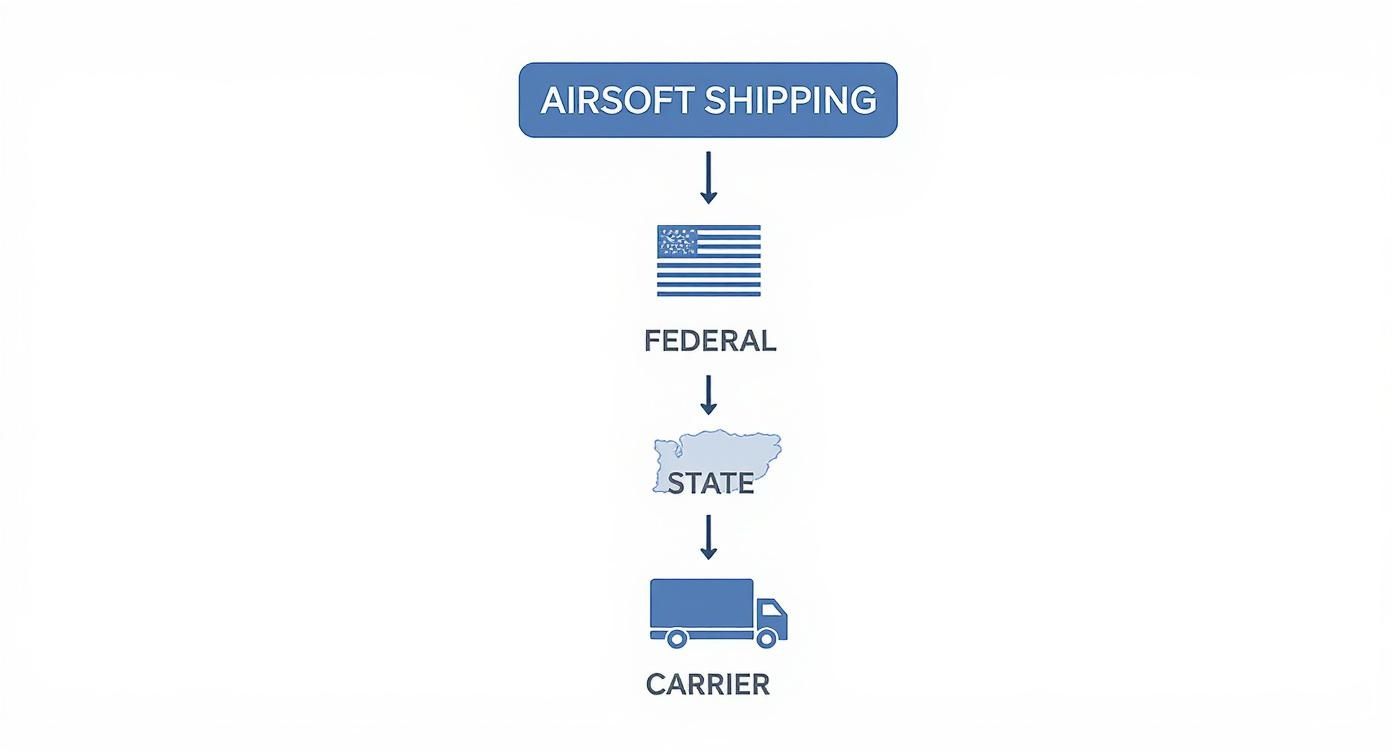
As you can see, federal rules are just the starting point, not the finish line.
The table below gives a quick overview of how these regulatory layers stack up, each with its own focus and set of rules you need to follow.
Overview of US Airsoft Shipping Regulation Layers
| Regulatory Layer | Primary Requirement/Concern | Example |
|---|---|---|
| Federal | Public safety & trademark law | All replicas must have a permanent ¼-inch blaze orange tip on the muzzle. |
| State/Local | Varies by jurisdiction; often stricter than federal law | California requires additional bright color markings beyond the orange tip. |
| Carrier | Internal liability & operational risk | FedEx and UPS have specific packaging and labeling rules for firearm-like items. |
Let's dig into what each of these layers means for your business in more detail.
Free Firearms Compliance Audit
Selling firearms or ammunition? We'll review your WooCommerce store's shipping compliance for free.
Layer 1: Federal Regulations
At the top of the pyramid are federal laws. These rules set the absolute minimum standard for every airsoft replica sold anywhere in the United States. The government's main concerns here are pretty straightforward: making sure airsoft replicas aren't easily mistaken for real firearms and don't violate any intellectual property rights.
The key federal rules, based on Title 15 of the Code of Federal Regulations, Section 272, create a baseline for every single sale:
- The Orange Tip: A non-negotiable, permanently affixed ¼-inch blaze orange tip on the muzzle is mandatory.
- Trademark Removal: Any logos or markings that copy a real firearm manufacturer must be removed before the product is imported.
Fail to meet these standards, and your inventory could get seized by customs before it ever even hits your warehouse. But remember, getting this part right is just step one.
Layer 2: State and Local Laws
This is where things get really complicated. While federal law gives you a universal baseline, individual states, counties, and even cities are free to pile on their own, often much stricter, regulations. This creates a messy "compliance patchwork quilt" that can change dramatically from one zip code to the next.
For instance, states like California and New York have laws demanding additional bright color markings on the body of the airsoft replica, not just the orange tip. But the rules get even more specific.
A common and costly mistake for online sellers is assuming state-level compliance is enough. Major cities like New York City, Chicago, and Washington D.C. have complete bans on the sale and possession of airsoft replicas, creating critical no-ship zones within otherwise permissible states.
This layer is where most merchants trip up, especially if they don't have a system that understands geography. What's perfectly legal to ship to one customer might be completely illegal for their neighbor just a few miles down the road.
Layer 3: Carrier Policies
The final hurdle comes from the shipping companies themselves. Carriers like UPS, FedEx, and USPS have their own internal policies for anything that even looks like a firearm, and their rules are often tougher than the actual law.
They do this to minimize their own liability and risk. A carrier can flat-out refuse to ship your products even if they are 100% compliant with federal and local laws. USPS, for example, has notoriously vague rules that let any employee reject a package if they think a replica is "so realistic as to be reasonably perceived as an actual firearm." That kind of subjectivity makes them an unreliable partner for a lot of airsoft businesses.
Private carriers like FedEx and UPS usually have clearer guidelines, but they are still incredibly strict about how these items must be packaged and declared.
Key State and City Restrictions You Must Know
If you're only following federal law for your shipping policy, you're navigating with the wrong map. It's like trying to find a specific coffee shop in downtown Manhattan using a map of the entire United States—you're missing all the critical details and are bound to get lost. The real headaches in shipping airsoft replicas come from the crazy quilt of state, county, and city-level rules.
A "one-size-fits-all" shipping policy is a fast track to getting packages returned, inventory seized, and customers furious. An airsoft gun that’s perfectly legal to ship to one address could be a prohibited item just a few miles down the road. This is exactly why a geographically-aware shipping strategy isn't just a nice-to-have; it's non-negotiable for any serious online airsoft store.
California and New York: The Marking Minefield
California and New York are perfect examples of states that take federal law as a starting point and then add their own layers of complexity. The issue isn't if you can ship there; it's what you ship and exactly how it's marked.
-
California: State law here requires airsoft replicas to have fluorescent coloring over the trigger guard and adhesive tape on the grip. This is on top of the federal blaze orange tip. If those markings are missing, the product is non-compliant for sale anywhere in the state.
-
New York State: New York has a similar approach, demanding that airsoft replicas be either brightly colored all over or built from clear or translucent materials. Shipping a standard black or tan replica into the state—even with the orange tip—is a violation of state law.
These rules create a real logistical puzzle. You either have to maintain a separate, compliant inventory just for these two states or build a pre-shipment process to modify replicas on the fly, adding labor costs and slowing down fulfillment.
The Absolute No-Ship Zones
Beyond states with special marking rules, you have jurisdictions where selling airsoft replicas is banned entirely. These are the critical "no-ship" zones your e-commerce store must be able to identify and block at checkout. Every order you attempt to ship to these places is a guaranteed loss of product, shipping fees, and time.
The most dangerous compliance blind spots are almost always at the city level. An order can look perfectly fine based on the state, but be completely illegal because of the customer's specific city or ZIP code. This is one of the most common—and costly—oversights for online sellers.
A prime example is New York. While New York State allows the sale of properly marked replicas, New York City enforces a complete ban on the sale, possession, and use of all airsoft guns. Any order addressed to one of the five boroughs (Manhattan, Brooklyn, Queens, the Bronx, and Staten Island) has to be stopped cold.
Other High-Risk Jurisdictions
And the list of tricky locations doesn't stop with NYC. Several other major metro areas have passed strict ordinances that effectively prohibit airsoft sales. Knowing these local rules is crucial.
Here are a few more critical areas to keep on your radar:
- Chicago, Illinois: Just like NYC, Chicago has a strict ban on airsoft replicas.
- Washington D.C.: The District of Columbia prohibits the possession and sale of most airsoft guns.
- Parts of Michigan: While the state has broad preemption laws for actual firearms, airsoft guns often don't fall under that protection. Local cities and towns can—and do—make their own rules.
- Johnson City, Tennessee: This town is a great example of a smaller municipality that has an outright ban on airsoft guns, proving you can't just focus on major cities.
This handful of examples makes it clear: state-level compliance is just the first step. To be truly protected, you have to drill down deeper. As many sellers have learned the hard way, county-level shipping restrictions can add yet another layer of complexity. A truly effective system has to check for restrictions at every level—state, county, city, and even ZIP code—to shield your business from expensive mistakes.
Shipping Airsoft Replicas Internationally
<iframe width="100%" style="aspect-ratio: 16 / 9;" src="https://www.youtube.com/embed/4LuSSdzK6aM" frameborder="0" allow="autoplay; encrypted-media" allowfullscreen></iframe>If you thought navigating the patchwork of U.S. state and city laws was a headache, welcome to the big leagues. International shipping adds a whole new dimension of risk and complexity to selling airsoft replicas. When you sell across borders, you’re no longer just dealing with domestic regulations; you’re stepping into a world of customs, import laws, and country-specific prohibitions that change dramatically from one border to the next.
For any U.S.-based seller, this is the final boss of airsoft replica firearm shipping restrictions.
Trying to ship internationally without a rock-solid, country-by-country compliance system isn't just risky—it's a recipe for disaster. We're talking seized goods, total financial loss, and even potential legal trouble with foreign governments. A product that’s perfectly legal to sell in Ohio could be classified as a prohibited weapon somewhere else, and pleading ignorance won’t get your package out of customs.
A World of Different Rules
The moment a package crosses a border, the rulebook for airsoft replicas gets thrown out and rewritten. There’s no universal standard here. What one country considers a toy, another might classify as a dangerous weapon requiring a special permit or an outright ban. The due diligence required is massive because every single destination has its own legal framework.
The differences can be staggering. The United Kingdom, for instance, requires "unrealistic imitation firearms" to be mostly transparent or painted in a bright, non-military color like red, orange, or yellow. Hop over to Canada, and you'll find a bizarre system where replicas shooting below 366 fps with a 0.2-gram pellet are paradoxically deemed illegal replica firearms.
And some nations take a much harder line. China imposes exceptionally severe penalties, including potential life imprisonment for trafficking replica firearms, while Singapore just bans all airsoft guns, period. You can see more country-specific policies on Airsoft Station.
The key takeaway for merchants is that you cannot apply a single international shipping policy. Each country must be treated as a separate and unique legal entity. Failure to do so will inevitably lead to costly customs seizures.
It’s also helpful to look at how other restricted items are handled, like the rules for shipping ammunition internationally, to get a sense of the compliance hurdles you’ll face.
Core Challenges of International Sales
Successfully shipping overseas involves more than just knowing the laws. You have to tackle the practical headaches of customs declarations, carrier politics, and the steep price of making a mistake.
- Customs Declarations: Every international shipment needs a customs form detailing the contents and value. Mislabeling an airsoft replica, whether you mean to or not, is a fast track to seizure and fines.
- Import Permits: Some countries allow airsoft replicas but require the buyer to get an import permit first. Shipping an order without confirming that permit is in place is a classic, costly error.
- Carrier Refusals: International carriers are often even more cautious than domestic ones. They might refuse to carry anything that looks like a firearm to certain countries—regardless of local laws—just to avoid their own liability.
The challenges of cross-border commerce go way beyond just airsoft. To get a broader look at the issues involved, check out our guide on international shipping restrictions for sporting goods.
For most small to medium-sized airsoft businesses, the risk and overhead of international shipping simply outweigh the potential reward. Sticking to a domestic-only policy is often the safer and more manageable strategy.
How to Automate Shipping Compliance in Your Store
Let's be honest: manually checking every single order against an ever-shifting list of state, county, and city rules isn't a business strategy—it's a recipe for disaster. It’s a tedious, soul-crushing process that’s practically guaranteed to lead to mistakes, lost inventory, and seriously unhappy customers. The minute your store starts to see real growth, this manual approach becomes a massive bottleneck and a huge financial risk.
There's only one way to scale this reliably: take human error out of the equation. By automating your shipping rules, you transform compliance from a reactive chore into a proactive defense for your business. An automated system acts as a digital gatekeeper, instantly checking every customer's address at checkout and stopping bad orders before they ever become a problem.

This is the command center for your store's compliance. It's where you build specific, intelligent rules that enforce the complex airsoft replica firearm shipping restrictions we've been talking about.
Building Your First Automated Rule
Let’s walk through a real-world example of how this works. One of the most common—and costly—mistakes is shipping an airsoft replica to New York City, where they are banned. Trying to catch every NYC-bound order manually is a nightmare. Customers might use different borough names or zip code abbreviations, and something will inevitably slip through.
With an automated tool, you can build a simple, powerful rule to solve this problem for good.
- Name Your Rule: Give it a clear, obvious name like "Block All Airsoft Sales to NYC."
- Select the Products: Apply this rule to your "Airsoft Replicas" product category or maybe a specific product tag. This makes sure it only fires for the items you actually need to restrict.
- Define the Location: This is the key. Instead of trying to guess city names, you can simply input all the ZIP codes for the five boroughs of NYC. A quick online search gives you a comprehensive list you can copy and paste.
- Set the Action: The action is blunt and effective: "Prevent Order." This completely disables the checkout process for any customer whose cart contains a restricted product and a shipping address in an NYC ZIP code.
Just like that, you've completely plugged one of the biggest compliance holes in the country. You can use this exact same method for Chicago, Washington D.C., and any other jurisdiction where these products are flat-out prohibited. To see this in more detail, check out our complete guide on automated shipping compliance for WooCommerce stores.
Creating Nuanced Rules with Custom Messaging
Not all restrictions are a simple yes or no. Some places, like California, allow sales but have very specific requirements. A blunt "Prevent Order" rule doesn't work here; you'd be turning away perfectly good business. What you need is a smarter approach that informs the customer and manages their expectations.
Here’s how you could build a rule for California:
- Rule Name: California Airsoft Compliance Notice
- Products: Apply to the "Airsoft Replicas" category.
- Location: Select the entire state of California.
- Action: Instead of blocking the sale, you choose to "Show a Custom Message."
This is where the power of automation really shines. You can write a specific, helpful message that only appears at checkout for California customers who are buying an airsoft replica.
Example Message: "Just a heads-up! Due to California regulations, all airsoft replicas shipped to your state require additional colored markings. This may add 1-2 business days to your order's processing time. Thanks for your understanding!"
This simple message does so much work for you. It tells the customer about a potential delay, explains why it's happening (you're following the law), and sets their expectations correctly from the start. This kind of transparency dramatically cuts down on "Where is my order?" emails and builds trust by showing you're a professional, compliant business.
Maintaining Your Compliance System
Getting your rules set up is the biggest part of the job, but compliance isn't a "set it and forget it" task. Laws change. New local ordinances pop up with little warning. A solid automation strategy has to include a plan for maintenance.
- Scheduled Audits: Put a recurring reminder on your calendar—maybe once a quarter—to review your rules. Check for any new state or local laws that might impact your products.
- Supplier Agreements: Your compliance responsibility extends to your partners. Make sure you have clear, effective supplier contracts with your shipping carriers and distributors that outline exactly how they should handle your regulated items.
- Stay Informed: Follow industry news and legal updates related to airsoft regulations. Being proactive means you can update your rules before a new law catches you by surprise.
By moving from a manual checklist to an automated, rules-based system, you're doing more than just saving time. You're building a resilient, compliant e-commerce operation that can confidently handle the tangled mess of airsoft replica firearm shipping restrictions.
Why Proactive Compliance Is Your Best Defense
When you’re selling airsoft replicas, just hoping for the best on shipping restrictions isn't a real business strategy. The simple truth is that ignorance of the complex web of federal, state, and carrier rules offers zero protection from the fallout—we're talking seized inventory, painful fines, and even losing your payment processor.
We’ve seen how compliance works across three different layers: Federal, State/Local, and the carriers themselves. The days of trying to catch everything with manual order reviews are long gone. A single order slipping through to a prohibited zone like New York City or Chicago can easily cost you hundreds in lost product and shipping fees.
The only way to scale and protect your business is to switch to an automated, rules-based system.
A Competitive Advantage, Not an Expense
Thinking about this proactively is much more than just a defensive move. It builds critical trust with your customers, protects your business assets, and ensures you can actually operate and grow in this highly regulated market. The global airsoft gun market is on track to hit USD 4.5 billion by 2034, and you can bet that growth will bring even more regulatory scrutiny. U.S. Customs and Border Protection has already seized hundreds of non-compliant airsoft rifles at major ports, which shows you just how real the enforcement is. You can dig into the numbers and challenges in this detailed industry analysis from GMInsights.com.
Proactive compliance isn't just another expense; it's a powerful competitive advantage. It signals professionalism, shields your business from predictable losses, and gives you the stable foundation you need for long-term growth.
At the end of the day, the small investment in automating your shipping rules pays for itself by preventing just one or two costly mistakes. The time to get your shipping policies audited and implement a robust, automated solution is now—before a preventable error puts your entire business at risk.
Frequently Asked Questions
Even with a rock-solid compliance strategy, edge cases and specific questions always pop up. Here are some quick, clear answers to the most common queries we hear from merchants dealing with airsoft replica firearm shipping restrictions.
Can I Ship Airsoft Guns Through USPS?
Our advice? Don't. While you technically can, using the United States Postal Service (USPS) for business shipments of airsoft replicas is a risky bet. Their internal rules are just too subjective.
USPS policies do allow for "toy guns" with the right markings. The problem is, they also give any postal employee the right to reject a package if they think a replica is "so realistic as to be reasonably perceived as an actual firearm." That means your shipment could get seized or returned based on one person's gut feeling, creating fulfillment nightmares and angry customers.
Private carriers like FedEx or UPS offer much clearer and more consistent guidelines for shipping airsoft products. They might cost a bit more, but the reliability is worth every penny for regulated items.
Do I Still Need an Orange Tip for Local Sales?
Yes. 100%. Think of the blaze orange tip as a non-negotiable safety feature for every single sale you make.
While federal law is specifically aimed at manufacturing and shipping products between states, that orange tip has become a universal safety marker. Law enforcement and the public instantly recognize it. Selling a replica without one—even for a local pickup—opens you up to massive liability. If that item is ever misused, you could be found negligent.
To protect your business, ensure public safety, and comply with the many state laws that build on the federal standard, every airsoft replica you sell must have a permanently affixed orange tip. No exceptions.
What Happens if My Shipment Is Seized by Customs?
When an international shipment gets snagged by customs, you’ll eventually get an official notice explaining why. From there, you're pretty much left with two options:
- Abandon the Merchandise: This is what happens 99% of the time. You forfeit the product, and it's a total loss.
- Contest the Seizure: Get ready for a long and expensive legal battle. This means hiring lawyers and drowning in paperwork.
For nearly every e-commerce business, fighting a seizure costs way more than the product is worth. The shipment becomes a complete write-off, and you're still left dealing with the customer who never got their order. This is precisely why automated shipping rules are so vital—they stop the problem before it starts, protecting your inventory and your reputation.
Ready to automate your compliance and eliminate these headaches for good? Ship Restrict for WooCommerce lets you build precise rules to block sales to restricted states, cities, or even specific ZIP codes. You can finally ensure every order you ship is a safe one.
Automate FFL Shipping Compliance
Stop worrying about restricted states. Ship Restrict handles it automatically.

Cody Yurk
Founder and Lead Developer of ShipRestrict, helping e-commerce businesses navigate complex shipping regulations for regulated products. Ecommerce store owner turned developer.
Automate FFL Compliance
- Block restricted states
- No more cancellations
- Set and forget
3-day free trial · Card required