Airgun Pellet Gun Shipping Restrictions by State A Comprehensive Guide
Navigate the complex airgun pellet gun shipping restrictions by state. Our guide covers laws, age limits, and carrier rules for full eCommerce compliance.
Trying to ship airguns and pellet guns can feel like navigating a minefield for any eCommerce business. Unlike regular firearms, there's no single federal law that covers them. This leaves sellers grappling with a confusing patchwork of state and local rules that can easily lead to expensive shipping mistakes and legal headaches.
The Tangled Web of Airgun Shipping Laws
Selling airguns online in the United States isn't as simple as boxing up an order and sending it on its way. Because the federal government doesn't classify most airguns as firearms, the job of regulating them falls to individual states, counties, and even cities. The result is a chaotic legal landscape where an airgun that’s perfectly legal to ship to one town might be banned in the one right next to it.
This jumble of rules creates some serious risks. One wrong move could mean returned shipments, penalties from carriers like UPS or FedEx, or even hefty fines from local authorities. For online retailers, understanding these hyper-local laws is absolutely critical.
Key Differences in State Rules to Watch Out For
The real challenge comes from how different places define and regulate airguns. There’s no universal standard, which means you have to keep track of several moving parts. Here’s what you’ll run into:
Automate FFL Shipping Compliance
Block orders to restricted states automatically. 3-day free trial.
Start Free Trial- Outright Bans: Some major cities and a handful of states completely prohibit shipping airguns directly to a customer's door.
- Velocity and Caliber Rules: Certain states, like Illinois, treat high-powered airguns as firearms. If a pellet gun shoots faster than 700 feet per second, it has to be shipped to a licensed gun dealer (an FFL), not the customer.
- Age Verification: Most states mandate that buyers must be at least 18 years old. This puts the legal burden squarely on the seller to verify a customer’s age before the package leaves the warehouse.
To give you a sense of the problem, at least seven major jurisdictions ban direct-to-consumer shipments entirely. This creates massive compliance headaches for anyone trying to sell nationwide. Manufacturers often can't ship to places like Washington D.C., New York City, Philadelphia, and Chicago. Meanwhile, as mentioned, Illinois forces powerful airguns through an FFL dealer.
You can see for yourself by reviewing a sample of these complex state regulations. This crazy quilt of rules makes one thing crystal clear: you need an automated system to manage compliance and protect your business.
State by State Airgun Shipping Rules Quick Reference
Trying to keep up with the patchwork of airgun and pellet gun shipping restrictions by state can feel like a full-time job. With rules changing from one state line to the next—and sometimes from one city to another—manually checking every local ordinance for every order is a recipe for mistakes and wasted time. That's where a solid quick-reference guide comes in.
This summary gives you a high-level view of the most important compliance points. It's designed so you can quickly see a state's general shipping status, check for age limits, and spot any major local trouble spots without getting bogged down in legal jargon. Think of it as your first line of defense against costly shipping errors and confused customers.
The infographic below breaks down the main layers of complexity you'll run into, mapping out the banned jurisdictions, states that treat certain airguns like firearms (requiring an FFL), and those with specific age limits.
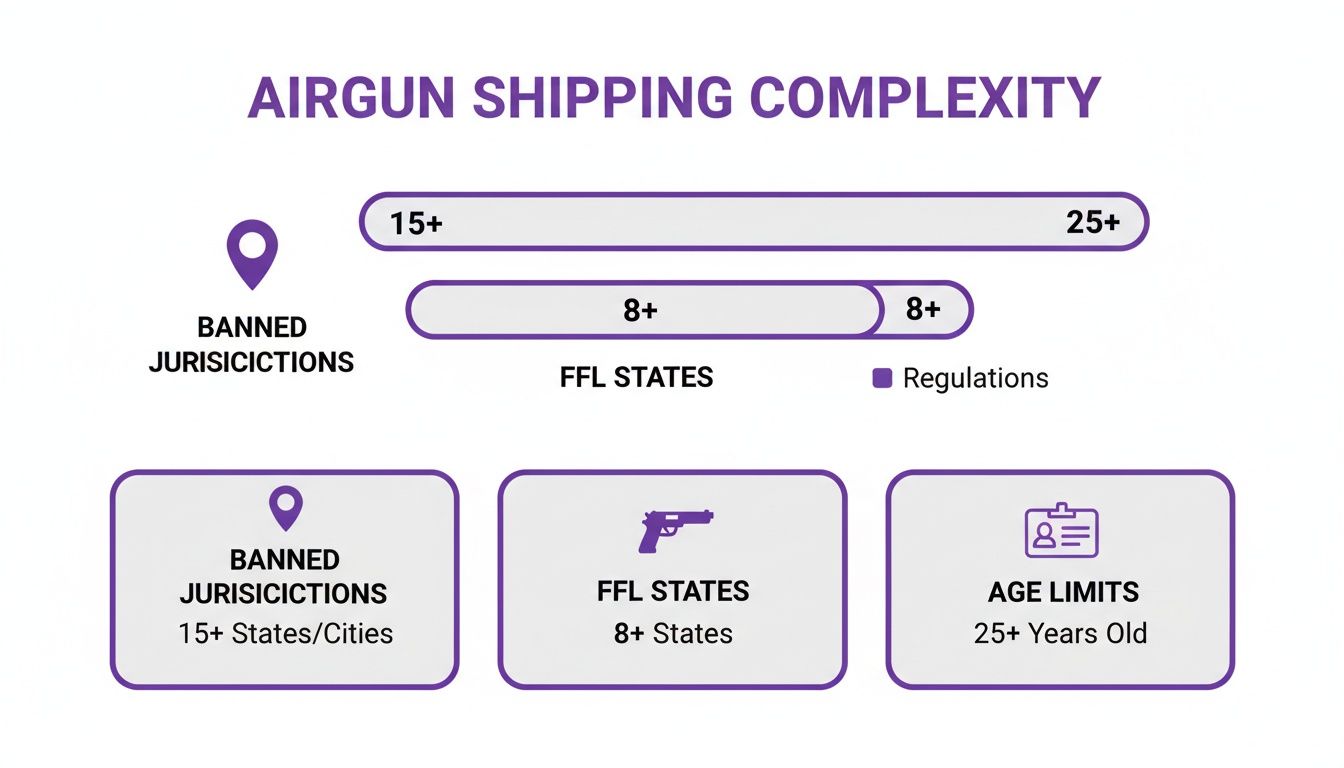
As you can see, it's never a simple "yes" or "no" answer. Compliance is a moving target that looks very different depending on where you're shipping.
State by State Airgun Shipping Restriction Summary
The table below is your go-to resource for a fast, initial check on airgun shipping rules across the U.S. Use it as a starting point to validate orders, but always remember that laws can and do change. For states with complex or city-specific rules, this table will point you in the right direction for a deeper dive.
| State | General Shipping Status | Minimum Age | FFL Required (Conditions) | Notable Local Prohibitions (Cities/Counties) |
|---|---|---|---|---|
| California | Restricted | 18 | No (for most airguns) | San Francisco, Los Angeles County |
| Delaware | Restricted | 16 | No | Wilmington (bans possession by unsupervised youth) |
| Illinois | Restricted | 13 | Yes (for certain high-power airguns) | Chicago (Prohibited), Cook County |
| New Jersey | Restricted | 18 | Yes (all airguns classified as firearms) | Statewide firearm classification applies |
| New York | Restricted | 16 | No | New York City & Boroughs (Prohibited) |
| North Carolina | Restricted | 18 | No | Multiple cities have local ordinances |
| Pennsylvania | Restricted | 18 | No | Philadelphia (Prohibited) |
| Rhode Island | Restricted | 18 | Yes (all airguns classified as firearms) | Felons prohibited from possessing airguns |
| Washington D.C. | Prohibited | 18 | N/A | Prohibited across the entire district |
This summary highlights the most common restrictions, but it's crucial to remember that this isn't an exhaustive list. Always cross-reference with our detailed state-by-state guides, especially when dealing with the more heavily regulated jurisdictions.
Free Firearms Compliance Audit
Selling firearms or ammunition? We'll review your WooCommerce store's shipping compliance for free.
Important Takeaway: Even in states where airgun shipments are generally allowed, major cities often have their own complete bans. A classic and expensive mistake is assuming a state’s general policy applies everywhere. For example, while Illinois permits some airgun shipments, sending one to Chicago is a definite no-go. Always check both state and local rules.
Navigating Critical Age Verification Mandates
When it comes to selling airguns online, age restrictions are one of the biggest compliance hurdles you'll face. The overwhelming majority of states require a minimum purchase age, which is usually 18 years old. The legal responsibility falls squarely on you, the seller, to make sure your buyer is old enough before you ship anything.
Getting this wrong isn't just a simple customer service mistake; it's a serious legal liability. This goes way beyond a simple checkbox at checkout. The real challenge is putting a reliable and robust age verification process in place online. Without a system that actively confirms a customer's age, your business is wide open to major financial and legal risks. Shipping to a minor can lead to hefty fines, returned products, and lasting damage to your reputation.
The High Stakes of Non-Compliance
The penalties for shipping airguns to underage buyers vary from state to state, but some places have incredibly strict laws on the books. These regulations make it crystal clear that a casual approach to age verification is no longer an option for any serious eCommerce business.
Age rules have a huge impact on airgun pellet gun shipping restrictions by state. A full 45 states enforce an age minimum of 18. Even more critically, shipping to a minor between 16 and 18 can trigger criminal charges in over 20% of cases. California's AB 1788, which took effect on January 1, 2020, is a perfect example. The law demands rigorous age verification for "less lethal weapons," a category that includes airguns, and slaps violators with civil penalties up to $7,500 per violation. It also forbids you from retaining customer data beyond what’s necessary for compliance.
This legal minefield makes automated verification systems an absolute must-have for managing risk and keeping every sale compliant. To stay on top of these requirements and prevent illegal sales, it can also be useful to review some guidance on identifying fake IDs to tighten up your compliance process.
Implementing Effective Age Verification
Manually checking every single order just isn't practical, especially as your business grows. It's slow and leaves way too much room for human error. The smart move is to integrate automated tools that handle the verification step seamlessly during the checkout process.
Key Insight: The point of online age verification isn't just about ticking a legal box. It's about creating a customer experience that is both compliant and frictionless. A system that's too clunky will cause people to abandon their carts, while one that's too loose leaves your business exposed to unacceptable risk.
For eCommerce stores, particularly those running on platforms like WooCommerce, this means using solutions built specifically for regulated products. To get a better handle on the different methods out there, check out our guide on age verification for online sales best practices for regulated products. An automated system doesn't just protect you legally—it makes your entire fulfillment workflow smoother.
A Closer Look at Highly Restricted Jurisdictions
While a quick reference table is great for a fast check, navigating airgun and pellet gun shipping restrictions by state really means getting into the weeds of the most complex legal environments. A handful of states and major cities have passed laws so tough they essentially create "no-ship" zones for online retailers. If you try to ship into these areas without knowing the exact rules, you're risking seized packages, furious customers, and serious legal heat.
This section goes beyond the summaries. We'll break down the specific legal language, velocity or caliber thresholds, and unique rules like mandatory FFL transfers that define these tricky markets. Getting these details right is the only way to build a compliance strategy that actually protects your e-commerce store.
New York and New York City
New York State law is fairly simple on its face: a person must be at least 16 years old to possess an airgun. But the real headache begins when you look at the five boroughs of New York City (Manhattan, Brooklyn, Bronx, Queens, and Staten Island).
NYC's Administrative Code is unambiguous: air pistols and air rifles are considered prohibited items. The law makes it flat-out illegal to sell, own, or use them anywhere within city limits. For online sellers, this translates to an absolute shipping ban.
- State Law: Minimum age is 16 for possession.
- NYC Law: A complete ban on the sale and possession of all airguns.
- Actionable Takeaway: You have to block all orders containing airguns going to ZIP codes inside NYC's five boroughs. You'll also need a statewide age verification process for the rest of New York.
New Jersey
New Jersey has some of the most restrictive airgun laws in the entire country. The state legally classifies all airguns as firearms, no matter their power, design, or caliber. That one reclassification changes everything for shipping.
Because airguns are legally treated as firearms, you can't ship them directly to a customer's home. Every sale has to be processed through a licensed firearms dealer (FFL). This forces the customer to have the airgun shipped to a local FFL, where they must go in person to complete a background check and all the required paperwork—the same process as buying a traditional handgun or rifle.
Critical Insight: The FFL requirement in New Jersey makes direct-to-consumer sales of airguns almost impossible without a highly specialized fulfillment process. To avoid the logistical nightmare and legal risks of FFL transfers, most online retailers simply block all airgun shipments to New Jersey.
Illinois and Chicago
Illinois uses a two-tiered system that can easily catch sellers off guard. The state law hinges on the power of the airgun. Specifically, any airgun that is .18 caliber or larger and has a muzzle velocity of more than 700 feet per second (FPS) is legally defined as a firearm. Just like in New Jersey, these powerful airguns have to be shipped to an FFL dealer for a formal transfer.
But the City of Chicago and many nearby towns in Cook County have their own, much stricter rules. Chicago completely bans the sale and possession of all airguns, period. This creates another no-ship zone, much like New York City.
- State Law: Airguns over 700 FPS and .18+ caliber need an FFL transfer.
- Chicago Ordinance: A complete ban on all airgun sales and shipments.
- Compliance Strategy: Your store's system needs to be smart enough to check product velocity and caliber to enforce the FFL rule for Illinois shipments, while also completely blocking any orders heading to Chicago-area ZIP codes.
Michigan
Michigan's laws are similar to those in Illinois, defining certain powerful airguns as firearms. The state classifies any pistol that fires a pellet or BB using gas or air as a firearm. Because this definition is so broad, many popular air pistols automatically fall under firearm regulations and either require a purchase permit or must be sent through an FFL.
This classification makes shipping air pistols directly to customers in Michigan a major compliance gamble. Given the law's ambiguity and strict enforcement, many online retailers play it safe and just block all air pistol shipments to the entire state of Michigan. It's the simplest way to avoid accidentally breaking state firearm laws.
Other Notable Jurisdictions
Beyond those key states, several other major cities and districts have their own strict bans that you absolutely have to follow.
| Jurisdiction | Restriction Type | Key Details |
|---|---|---|
| Washington D.C. | Total Prohibition | It is illegal to possess or carry any air rifle, air pistol, or BB gun in the District of Columbia. All shipments are prohibited. |
| Philadelphia, PA | Total Prohibition | Just like NYC and Chicago, Philadelphia has a city ordinance that bans the sale and transfer of airguns. |
| San Francisco, CA | Local Prohibition | San Francisco has specific municipal codes that restrict the sale of airguns, making direct-to-consumer shipments into the city prohibited. |
Trying to manage these overlapping and constantly changing rules without an automated system is next to impossible. Manually checking every single order against a labyrinth of state and city laws is slow, inefficient, and a recipe for human error. That's the kind of mistake that puts your business at serious risk.
Understanding Federal Laws and Carrier Policies
<iframe width="100%" style="aspect-ratio: 16 / 9;" src="https://www.youtube.com/embed/LcPwjt0uA_g" frameborder="0" allow="autoplay; encrypted-media" allowfullscreen></iframe>Figuring out the maze of airgun and pellet gun shipping restrictions by state is really only half the battle. You can follow every city and state law to the letter, but your package can still get flagged and sent right back to you. Why? Because every major shipping carrier—USPS, UPS, and FedEx—has its own playbook for handling airguns and their accessories.
This extra layer of private carrier policies is where a lot of retailers get tripped up. If you ignore their rules, you’re looking at returned packages, angry customers, and maybe even a suspended shipping account. Knowing how to navigate these policies is just as critical as knowing the state laws.
The Federal Government's Role (or Lack Thereof)
First, let's clear up a common point of confusion: the federal government's stance. The Bureau of Alcohol, Tobacco, Firearms and Explosives (ATF) does not classify most airguns as firearms. This is a huge distinction, and it's why the bulk of the regulations you'll face come from state and local governments, not the feds.
Now, there's a small gray area. Some extremely high-powered air rifles could technically meet the criteria to be classified as firearms under federal law, but this is incredibly rare. For the overwhelming majority of eCommerce sellers, the ATF isn't the primary concern; state laws and carrier rules are where you need to focus.
How the Big Three Carriers Handle Airguns
Each carrier views airguns, pellets, and CO2 cartridges differently. A shipment that one carrier accepts without a problem might be a non-starter for another.
- USPS: The United States Postal Service is often the most restrictive. They tend to be extremely cautious with anything that even remotely resembles a firearm. They also have very specific rules about shipping compressed gas cartridges like CO2.
- UPS: UPS is generally willing to transport airguns, but they have very clear requirements for packaging and labeling. They also classify CO2 cartridges as hazardous materials, which means they can only ship via ground services.
- FedEx: Much like UPS, FedEx gives the green light to airgun shipments as long as you meet their packaging standards. They also have a strict policy for hazardous materials, requiring CO2 to be sent via ground transport only.
Key Takeaway: A huge mistake is thinking that if a shipment is legal in a state, it's automatically good to go. You have to play by the carrier's rules, too, especially for accessories. For example, trying to ship CO2 cartridges via any air service is a universal no-go that will get your package stopped in its tracks.
The differences between carriers are not just minor details; they can make or break your fulfillment process. For a deeper dive, check out our comparison of UPS vs. FedEx vs. USPS for regulated shipping. Getting these policies down pat is the key to ensuring your orders reach your customers without expensive delays.
Automating Compliance to Avoid Costly Shipping Errors
Manually checking every single order against the tangled web of airgun and pellet gun shipping restrictions by state isn't just a drag on your time—it's a serious business risk. For each order, your team has to stop what they're doing and play detective. They need to verify state laws, hunt down obscure city and county ordinances, confirm the buyer's age, and check product specs like velocity against local rules. It's slow, tedious work that's begging for human error.
One simple mistake, like sending a banned airgun to a Chicago ZIP code or a high-velocity model to Illinois without an FFL, can snowball into a massive headache. You're looking at returned shipments, fines from carriers, and frustrated customers who will blame your store for the hold-up. A pattern of these mistakes can attract legal heat, putting your entire business on the line. Even the cost of return shipping fees alone will eat away at your profits.
The Power of Automated Rule Enforcement
Instead of crossing your fingers and hoping your team catches everything, there's a much smarter way: automate your compliance. Modern eCommerce tools let you build granular, targeted shipping rules that stop a prohibited order before it's even placed. This flips your compliance strategy from a reactive, post-order cleanup job to a proactive defense at checkout.
With an automated system, you can set up rules based on:
- Location: Block shipments to entire states (like New Jersey), specific cities (Philadelphia, New York City), or even down to the individual ZIP code.
- Product Attributes: Restrict certain high-velocity airguns from shipping to states like Illinois or Michigan where they're legally classified as firearms.
- Cart Contents: Prevent orders containing CO2 cartridges from being shipped via air freight, keeping you in line with carrier policies.
Trying to achieve this level of precision by hand is next to impossible without burning through countless hours on order verification.
Key Insight: Automation transforms your compliance strategy from a manual checklist into an intelligent gatekeeper. It works 24/7 to protect your business, eliminating the guesswork and human error that lead to expensive shipping mistakes and legal headaches.
Protecting Your Business and Improving Customer Experience
Putting an automated shipping restriction system in place offers immediate, tangible benefits. First and foremost, it slashes your legal and financial risk by ensuring only compliant orders get through. That means real savings on return shipping fees and potential fines.
It also creates a much better customer experience. When someone from a restricted area tries to buy an item they can't have, the system tells them why at checkout—instantly. This kind of transparency is far better than accepting their money only to cancel the order hours or days later, which is a fast track to angry emails and bad reviews. While we're focused on airguns here, the principles of selecting good tools for compliance automation apply no matter what you're selling. By automating these critical checks, you free up your team from mind-numbing administrative work so they can focus on what really matters: growing the business and helping customers.
How to Configure Shipping Rules for Airgun Products
Trying to manually check every order against the crazy quilt of airgun and pellet gun shipping restrictions by state is a recipe for disaster. It's time-consuming, prone to human error, and simply doesn't scale. The only sane way to protect your business and give customers a clear, frustration-free checkout is to automate your compliance.
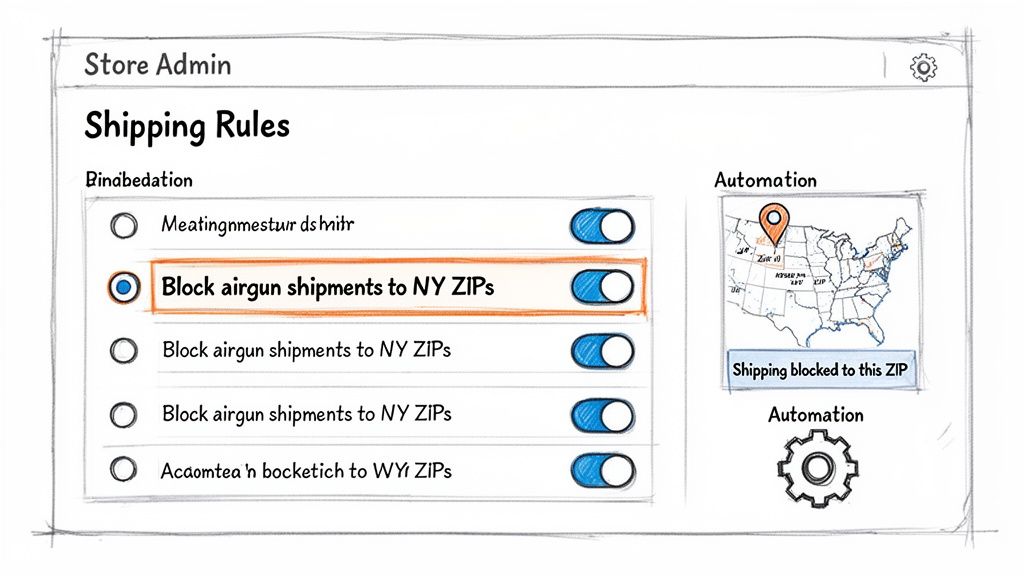
This means setting up smart rules in your store's backend that automatically check a customer's shipping address and cart contents. Instead of an employee digging through ZIP code lists to see if an address is in New York City, a rule does it instantly. The system acts as a gatekeeper, stopping non-compliant orders before they’re even placed.
Setting Up Basic Location-Based Rules
Your first and most critical step is to block shipments to places with outright bans. These rules are usually based on a state, a city, or a specific list of ZIP codes. A good system makes this pretty simple.
Take New York City’s ban, for example. You’d create a rule that stops any product you’ve categorized as an "airgun" from shipping to the five boroughs.
- Step 1: Define the products you're restricting (e.g., everything in your "Airguns" category).
- Step 2: Pinpoint the restricted locations. Here, you'd paste in a list of all ZIP codes for Manhattan, Brooklyn, the Bronx, Queens, and Staten Island.
- Step 3: Set the action. Configure the rule to hide all shipping options if the cart meets these conditions, which effectively blocks the order.
You can use this exact same logic for other no-go zones like Chicago, IL, and Philadelphia, PA.
Handling Advanced Product-Specific Restrictions
Of course, it's not always that simple. Some state laws get into the weeds, with restrictions based on product specs like velocity or caliber. Illinois, for instance, treats any airgun shooting over 700 FPS and larger than .177 caliber as a firearm, which means it needs an FFL transfer.
To handle this, you need a system that can actually read your product data. The rule would look something like this:
Rule Condition: If a product in the cart has
category = 'airgun'ANDattribute_velocity > 700ANDattribute_caliber > .177ANDshipping_state = IL. Action: Hide direct-to-consumer shipping options and instead display a custom message telling the customer to arrange for an FFL transfer.
Trying to manage that level of detail by hand is impossible if you're processing more than a few orders a day. For WooCommerce store owners, getting these rules right is crucial. Our guide on firearms and ammunition shipping compliance for WooCommerce stores dives deeper into building out these more complex rule sets.
Crafting Clear Customer Messages
The final piece of the puzzle is communication. When a rule blocks an order, the customer has to know why. A generic error message just creates confusion, abandoned carts, and a flood of support tickets.
Your system should let you write custom messages for each specific rule.
- For the NYC Block: "Sorry, we cannot ship airguns to your location due to restrictions in New York City."
- For an FFL Requirement: "This high-power airgun must be shipped to a licensed FFL dealer in your state. Please contact us to arrange the transfer."
Clear, automated messages turn a potential dead-end into an informative experience. It protects your business while keeping your customers in the loop, ultimately reducing frustration and showing that you're a responsible, compliant retailer.
Common Questions About Shipping Airguns
When you're dealing with the tangled web of airgun and pellet gun shipping restrictions, a lot of practical questions come up. We see the same issues trip up sellers all the time. Here are some quick answers to the most common scenarios we run into.
Can I Ship an Airgun to a P.O. Box?
Honestly, it’s a bad idea and almost always against carrier rules. Major shippers like UPS and FedEx won't deliver to P.O. boxes because they require a physical street address for delivery. A big reason for this is that many states demand an adult signature upon receipt.
You can't get an adult signature at a P.O. Box, which makes it impossible to meet the age verification requirements in states that mandate it. To stay compliant and keep packages from getting bounced back, you should always require a physical address for any order that includes an airgun or pellet gun.
What Happens If I Accidentally Ship to a Restricted Area?
Shipping an airgun to a prohibited city or state by mistake will create immediate headaches. For starters, the carrier will almost certainly flag the package and return it to you. You'll be on the hook for the return shipping fees.
Not only does this cost you money, but it also creates a terrible customer experience, leading to a lost sale and probably a negative review. Even worse, depending on the specific law you violated, your business could face legal trouble, including some pretty substantial fines. This is exactly why automated shipping rules are so critical—they prevent these expensive mistakes before they happen.
Do Shipping Restrictions Apply to Airgun Accessories?
Yes, they often do, especially for items like CO2 cartridges and ammunition. CO2 cartridges are almost universally classified by carriers as hazardous materials (HAZMAT), which means they are restricted to ground shipping only. You can't ship them by air.
On top of that, some local laws put age restrictions on selling pellets. While the rules for accessories aren't usually as strict as those for the airguns themselves, you still have to check carrier policies and local laws for every single item in a customer's cart. A city that bans airguns is very likely to ban the components needed to use them, too.
Important Reminder: These laws are always in flux. The legal landscape for airgun shipping is constantly changing as state and city governments pass new regulations. Trying to track these updates manually across hundreds of different places is a recipe for disaster and puts your business at serious risk.
Using an automated compliance tool is the only reliable way to keep your store up-to-date with these shifts. It protects you from violations without you having to become a full-time legal expert.
Stop wasting time on manual order checks and get rid of costly shipping errors for good. Ship Restrict automates your compliance with smart, precise rules that block prohibited orders right at checkout. Protect your store and streamline your fulfillment with Ship Restrict today.
Automate FFL Shipping Compliance
Stop worrying about restricted states. Ship Restrict handles it automatically.

Cody Yurk
Founder and Lead Developer of ShipRestrict, helping e-commerce businesses navigate complex shipping regulations for regulated products. Ecommerce store owner turned developer.
Automate FFL Compliance
- Block restricted states
- No more cancellations
- Set and forget
3-day free trial · Card required